
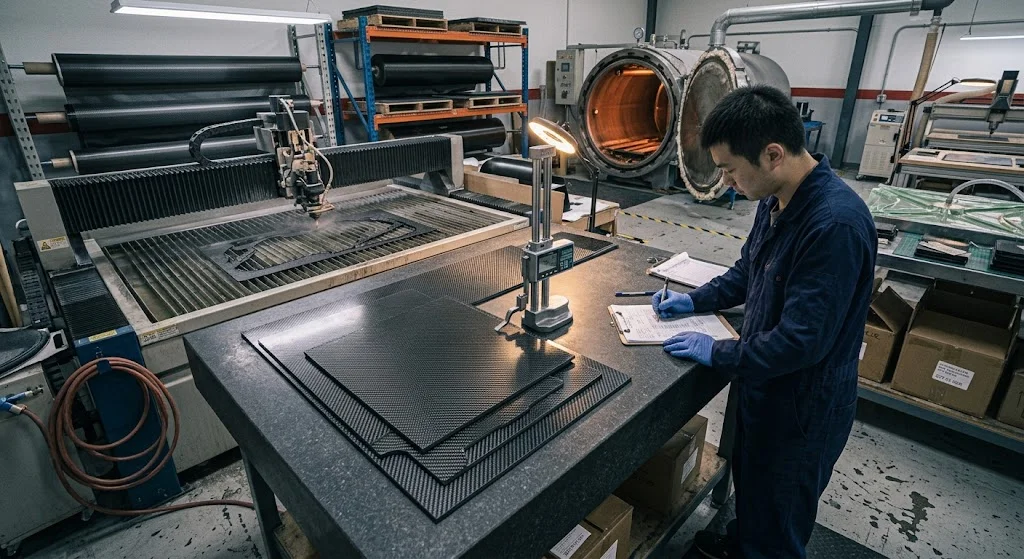
A carbon fibre sheet custom size order should be boring: you send dimensions, thickness, finish and quantity, and back comes a plate that fits the first time. In practice, buyers lose days to unstated tolerances, edge quality nobody defined, and sheets that arrive 2 mm short because the mill cut to
Introduction
A carbon fibre sheet custom size order should be boring: you send dimensions, thickness, finish and quantity, and back comes a plate that fits the first time. In practice, buyers lose days to unstated tolerances, edge quality nobody defined, and sheets that arrive 2 mm short because the mill cut to its own standard blank. This guide sets out exactly what to specify when you buy a carbon fibre sheet custom size for UK or EU projects, and what the numbers on the quotation should contain.
The figures below reflect small-batch cutting from cured plate stock: common sizes and thicknesses with realistic tolerances, how cutting and finishing are priced, and the checks that separate structural-grade material from carbon fibre for sale that only looks the part.
Carbon Fibre Sheet Custom Size: What to Specify
Five items define the part. Get all five onto the drawing and the quotation stops being guesswork.
- Finished dimensions and tolerance: state length and width with a tolerance — a blanket ±0.5 mm suits decorative panels, while machined mating faces usually need ±0.1 mm on the cut edge. CNC cutting holds ±0.1-0.2 mm; waterjet on thick plate lands closer to ±0.3 mm.
- Thickness and lay-up: give finished thickness plus allowable variation (typically ±0.1 mm for 1-3 mm plate) and say whether the lay-up is quasi-isotropic 0/90 with ±45 skins or a uniaxial 0° sheet meant for stiffness in one direction.
- Resin system: epoxy for structural and outdoor work with a Tg above 80 °C; vinyl ester or polyester only where cost dominates and chemical exposure is mild.
- Surface and edge finish: one-side gloss, both-sides sanded to 400 grit, or fully trimmed with edges broken 0.5 mm — each option changes the price and the lead time.
- Hole patterns and pockets: drill coordinates on the drawing with a backing board specified, because unbacked drilling chips the last plies on the exit side.
Ask for a first-article measurement report on the initial order. A shop that records cut dimensions and thickness at three points per sheet will catch its own drift before your fixtures do.
Common Sizes, Tolerances and What They Cost
Standard blanks are cheaper than odd sizes because they come from stock the mill already holds. Cutting to a custom outline adds a setup charge, not a new material cost.
| Sheet size | Thickness range | Cut tolerance | Finish | Indicative price per piece |
|---|---|---|---|---|
| 500 x 500 mm | 1-20 mm | ±0.2 mm | sanded both sides | $55-140 |
| 1000 x 500 mm | 1-20 mm | ±0.2 mm | sanded both sides | $95-260 |
| 1000 x 1000 mm | 2-20 mm | ±0.3 mm | sanded both sides | $170-480 |
| 2000 x 1000 mm | 2-20 mm | ±0.3 mm | one-side gloss | $330-940 |
| Cut-to-size blanks | 0.5-30 mm | ±0.1-0.2 mm (CNC) | edges broken, deburred | quote per drawing |
Prices assume a quasi-isotropic epoxy lay-up with a 3K twill face cloth. Adding a unidirectional core for stiffness, a Class A cosmetic face, or fire-retardant resin shifts the range upward by 15-30 percent.
How a Cut-to-Size Order Is Priced and Scheduled
Three cost blocks make up the invoice: material by area and thickness, cutting by machine time, and finishing by edge length. A rectangular blank from stock usually ships in 5-10 working days; waterjet or CNC profiling of a custom outline adds 3-7 days, and hole patterns add a day. Quantity breaks are steep below ten pieces because setup dominates — five identical plates cost nearly as much as one. If you need both faces visible, specify the cosmetic face on the drawing; laminating is asymmetric and the nicer weave usually sits on one side only.
Carbon Fibre for Sale Online: How to Judge Quality
Photographs prove nothing; three checks do. First, ask for the laminate schedule — ply count, orientation and resin — and reject suppliers who will not share it for structural use. Second, inspect the first sheet flat on a surface plate: weave should run straight without bows, thickness measured at three points should stay inside the stated tolerance, and pinholes or dry patches on the back face mean the cure or the bag was sloppy. Third, tap the plate with a coin — a dull thud in one region signals a void or a delamination under the skin. For a carbon fibre sheet Australia, UK or EU purchase, also confirm the resin meets REACH and that the sheet ships flat on a rigid pallet, because a bowed plate machined flat will spring back.
UK and EU Stock Versus a Carbon Fibre Sheet Australia or Factory Order
Local UK and EU stock wins on speed: next-day or 48-hour delivery, no import paperwork, and a person you can call when a plate arrives short. You pay a premium of roughly 20-40 percent over factory pricing. A direct factory order brings full lay-up control, thicknesses up to 30 mm and unit prices that fall sharply from 20 pieces upward, but adds 4-6 weeks of lead time, mould-free cutting charges, freight by air or sea, and VAT plus duty at the border. The Australian market follows the same logic as the UK: stock is thin and freight is long, so most buyers prototype from local carbon fibre sheet Australia inventory and repeat the series from the factory once drawings and tolerances are frozen.
Frequently Asked Questions
What tolerance can I expect on a carbon fibre sheet cut to size?
CNC cutting holds ±0.1-0.2 mm on length and width for plate up to 10 mm thick, waterjet holds roughly ±0.3 mm, and thickness variation on cured plate is typically ±0.1 mm for 1-3 mm sheets. State the tolerance on the drawing rather than accepting a house standard.
Can carbon fibre sheet be drilled, tapped or machined?
Yes — drill with a backing board at moderate speed, use carbide tooling for batch work, and avoid tapping directly into thin laminate; instead bond in threaded inserts or sandwich a metal plate. Deburr edges immediately, because exposed cut fibres wick moisture.
Do you supply certificates and material data with the sheet?
Reputable suppliers provide a laminate schedule, resin system, cured density and first-article dimensions on request; series orders can add batch records for traceability. Ask for the data with your quotation so it is contractual rather than optional.
Conclusion
A carbon fibre sheet custom size order goes wrong only when the specification is vague. Fix the dimensions and tolerance, the lay-up and resin, the finish and the hole pattern on one drawing, judge suppliers by their laminate schedule rather than their photographs, and choose stock or factory by lead time rather than habit. Do that and the plate arrives square, in tolerance, and ready for the machine.
YongXian cuts carbon fibre sheet, plate, tube and rod to customer dimensions, with CNC profiling, edge finishing and drilled patterns on request. Browse our carbon fiber range or send your cutting list to our engineering team for a quotation.
Part of topic
Related Articles
- Carbon Fiber Drone Frame Price: Tiers, Thickness, and Cost Drivers
- Carbon Fiber Sheets for Sale Near Me: A Local Sourcing Guide
- Price of Carbon Fibre 2026: Global Carbon Fiber Price Benchmarks
- Carbon Fiber Custom Rod Sourcing Guide: Pultruded vs Roll-Wrapped
- Carbon Fiber Tube Price in Pakistan: Import Costs and Local Market
- How to Choose a Carbon Fiber Drone Manufacturer
Interested in Our Products?
Contact our team for competitive pricing and technical specifications.
Get a QuoteRelated Products

Round Carbon Fiber Tube — 3K Plain Weave T700
Standard round carbon fiber tube manufactured from Toray T700 grade fiber with 3K plain weave. Offers balanced strength and stiffness for general industrial applications including robotics, automation, sports equipment, and aerospace structures.

Carbon Fiber Pickleball Paddle
High-performance pickleball paddle with Toray T700 carbon fiber face and polypropylene honeycomb core. Delivers excellent power-to-weight ratio, spin generation, and vibration dampening for competitive play.

Square Carbon Fiber Tube — 3K Twill T700
Square cross-section carbon fiber tube manufactured with 3K twill weave for torsional strength. Preferred for structural frames, trusses, and support columns where rectangular geometry offers design flexibility.
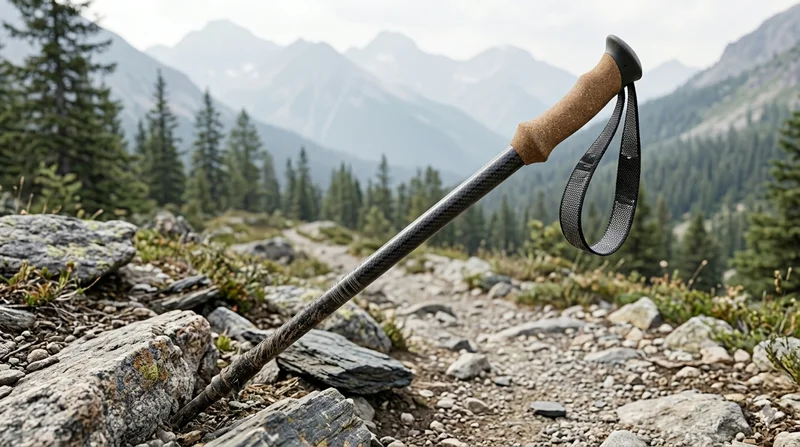
Carbon Fiber Trekking Pole
Lightweight carbon fiber trekking pole manufactured from high-grade carbon fiber tube. Weighs only 160g per pole while providing superior shock absorption and durability for hiking, trail running, and backpacking.

Round Carbon Fiber Tube — 3K Twill
Lightweight and ultra-stiff round tubes ideal for drone frames, robotics, and structural applications.