
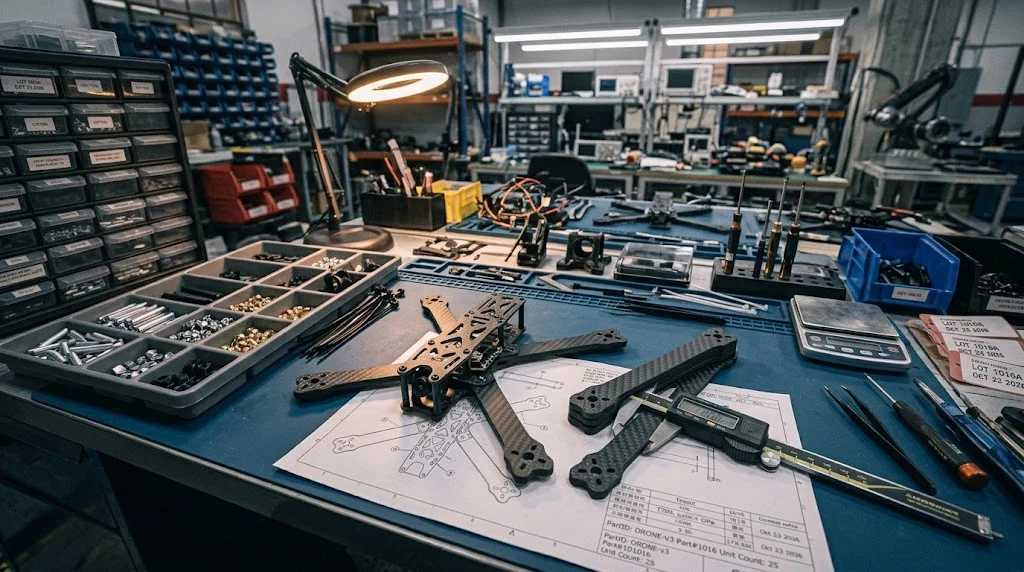
The carbon fiber drone frame price spans an order of magnitude between a 65 mm whoop cage and a heavy-lift octocopter plate set, and the spread is not marketing: it tracks fiber grade, plate thickness, cutting process and order volume almost linearly. A basic 5-inch freestyle frame kit in standard-m
Introduction
The carbon fiber drone frame price spans an order of magnitude between a 65 mm whoop cage and a heavy-lift octocopter plate set, and the spread is not marketing: it tracks fiber grade, plate thickness, cutting process and order volume almost linearly. A basic 5-inch freestyle frame kit in standard-modulus carbon plate sells for 15 to 30 dollars online, while a 10-inch cinematography frame with 4 mm arms and machined aluminum standoffs runs 120 to 300 dollars, and a fully tooled heavy-lift airframe can pass 800 dollars before any electronics are bolted on. Buyers who understand the cost structure get frames that match their mission; buyers who do not pay for thickness or carbon grade they will never load.
This guide breaks the carbon fiber drone frame price into its real components: class tiers with typical price bands, the thickness question (3 mm versus 4 mm versus molded monocoque), material and process drivers, and the retail-versus-factory tradeoff for brands building in volume.
Carbon Fiber Drone Frame Price Tiers by Class
Drone frames sort into classes by wheelbase and mission, and each class carries a characteristic price band because the plate area, arm count and tolerance demands scale with size. The table below reflects typical 2026 market pricing for unbranded or mid-tier frames in standard-modulus T300-class carbon; premium T700 layups and branded flight-controller integration push the upper bounds.
| Class | Wheelbase | Plate thickness typical | Carbon fiber drone frame price band | Notes |
|---|---|---|---|---|
| Whoop / micro cage | 65-85 mm | 1.5-2 mm plate or molded | 4-12 USD | molded cages dominate, tiny plate area |
| Toothpick / light freestyle | 140-160 mm | 2-3 mm arms | 10-25 USD | minimal plates, single-layer arms |
| 5-inch freestyle and race | 220-250 mm | 3-4 mm arms | 15-40 USD | highest volume, tight price competition |
| 7-inch long range | 280-330 mm | 4 mm arms | 30-80 USD | larger plates, often 4S-6S battery bays |
| 10-15 inch cinema / inspection | 400-700 mm | 4-5 mm arms, 2-3 mm plates | 100-350 USD | CNC standoffs, vibration-isolated bays |
| Heavy-lift multirotor set | 900 mm and up | 5-8 mm arms, 3-4 mm plates | 400-1200+ USD | per-motor arm kits, folding hinges |
Within a tier, the carbon fiber drone frame price moves with arm count (a deadcat freestyle frame is cheaper than a six-arm hexacopter kit), hardware kit contents (aluminum standoffs, press-nuts, TPU prints) and whether the frame ships as bare plates or as a full kit with hardware.
3mm Versus 4mm: Why Plate Thickness Moves the Price
Plate thickness is the single most visible cost lever because carbon plate is sold by area and processed by cutting time. A 4 mm arm uses roughly one-third more sheet and one-third more CNC time than a 3 mm arm of the same outline, and the finished part resists folding loads proportionally better: on a 5-inch freestyle frame, upgrading arms from 3 mm to 4 mm raises the frame price 20 to 40 percent in retail channels and adds real crash tolerance for pilots who land on concrete. A 4 mm carbon fiber drone frame is the default recommendation for freestyle and long-range builds where arm flex under aggressive throttle would couple into the flight controller's gyroscope; race pilots running protected race gates often save weight with 3 mm arms instead. The decision is mission-driven, not a quality ranking.
- Choose 3 mm arms for race builds, lightweight long-range with gentle throttle curves, and any build where every gram matters more than spare stiffness.
- Choose 4 mm arms for freestyle, freestyle-adjacent cinema rigs and long-range platforms that will be hand-launched or belly-landed.
- Choose molded monocoque or sandwich plates for micro cages and production consumer drones where tooling amortizes across thousands of units.
Cost Drivers Behind the Carbon Fiber Drone Frame Price
Four factors explain most of the spread between a 15 dollar frame and a 150 dollar frame.
- Fiber grade: T300-class standard-modulus tow is the cost baseline; T700-class adds 20 to 50 percent to material cost and delivers higher specific strength, which matters on long arms that see repeated impact cycling. Premium brands quoting aerospace-grade tow sit at the top of the tier.
- Cut quality and edge finish: CNC routing with sharp tooling and dust extraction leaves clean, sealed edges; cheap cutting leaves frayed delaminated edges that wick moisture and grow cracks. Edge sealing labor is visible in the price.
- Kit completeness: bare carbon plates are the cheapest form; adding anodized standoffs, titanium hardware, battery pads and 3D-printed TPU parts can double the kit price without changing the carbon at all.
- Order volume: a one-off retail order carries distributor margin; a factory order of 500 sets amortizes CNC programming and fixture cost, typically landing 30 to 50 percent below retail for the same plate set.
Quasi-isotropic layups (0/90 plus plus-or-minus 45 plies balanced across the thickness) cost more than cheap quasi-orthogonal layups that prioritize stiffness in one direction; frames marketed for crash resistance usually publish their ply schedule, while the cheapest frames list only "carbon fiber" with no grade or layup data.
Retail, Custom, and Factory Economics
For a single build, retail is almost always cheaper once shipping and hardware are counted: a 25 dollar freestyle frame kit with hardware beats the landed cost of a custom 10-piece minimum. The calculus changes for brands and fleet operators. A custom carbon fiber drone frame program starts with a tooling charge for nested CNC fixtures, a 3 to 5 week first-article lead, and minimums around 50 to 100 sets depending on plate count; above that, unit price falls steeply because CNC time, not material, dominates. Fleet operators ordering replacement arm sets on a schedule can also negotiate consignment stock, holding price steady while absorbing crash attrition. The honest rule: buy retail until your annual frame consumption exceeds what the volume discount covers, then move the high-turnover SKUs to a factory program and keep exotic prototypes at retail.
Frequently Asked Questions
Why does a 4mm carbon fiber drone frame cost more than a 3mm frame of the same design?
Plate cost scales with area and cutting time, and 4 mm sheet uses about one-third more of both than 3 mm for the same outline. The price premium, typically 20 to 40 percent, buys proportional resistance to arm fold and bend under hard landings and aggressive throttle.
Is a more expensive carbon fiber drone frame always better?
No. A heavy 5 mm cinema frame on a race quad wastes money and hurts flight time; a light 2 mm micro frame on a long-range build flexes into the gyro. Match thickness and layup to the mission, then compare fiber grade and edge finish within that class.
Can a factory cut a custom drone frame from my DXF or STEP file?
Yes. Most composite machine shops accept DXF flat patterns or STEP assemblies, quote per plate set, and offer prototype single sets before volume runs. Expect a 3 to 5 week first article and minimums in the 50 set range for nested CNC programs.
Conclusion
The carbon fiber drone frame price tracks plate area, thickness, fiber grade and order volume more than it tracks brand story. Define the mission, pick the thickness that mission demands, verify the fiber grade and layup data, and choose retail or factory based on how many sets per year you actually crash through. When the numbers justify a custom program, a factory quote usually lands well below retail for identical plate geometry.
YongXian cuts and assembles carbon fiber plate sets for drone and robotics OEMs, with CNC nesting, edge sealing and hardware kitting in-house. Browse our carbon fiber plate range or send your frame drawings for a quote.
Related Articles
- Carbon Fibre Sheet Custom Size Guide: Ordering Cut-to-Size Plates for UK and EU Buyers
- Carbon Fiber Sheets for Sale Near Me: A Local Sourcing Guide
- Price of Carbon Fibre 2026: Global Carbon Fiber Price Benchmarks
- Carbon Fiber Custom Rod Sourcing Guide: Pultruded vs Roll-Wrapped
- Carbon Fiber Tube Price in Pakistan: Import Costs and Local Market
- How to Choose a Carbon Fiber Drone Manufacturer
Interested in Our Products?
Contact our team for competitive pricing and technical specifications.
Get a QuoteRelated Products

Round Carbon Fiber Tube — 3K Plain Weave T700
Standard round carbon fiber tube manufactured from Toray T700 grade fiber with 3K plain weave. Offers balanced strength and stiffness for general industrial applications including robotics, automation, sports equipment, and aerospace structures.

Carbon Fiber Pickleball Paddle
High-performance pickleball paddle with Toray T700 carbon fiber face and polypropylene honeycomb core. Delivers excellent power-to-weight ratio, spin generation, and vibration dampening for competitive play.

Square Carbon Fiber Tube — 3K Twill T700
Square cross-section carbon fiber tube manufactured with 3K twill weave for torsional strength. Preferred for structural frames, trusses, and support columns where rectangular geometry offers design flexibility.
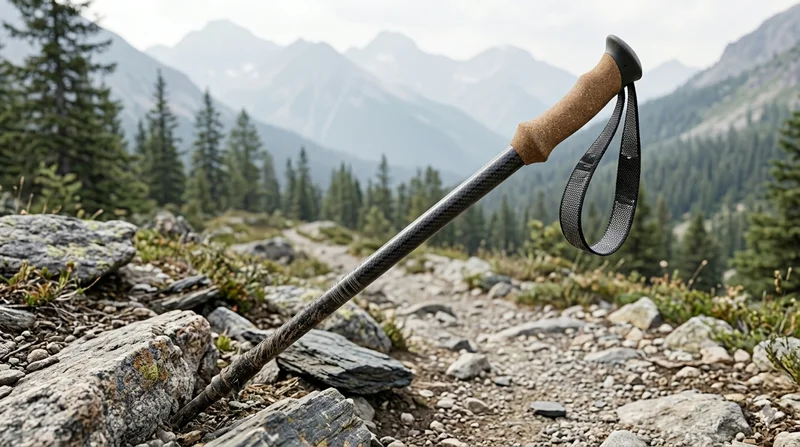
Carbon Fiber Trekking Pole
Lightweight carbon fiber trekking pole manufactured from high-grade carbon fiber tube. Weighs only 160g per pole while providing superior shock absorption and durability for hiking, trail running, and backpacking.

Round Carbon Fiber Tube — 3K Twill
Lightweight and ultra-stiff round tubes ideal for drone frames, robotics, and structural applications.