
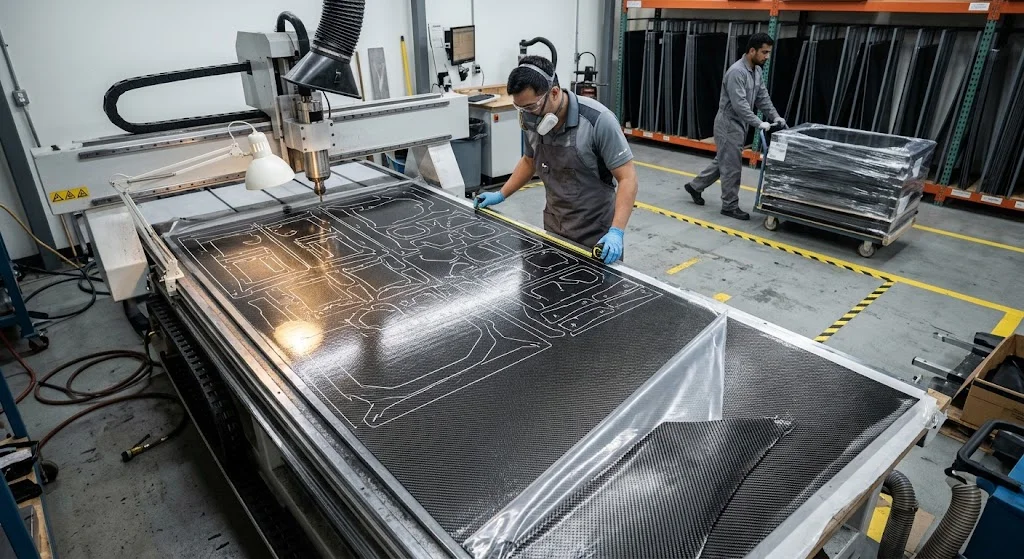
Carbon fiber sheets 4x8 are the standard large-format panel in the composite trade: 1219 x 2438 mm, or 2.97 m2 of flat laminate that can be nested into dozens of parts in a single CNC run. Buying the sheet is straightforward; buying it well means knowing what the panel contains, what it weighs at yo
Introduction
Carbon fiber sheets 4x8 are the standard large-format panel in the composite trade: 1219 x 2438 mm, or 2.97 m2 of flat laminate that can be nested into dozens of parts in a single CNC run. Buying the sheet is straightforward; buying it well means knowing what the panel contains, what it weighs at your thickness, and how the price behaves when you order a full carbon fiber plate instead of a veneered lookalike.
This guide covers carbon fiber sheets 4x8 from the buyer's side: layup and thickness options, realistic price bands, where large format panels earn their keep, how to plan nesting so waste stays under 10%, and what to check when you compare carbon fiber sheets for sale from different suppliers.
What a Carbon Fiber Sheet 4x8 Actually Contains
A 4x8 panel is not one material — it is a stack of plies with a chosen orientation, cured under vacuum or in a hot press, then sanded to thickness. The layup decides everything downstream: stiffness, flatness, how it machines, and how it behaves when cut into small parts.
| Thickness | Sheet weight (4x8) | Typical layup | Price band (full carbon) | Common use |
|---|---|---|---|---|
| 1 mm | 4.5-4.7 kg | 2-3 plies, 0/90 | $110-190 | Skins, cosmetic panels, overlays |
| 2 mm | 9.0-9.4 kg | 4-6 plies, quasi-isotropic | $180-320 | Covers, jigs, drone plates |
| 3 mm | 13.5-14.1 kg | 6-8 plies, 0/90 + +/-45 | $250-430 | Structural brackets, fixtures |
| 5 mm | 22.5-23.5 kg | 10-12 plies, balanced | $420-760 | Molds, tooling, load-bearing panels |
| 10 mm | 45-47 kg | 20+ plies, cross-ply | $780-1400 | Heavy fixtures, cutting beds, dies |
Weight scales almost linearly with thickness at roughly 4.5-4.7 kg per millimeter, which matters when a 5 mm panel has to be lifted onto a machine table by one person. Price does not scale linearly — thick sheets cure slower and reject more often, so the per-kilogram cost rises with thickness.
Where Carbon Fiber Sheets 4x8 Are Used
The full-size panel earns its keep wherever nesting matters: one sheet becomes many parts with shared edges, and the scrap that remains can be reclaimed for filler or short-run pieces.
- CNC nesting for drone and robotics plates: a single 4x8 sheet yields 40-60 small arms, plates and brackets at 2 mm, with offcuts feeding smaller jigs.
- Tooling and molds: 5-10 mm full carbon fiber plate makes durable vacuum form plugs and trim fixtures that hold tolerance better than tooling board.
- Automotive and marine panels: large flat sections for floors, bulkheads and interior panels where a visible weave is part of the specification.
- Signage and architectural cladding: 1-2 mm sheets cut into letters, fascia panels and feature walls, light enough for standard fixings.
- Test rigs and inspection benches: flat, stiff, non-magnetic surfaces that stay flat under fixture loads.
If your parts are small and scattered, ask whether cut-to-size blanks beat a full sheet — suppliers can often ship 300 x 600 mm pieces with less freight and less handling risk.
Full Carbon Fiber Plate vs Veneered Panels
Most disputes between buyers and suppliers come down to what sits under the surface. A full carbon fiber plate is carbon laminate through the entire thickness: it machines cleanly on both faces, takes threaded inserts, and can be re-sanded without showing a substrate. A veneered panel puts a thin carbon layer over an aluminum honeycomb, PVC core or G10 base — lighter in some constructions and cheaper, but drilling through it exposes the core and the edge build-up is obvious.
Three checks separate the two: tap the panel (solid laminate sounds dense and dull, core sounds hollow), weigh it against the density calculation above, and ask for a cross-section sample from the same batch. A 3 mm full carbon sheet should come in near 14 kg per 4x8; a honeycomb-core panel of the same size can weigh half that, and no amount of marketing copy changes the arithmetic.
Ordering and Nesting: Keeping Waste Under 10%
The cheapest sheet is the one you fully use. Before ordering, lay out the parts on a 1219 x 2438 mm rectangle in your CAM software and check three things: grain direction, because most layups are stronger along the roll axis; cut kerf, typically 2-3 mm with a compression bit; and clamp margins, since the outer 50 mm of the sheet is hard to hold down reliably.
- Batch parts by thickness: nesting 2 mm and 5 mm parts from one sheet wastes material on both.
- Order one spare sheet for rework: a scrapped fixture mid-project costs more than the 8-12% extra material.
- Specify tolerance up front: standard CNC tolerance of +/-0.2 mm on thickness and +/-0.15 mm on cut dimensions prevents acceptance disputes.
- Confirm surface side: one face is usually cleaner; if the weave will be visible, mark the show side on the drawing.
Frequently Asked Questions
How much do carbon fiber sheets 4x8 weigh?
About 4.5-4.7 kg per millimeter of thickness across the full 1219 x 2438 mm panel, so a 1 mm sheet is roughly 4.6 kg, a 3 mm sheet about 14 kg and a 5 mm sheet about 23 kg. Core-sandwich constructions weigh less, which is why weight is a reliable first check on material claims.
Can you cut a 4x8 carbon fiber sheet to size before shipping?
Yes, and it usually reduces both cost and freight: most suppliers will nest and cut to your drawing, shipping parts or smaller blanks instead of the full panel. Send a DXF with grain direction marked, state the tolerance, and ask for offcut retention if your smaller parts can be nested from the remnants.
What is the difference between a full carbon fiber plate and a carbon-look panel?
A full carbon fiber plate is laminate through the whole thickness and can be machined, drilled and re-sanded on either face. A carbon-look or veneered panel has a thin cosmetic layer over a core or substrate; it is lighter or cheaper, but exposed edges show the construction and inserts do not hold as well.
Conclusion
Carbon fiber sheets 4x8 reward buyers who do the arithmetic first: match thickness to load, verify weight against density, separate full carbon fiber plate from veneered stock, and nest parts so waste stays under 10%. Do that, and the large-format panel is the most economical way to buy carbon in volume.
YongXian manufactures vacuum-cured carbon fiber sheets in 1-20 mm thickness, supplies full sheets or cut-to-size blanks, and nests customer parts from 4x8 panels to order. Browse our carbon fiber range or contact our engineering team with your drawing, thickness and annual volume.
Part of topic
Related Articles
- Carbon Fiber Road Wheels: What Matters for Buyers
- Carbon Fiber Drone Chassis Design: Loads, Layout and Layup
- Carbon Fiber Tube for RC Plane Spars and Pushrods: A Builder Guide
- Filament Wound Pipe Applications: Corrosion and Pressure Duty
- Filament Wound Bearing Design: Composite Sleeves That Outlast Bronze
- Custom Carbon Fiber Rod Grips: Fishing Rods, Tool Handles, and Ordering Specs
Interested in Our Products?
Contact our team for competitive pricing and technical specifications.
Get a QuoteRelated Products

Round Carbon Fiber Tube — 3K Plain Weave T700
Standard round carbon fiber tube manufactured from Toray T700 grade fiber with 3K plain weave. Offers balanced strength and stiffness for general industrial applications including robotics, automation, sports equipment, and aerospace structures.

Square Carbon Fiber Tube — 3K Twill T700
Square cross-section carbon fiber tube manufactured with 3K twill weave for torsional strength. Preferred for structural frames, trusses, and support columns where rectangular geometry offers design flexibility.

Round Carbon Fiber Tube — 3K Twill
Lightweight and ultra-stiff round tubes ideal for drone frames, robotics, and structural applications.

Round Carbon Fiber Tube — UD Unidirectional T700
Unidirectional (UD) round tube with all fibers aligned axially for maximum longitudinal stiffness. Ideal for applications requiring high bending rigidity with minimal weight, such as shafts, struts, and structural reinforcements.

Carbon Fiber Plate — 3K Twill T700 3.0mm
Medium-thickness 3.0mm carbon fiber plate offering significantly higher load capacity while maintaining attractive 3K twill finish. Suitable for structural brackets, reinforcement plates, and load-bearing panels.