
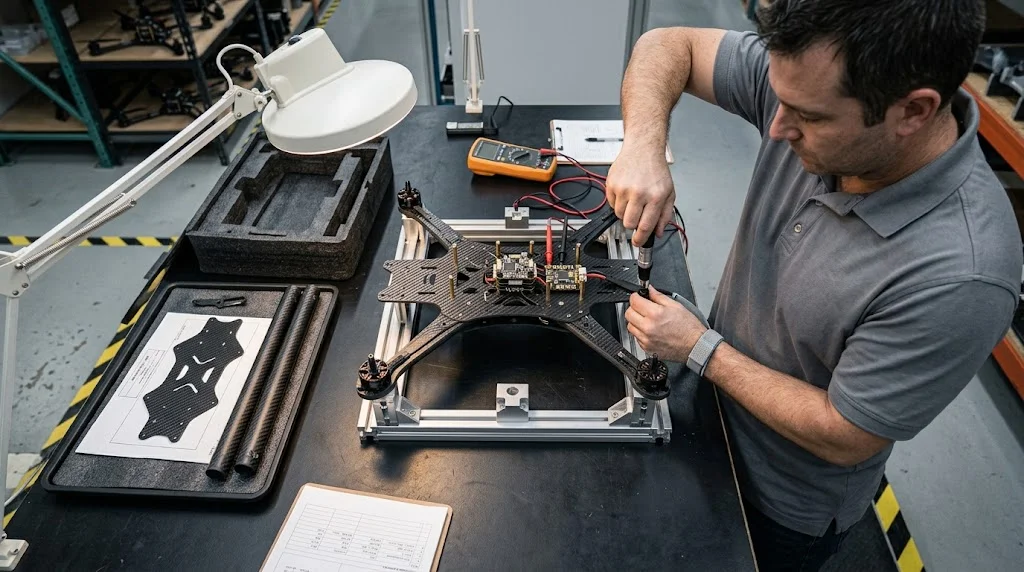
A carbon fiber drone chassis is a structure problem disguised as a parts list: every gram of plate has to earn its place by carrying motor loads, protecting the stack, or surviving the one hard landing that defines the airframe. Get the load path right and a 3 mm plate will outfly a heavier 4 mm one
Introduction
A carbon fiber drone chassis is a structure problem disguised as a parts list: every gram of plate has to earn its place by carrying motor loads, protecting the stack, or surviving the one hard landing that defines the airframe. Get the load path right and a 3 mm plate will outfly a heavier 4 mm one; get it wrong and the frame cracks at a bolt hole long before the electronics wear out.
This guide walks through carbon fiber drone chassis design from geometry to fasteners — how carbon fiber drone frames distribute thrust and impact, where a carbon fiber tube for drone arms beats flat stock, what a custom carbon fiber drone frame needs from your drawing, and the layup, edge and mounting details that decide service life.
Carbon Fiber Drone Chassis Design: Where the Loads Go
Four motors push up, the payload pulls down, and every maneuver adds torsion the plate has to carry from arm root to arm root. In a good layout the motor thrust enters the plate through a wide bearing area, passes over a continuous fiber path, and lands on the battery cradle or landing gear mounts without crossing a drilled hole. Weak designs concentrate the same load into a narrow bridge between two cutouts, which is exactly where fatigue cracks start.
| Design decision | Typical range | Effect on the chassis |
|---|---|---|
| Center plate thickness | 2.5-4 mm | 2.5-3 mm suits 250-450 mm builds; 4 mm for heavy-lift frames above 8 kg |
| Arm plate thickness | 3-5 mm | Thicker arms take motor torque; plate thickness matters less than root fillet size |
| Motor mount hole pattern | 16-30 mm bolt circle | Wide pattern spreads thrust over more fiber instead of a single line |
| Stack standoffs | 20-30 mm | Controls wire routing space and raises or lowers the center of gravity |
| Arm root radius | 8-15 mm | Largest single lever on fatigue life; never butt a sharp corner into a load path |
Model the plate as a web with cutouts before you cut it: the fibers between two holes carry everything, so keep at least one continuous band of uncut material running from each arm root to the opposite side of the frame.
Carbon Fiber Drone Frames: Stack Mounting and Vibration
The flight controller hates two things: high-frequency noise and a chassis that tunes into the propeller pass band. Mounting the stack on rubber grommets isolates the gyro, but soft mounts let the electronics sway during hard maneuvers, so the compromise is a stiff carbon fiber drone frames center plate with damped standoffs rather than a floppy plate with hard bolts.
- Isolate, do not float: use M3 grommets rated for the stack mass; oversized soft mounts let the board oscillate at exactly the frequencies the filters are trying to remove.
- Watch the first mode: a plate that buzzes when tapped by hand will ring in flight — add a rib, thicken the span, or move the battery to change the mass distribution.
- Route wires off the edges: friction against a raw cut edge wicks dust and moisture into the laminate; sand the edge and use grommets where cables pass through.
- Keep hardware consistent: titanium or nylon-insert bolts at motor mounts, torqued the same on all four arms, keep the frame balanced and the vibration signature symmetric.
Log a few flights after any chassis change: if gyro noise climbs at a fixed frequency, the structure is ringing rather than the motors being out of balance.
Carbon Fiber Tube for Drone Arms: When Round Beats Flat
Flat plate arms are simple to cut but weak in torsion; a carbon fiber tube for drone arms converts the same mass into a closed section that resists twisting far better. Pultruded tubes with a 1.5-2 mm wall handle small builds, while roll-wrapped tubes with a 45-degree helical plie survive motor torque and crash loads that would split pultruded stock along its fibers.
- Join with a sleeve: bond the tube into a machined carbon or aluminum root with a thin epoxy film and two dowel pins; glue alone creeps under vibration.
- Mind the grain: pultruded tubes are strongest along the axis and split easily across it — never clamp a saddle directly onto pultruded wall without a filler strip.
- Serviceability: a bolted flat arm swaps in the field, a bonded tube arm comes back to the bench, so match the choice to how often the fleet crashes.
Custom Carbon Fiber Drone Frame: From Drawing to Cut Part
Most frame failures start as drawing errors. A custom carbon fiber drone frame should arrive from the supplier with the mounting holes drilled and countersunk during lamination, edges sealed against moisture, and a cut file that keeps 6-8 mm of material between any hole and the outer profile. Send the drawing with the load cases stated — motor thrust, all-up weight, landing drop height — and the supplier can advise plate grade and ply orientation instead of guessing from geometry alone.
Accept the first article with a checklist: hole positions within 0.1 mm, no delamination at the edges, consistent thickness across the plate, and fiber orientation visible at the cut face. Cheap frames skip the edge sealing and the tolerances; those are exactly the corners that show up as cracks in month three.
Frequently Asked Questions
How thick should a carbon fiber drone chassis plate be?
For 250-450 mm quad builds, a 2.5-3 mm center plate with 3-4 mm arms is the usual balance of weight and stiffness; heavy-lift frames above 8 kg move to 4 mm plates with bonded reinforcement at the arm roots. Thickness is not a substitute for a clean load path — a 3 mm plate with good radii outlasts a 4 mm plate with sharp cutouts.
Should I build a carbon fiber drone frames stack mount or use soft grommets?
Use damped standoffs on a stiff center plate for most builds. Soft grommets help when the frame is genuinely noisy, but they must be sized to the stack mass; oversized rubber lets the board move during aggressive maneuvers and introduces sensor error exactly when you need clean data.
Is a carbon fiber tube for drone arms stronger than flat plate?
In torsion, yes — a closed round section resists twisting several times better than a flat bar of the same mass, which reduces arm flutter at high throttle. Flat plate wins on repairability and ease of machining, so racing builds often stay flat while inspection and long-endurance platforms move to tube arms.
Conclusion
A carbon fiber drone chassis rewards the boring decisions: continuous fiber paths, generous radii, isolated stack mounts and edges that are sealed before the first flight. Choose arm architecture — flat plate or tube — around how the aircraft is serviced, and treat the drawing as part of the structure rather than a formality.
YongXian supplies carbon fiber plate, sheet and tube stock for airframe programs, plus CNC cutting for a custom carbon fiber drone frame built to your drawing. Browse our carbon fiber range or contact our engineering team with your geometry, all-up weight and annual volume.
Part of topic
Related Articles
- Carbon Fiber Road Wheels: What Matters for Buyers
- Carbon Fiber Sheets 4x8: Buying, Pricing and Large Format Panel Uses
- Carbon Fiber Tube for RC Plane Spars and Pushrods: A Builder Guide
- Filament Wound Pipe Applications: Corrosion and Pressure Duty
- Filament Wound Bearing Design: Composite Sleeves That Outlast Bronze
- Custom Carbon Fiber Rod Grips: Fishing Rods, Tool Handles, and Ordering Specs
Interested in Our Products?
Contact our team for competitive pricing and technical specifications.
Get a QuoteRelated Products

Round Carbon Fiber Tube — 3K Plain Weave T700
Standard round carbon fiber tube manufactured from Toray T700 grade fiber with 3K plain weave. Offers balanced strength and stiffness for general industrial applications including robotics, automation, sports equipment, and aerospace structures.

Square Carbon Fiber Tube — 3K Twill T700
Square cross-section carbon fiber tube manufactured with 3K twill weave for torsional strength. Preferred for structural frames, trusses, and support columns where rectangular geometry offers design flexibility.

Round Carbon Fiber Tube — 3K Twill
Lightweight and ultra-stiff round tubes ideal for drone frames, robotics, and structural applications.

Round Carbon Fiber Tube — UD Unidirectional T700
Unidirectional (UD) round tube with all fibers aligned axially for maximum longitudinal stiffness. Ideal for applications requiring high bending rigidity with minimal weight, such as shafts, struts, and structural reinforcements.

Carbon Fiber Plate — 3K Twill T700 3.0mm
Medium-thickness 3.0mm carbon fiber plate offering significantly higher load capacity while maintaining attractive 3K twill finish. Suitable for structural brackets, reinforcement plates, and load-bearing panels.