
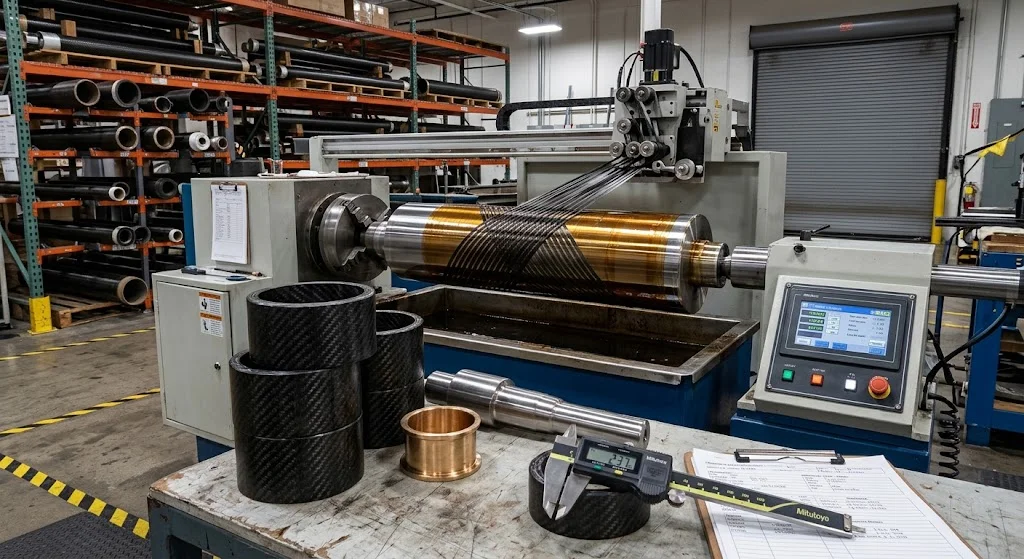
A filament wound bearing is a plain bearing sleeve made by winding continuous carbon or glass fiber onto a mandrel, curing it, and machining the bore — no steel backing, no bronze, no oil. The idea sounds exotic until you meet the service conditions that destroy metal bushings: seawater on a boat sh
Introduction
A filament wound bearing is a plain bearing sleeve made by winding continuous carbon or glass fiber onto a mandrel, curing it, and machining the bore — no steel backing, no bronze, no oil. The idea sounds exotic until you meet the service conditions that destroy metal bushings: seawater on a boat shaft, acidic process fluids in a pump, or a dry food-processing line where grease is forbidden. In those places a filament wound bearing runs unlubricated, weighs roughly a fifth of the bronze part it replaces, and simply does not corrode. This guide explains how the sleeves are made, how their properties compare with bronze and PTFE-lined alternatives, what they inherit from filament wound pipe production, and which epoxy properties decide how long the bearing lasts.
Composite plain bearings are not a universal substitute: they shine on corrosion, weight, and dry running, and they lose to bronze under heavy shock loads and high continuous surface speeds. Matching the bearing to the duty is the whole design problem.
What Is a Filament Wound Bearing
A filament wound bearing is a cylindrical plain bearing — a sleeve or bushing — whose wall is built from hundreds of continuous tows laid down by a winding head under tension. Unlike molded or machined composite bushings, the fibers stay unbroken from start to finish of the winding path, which is what gives the sleeve its hoop strength and its resistance to press-fit cracking. The matrix is typically an epoxy formulated for toughness; some designs add solid lubricant fillers such as PTFE powder or graphite into the resin so the running surface transfers a low-friction film to the shaft during break-in. Inner diameters from about 6 mm up to 120 mm are common on production winding lines, with wall thicknesses sized for a light interference fit in a housing.
How a Filament Wound Bearing Is Manufactured
The process is a short, controlled version of tube production. A polished steel mandrel at the target bore size is loaded into the winding machine; tows pass through a resin bath or heated resin metering head, then lay down in a programmed pattern — usually a multi-layer helix near 55 to 75 degrees for a balance of hoop and axial strength, sometimes finished with a near-hoop ring at the running surface. After winding, the sleeve cures on the mandrel in an oven, is demolded, and moves to the machine shop: the bore is precision ground or reamed to fit, faces are squared, and oil grooves or flanges are added if the drawing calls for them. The quality gates that matter are fiber tension control, resin content (typically 35 to 40 percent by weight, leaving 60 to 65 percent fiber volume), and cure temperature profile — miss the profile and the glass transition temperature of the finished sleeve drops far enough to ruin its heat limit.
Composite Bearing Versus Bronze and PTFE: The Numbers
The table compares a typical carbon-epoxy filament wound sleeve against the two bushings it most often replaces. Numbers are representative ranges, not a single product datasheet — always confirm against the supplier's test data for your duty.
| Property | Filament wound carbon-epoxy | Sintered bronze, oil-impregnated | PTFE-lined steel |
|---|---|---|---|
| Dry friction coefficient | 0.1-0.3 against hardened steel | 0.05-0.2, falling after break-in | 0.03-0.2 |
| Density | 1.5-1.6 g/cm³ | 7-8 g/cm³ | about 7 g/cm³ with steel back |
| Continuous temperature | 120-180 °C, set by resin glass transition | about 100 °C before oil dries out | up to 250 °C |
| Corrosion behavior | immune to seawater, salts, many chemicals | galvanic attack possible near steel shafts | steel back can rust if the lining is cut |
| Lubrication | none required | reseal oil, re-lubricate service | none required |
| Relative cost per piece | moderate, tooling-light | low at volume | high |
Two lines in that table decide most selections. The density gap means a composite sleeve cuts rotating or hanging mass by 75 to 80 percent, which matters on crane pivots and marine shafts. The corrosion line is why naval architects specify filament wound bearing sleeves on unmanned boat drives and deck equipment where a bronze bushing would need sacrificial anodes.
From Filament Wound Pipe to Bearing Sleeves
A factory that already runs filament wound pipe production can make bearing sleeves with almost no new equipment: the same winding machines, resin systems, and cure ovens, just shorter mandrels and tighter dimensional control. That shared production route is why bearing sleeves from tube specialists are often competitive against dedicated bushing plants, and why large-diameter pipe programs occasionally spin off a bearing family for the same customer. The differences are in the finishing: pipe is cut to length with a saw, while a bearing sleeve needs a ground bore and squared faces, so the machining step carries more of the tolerance budget than it does for pipe.
Filament Wound Epoxy Tubes Properties That Set Bearing Life
Because the sleeve is a short section of winding, its life follows the same filament wound epoxy tubes properties that govern structural tube. Three dominate. Glass transition temperature sets the heat ceiling: a standard toughened epoxy runs continuous service near 120-150 °C, and a high-Tg system pushes toward 180 °C but is more brittle. Fiber volume fraction sets wear behavior: above 60 percent fibers, the running surface presents mostly fiber to the shaft, which keeps the friction coefficient stable as the matrix wears back a few micrometers. Moisture uptake matters in water service: standard epoxies absorb a fraction of a percent by weight at saturation, which barely changes dimensions but can soften the surface layer — for submerged or splash-zone duty, a low-absorption resin or a vinyl ester system is the right call. Designers should also respect anisotropy: hoop strength is excellent, but a hard point load pressed against a single spot can crush the wall where a bronze sleeve would just deform.
Where Filament Wound Bearings Win
The application list follows directly from the property table: wherever corrosion, weight, or dry running dominate the duty cycle, a filament wound bearing earns its place against metal bushings.
- Marine shaft bearings and deck fittings: run in seawater with no grease allowed on exposed structures.
- Chemical pump bushings: sit in fluids that would emulsify the oil out of sintered bronze within weeks.
- Food and packaging lines: need dry-running bearings that will not contaminate product with lubricant.
- Crane and elevator pivots: value the weight reduction and the absence of oil drips on painted structures.
- Unmanned vessels and marine robotics: use the sleeves as stern tube bearings where galvanic pairing with a stainless shaft would destroy bronze in a season.
For high-speed spindles or heavy impact joints, bronze, PTFE-lined, or rolling elements remain the better answer. When a standard bore does not fit, ask for carbon fiber tube custom sizing: sleeves can be wound to non-standard inner and outer diameters on the same line, at lower tooling cost than a machined-from-solid bushing program.
Frequently Asked Questions
Does a filament wound bearing need lubrication?
No. The dry-running surface works against hardened steel shafts straight out of the machine, and designs with PTFE or graphite in the resin improve break-in further. A light grease is sometimes used during assembly to ease installation, but it is not required in service.
What shaft material pairs best with a composite sleeve?
Hardened stainless such as 440C, or hard-chrome-plated carbon steel, ground to a surface roughness around 0.4 to 0.8 micrometers Ra. Softer shafts will wear into the composite; rough shafts shred the running surface.
How much weight does a filament wound bearing save versus bronze?
Density runs about 1.5 to 1.6 g/cm³ against 7 to 8 g/cm³ for oil-impregnated bronze, so a like-for-like sleeve typically removes 75 to 80 percent of the bushing mass — meaningful on cranes, mast pivots, and marine running gear.
Conclusion
Filament wound bearing sleeves convert a tube-production skill into a dry-running, corrosion-proof plain bearing: wound fibers carry the hoop loads, a tough epoxy holds them, and a ground bore drops into the housing. Match the resin's glass transition temperature to the duty, pair the sleeve with a properly hardened shaft, and reserve bronze for the shock-load cases where metal still wins.
YongXian runs filament winding lines for tubes and sleeves, can wind bearing grades to customer bores and wall thicknesses, and supplies carbon fiber tube custom sections for the same programs. Browse our carbon fiber range or send your bore, load, and speed data to our engineering team.
Part of topic
Related Articles
- Carbon Fiber Tube for RC Plane Spars and Pushrods: A Builder Guide
- Filament Wound Pipe Applications: Corrosion and Pressure Duty
- Custom Carbon Fiber Rod Grips: Fishing Rods, Tool Handles, and Ordering Specs
- Carbon Fiber Fishing Rods: Blank Types, Actions, and Buying Checks
- Custom Carbon Fiber Parts for Cars: From Trim to Structural Upgrades
- Custom Carbon Fiber Parts for Motorcycle Builds: Fit, Finish and Sourcing