
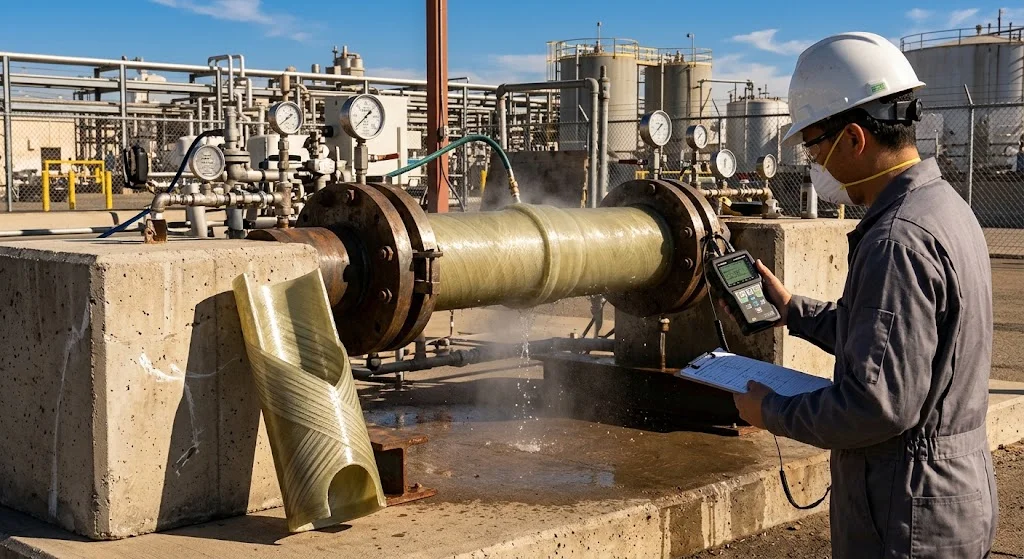
Filament wound pipe is not a commodity plastic tube — it is an engineered composite whose performance is designed into the winding angle, fiber volume and resin system before a single foot of pipe is wound. In corrosion service where steel rusts and HDPE creeps, and in pressure duty where wall thick
Introduction
Filament wound pipe is not a commodity plastic tube — it is an engineered composite whose performance is designed into the winding angle, fiber volume and resin system before a single foot of pipe is wound. In corrosion service where steel rusts and HDPE creeps, and in pressure duty where wall thickness and hoop strength decide whether a line holds or fails, filament wound frp pipe earns its specification by the numbers. This guide covers the mechanics of winding-angle design, a property comparison against steel and HDPE for chemical service, typical pressure and temperature ratings, joint and lining options for process piping, where filament wound bearing sleeves and epoxy tubes share the same production route, and the inspection steps that catch a non-conforming pipe before it enters a plant.
Covered: how the winding angle schedule sets the strength profile, a comparison table of filament wound pipe against steel and HDPE, pressure ratings by diameter and resin system, joint types (bell-and-spigot, flanged, adhesive), and the three inspection checks that separate certified pipe from warehouse stock.
How Winding Angle Sets the Strength Profile
The winding angle is the single most important design variable in filament wound pipe. A 90° hoop wind resists internal pressure; a 15-25° helical wind resists axial tension from end loads and thermal expansion. Most structural pipe uses a multi-layer schedule: a hoop-dominated layer at 75-90° for pressure capacity, a helical layer at 45-55° for axial and torsional stiffness, and sometimes a thin hoop liner at the bore for wear resistance.
| Winding angle (from axis) | Primary load carried | Typical use | Relative hoop strength |
|---|---|---|---|
| 15-25° | axial tension, bending | long-span risers, structural columns | low |
| 45-55° | balanced hoop and axial | general process piping, moderate pressure | moderate |
| 75-90° | hoop (internal pressure) | high-pressure lines, tank reinforcement | high |
A pipe specified for 16 bar internal pressure at DN300 will typically carry a 75-90° hoop layer as the primary structure, with a 45° layer for stiffness; a pipe specified for a 12 m free span with no pressure will invert the schedule — 25° axial layers for bending capacity, thin hoop skins for crush resistance. Getting this wrong is the most common specification error: a hoop-wound pipe in axial tension will split along the helix, and an axially-wound pipe under internal pressure will balloon until the matrix cracks.
Filament Wound Pipe vs Steel and HDPE: The Numbers
The table below compares a typical glass-vinyl ester filament wound pipe against Schedule 80 carbon steel and HDPE for chemical service at DN300. Numbers are representative ranges — always confirm against the specific resin system and layup certificate.
| Property | Glass-vinyl ester filament wound | Schedule 80 carbon steel | HDPE |
|---|---|---|---|
| Density | 1.8-2.0 g/cm³ | 7.85 g/cm³ | 0.95 g/cm³ |
| Corrosion resistance | broad chemical resistance, no cathodic protection needed | requires lining or CP; fails in seawater and acids | broad chemical resistance, but permeates some solvents |
| Pressure rating (DN300, SDR) | 10-25 bar depending on schedule | 25-40 bar | 6-10 bar (PN10) |
| Temperature limit | 80-120 °C, resin dependent | unlimited for mechanical, limited by lining | 60-80 °C continuous |
| Relative weight | 1.0 (baseline) | 4-5x heavier | 0.4-0.5x lighter |
| Install method | bell-and-spigot, flanged, or adhesive | welded or flanged | fused or mechanical |
| Service life (corrosive) | 20-30 years typical | 5-15 years without protection | 20-40 years |
Two lines in that table decide most selections. The pressure rating line is why steel remains the default for high-pressure hydrocarbons and why filament wound pipe wins in chemical process lines at 10-25 bar. The corrosion line is why naval and offshore engineers specify FRP for ballast, bilge and seawater service where steel would need continuous cathodic protection.
Pressure and Temperature Ratings: What the Numbers Mean
Filament wound pipe is rated by a design factor against the hoop burst pressure. A common industrial standard uses a safety factor of 4:1 to 6:1 on the ultimate hoop strength, which means a pipe with a 100 MPa ultimate hoop strength is rated for 16-25 bar working pressure. Temperature derating is the second factor: a vinyl ester system loses roughly 10-15% of its pressure rating per 20 °C above 50 °C, which is why a pipe rated 16 bar at ambient may only be rated 10 bar at 80 °C. Designers should request the pressure-temperature derating curve from the manufacturer, not assume a flat rating. For service above 120 °C, epoxy systems with higher glass transition temperatures (150-180 °C Tg) are specified, but these are more brittle and less forgiving of impact.
Joint and Lining Options for Process Piping
The joint is often the weak link in a filament wound pipe system. Four joint types cover most process applications.
- Bell-and-spigot with elastomeric seal: the standard for buried water and chemical lines — allows slight angular deflection (typically 1-3°) per joint, absorbs thermal expansion, and is quick to assemble. Not for high-pressure above-ground lines.
- Flanged joints: steel or FRP flanges bonded or bolted to the pipe end — required for equipment connections, valves, and any joint that must be disassembled for maintenance. Torque the bolts in a star pattern to avoid flange distortion.
- Adhesive (socket) joints: a structural epoxy adhesive bonds the spigot into the bell — high strength, leak-tight, but permanent. Use where disassembly is not planned and vibration is low.
- Threaded couplings: limited to small bore (typically DN50 and below) and low pressure — common in instrument air and utility water.
Lining options depend on the fluid. A thin epoxy or vinyl ester liner (0.5-2 mm) at the bore provides the chemical barrier; for abrasive slurries, a ceramic-filled or rubber-lined bore is specified. The liner must be compatible with both the fluid and the structural laminate's resin — a mismatch will delaminate under thermal cycling.
Shared Production: Filament Wound Bearing Sleeves and Epoxy Tubes
A factory that runs filament wound pipe production can make filament wound bearing sleeves and filament wound epoxy tubes with almost no new equipment: the same winding machines, resin systems and cure ovens, just shorter mandrels and tighter dimensional control. That shared production route is why bearing sleeves from tube specialists are often competitive against dedicated bushing plants, and why large-diameter pipe programs occasionally spin off a bearing family for the same customer. The difference is in the finishing: pipe is cut to length with a saw, while a bearing sleeve needs a ground bore and squared faces, so machining carries more of the tolerance budget.
Inspection Checks That Catch a Bad Pipe
Before a length of filament wound pipe enters service, three checks will tell you whether it meets the specification. First, a hydrostatic test at 1.5x working pressure for 1-5 minutes — the pipe must hold without weeping at the joints or showing bloom (resin whitening) on the wall, which indicates microcracking. Second, an ultrasonic wall scan along the full length — wall thickness must stay within ±10% of nominal, and any thin spot below the pressure derating curve is grounds for rejection. Third, a dimensional audit of the joint geometry — bell depth, spigot OD and flange flatness all affect the seal, and a pipe that fails dimensional check will leak regardless of laminate quality. Ask for the certificate of conformance with the batch number, winding schedule and hydrotest result before accepting delivery.
Frequently Asked Questions
What pressure can filament wound pipe hold?
Typical industrial ratings for glass-vinyl ester filament wound pipe run 10-25 bar at DN300 depending on the winding schedule and wall thickness, with carbon-epoxy systems reaching higher pressures in smaller diameters. Always derate for temperature: a vinyl ester pipe loses 10-15% of its pressure rating per 20 °C above 50 °C.
How does filament wound frp pipe compare to steel for chemical service?
FRP wins on corrosion resistance (no lining or cathodic protection needed), weight (4-5x lighter), and service life in corrosive duty (20-30 years vs 5-15 for unprotected steel). Steel wins on pressure rating above 25 bar, temperature above 120 °C, and impact resistance. For chemical process lines at 10-25 bar and ambient to 80 °C, FRP is usually the better total-cost choice.
Can filament wound pipe be used for potable water?
Yes, with the right resin system: potable-water-approved vinyl ester or epoxy liners that meet NSF/ANSI 61 or equivalent drinking-water standards. Confirm the liner certification with the manufacturer — not all chemical-resistant resins are approved for potable contact.
Conclusion
Filament wound pipe applications come down to three design decisions: winding angle schedule for the load path, resin system for the chemical and temperature environment, and joint type for the installation. Get those three right, demand a hydrotest and ultrasonic certificate with every batch, and filament wound frp pipe will outlast steel in corrosive service at a fraction of the weight. YongXian produces filament wound pipe, bearing sleeves and epoxy tubes on shared production lines with documented winding schedules and test data. Browse our composite tube range or contact our engineering team with your diameter, pressure, fluid and temperature.
Part of topic
Related Articles
- Carbon Fiber Tube for RC Plane Spars and Pushrods: A Builder Guide
- Filament Wound Bearing Design: Composite Sleeves That Outlast Bronze
- Custom Carbon Fiber Rod Grips: Fishing Rods, Tool Handles, and Ordering Specs
- Carbon Fiber Fishing Rods: Blank Types, Actions, and Buying Checks
- Custom Carbon Fiber Parts for Cars: From Trim to Structural Upgrades
- Custom Carbon Fiber Parts for Motorcycle Builds: Fit, Finish and Sourcing
Interested in Our Products?
Contact our team for competitive pricing and technical specifications.
Get a QuoteRelated Products

Round Carbon Fiber Tube — 3K Plain Weave T700
Standard round carbon fiber tube manufactured from Toray T700 grade fiber with 3K plain weave. Offers balanced strength and stiffness for general industrial applications including robotics, automation, sports equipment, and aerospace structures.
Carbon Fiber Plate — 3K Twill T700 1.5mm
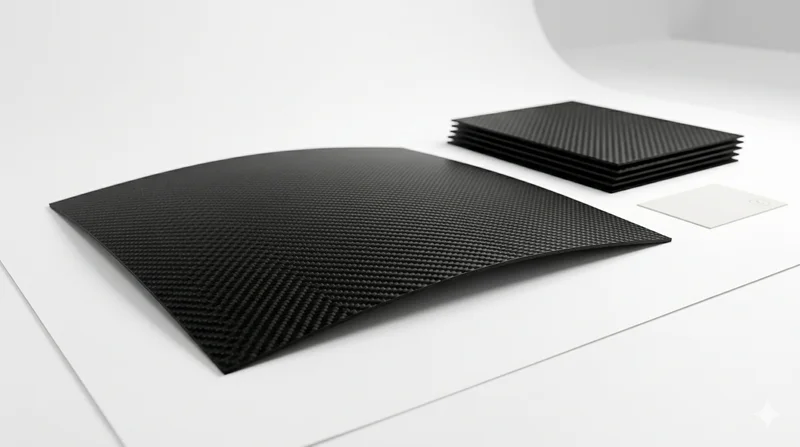
Thin 1.5mm carbon fiber plate with 3K twill weave surface. Lightweight and stiff, commonly used for covers, panels, drone bodies, and applications requiring a premium aesthetic appearance.