
The carbon fiber road wheels market offers dozens of brands at prices from a few hundred dollars to the cost of a decent used car, and the spec sheets all claim the same things: stiff, light, aero. Sorting real engineering from marketing takes knowing which numbers actually change how a wheel feels
Introduction
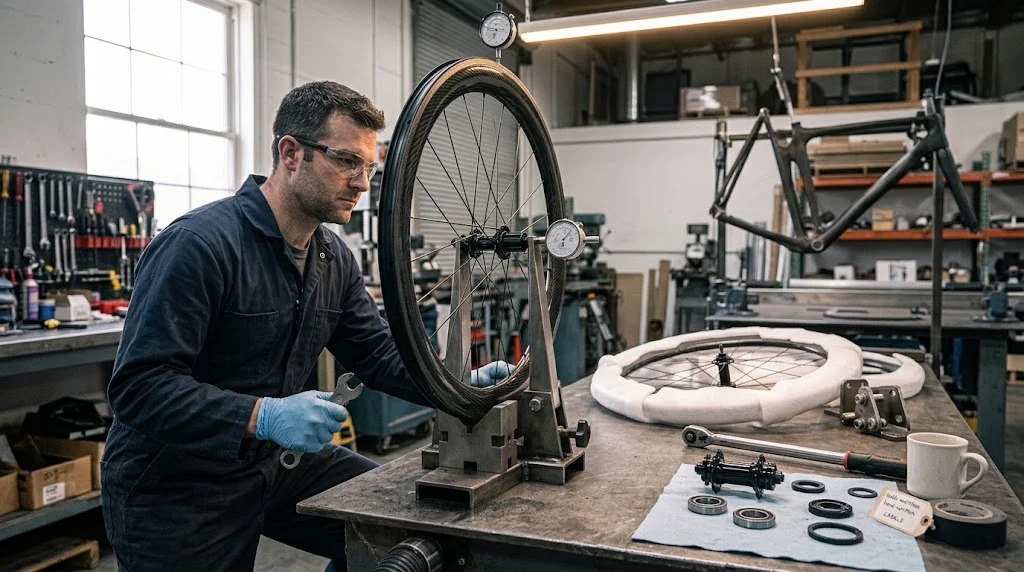
The carbon fiber road wheels market offers dozens of brands at prices from a few hundred dollars to the cost of a decent used car, and the spec sheets all claim the same things: stiff, light, aero. Sorting real engineering from marketing takes knowing which numbers actually change how a wheel feels on the road — rim depth and mass, lateral stiffness at the spokes, hub bearing quality, and what happens to the brake track after a long Alpine descent.
This guide covers carbon fiber road wheels from rim to hub, then looks at how carbon fiber sheet for bike production feeds the same factories, when carbon fiber top tube repair makes more sense than a new frame, and why the material logic of carbon fiber fishing rods looks surprisingly familiar to riders.
Carbon Fiber Road Wheels: The Numbers That Matter
Wheel weight gets the headlines, but rim depth and stiffness distribution decide daily ride quality. A shallow 30 mm rim climbs well and handles crosswinds calmly; a 50-60 mm rim carries speed on the flats but steers harder in gusts. The honest comparison is against a quality aluminum wheelset, which still wins on repairability and cold-weather braking.
| Metric | Carbon road wheel (50 mm) | Aluminum wheelset | What the rider notices |
|---|---|---|---|
| Wheelset weight | 1,400-1,650 g | 1,750-2,100 g | Snappier acceleration, easier climb standing |
| Rim lateral stiffness | High, spokes tensioned 110-130 kgf | Moderate | Less rub under hard sprinting effort |
| Aero drag at 40 km/h | 8-14 W saved per pair | Baseline | Noticeable only with a speed meter and long pulls |
| Brake heat behavior | Resin-sensitive, needs groove track | Excellent, all weather | Critical on wet, gritty descents |
| Typical price per set | $450-2,500 | $120-400 | Carbon premium buys weight and aero, not durability |
Riders who race or train with power numbers feel the weight and aero rows immediately; commuters rarely notice either difference, which is why aluminum remains the rational choice for a winter bike.
Hub, Bearings and Spoke Choice Decide Lifespan
A great rim on a mediocre hub is a mediocre wheel. Sealed cartridge bearings from named makers outlast loose-ball setups, and straight-pull spokes distribute fatigue better than bent J-bend elbows at the flange. Ask three questions before buying: what bearings are fitted, what is the spoke count and pattern, and are replacement rims and spokes stocked locally.
- Bearings: 6800 or 29er-series sealed cartridges, serviceable with a spacer and a pick every 4,000-6,000 km.
- Spokes: 20-24 front, 24 rear, two-cross at the drive side keeps the rear wheel true under sprint loads.
- Freehub: steel spline bodies survive winter grit; aluminum bodies save 40 g and wear faster.
- Rim bed: tubeless-ready tape and a hooked bead matter more than any aero claim for daily use.
Carbon Fiber Sheet for Bike Production Feeds the Same Line
Most wheel factories buy CNC-cut prepreg kits from the same suppliers who make carbon fiber sheet for bike frames, top tubes and bespoke parts. Sheet grade determines everything downstream: T700-class fabric at 200-300 g/m2 lays up into a durable rim blank, while ultra-high-modulus plies add stiffness but chip more easily against a rock strike. When you evaluate a wheel brand, asking what fabric and resin system they use tells you more than a weight graphic.
Carbon Fiber Top Tube Repair: When to Fix the Frame
A cracked top tube from a parking-lot knock usually costs far less to repair than to replace, provided the damage sits in a low-load zone away from the head tube junction. A qualified repair shop cuts back the damaged laminate, lays in new prepreg and post-cures the joint, restoring most of the original stiffness for a fraction of frame price. Deep splits at the weld-free junctions, damage reaching the bottom bracket or repeated cracks in the same area mean the frame should retire — and the same rule applies to a rim with a through-crack in the bead.
- Repairable: surface cracks under 100 mm, paint-level scratches with no weave distortion, isolated delamination smaller than a coin.
- Replace: cracks crossing a bonded joint, crunch felt when squeezing the tube, damage exposing fibers along more than a third of the circumference.
Carbon Fiber Fishing Rods Share the Same Material Lesson
Anglers learned decades ago what riders are still discovering: carbon's stiffness-to-weight is addictive, but brittleness punishes side impacts. A carbon fiber fishing rod snaps on a snagged cast the same way a road rim fails on a square-edged pothole — both failures come from point loads the layup was never designed to carry. The lesson for wheel buyers is to treat carbon as a precision component: check the brake track each month, keep tires at correct pressure, and retire gear after a major impact even when nothing looks broken.
Frequently Asked Questions
Are carbon fiber road wheels worth it for a recreational rider?
For riders covering more than 100 km a week or timing themselves on climbs, the 300-500 g saved per wheelset and the calmer handling in crosswinds justify the cost. For social rides under 50 km, a quality aluminum wheelset with good tires is the better value and survives winter salt without worry.
How long do carbon road wheels typically last?
With average mileage of 3,000-5,000 km per year, a well-built carbon wheelset lasts 8-12 years before spokes fatigue or a rim wears through the brake track. Bearing service every season and one true-check after the first month of riding are the two habits that extend service life most.
Can carbon wheels be ridden in the rain?
Yes, with a dedicated grooved brake track and quality pads rated for carbon. Wet braking is weaker than aluminum and pads wear faster, so increase following distance on descents and clean the track after gritty rides; avoid cheap pads, which overheat and glaze the surface.
Conclusion
Carbon fiber road wheels reward riders who match rim depth to their terrain, insist on a quality hub and service bearings on schedule. Buy aluminum when repairability and budget matter most, buy carbon when every climb and crosswind actually gets felt — and inspect after every crash regardless of which material you chose.
YongXian supplies carbon fiber sheet, tube and CNC-cut components used across cycling and sporting-goods production. Browse our carbon fiber range or contact our engineering team with your layup and volume requirements.
Part of topic
Related Articles
- Carbon Fiber Drone Chassis Design: Loads, Layout and Layup
- Carbon Fiber Sheets 4x8: Buying, Pricing and Large Format Panel Uses
- Carbon Fiber Tube for RC Plane Spars and Pushrods: A Builder Guide
- Filament Wound Pipe Applications: Corrosion and Pressure Duty
- Filament Wound Bearing Design: Composite Sleeves That Outlast Bronze
- Custom Carbon Fiber Rod Grips: Fishing Rods, Tool Handles, and Ordering Specs
Interested in Our Products?
Contact our team for competitive pricing and technical specifications.
Get a QuoteRelated Products

Round Carbon Fiber Tube — 3K Plain Weave T700
Standard round carbon fiber tube manufactured from Toray T700 grade fiber with 3K plain weave. Offers balanced strength and stiffness for general industrial applications including robotics, automation, sports equipment, and aerospace structures.

Square Carbon Fiber Tube — 3K Twill T700
Square cross-section carbon fiber tube manufactured with 3K twill weave for torsional strength. Preferred for structural frames, trusses, and support columns where rectangular geometry offers design flexibility.

Round Carbon Fiber Tube — 3K Twill
Lightweight and ultra-stiff round tubes ideal for drone frames, robotics, and structural applications.

Round Carbon Fiber Tube — UD Unidirectional T700
Unidirectional (UD) round tube with all fibers aligned axially for maximum longitudinal stiffness. Ideal for applications requiring high bending rigidity with minimal weight, such as shafts, struts, and structural reinforcements.

Carbon Fiber Plate — 3K Twill T700 3.0mm
Medium-thickness 3.0mm carbon fiber plate offering significantly higher load capacity while maintaining attractive 3K twill finish. Suitable for structural brackets, reinforcement plates, and load-bearing panels.