
Carbon fiber rod ends are the highest-stress point in any rod-based assembly: a pushrod, a tent pole, a camera truss or a robotics linkage fails at the joint long before the carbon fiber solid rod itself gives way. A typical 8 millimetre pultruded rod carries 1,800 newtons in pure tension, yet the s
Introduction
Carbon fiber rod ends are the highest-stress point in any rod-based assembly: a pushrod, a tent pole, a camera truss or a robotics linkage fails at the joint long before the carbon fiber solid rod itself gives way. A typical 8 millimetre pultruded rod carries 1,800 newtons in pure tension, yet the same rod epoxied into a poorly prepared socket let go at 400 newtons — the interface, not the fiber, sets the rating. This article maps the hardware options for a reliable carbon fiber rod connection, from bonded sockets and threaded inserts to mechanical clevises, and gives the numbers needed to pick one.
The choice matters more than it looks. Rod ends decide service load, adjustability, field replacement and failure mode, and they are the part buyers most often get wrong when they specify a carbon fiber rod handles project — a handle assembly with a press-fit aluminium plug that splits the laminate after two hundred cycles. What follows is a practical guide to the four joint families, their measured pull-out strengths, and where each belongs.
Why Carbon Fiber Rod Ends Limit the Assembly Rating
A pultruded carbon rod is strongest along its axis and weakest through its thickness, and almost every end fitting attacks that weakness in one of two ways: it tries to expand the tube from inside (hoop tension), or it concentrates load into a small patch of surface (interlaminar shear). Both failure modes live in the laminate, not in the metal:
- Hoop splitting: wedge anchors, expanded inserts and press-fit plugs drive radial stress into thin walls; a 2 millimetre wall on an 8 millimetre rod splits at roughly a third of the rod's axial rating.
- Pull-out: bond-only joints depend on surface preparation; sanding to 120 grit plus solvent wipe raises epoxy pull-out by 60-80 percent versus a smooth as-pultruded surface.
- Peel at the lip: any fitting that loads the rod end off-axis introduces a bending moment, and the adhesive fillet at the socket mouth is where the crack starts.
- Crush under clamp: bolting a rod directly through its wall crushes the matrix; through-bolts need a metal sleeve inside the bore to carry the compression.
The engineering rule is simple: keep the joint axial, spread the load over at least 10 rod diameters of bond length, and let metal — not laminate — take every concentrated force.
Bonded Sockets: The Standard Carbon Fiber Rod Connection
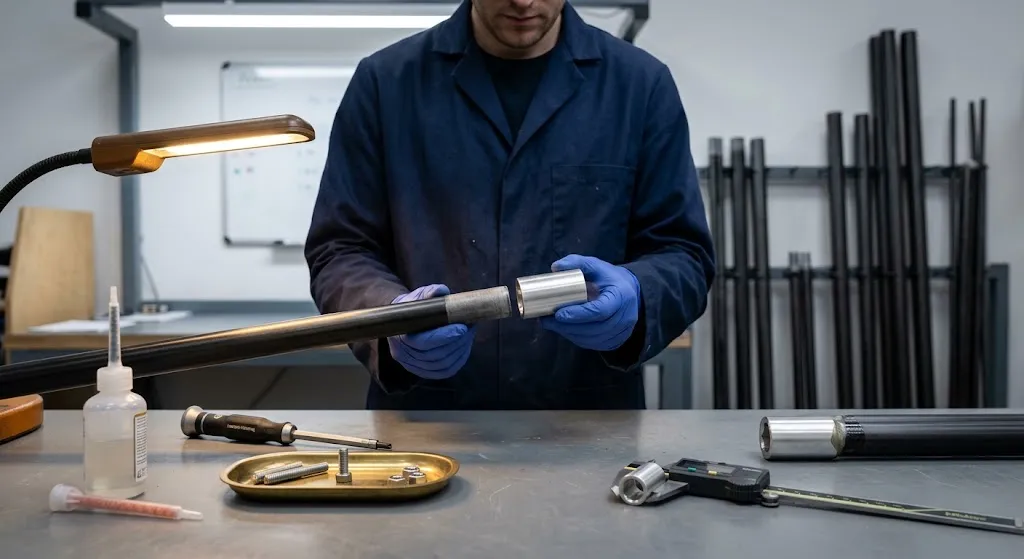
The bonded socket is the workhorse joint: a cylindrical aluminium or steel ferrule epoxied over the rod end, load transferring through shear into the adhesive line. Done properly it typically develops 70-85 percent of the rod's own tensile strength, which is why it dominates camera trusses, UAV booms and instrument booms.
| End fitting | Typical pull-out (8 mm rod) | % of rod rating | Adjustable | Field replaceable |
|---|---|---|---|---|
| Bonded aluminium socket, 40 mm bond length | 1,450 N | 80% | No | With sleeve removal |
| Threaded insert, moulded-in (M4 stud) | 1,250 N | 69% | Yes | No — permanent |
| Mechanical collet / set-screw ferrule | 900 N | 50% | Yes | Yes |
| Clevis with through-bolt and inner sleeve | 1,650 N | 91% | Yes | Yes |
| Press-fit plug, no adhesive | 400 N | 22% | No | Yes |
Surface prep is the variable that moves the number most: abrade with 80-120 grit paper, wipe with acetone, and use a toughened epoxy with 0.3-0.5 millimetre bond-line thickness. Structural acrylics work for prototyping but creep under sustained load; two-part epoxies do not.
Threaded Inserts and Mechanical Options for Carbon Fiber Rod Ends
When the joint must be disassembled — drone arms that fold, adjustable pushrods, modular tent poles — mechanical hardware takes over:
- Moulded-in threaded inserts: an aluminium insert wet-laid into the final plies during pultrusion or roll-wrapping; highest stiffness, no field service, and the stud becomes the weak point in overload.
- Set-screw ferrules: a metal sleeve slid over the rod and locked with two or three set screws pinched through nylon tips; simple, repeatable, but rated at roughly half the bonded options because contact is line-load, not area-load.
- Collet chucks: split cones that grip over a longer length; good for carbon fiber rod handles on hand tools where vibration loosens set screws.
- Through-bolt clevises: a bolt passes across the bore inside a metal sleeve; the highest-capacity removable joint, and the only one that survives shock loading without adhesive.
Whatever the mechanism, the metal sleeve inside the bore is not optional — it is what keeps the clamp and bolt loads out of the laminate.
Selecting the Joint for the Application
Match the end treatment to the duty cycle: bonded sockets for permanent, axially loaded structures; moulded-in inserts where adjustability is needed but service is not; collet or set-screw ferrules for hand tools and quick-build fixtures; through-bolt clevises for anything that sees shock, cycling or field replacement. Design the bond length at a minimum of 10 times the rod diameter, keep eccentricity near zero, and specify the rod — browse our carbon fiber rod range — together with the fitting so the two are engineered as one joint rather than assembled as an afterthought.
Frequently Asked Questions
What is the pull-out strength of a bonded carbon fiber rod end?
On an 8 millimetre pultruded rod with a 40 millimetre bond length, a properly prepared aluminium socket in toughened epoxy develops about 1,450 newtons — roughly 80 percent of the rod's 1,800 newton axial rating. Bond length below 10 rod diameters, a smooth un-abraded surface, or a brittle adhesive will each cut that figure by a third or more.
Can I screw fittings directly into a carbon fiber rod?
Not into the laminate itself. Tapped carbon threads have shallow engagement and crush under torque, so the rod splits at the first over-tightening. Use a moulded-in or bonded metal insert instead; if the rod is hollow, an internally threaded sleeve epoxied into the bore gives full thread depth without loading the wall.
Which joint is best for a carbon fiber rod connection that must be disassembled in the field?
A through-bolt clevis with an inner metal sleeve. It develops the highest removable-joint capacity (about 1,650 newtons on an 8 millimetre rod), needs no adhesive cure time, survives shock loading, and can be swapped with a hex key. Set-screw ferrules are simpler still but should be limited to roughly 50 percent of the rod rating.
Conclusion
Carbon fiber rod ends, not the rod, set the rating of any assembly: a well-bonded socket reaches 80 percent of rod strength while a press-fit plug fails at 22 percent, and the difference is entirely surface preparation, bond length and keeping loads axial. Choose bonded sockets for permanent structures, moulded-in inserts for adjustable non-serviceable joints, and through-bolt clevises for anything cyclic or field-serviced — with a metal sleeve inside every bore. For rods and matched end fittings engineered together, browse our carbon fiber rod range or contact our technical team with your load case, diameter and length.
Related Articles
- Carbon Fiber Plate Cover: Protective and Cosmetic Applications
- Carbon Fiber Plates: Standard Sizes and Application Overview
- Carbon Fiber Plate in Running Shoes: Pros, Cons and Fit Guide
- Carbon Fiber Foot Plate: Orthotic and Prosthetic Applications
- Carbon Fiber Intake Tube: Engine Air Induction Systems
- Carbon Fiber Arrow Shafts: Spine Selection and Performance
Interested in Our Products?
Contact our team for competitive pricing and technical specifications.
Get a QuoteRelated Products

Carbon Fiber Plate — 3K Twill T700 1.5mm
Thin 1.5mm carbon fiber plate with 3K twill weave surface. Lightweight and stiff, commonly used for covers, panels, drone bodies, and applications requiring a premium aesthetic appearance.

Carbon Fiber Plate — 3K Twill T700 3.0mm
Medium-thickness 3.0mm carbon fiber plate offering significantly higher load capacity while maintaining attractive 3K twill finish. Suitable for structural brackets, reinforcement plates, and load-bearing panels.

Square Carbon Fiber Tube — 3K Twill T700
Square cross-section carbon fiber tube manufactured with 3K twill weave for torsional strength. Preferred for structural frames, trusses, and support columns where rectangular geometry offers design flexibility.

Round Carbon Fiber Tube — UD Unidirectional T700
Unidirectional (UD) round tube with all fibers aligned axially for maximum longitudinal stiffness. Ideal for applications requiring high bending rigidity with minimal weight, such as shafts, struts, and structural reinforcements.

Round Carbon Fiber Tube — 3K Plain Weave T700
Standard round carbon fiber tube manufactured from Toray T700 grade fiber with 3K plain weave. Offers balanced strength and stiffness for general industrial applications including robotics, automation, sports equipment, and aerospace structures.