
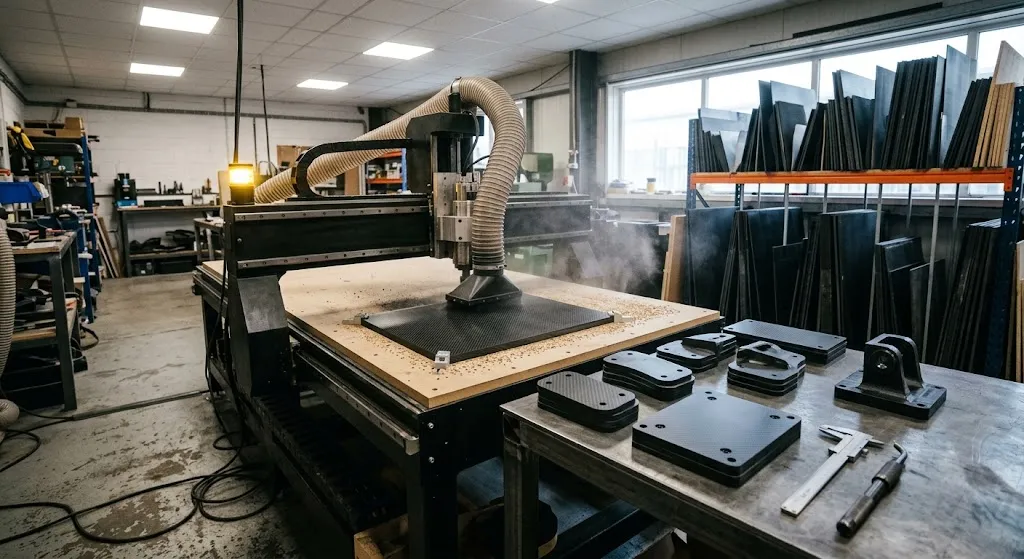
Carbon fiber plates are flat laminated panels cut from carbon fabric and epoxy resin, and they are the form in which most buyers first encounter structural composite material. A standard plate weighs about 1.55 to 1.60 grams per cubic centimetre — roughly a fifth of aluminum — while delivering tensi
Introduction
Carbon fiber plates are flat laminated panels cut from carbon fabric and epoxy resin, and they are the form in which most buyers first encounter structural composite material. A standard plate weighs about 1.55 to 1.60 grams per cubic centimetre — roughly a fifth of aluminum — while delivering tensile strength in the 600 to 900 megapascal range, which is why the same catalog item shows up in drone frames, robot chassis, sporting goods, and medical orthoses.
This guide covers what a buyer needs to specify an order: the stock sheet sizes plates are cut from, how density and mechanical properties change with layup and weave, how to cut and machine carbon fiber plates without damaging them, and where each class is applied. All figures are typical commercial ranges for epoxy-laminated plates cured under vacuum or in an autoclave.
What Carbon Fiber Plates Are Made Of
A plate is a stack of plies: carbon fabric layers bonded by epoxy under heat and pressure. Three choices define the panel before any geometry is applied:
- Fiber grade: T300-class fiber covers general engineering; T700 raises tensile strength about 20 percent at similar modulus and is the common choice where weight matters more than cost.
- Weave: Plain weave is the stiffest and flattest; twill drapes better over curves; unidirectional laminate maximizes properties in one direction when the load path is known.
- Resin system: Standard epoxy cures at 120 to 130 °C; high-temperature systems raise the service ceiling toward 180 °C for under-hood or industrial oven exposure.
Fabric weight, ply count, and cure cycle decide thickness, mass, and mechanical values; a supplier should state all three on the datasheet.
Standard Sizes of Carbon Fiber Plates
Plates are laminated as large sheets and cut to order, so "standard size" means the stock sheet. The common catalog sizes are:
| Stock sheet (mm) | Stock sheet (in) | Common thicknesses (mm) | Typical use |
|---|---|---|---|
| 300 × 200 | 11.8 × 7.9 | 1, 2, 3, 4, 5, 6 | Hobby, repair patches, small brackets |
| 400 × 300 | 15.7 × 11.8 | 1, 2, 3, 4, 5, 6, 8 | Robotics, drone frames, jigs |
| 500 × 400 | 19.7 × 15.7 | 2, 3, 4, 5, 6, 8, 10 | Automation tooling, automotive brackets |
| 1000 × 500 | 39.4 × 19.7 | 2, 3, 4, 5, 6, 8, 10, 12 | Production panels, machine bases |
| 1000 × 1000 | 39.4 × 39.4 | 2–20 (5 mm steps above 10) | Full-sheet industrial supply |
Among individual thicknesses, the carbon fiber plate 4 millimetre variant is the most ordered: stiff enough for structural brackets, light enough to stay a drop-in metal replacement. Thickness tolerance is typically ±0.2 millimetres, and flatness around 0.5 millimetres per metre. For sizes outside the stock list, laminating a custom blank is usually cheaper than cutting down a large sheet.
Carbon Fiber Plate Density and Mechanical Data
Carbon fiber plate density is set by the fiber volume fraction, which depends on fabric weight and cure pressure. Typical values by construction:
| Construction | Density (g/cm³) | Tensile strength (MPa) | Elastic modulus (GPa) | Fiber volume |
|---|---|---|---|---|
| 3K twill, vacuum bagged | 1.50–1.55 | 550–700 | 45–55 | 50–55% |
| 3K twill, autoclave | 1.55–1.60 | 700–900 | 55–65 | 55–60% |
| Unidirectional, autoclave | 1.55–1.62 | 900–1,200 (0°) | 120–140 (0°) | 58–62% |
| Carbon-epoxy sandwich (honeycomb core) | 0.45–0.80 | Bond-limited | Equivalent to face sheet | Face: 55–60% |
Two readings matter. Density changes little between constructions — 1.50 to 1.62 grams per cubic centimetre — so mass is driven by thickness, not grade. Modulus in the unidirectional direction is roughly double the quasi-isotropic layup, so plate selection starts with the load direction.
Carbon Fiber Plate Cutting and Machining
Cutting carbon fiber plate behaves differently from metalworking, and the wrong tool ruins the edge:
- Cutting: Use a diamond-coated or carbide blade at high speed with water or air cooling and dust extraction. Scoring the face with a guided knife before snapping is only reliable below 2 millimetres.
- Drilling: Carbide drill bits at 2,000 to 4,000 rpm, with a backing board to prevent breakout. Deburr from the exit side, and seal hole edges if the plate will see moisture.
- Milling: Compression cutters prevent delamination at both faces; conventional end mills lift the top plies. Keep depth of cut shallow and step down rather than taking full thickness in one pass.
- Safety: Carbon dust is electrically conductive and an irritant — always cut under extraction, and never blow dust out of electronics with air that passed over a cutting operation.
Edge finishing ranges from a quick resin seal for hidden brackets to rounded, sanded, clear-coated edges for visible parts. Sealed edges also slow moisture wicking into the fiber bed.
Application Overview
Where each class of plate lands depends on the property that dominates the design:
- Drones and robotics: 1 to 3 millimetre plates for arms, mounts, and chassis plates where stiffness-to-mass governs.
- Automation and jigs: 4 to 8 millimetre plates for end-of-arm tooling and fixture faces that must stay rigid without the mass of steel.
- Automotive and motorsport: brackets, splitter supports, and interior structures; 4 millimetre plate is the common structural default.
- Medical and orthotic: 1.5 to 3 millimetre plates formed to patient contours, where fatigue life and corrosion immunity dominate.
- Sports equipment: plate blanks for skis, snowboards, and protective gear insert zones.
Frequently Asked Questions
How much does a carbon fiber plate weigh?
Mass scales directly with thickness and area. With a density near 1.55 grams per cubic centimetre, a 400 × 300 millimetre plate weighs about 185 grams at 1 millimetre, 370 grams at 2 millimetres, 740 grams at 4 millimetres, and 1,110 grams at 6 millimetres. Quotes without thickness and layup are not usable: a unidirectional and a twill plate at the same thickness differ in stiffness by a factor of two.
Can you glue carbon fiber plates to metal?
Yes, with surface preparation. Structural epoxy adhesives work best: abrade both surfaces, degrease with solvent, and clamp at the specified pressure. Mechanical fasteners are preferred for primary structure because they allow inspection and tolerate differential thermal expansion — carbon laminate expands along its length at about 0.2 to 0.6 × 10⁻⁶ per degree Celsius while aluminum expands near 23 × 10⁻⁶, so a bonded joint develops shear stress through every thermal cycle.
Are carbon fiber plates waterproof?
The cured epoxy matrix is essentially impermeable, but cut edges are not: moisture can wick along fibers into the laminate if edges stay raw. Seal edges with epoxy or a rubber edge trim, avoid continuous immersion in hot water, and plates survive outdoor and marine duty. UV does not degrade the laminate, but it embrittles unprotected resin, so visible parts should carry a UV-stable clear coat.
Conclusion
Specifying carbon fiber plates comes down to four decisions: stock sheet size, thickness, layup, and edge finish. Standard stock from 300 × 200 to 1000 × 1000 millimetres covers most builds; the carbon fiber plate 4 millimetre thickness is the workhorse for structural brackets; carbon fiber plate density stays in a narrow 1.50 to 1.62 grams per cubic centimetre band, so mass follows thickness; and careful carbon fiber plate cutting protects the edge and the operators. For stock sheets, cut blanks, or plates machined to your drawing, browse our carbon fiber plate range or contact our technical team with your dimensions, layup, and target properties.
Part of topic
Related Articles
- Carbon Fiber Rod Ends: Connectors and Hardware Options
- Carbon Fiber Plate Cover: Protective and Cosmetic Applications
- Carbon Fiber Plate in Running Shoes: Pros, Cons and Fit Guide
- Carbon Fiber Foot Plate: Orthotic and Prosthetic Applications
- Carbon Fiber Intake Tube: Engine Air Induction Systems
- Carbon Fiber Arrow Shafts: Spine Selection and Performance
Interested in Our Products?
Contact our team for competitive pricing and technical specifications.
Get a QuoteRelated Products

Carbon Fiber Plate — 3K Twill T700 1.5mm
Thin 1.5mm carbon fiber plate with 3K twill weave surface. Lightweight and stiff, commonly used for covers, panels, drone bodies, and applications requiring a premium aesthetic appearance.

Carbon Fiber Plate — 3K Twill T700 3.0mm
Medium-thickness 3.0mm carbon fiber plate offering significantly higher load capacity while maintaining attractive 3K twill finish. Suitable for structural brackets, reinforcement plates, and load-bearing panels.

Square Carbon Fiber Tube — 3K Twill T700
Square cross-section carbon fiber tube manufactured with 3K twill weave for torsional strength. Preferred for structural frames, trusses, and support columns where rectangular geometry offers design flexibility.

Round Carbon Fiber Tube — UD Unidirectional T700
Unidirectional (UD) round tube with all fibers aligned axially for maximum longitudinal stiffness. Ideal for applications requiring high bending rigidity with minimal weight, such as shafts, struts, and structural reinforcements.

Round Carbon Fiber Tube — 3K Plain Weave T700
Standard round carbon fiber tube manufactured from Toray T700 grade fiber with 3K plain weave. Offers balanced strength and stiffness for general industrial applications including robotics, automation, sports equipment, and aerospace structures.