
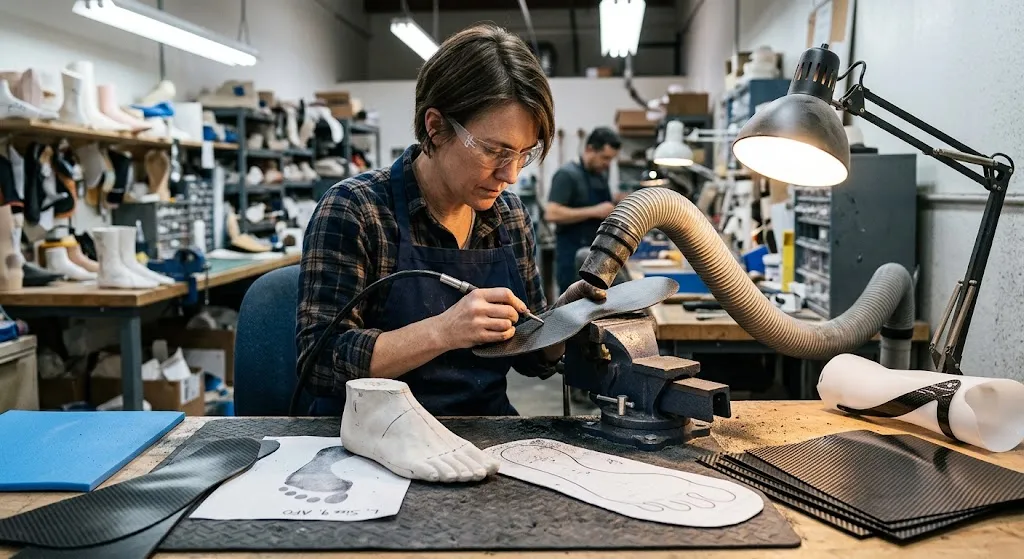
A carbon fiber foot plate is a thin, shaped laminate that sits under the foot — inside a shoe, inside an orthosis, or beneath a prosthetic assembly — and changes how much the foot bends while adding almost no weight. A typical plate weighs 25 to 60 grams against the 90 to 140 grams of the steel or p
Introduction
A carbon fiber foot plate is a thin, shaped laminate that sits under the foot — inside a shoe, inside an orthosis, or beneath a prosthetic assembly — and changes how much the foot bends while adding almost no weight. A typical plate weighs 25 to 60 grams against the 90 to 140 grams of the steel or polypropylene stay it replaces. In clinical practice the part limits pronation, unloads the plantar fascia, and stabilizes the midfoot; in prosthetics the same laminates form the keel of a dynamic response foot and the reinforcement of a below-knee socket.
The reason a carbon fiber foot plate appears in both medical devices and performance footwear is that carbon fiber stores elastic energy and returns most of it, so one component can both control motion and add propulsion. This guide covers what the part does, how it compares with alternatives, where it is used, and what to specify when ordering plates for a clinic, lab, or production run.
What a Carbon Fiber Foot Plate Does
A foot plate is fundamentally a stiffness device. Its job is to decide how much the forefoot can bend relative to the rearfoot at a chosen location in the gait cycle, while staying thin enough to fit inside existing footwear. Four functions cover most prescriptions:
- Limit unwanted motion: The plate resists excessive pronation or medial collapse by raising bending stiffness under the midfoot.
- Protect healing tissue: After plantar fascia surgery, stress fracture, or metatarsal injury, a rigid plate reduces peak plantar pressure by spreading load along its length.
- Store and return energy: A carbon laminate deflects during stance and releases that energy at toe-off, the mechanism behind carbon fiber plate insert shoe designs and the propulsion feel of modern racing shoes.
- Add structure without bulk: At 1.5 to 3.0 millimetres a plate clears the toe box and heel counter of standard shoes, where a steel stay of equal stiffness would need more thickness and would not spring back reliably.
Carbon Fiber Foot Plate vs Steel, Polypropylene and Aluminum
Material choice decides comfort, durability, and how much room the device leaves inside the shoe.
| Property | Carbon fiber plate | Polypropylene | Stainless steel | Aluminum alloy |
|---|---|---|---|---|
| Density (g/cm³) | 1.55–1.60 | 0.90–0.91 | 7.90 | 2.70 |
| Tensile strength (MPa) | 600–900 | 25–40 | 500–700 | 310–450 |
| Elastic modulus (GPa) | 45–75 | 1.1–1.5 | 190–200 | 69 |
| Typical plate thickness (mm) | 1.5–3.0 | 3.0–6.0 | 1.0–2.0 | 2.0–4.0 |
| Mass of a 260 mm plate (g) | 30–55 | 75–140 | 200–400 | 70–130 |
| Energy return | High (85–92%) | Low | Moderate | Moderate |
| Corrosion in sweat contact | None (sealed) | None | Pitting possible | Surface oxidation |
| Fatigue life at 10⁶ cycles | Stable | Crazes and whitens | Good | Fatigue-sensitive |
Two rows matter most. Stiffness scales with the cube of thickness, which is why a carbon plate can be half the thickness of polypropylene and still hold alignment. And every gram removed below the ankle reduces the metabolic cost of swinging the limb — which is why labs accept the higher material cost.
Orthotic Use: AFOs, Insoles and Carbon Fiber Plate Insert Shoe Designs
In orthotics the plate is specified as a full-length or three-quarter-length reinforcement, cut to a footprint pattern and formed to the patient's arch. Typical prescriptions include:
- Post-operative forefoot release: A stiff plate under the metatarsals limits extension of the great toe joint during push-off while the surgical site consolidates.
- Plantar fascia unloading: Full-length plates reduce peak pressure under the heel by 15 to 30 percent compared with unfilled insoles in gait studies of symptomatic patients.
- Ankle-foot orthoses: Carbon AFO shells use the same laminate as a spring element, storing energy at heel strike and returning it at toe-off for drop-foot patients.
- Performance insoles: Running and hiking insoles embed a carbon fiber plate insert shoe style reinforcement under the midfoot to add torsional rigidity without raising the heel.
Fabricators keep semi-finished sheets and cut blanks to order, because arch height, plate length, and the stiffness break point differ with almost every prescription. A carbon fiber plate cover or closed-cell foam top layer protects the laminate from sock abrasion and hides the weave.
Prosthetic Use: Dynamic Response Feet and Sockets
Prosthetics take the same material further. A dynamic response foot uses a carbon plate — or a multi-axial arrangement of two or three plates — as its energy-storing keel, transferring load from heel to toe during stance. Classification codes such as L5981 and L5984 describe these feet, and almost all modern units in these classes are carbon laminate constructions.
Sockets use carbon fiber differently: the laminate is laid over a plaster or CAD-CAM positive and cured to a rigid, thin-walled below-knee socket that spreads pressure across the residual limb. Carbon's stiffness-to-thickness ratio allows a 2 to 4 millimetre wall that still resists walking loads, and dimensional stability keeps the fit from creeping the way a thermoplastic socket can.
How to Specify a Carbon Fiber Foot Plate
When ordering for a lab or device manufacturer, define six parameters: fiber grade and weave (commonly T300 or T700 3K twill), laminate thickness, plate length and width, bend profile or flat, target bending stiffness in newton-millimetres per metre, and surface finish (smooth, textured, or covered). Suppliers should confirm flexural strength of at least 500 MPa, void content below 2 percent, and edge sealing. Include the intended footwear or orthosis shell: clearance under the toe box most often forces a thickness change after the first samples.
Frequently Asked Questions
Can a carbon fiber foot plate be cut and trimmed by a clinic?
Yes. Trim with a diamond or carbide burr at moderate speed under dust extraction — carbon dust is an irritant and electrically conductive — then seal the edges with resin or a rubber strip. Do not use hand shears above about 1.5 millimetres: they crush the edge plies and start delamination.
How long does a carbon fiber plate last inside a shoe?
Three to five years of daily wear, or one to two million loading cycles. Replace when you see permanent set in the arch, cracking noise at the midfoot, or edge delamination longer than 10 millimetres. Wash in water and dry away from direct heat: elevated temperature softens the epoxy matrix.
Is a carbon fiber plate safe for patients with neuropathy?
Safe when stiffness matches the patient's sensation and skin condition. The plate creates no electrical or thermal hazard and its sealed surface does not abrade insensate skin. The clinical risk is pressure concentration at the heel or metatarsal heads where injury can develop unseen, so pair new plates with a two-week wearing schedule, a plantar pressure check, and a foam or silicone top cover.
Conclusion
A carbon fiber foot plate earns its place in orthotic and prosthetic work through high bending stiffness at low thickness, fatigue stability over millions of cycles, energy return during push-off, and corrosion resistance against sweat. Whether the part is a three-quarter orthotic reinforcement, the keel of a dynamic response prosthetic foot, or a carbon fiber plate insert shoe design for performance footwear, the logic is the same — set the stiffness target first, then choose thickness, length, and layup within the space available. For clinics and device makers, browse our carbon fiber plate and sheet range or contact our technical team with your footprint drawing and stiffness target for a quote.
Part of topic
Related Articles
- Carbon Fiber Rod Ends: Connectors and Hardware Options
- Carbon Fiber Plate Cover: Protective and Cosmetic Applications
- Carbon Fiber Plates: Standard Sizes and Application Overview
- Carbon Fiber Plate in Running Shoes: Pros, Cons and Fit Guide
- Carbon Fiber Intake Tube: Engine Air Induction Systems
- Carbon Fiber Arrow Shafts: Spine Selection and Performance
Interested in Our Products?
Contact our team for competitive pricing and technical specifications.
Get a QuoteRelated Products

Carbon Fiber Plate — 3K Twill T700 1.5mm
Thin 1.5mm carbon fiber plate with 3K twill weave surface. Lightweight and stiff, commonly used for covers, panels, drone bodies, and applications requiring a premium aesthetic appearance.

Carbon Fiber Plate — 3K Twill T700 3.0mm
Medium-thickness 3.0mm carbon fiber plate offering significantly higher load capacity while maintaining attractive 3K twill finish. Suitable for structural brackets, reinforcement plates, and load-bearing panels.

Square Carbon Fiber Tube — 3K Twill T700
Square cross-section carbon fiber tube manufactured with 3K twill weave for torsional strength. Preferred for structural frames, trusses, and support columns where rectangular geometry offers design flexibility.

Round Carbon Fiber Tube — UD Unidirectional T700
Unidirectional (UD) round tube with all fibers aligned axially for maximum longitudinal stiffness. Ideal for applications requiring high bending rigidity with minimal weight, such as shafts, struts, and structural reinforcements.

Round Carbon Fiber Tube — 3K Plain Weave T700
Standard round carbon fiber tube manufactured from Toray T700 grade fiber with 3K plain weave. Offers balanced strength and stiffness for general industrial applications including robotics, automation, sports equipment, and aerospace structures.