
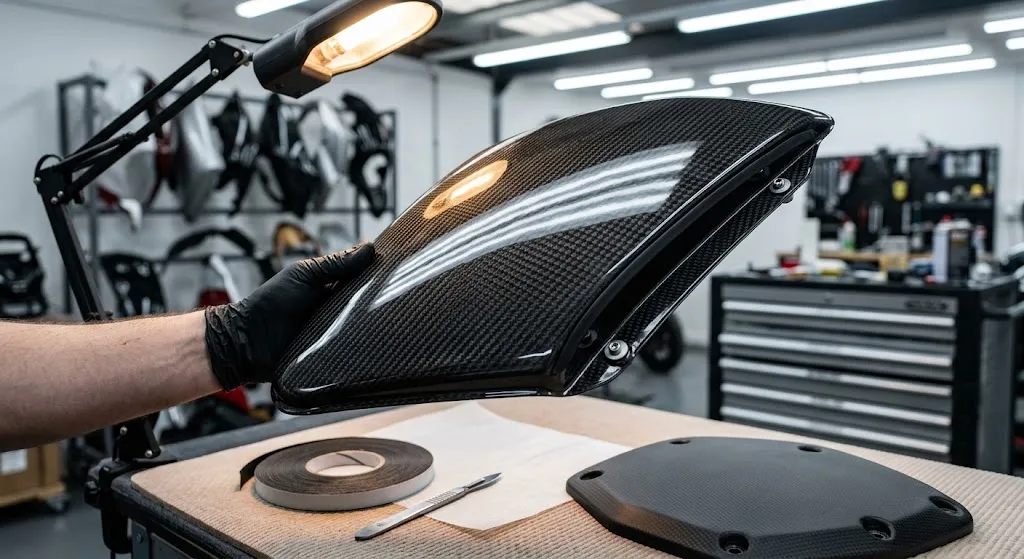
A carbon fiber plate cover is a flat or formed laminate panel fitted over a surface to protect it or to change how it looks, and it is one of the highest-volume uses of cut carbon plate outside structural brackets. A thin cover weighs under 300 grams per square metre, survives fuel, sweat and salt s
Introduction
A carbon fiber plate cover is a flat or formed laminate panel fitted over a surface to protect it or to change how it looks, and it is one of the highest-volume uses of cut carbon plate outside structural brackets. A thin cover weighs under 300 grams per square metre, survives fuel, sweat and salt spray, and holds its finish for years — which is why the same product family shows up as motorcycle side panels, control-cabinet shrouds, speaker grilles, marine deck fittings, and the cosmetic shells over orthotic carbon fiber foot plate devices.
This article covers what a buyer needs to specify one: the thickness and layup choices for protective versus cosmetic duty, the mounting methods that actually hold, the isolation details that stop carbon attacking aluminium underneath, and how a carbon fiber plate cover differs from a holder or a structural plate.
What a Carbon Fiber Plate Cover Does
Covers pull double duty, and the two jobs drive every other decision:
- Protection: taking abrasion, impact, UV and chemical exposure on behalf of the painted metal, plastic or instrument underneath. A 2 to 4 millimetre cover turns a scratch into a serviceable surface instead of a scrapped panel.
- Cosmetics: presenting the woven texture as the visible surface. For this job the layup must be defect-free on the show face, because resin-rich spots, print-through of the backing plies and weave distortion all become visible under clear coat.
- Stiffening: a cover bonded over a thin sheet metal panel raises its first natural frequency, which is why door skins and equipment housings use them to kill drumming noise.
- Identification: in motorsport and marine use, contrasting weave orientation between adjacent covers makes inspection for impact damage faster.
Cover Types, Thicknesses and Finishes
Thickness follows the duty. The table lists typical commercial ranges:
| Cover type | Thickness | Mass (approx.) | Mounting | Primary function |
|---|---|---|---|---|
| Cosmetic skin, flat | 0.8–1.5 mm | 1.2–2.3 kg/m² | VHB tape + primer | Trim panels, device lids, badges area |
| Formed cosmetic cover | 1.0–2.0 mm | 1.6–3.1 kg/m² | Adhesive + edge clip | Tank covers, fairings, curved housings |
| Protective plate cover | 2.0–4.0 mm | 3.1–6.2 kg/m² | Standoffs + M3/M4 bolts | Machine guards, step plates, kick panels |
| Impact cover, 4 mm class | 4.0–5.0 mm | 6.2–7.8 kg/m² | Bolted frame, bonded edge | Skid plates, hatch covers, robot bumpers |
| Ventilated electronics cover | 1.5–3.0 mm | 2.3–4.7 kg/m² | Standoffs with air gap | Control boxes, power electronics lids |
A carbon fiber plate density near 1.55 grams per cubic centimetre means mass is set almost entirely by thickness: a 500 × 400 millimetre cosmetic skin at 1.2 millimetres weighs about 370 grams, while a 4 millimetre carbon fiber plate 4mm-class cover of the same footprint weighs about 1.24 kilograms. Flat covers are cut from stock sheets; curved covers are either thermoformed over a mould or laid up directly on the part they will protect.
Mounting a Carbon Fiber Plate Cover
Mounting choice decides whether the cover survives thermal cycling and service:
- Adhesive bonding: structural acrylic foam tape (VHB class) on a degreased, abraded surface carries most cosmetic covers up to about 3 kilograms. For heavier plates use two-part structural epoxy with a 0.1 to 0.2 millimetre bond-line shim.
- Standoffs: aluminium or nylon standoffs with M3/M4 bolts give an air gap that ventilates electronics and lets the cover flex under impact instead of transferring the load. Drill oversized holes so the bolt floats as the cover and the chassis expand at different rates.
- Hinges and quick release: stainless hinges with bonded-in backing plates, or quarter-turn fasteners in reinforced holes, for service covers opened repeatedly.
- Galvanic isolation: carbon against bare aluminium corrodes the aluminium within months in wet service. Always place a glass-fibre veil, paint film or isolating tape at the interface, and use stainless or coated fasteners.
A cover that is bonded only with tape and bolted directly to aluminium without isolation is the most common field failure we see — the adhesive holds, and the aluminium under it wastes away.
Protective Duty Versus Cosmetic Duty
The two duties conflict, and the spec has to pick a side. Cosmetic covers want a void-free show face, a UV-stable high-gloss clear coat, and the lightest laminate that holds shape — usually 0.8 to 1.5 millimetres of 3K twill with a fine weave. Protective covers want damage tolerance: thicker layup, often a plain weave that hides scratches better than twill, matte clear coat so abrasion is less visible, and sacrificial edge trim that can be replaced. Print-through — the weave pattern showing through the resin — is normal on thin cosmetic parts and can be reduced with a surface veil and a resin-rich outer ply, but never fully eliminated below about 1.5 millimetres.
Cover, Holder or Structural Plate?
Buyers often search for a carbon fiber plate cover when they actually need a different part, and the three are not interchangeable:
- Cover: sits over a surface, mostly non-structural, takes abrasion and defines appearance. Typically 0.8 to 4 millimetres.
- Holder: a carbon fiber plate holder clamps or cradles something — a sensor, a battery, a display — and carries working load through its fasteners. It is thicker, often 3 to 6 millimetres, with machined pockets and bearing faces.
- Structural plate: a chassis or fixture plate that is the structure itself; a 4 to 8 millimetre solid laminate whose edges and holes are engineering features, not trim.
A related case is footwear and orthotics: a cosmetic cover over a carbon fiber foot plate protects the laminate from scuffing and hides the cut edges, but it is the underlying foot plate, not the cover, that carries body load — so never substitute a cover grade where a structural grade is specified.
Frequently Asked Questions
How thick should a carbon fiber plate cover be?
For purely cosmetic trim, 0.8 to 1.5 millimetres is enough and keeps mass near 1.2 to 2.3 kilograms per square metre. For protection against impact and foot traffic use 2 to 4 millimetres; the 4 millimetre class is the practical ceiling for a bolted cover that must not oil-can under load. If the cover is also a step or skid surface, go to 4 or 5 millimetres and bolt it rather than bond it.
Can I bond a carbon fiber cover to aluminium?
Yes, but isolate it first. Clean and abrade both surfaces, then interpose a glass-fibre veil, a paint film or isolating tape so the carbon never touches bare aluminium — in wet conditions the galvanic couple attacks the aluminium within months. Use a structural acrylic foam tape or two-part epoxy, and prefer mechanical fasteners with isolation washers for anything over about 3 kilograms or exposed to thermal cycling.
Will a carbon fiber cover hide scratches?
Depends on the finish. A matte clear coat over plain weave hides light abrasion far better than high-gloss twill, where every scratch catches the light. Deep scratches cut through the clear coat into the fabric and are repaired by sanding and re-clearing the whole panel — a cover is serviceable in a way painted metal is not, but the repair is a refinishing job, not a touch-up.
Conclusion
Specifying a carbon fiber plate cover comes down to duty first and looks second: decide whether the panel is protecting a surface, presenting the weave, or both, then pick thickness from the 0.8 to 5 millimetre range accordingly, and treat mounting as part of the design — adhesive for light cosmetic skins, standoffs or bolts plus galvanic isolation for anything structural or exposed. Keep the distinction from holders and structural plates clear so the part you receive does the job you meant. For custom covers, holders and plates cut or formed to your drawing, browse our carbon fiber plate range or contact our technical team with your dimensions, finish and service environment.
Part of topic
Related Articles
- Carbon Fiber Rod Ends: Connectors and Hardware Options
- Carbon Fiber Plates: Standard Sizes and Application Overview
- Carbon Fiber Plate in Running Shoes: Pros, Cons and Fit Guide
- Carbon Fiber Foot Plate: Orthotic and Prosthetic Applications
- Carbon Fiber Intake Tube: Engine Air Induction Systems
- Carbon Fiber Arrow Shafts: Spine Selection and Performance
Interested in Our Products?
Contact our team for competitive pricing and technical specifications.
Get a QuoteRelated Products

Carbon Fiber Plate — 3K Twill T700 1.5mm
Thin 1.5mm carbon fiber plate with 3K twill weave surface. Lightweight and stiff, commonly used for covers, panels, drone bodies, and applications requiring a premium aesthetic appearance.

Carbon Fiber Plate — 3K Twill T700 3.0mm
Medium-thickness 3.0mm carbon fiber plate offering significantly higher load capacity while maintaining attractive 3K twill finish. Suitable for structural brackets, reinforcement plates, and load-bearing panels.

Square Carbon Fiber Tube — 3K Twill T700
Square cross-section carbon fiber tube manufactured with 3K twill weave for torsional strength. Preferred for structural frames, trusses, and support columns where rectangular geometry offers design flexibility.

Round Carbon Fiber Tube — UD Unidirectional T700
Unidirectional (UD) round tube with all fibers aligned axially for maximum longitudinal stiffness. Ideal for applications requiring high bending rigidity with minimal weight, such as shafts, struts, and structural reinforcements.

Round Carbon Fiber Tube — 3K Plain Weave T700
Standard round carbon fiber tube manufactured from Toray T700 grade fiber with 3K plain weave. Offers balanced strength and stiffness for general industrial applications including robotics, automation, sports equipment, and aerospace structures.