
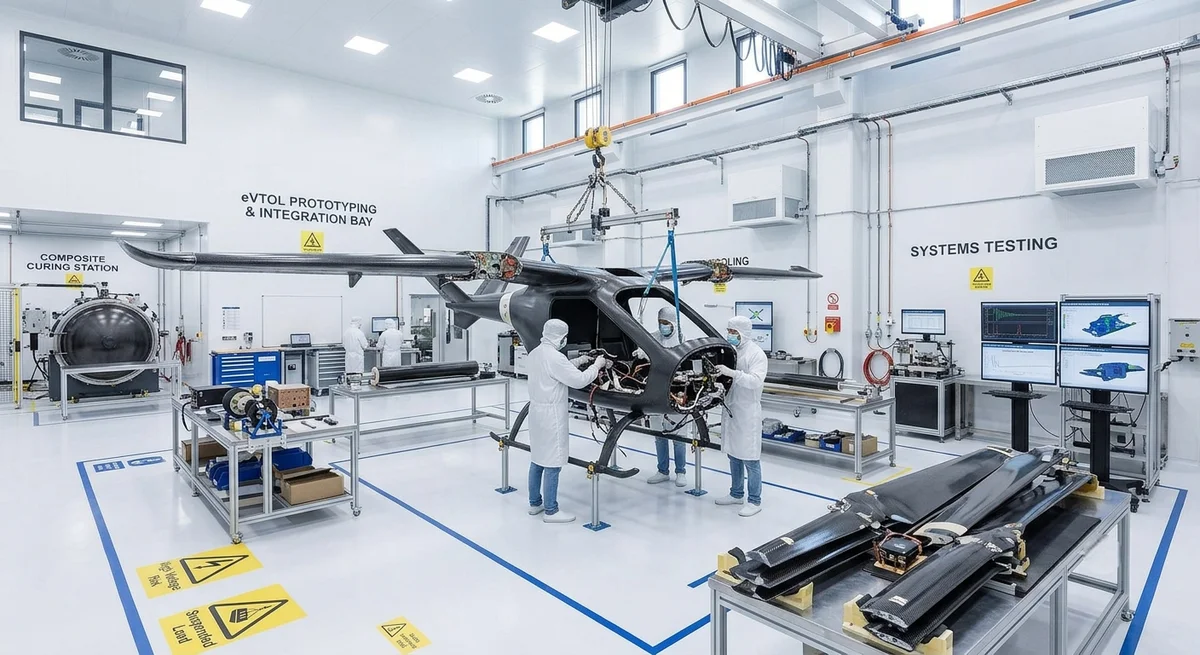
The eVTOL (electric vertical takeoff and landing) industry is projected to consume 3,500–5,000 tonnes of carbon fiber annually by 2030. This article covers 2026 market status, material grade requirements (IM7, T800, M40J), manufacturing processes, cost targets, and the leading OEM qualification roadmaps.
eVTOL: The Next Growth Engine for Carbon Fiber
The eVTOL (electric vertical takeoff and landing) industry is transitioning from prototype development to serial production in 2026. With type certification expected for the first platforms in late 2026 to 2027 (Joby Aviation S4, Archer Aviation Midnight, Lilium Jet, Volocopter VoloCity, EHang EH216-S), carbon fiber demand is poised for exponential growth. Current projections indicate 3,500–5,000 tonnes of annual carbon fiber consumption by 2030 — equivalent to 10–15% of total aerospace carbon fiber demand.
Each eVTOL airframe is 70–90% composite by structural weight, using 200–500 kg of carbon fiber per vehicle depending on size and configuration. With production forecasts of 5,000–10,000 units per year by 2030 (Morgan Stanley, Roland Berger, and Deloitte consensus estimates), the material demand is significant — and the technical requirements are distinct from both commercial aerospace and automotive composites.
2026 Market Status: Key Programs and Production Plans
| OEM | Aircraft | Configuration | Max Payload / Passengers | Range (km) | CFRP Weight per Airframe (kg) | TIM (Target Initial Market) / Certification Target | 2026 Production Plan |
|---|---|---|---|---|---|---|---|
| Joby Aviation | S4 | 6 tilting propellers, 6 seats | 4 pax + 1 pilot | 240 | 380 | FAA Part 23 — Q4 2026 | 20 units (pilot line), 500/yr by 2028 |
| Archer Aviation | Midnight | 12 fixed rotors, 4 seats | 4 pax + 1 pilot | 160 | 320 | FAA Part 23 — Q2 2027 | 10 units (conformance), 650/yr by 2029 |
| Lilium | Lilium Jet | 30 ducted fans, 7 seats | 6 pax + 1 pilot | 250 | 450 | EASA CS-23 / FAA — 2026 | 10 units, 400/yr by 2028 |
| Volocopter | VoloCity | 18 fixed rotors, 2 seats | 1 pax + 1 pilot | 35 | 250 | EASA SC-VTOL — Q4 2026 | 50 units (first production batch) |
| EHang | EH216-S | 16 fixed rotors, 2 seats | 2 pax (no pilot) | 30 | 200 | CAAC Type Certificate (granted 2024), production | 100–200 units |
| Beta Technologies | Alia CX300 | VTOL + conventional wing, 5 seats | 4 pax + 1 pilot | 460 | 350 | FAA Part 23 — 2027 | 5–10 units |
| Vertical Aerospace | VX4 | 8 propellers (4 tilting), 5 seats | 4 pax + 1 pilot | 160 | 300 | EASA / FAA — 2027 | Pilot line |
Material Grade Requirements for eVTOL
eVTOL airframes operate in a unique structural regime — somewhere between automotive and commercial aerospace — that dictates specific carbon fiber requirements:
- Intermediate modulus (IM7/T800-class) for primary structure: 276–294 GPa modulus, 5,800+ MPa tensile strength. Used for wing spars, rotor arms, fuselage frames. Rationale: eVTOL loads are lower than commercial aircraft (2–3g ultimate vs 3.75g for transport category), but fatigue life requirements (20,000–50,000 flight cycles) are demanding. IM7 offers the best strength-to-cycle life trade-off.
- Standard modulus (T700-class) for secondary structure: 240 GPa modulus. Used for fairings, doors, interior panels, battery enclosures. Lower cost ($24–30/kg vs $50–70/kg for IM7) makes it attractive for non-load-bearing applications.
- High-modulus (M40J-class) for specialized components: 390 GPa modulus. Used for rotor blades requiring high stiffness-to-weight ratio for aeroelastic stability. Limited use — primarily in high-speed tiltrotor configurations.
- Flame-resistant epoxy (FST-grade) for fuselage interiors: Must pass FAA FAR 25.853 (OSU 65/65) and ABD0031 (Airbus) fire/smoke/toxicity requirements. Key suppliers: Hexcel (HexPly M21), Toray (2510 FST), Solvay (CYCOM 5320-1).
| Property Requirement | eVTOL Primary Structure | Commercial Aerospace (B787) | High-Performance Automotive | eVTOL Specific Rationale |
|---|---|---|---|---|
| Tensile modulus (GPa) | 276–294 | 294 | 230–240 | High stiffness needed for aeroelastic stability of thin rotor blades |
| Tensile strength (MPa) | 5,800+ | 5,880 | 4,900 | High ultimate load safety factor for crashworthiness |
| Fatigue cycles (design life) | 20,000–50,000 | 100,000+ | 200,000+ (ground vehicle) | Fewer cycles than commercial aircraft but higher cycle frequency |
| Flame resistance | FAR 25.853 | FAR 25.853 | UL 94 V-0 (optional) | Same as commercial aircraft — passenger safety |
| Impact damage tolerance | CAI ≥ 200 MPa at 35 J | CAI ≥ 250 MPa at 35 J | CAI ≥ 150 MPa at 25 J | Lower energy impacts than bird strike, but frequent (debris) |
| Operating temperature range | −40°C to +85°C | −55°C to +80°C | −40°C to +120°C | Battery heat + environmental exposure |
| UV resistance | 5,000 kJ/m² (equivalent to 5 years) | 10,000+ hours | 2,000 hours | Frequent outdoor operation, short turnaround |
| Cost target (prepreg, $/kg) | $45–80 | $80–150 | $20–35 | Must be lower than commercial aero for viable unit economics |
Manufacturing Processes for Volume Production
To achieve production targets of 500–1,000 airframes per year per OEM, eVTOL manufacturers are moving beyond traditional hand lay-up and autoclave curing:
Automated Fiber Placement (AFP): Joby and Archer have both invested in 7-axis robotic AFP cells from Electroimpact and Coriolis Composites. AFP achieves lay-up rates of 10–25 kg/hour with ±0.3 mm positional accuracy, compared to 1–2 kg/hour for hand lay-up. AFP eliminates 60–80% of manual labor content and reduces scrap from 15–30% to 3–8%. Typical AFP cell cost: $800,000–1,500,000.
Out-of-Autoclave / Vacuum Bag Only (OOA/VBO): Lilium and Volocopter are using out-of-autoclave prepreg (e.g., Solvay CYCOM 5320-1, Hexcel HexPly M77) cured at 120–180°C with vacuum bag pressure only. OOA reduces cycle time by 30–50% vs autoclave and eliminates autoclave capital cost (each autoclave: $1–5 million). Void content: 0.5–1.5% (vs <0.5% for autoclave) — acceptable for eVTOL fatigue requirements.
Compression Molding for High-Volume Subcomponents: Battery enclosures, seat structures, and interior panels are well-suited to fast-cure (< 10 minutes) epoxy compression molding with 40–50% carbon fiber content (discontinuous fiber or SMC). Cycle time: 3–8 minutes per part. Tooling cost: $50,000–150,000 per cavity. Annual volume threshold for economic viability: 5,000+ parts per year.
Cost Targets and Roadmaps
The consensus eVTOL industry target is total airframe cost of $100–150 per kg of structural weight — comparable to automotive aluminum spaceframes. For carbon fiber composites to be viable at scale, the material + processing cost must reach $45–80/kg of finished part (vs $150–250/kg for commercial aerospace). Key levers:
- Material cost reduction: eVTOL-specific qualification of lower-cost IM-grade fibers (domestic Chinese T800 for EHang, Korean H2550 for Joby's Korean supply chain)
- Process automation: AFP + OOA combined, targeting $25–40/kg processing cost vs $60–100/kg for hand lay-up + autoclave
- Monolithic vs sandwich: Eliminating honeycomb core wherever possible to reduce assembly labor; using ribbed monolithic CFRP (additively manufactured tooling for complex geometries)
- Recyclability: 30% recycled carbon fiber content in non-structural parts by 2030 (target per eVTOL sustainability consortium)
FAQ
Q: Which eVTOL OEMs have the most advanced carbon fiber manufacturing capabilities?
A: As of 2026, Joby Aviation leads in in-house composite manufacturing capability. Their Marina, California facility has three 7-axis AFP cells, a 35 m² autoclave, and a fully automated ply cutting/kitting line. They manufacture 85% of their airframe composite components in-house, including wing spars, rotor arms, fuselage skins, and horizontal stabilizers. Archer Aviation uses a hybrid model — in-house AFP for primary structure + partners for secondary structure (Spirit AeroSystems for fuselage panels, Leonardo for rotor blades). Lilium outsources most composite manufacturing to composites specialists (FACC, Aernnova) and focuses on final assembly and systems integration. For B2B carbon fiber suppliers, the highest-potential customer is Joby (direct procurement), followed by Archer's supply chain partners.
Q: What are the key differences between eVTOL and commercial aerospace composite requirements?
A: Four critical differences: (1) Cost sensitivity — eVTOL needs $45–80/kg prepreg cost vs $80–150/kg for commercial aero. This drives interest in automotive-sourced fibers with aerospace-style quality systems. (2) Production rate — eVTOL targets 500–1,000 units/year/OEM, requiring AFP/OOA processes rather than hand lay-up. Commercial aircraft build rates are 50–70/month for narrowbodies. (3) Fatigue spectrum — eVTOL flight cycles are shorter (30–60 minute missions) with more takeoffs/landings per year, creating unique high-frequency fatigue regimes. (4) Certification basis — eVTOL certification is under FAA Part 23 (normal category) or EASA SC-VTOL (special condition), which are less prescriptive than Part 25 (transport category) for commercial aircraft, allowing more design flexibility — but requiring more analysis to demonstrate equivalent safety.
Q: What is the carbon fiber content of a typical eVTOL aircraft?
A: A typical 4–6 passenger eVTOL (Joby S4, Archer Midnight, Lilium Jet) uses 200–500 kg of carbon fiber per airframe, representing 70–90% of the airframe structural weight. The remaining 10–30% is aluminum (battery tray structure, landing gear), titanium (fasteners, high-temperature motor mounts), and thermoplastics (ducts, cable trays). By component breakdown: fuselage/belly structure 30–35%, wings/rotor arms 25–30%, rotor blades/propellers 15–20%, empennage 8–10%, doors/fairings 8–12%, interior 5–8%. Battery enclosures are a significant emerging application — 15–30 kg of CFRP per 2× 400V pack, requiring flame-resistant epoxy and 7–10 mm wall thickness for crash protection.
Q: When will eVTOL carbon fiber demand meaningfully impact the carbon fiber market?
A: Material demand becomes significant at the transition from pilot production to full rate production — expected 2028–2029 for most OEMs. At 5,000 units per year globally (Morgan Stanley bull case for 2030), with average 350 kg CFRP per airframe, annual demand reaches 1,750 tonnes. At 10,000 units (Roland Berger bull case), demand reaches 3,500 tonnes. For context, total aerospace carbon fiber demand was approximately 18,000 tonnes in 2025. So eVTOL will represent 10–20% of aerospace carbon fiber demand by 2030 — substantial but not transformative for the overall carbon fiber market (which was 200,000+ tonnes in 2025). However, eVTOL demand is strategically important because it requires intermediate-modulus fibers (IM7/T800) — the same grade family used in commercial aerospace — and will absorb 30–50% of new global IM-capacity additions planned for 2025–2028.
Part of topic
Related Articles
- Carbon Fiber Mooring for Floating Offshore Wind: Fatigue and Corrosion in Deep Water
- Carbon Fiber Bicycle Frame Optimization: Layup Design and Manufacturing for Competitive Racing
- Carbon Fiber CFRP Retrofit for Infrastructure: Bridge and Building Seismic Strengthening
- Carbon Fiber Medical Imaging Equipment: Lightweight Gantry and Couch Structures for MRI/CT
- Carbon Fiber EV Battery Enclosures: Crash Safety and Electromagnetic Shielding Design
- Carbon Fiber Structures for Low-Altitude Economy: UAV Airframes and eVTOL Components
Interested in Our Products?
Contact our team for competitive pricing and technical specifications.
Get a QuoteRelated Products
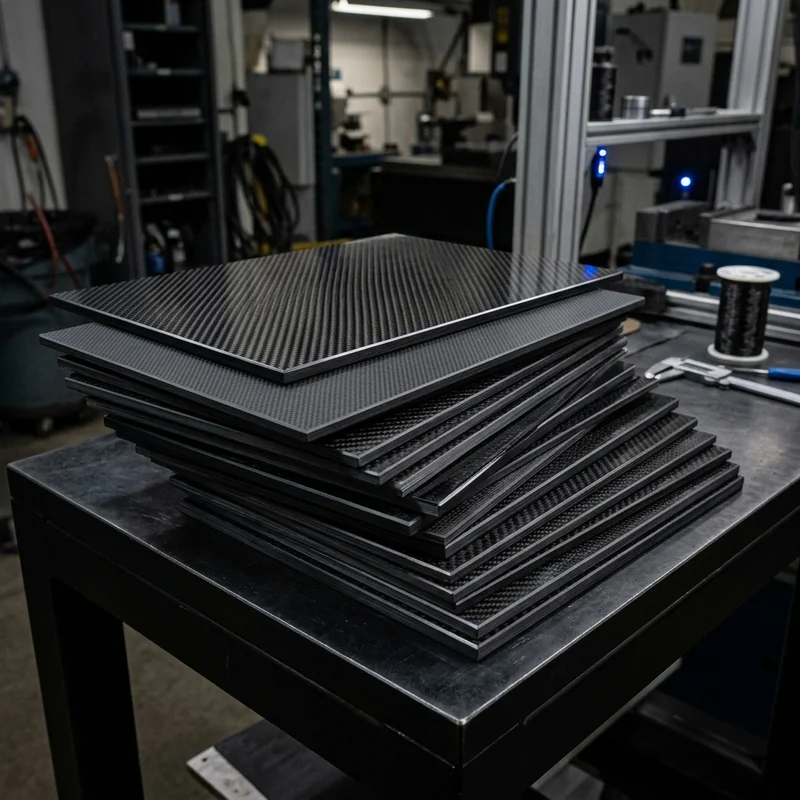
Carbon fiber standard plate-3k stripe
Lightweight, ultra-rigid standard sheets for drone fuselages, robot housings, facades and structural applications.

Carbon Fiber Plate — 3K Twill T700 1.5mm
Thin 1.5mm carbon fiber plate with 3K twill weave surface. Lightweight and stiff, commonly used for covers, panels, drone bodies, and applications requiring a premium aesthetic appearance.
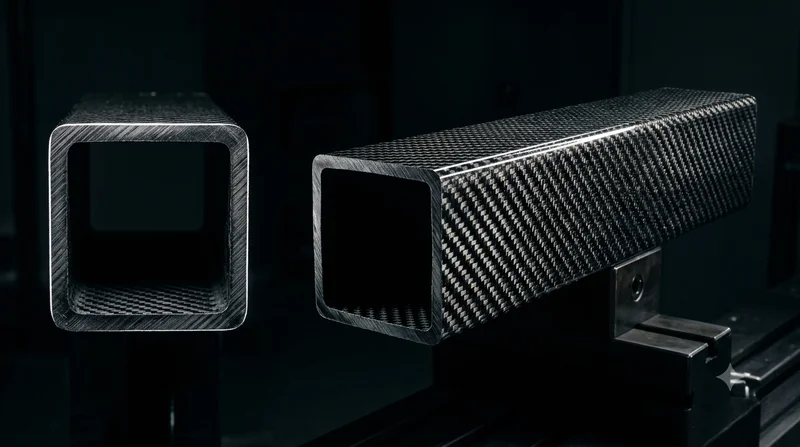
Square Carbon Fiber Tube — 3K Twill T700
Square cross-section carbon fiber tube manufactured with 3K twill weave for torsional strength. Preferred for structural frames, trusses, and support columns where rectangular geometry offers design flexibility.
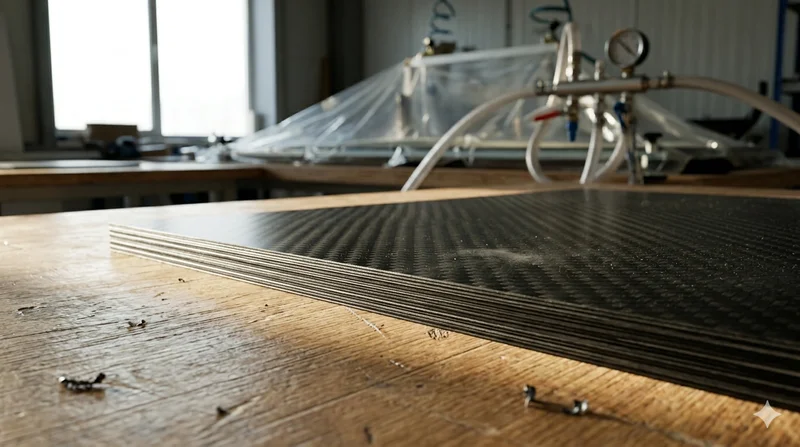
Carbon Fiber Plate — 3K Twill T700 3.0mm
Medium-thickness 3.0mm carbon fiber plate offering significantly higher load capacity while maintaining attractive 3K twill finish. Suitable for structural brackets, reinforcement plates, and load-bearing panels.
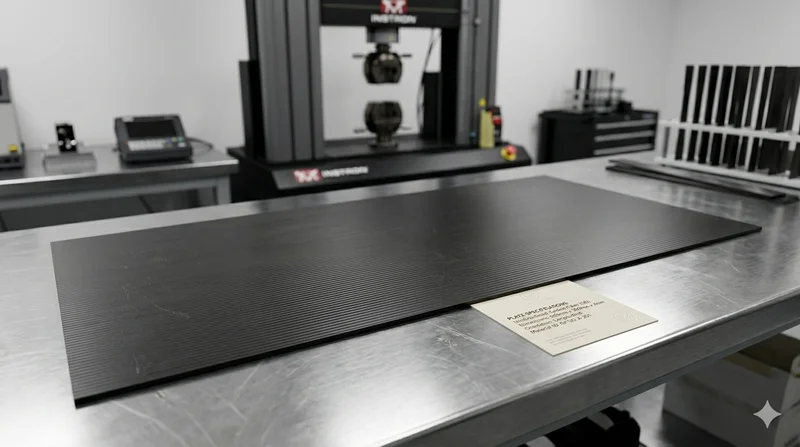
Carbon Fiber Plate — UD Unidirectional T700
Unidirectional carbon fiber plate with all fibers oriented in a single direction for maximum strength along the fiber axis. Essential for structural reinforcements, splints, and applications where load direction is predictable.