
The United Arab Emirates has built a diversified economy around three assets that happen to intersect with carbon fiber demand: a global aviation hub that moves more passengers through Dubai than almost any other airport on earth, a space program that has launched its own satellites and
Introduction
The United Arab Emirates has built a diversified economy around three assets that happen to intersect with carbon fiber demand: a global aviation hub that moves more passengers through Dubai than almost any other airport on earth, a space program that has launched its own satellites and astronauts, and a trading infrastructure centered on Jebel Ali port and free zones that re-exports billions of dollars of goods annually. Unlike manufacturing-heavy markets, the UAE's composite opportunity is a service-and-trade opportunity, and it is growing from a different logic than a factory relocation story.
This article looks at the three demand channels in turn. First, aviation hub services — MRO, fleet expansion, and the domestic aerostructures capability at Strata — create steady demand for repair-grade materials and aerospace components. Second, space ambitions, anchored by the Mohammed Bin Rashid Space Centre and the MBZ-Sat program, add high-value, technology-pulling demand for lightweight satellite structures. Third, trade re-export positions the UAE as the region's distribution hub for carbon fiber commodities, with logistics, finance, and free-zone advantages that make it the natural gateway for suppliers serving the Middle East and Africa.
Aviation Hub Services: MRO, Fleets and Strata
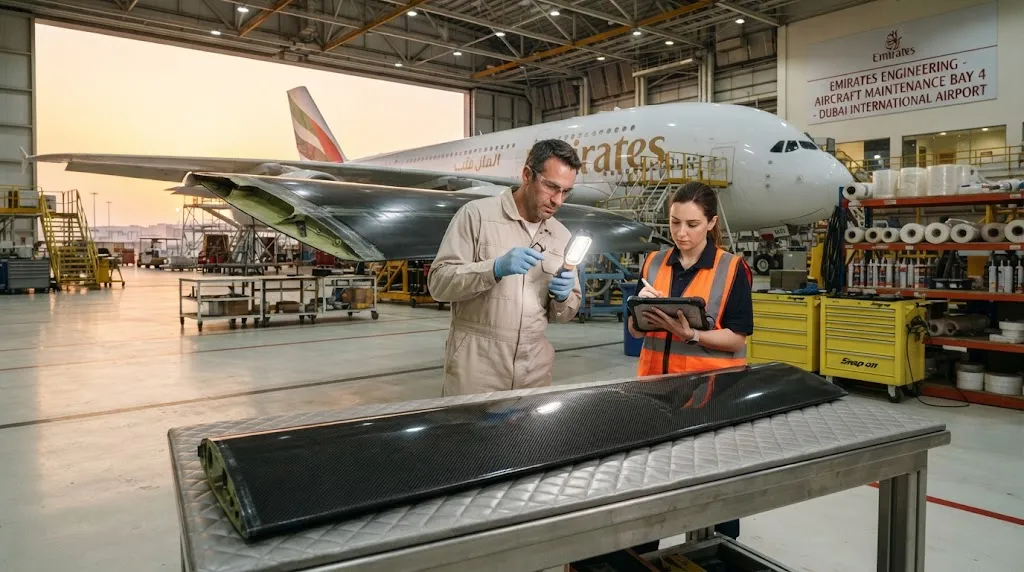
Dubai International Airport is one of the world's busiest for international passenger traffic, and the UAE's three airlines — Emirates, Etihad, and flydubai — operate some of the largest twin-aisle fleets in the industry. A large fleet means a large maintenance requirement: aircraft entering heavy checks require structural repairs, and modern widebodies use substantial carbon fiber in wings, fuselage sections, and engine components. The repair of these structures uses aerospace-grade prepreg, repair tow, and vacuum-bagging consumables — a demand channel that follows fleet hours rather than new construction cycles, making it exceptionally stable.
The domestic manufacturing anchor is Strata Manufacturing in Al Ain, a wholly owned Emirates company that produces composite ailerons, flaps, and empennage parts for Airbus and Boeing, and additional parts for the next-generation wing programs. Strata has grown from a startup to a multi-line aerostructures facility, and its supplier base consumes aerospace-grade carbon fiber fabric, prepreg, and adhesives. The table below summarizes the main aviation-related demand channels:
| Channel | Typical Carbon Fiber Products | Demand Character | Growth Driver |
|---|---|---|---|
| Fleet MRO | Repair prepreg, repair tow, consumables | Stable, recurring | Widebody fleet size and age |
| Aerostructures (Strata) | Aerospace fabric, prepreg, adhesives | Program-based | Airbus and Boeing production rates |
| Cabin and interiors | CFRP panels, veneers, structural parts | Growing | New aircraft and retrofits |
| Ground support | CFRP platforms, ramps, tooling | Opportunistic | Airport expansion programs |
For suppliers, the MRO channel rewards inventory presence and fast logistics — repair shops value locally stocked repair material over distant shipments. The aerostructures channel rewards aerospace-grade qualification and long-term supply agreements. Both demand channels are far less price-sensitive than infrastructure composites, which makes the aviation service segment the most attractive margin pool in the Gulf.
Space Ambitions: MBZ-Sat and Beyond
The UAE space program is the second pillar, and it is advancing faster than most regional observers expected. The Mohammed Bin Rashid Space Centre in Dubai has built and launched multiple remote-sensing satellites, sent the first Emirati astronaut to the International Space Station, and is developing MBZ-Sat, a high-resolution Earth observation satellite designed, integrated, and tested in the UAE. The program has also announced missions toward the Moon and asteroid exploration, positioning itself as a second-tier space power with ambitions beyond regional status.
Satellite structures are a carbon fiber application by default: the structural bus, solar panel substrates, antenna reflectors, and deployable booms of modern spacecraft are predominantly composite, because every kilogram of structural mass trades directly against propellant and payload. The UAE program's demand is small in tonnage but exceptional in value and technology pull — it qualifies suppliers against space-grade specifications, drives local engineering capability, and creates downstream demand for testing, anechoic, and materials qualification services in-country. For carbon fiber suppliers, the space channel is a strategic credential: space-grade qualification positions a company for the entire region's aerospace work, including the wider Gulf defense programs.
- Structural bus panels: aluminum honeycomb with carbon fiber facesheets is the standard spacecraft architecture.
- Solar array substrates: CFRP frames and panels for photovoltaic wings pushing high stiffness-to-weight ratios.
- Antenna and reflector structures: dimensionally stable CFRP for communication and radar payloads.
- Launch and integration services: composite tooling, handling fixtures, and transport containers for spacecraft.
Trade Re-Export: The Regional Distribution Hub
The third pillar is trade. Jebel Ali port is the largest container port between Rotterdam and Singapore, and the UAE's free zones — Jebel Ali Free Zone, Dubai Multi Commodities Centre, and others — provide 100 percent foreign ownership, zero corporate tax in many sub-zones, and streamlined customs that make re-export the default business model. A factory in China or Taiwan shipping carbon fiber to Africa, India, or the wider Middle East increasingly routes through the UAE rather than shipping directly, because consolidation, payment settlement, and regional distribution all work better from Dubai.
For carbon fiber commodity suppliers, this creates a straightforward opportunity: establish a UAE distribution entity, stock standard-modulus tow, fabric, and prepreg, and serve regional demand from a single bonded location. The UAE's advantages are compounded by the aviation channel — the same entity can stock both commodity reinforcement and aerospace repair material, serving construction customers and airline MROs from one inventory. The re-export model also insulates a supplier from individual country risk: political, logistical, or currency difficulties in one destination market do not stop the distribution hub from serving others.
Regional Gateway Economics and Supplier Positioning
The re-export advantage is sustained by economics that compound with scale. Jebel Ali's container throughput, the concentration of freight forwarders in Dubai, and same-day airfreight connections to Africa and South Asia compress delivery times for time-sensitive composite consumables such as prepregs, which have limited shelf life and cold-chain requirements. For a carbon fiber supplier, this reshapes inventory strategy: rather than shipping small batches to each Gulf country, a single UAE-based stockholding can serve MRO customers, construction contractors, and aerospace integrators across the region with lead times measured in days rather than weeks.
The strategic implication is that the UAE is best used as a regional hub of record — the entity that holds quality certifications, manages export documentation, and coordinates distribution — while manufacturing remains at optimal cost locations. Suppliers that structure this way capture regional demand without relocating production, and they ride the aviation growth that follows the region's fleet expansion and aerospace industrialization. The same hub structure also simplifies multi-country compliance, because one set of standard tests and certificates covers deliveries to several markets from a single bonded inventory.
Frequently Asked Questions
What is the main source of carbon fiber demand in the UAE?
The largest and most stable channel is aviation: fleet MRO consumes repair-grade prepreg and tow on a recurring basis, and Strata's aerostructures production takes aerospace-grade fabric and adhesives. Space programs add high-value satellite structures, while trade re-export positions the UAE as a distribution hub that adds logistics demand on top of local consumption.
How can a carbon fiber manufacturer enter the UAE market?
The most effective route is a free-zone trading entity combined with regional stock. A Jebel Ali Free Zone or DMCC company can hold bonded inventory, re-export to the Middle East and Africa, and serve airline MRO customers from a local stock. For aerospace programs, partnership or supply agreements with existing aerostructures and MRO companies accelerate qualification against program-specific specifications.
What role does Strata Manufacturing play in UAE composite demand?
Strata, in Al Ain, is the UAE's flagship aerostructures manufacturer, producing composite ailerons, flaps, and empennage parts for Airbus and Boeing programs. It is the domestic anchor for aerospace-grade carbon fiber demand and a gateway into the wider Gulf aerospace supply chain, including potential defense-related aerostructures opportunities.
Why would a carbon fiber producer use the UAE as a re-export hub?
The UAE combines a major container port, free zones with full foreign ownership and favorable tax treatment, fast customs, and strong banking and settlement infrastructure. Routing regional sales through a Dubai entity allows consolidation of shipments, simplified export documentation, and one inventory serving many destination markets, which reduces cost and lead time versus shipping to each country separately.
Conclusion
The UAE's carbon fiber opportunity is best understood as three channels with different economics. Aviation hub services deliver stable, recurring, margin-rich demand tied to the region's massive widebody fleet and Strata's aerostructures output. Space ambitions add high-value, technology-pulling demand that qualifies suppliers for regional aerospace work. Trade re-export turns the UAE into a distribution gateway where a single bonded inventory can serve the Middle East, Africa, and India beyond domestic consumption. Together, they make the UAE the most commercially efficient point of entry into the region for carbon fiber suppliers.
YongXian supplies carbon fiber tow, fabrics, and prepregs for aerospace repair, satellite structures, and regional distribution. Explore our carbon fiber product range or contact our team to discuss stocking, qualification, and re-export partnership options in the UAE.
Part of topic
Related Articles
- Recycled Carbon Fiber Market Forecast 2030: Technology Maturity and Commercialization Path
- South Korea Carbon Fiber Market 2026: Hydrogen Economy and Shipbuilding Innovation
- Wind Turbine Blade Leading Edge Protection 2026: Polyurethane, Tape, and Metallic Shield Solutions
- China Carbon Fiber Overcapacity 2026: Price War Impact and Industry Consolidation
- India Carbon Fiber Market 2026: Wind Energy, Aerospace, and Defense Expansion
- PAN Precursor Market 2026: Acrylonitrile Supply and Carbon Fiber Cost Structure
Interested in Our Products?
Contact our team for competitive pricing and technical specifications.
Get a QuoteRelated Products

Carbon Fiber Fishing Rod Blank
High-quality carbon fiber fishing rod blank manufactured from multiple grades of Toray carbon fiber cloth. Available in a wide range of lengths, powers, and actions for freshwater and saltwater applications. Suitable for OEM rod building.
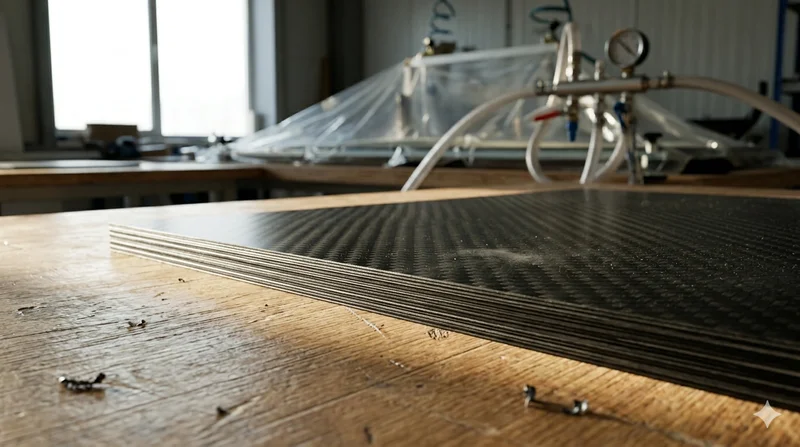
Carbon Fiber Plate — 3K Twill T700 3.0mm
Medium-thickness 3.0mm carbon fiber plate offering significantly higher load capacity while maintaining attractive 3K twill finish. Suitable for structural brackets, reinforcement plates, and load-bearing panels.

Carbon Fiber Plate — 3K Twill T700 1.5mm
Thin 1.5mm carbon fiber plate with 3K twill weave surface. Lightweight and stiff, commonly used for covers, panels, drone bodies, and applications requiring a premium aesthetic appearance.
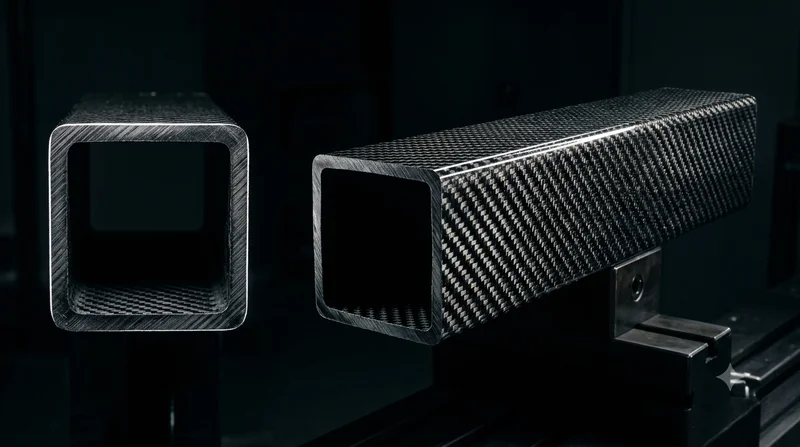
Square Carbon Fiber Tube — 3K Twill T700
Square cross-section carbon fiber tube manufactured with 3K twill weave for torsional strength. Preferred for structural frames, trusses, and support columns where rectangular geometry offers design flexibility.
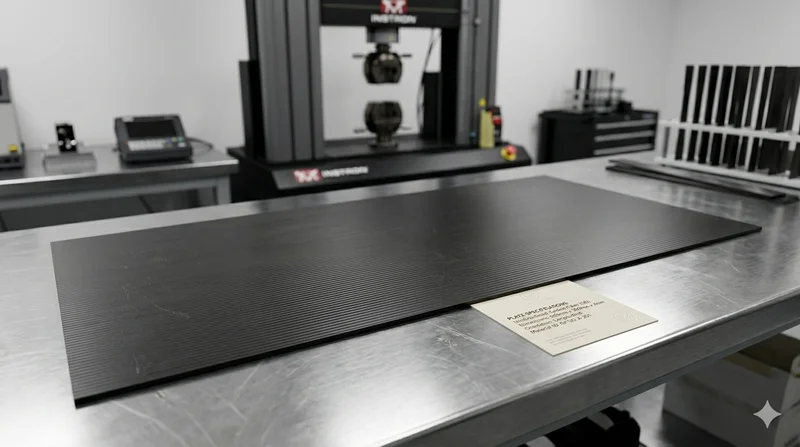
Carbon Fiber Plate — UD Unidirectional T700
Unidirectional carbon fiber plate with all fibers oriented in a single direction for maximum strength along the fiber axis. Essential for structural reinforcements, splints, and applications where load direction is predictable.