
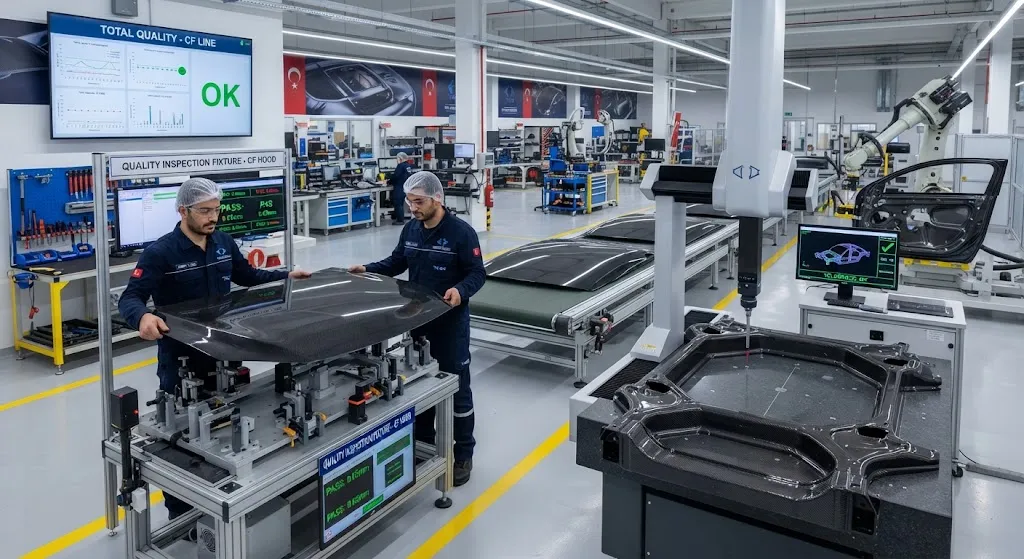
Turkey occupies a unique position in the global carbon fiber landscape. Situated at the crossroads of Europe and Asia, the country combines a mature automotive manufacturing sector — the 14th largest vehicle producer worldwide — with ambitious defense aviation programs and a textile ind
Introduction
Turkey occupies a unique position in the global carbon fiber landscape. Situated at the crossroads of Europe and Asia, the country combines a mature automotive manufacturing sector — the 14th largest vehicle producer worldwide — with ambitious defense aviation programs and a textile industry heritage that provides deep materials expertise. For carbon fiber producers and component suppliers, Turkey represents an underexploited market with compounding demand across multiple verticals.
Turkey's gross domestic product grew 4.5% in 2025 and is projected to maintain 3.5-4.5% growth through 2028, according to the World Bank. Manufacturing accounts for roughly 22% of GDP, with automotive and defense representing the highest-value segments. This article examines the three demand pillars — automotive production, defense aviation, and energy infrastructure — and lays out a practical sourcing strategy for carbon fiber buyers.
Automotive Manufacturing: The Domestic Demand Engine
Turkey produced 1.35 million vehicles in 2025, making it Europe's fifth-largest automotive manufacturer. Tofaş (Fiat Chrysler), Renault, Toyota, Hyundai, and Ford Otosan operate major assembly plants across the Marmara and Aegean regions. The country also exports 80% of its vehicle production, primarily to EU markets, creating a dual demand base of domestic consumption and export-driven manufacturing.
Carbon fiber demand from the automotive sector is growing in several categories:
- Lightweight body panels: Carbon fiber hoods, roof panels, and trunk lids for premium and performance vehicle variants, where 30-40% weight reduction translates to measurable fuel efficiency gains.
- Powertrain components: Carbon fiber-reinforced engine covers, intake manifolds, and structural brackets for high-performance models, where thermal resistance and vibration damping are critical.
- Interior structures: Carbon fiber seat frames, dashboard carriers, and door inner panels for luxury trim levels, offering stiffness-to-weight advantages over traditional steel and aluminum.
- Racing and motorsport: Turkey hosts a Formula 1 Grand Prix and growing touring car series, creating demand for carbon fiber chassis components, aerodynamic elements, and safety structures.
The Turkish automotive industry's compound annual growth rate has averaged 6.2% over the past five years, and government incentives for electric vehicle production — including the Togg national EV brand — are expected to accelerate carbon fiber adoption as manufacturers seek weight reduction to offset battery mass.
Defense Aviation: The KAAN Effect
Turkey's defense aviation program is the most significant catalyst for high-performance carbon fiber demand. The Turkish Aerospace Industries (TAI) KAAN fifth-generation fighter jet program requires extensive use of carbon fiber composites in fuselage skins, wing structures, and control surfaces. The KAAN's first delivery to the Turkish Air Force is scheduled for 2028, with a planned production run of over 300 aircraft.
Beyond the KAAN, Turkey's defense aviation ecosystem includes the Bayraktar TB2 and AKINCI unmanned aerial vehicles (UAVs), which have demonstrated global combat effectiveness and created export demand. The Bayraktar TB2 uses carbon fiber wing structures and fuselage panels, while the larger AKINCI incorporates carbon fiber in its blended wing body and engine nacelles.
| Defense Program | Carbon Fiber Application | Est. CF Content per Unit | Production Target |
|---|---|---|---|
| KAAN fighter jet | Fuselage skins, wing panels, control surfaces | 1,200-1,800 kg | 300+ aircraft |
| Bayraktar TB2 UAV | Wing structures, fuselage panels | 85-120 kg | 600+ units |
| Bayraktar AKINCI | Blended wing body, engine nacelles | 450-600 kg | 100+ units |
| ATAK II helicopter | Main rotor blades, tail boom, cabin panels | 200-350 kg | 150+ units |
The defense aviation program creates a strategic imperative: Turkey needs domestic carbon fiber production capability to reduce import dependence for military applications. Several Turkish companies, including DoktorTeker and Catoni, are investing in prepreg and autoclave capacity to serve the KAAN supply chain.
Textile Heritage: The Composites Workforce Advantage
Turkey's textile industry — the world's seventh-largest exporter of textiles and clothing — provides a unique workforce advantage for carbon fiber manufacturing. Turkish textile workers have deep expertise in fiber handling, weaving, and surface treatment that transfers directly to carbon fiber fabric production. Several Turkish companies, including Kordsa and Sabancı, have leveraged this heritage to establish carbon fiber prepreg and woven fabric production lines.
Kordsa, a subsidiary of Sabancı Holding, operates one of the region's most advanced composites facilities, producing prepreg, woven carbon fiber fabrics, and pultruded profiles. The company supplies both the Turkish defense sector and European automotive OEMs, positioning Turkey as a regional hub for composites conversion.
Energy Infrastructure: Wind and Beyond
Turkey's energy infrastructure investments are creating additional carbon fiber demand. The country targets 30 GW of wind capacity by 2030, up from 12 GW in 2025, with significant offshore wind development planned in the Black Sea and Aegean regions. Wind turbine blade manufacturing requires substantial carbon fiber in spar caps and shear webs, and Turkey's limited domestic blade production capacity creates import demand for both materials and finished components.
Frequently Asked Questions
What are Turkey's main advantages as a carbon fiber sourcing destination?
Turkey offers three structural advantages: competitive labor costs (roughly 40-50% lower than EU equivalents), proximity to European markets with favorable customs union treatment, and a diversified manufacturing base spanning automotive, defense, and energy. The country's textile heritage provides a skilled composites workforce, while government incentives for defense and EV manufacturing create policy support for advanced materials adoption. Logistically, Turkish ports on the Mediterranean and Black Sea serve both EU and Middle Eastern markets efficiently.
How does Turkey's defense aviation program affect carbon fiber import demand?
The KAAN fighter jet program alone is expected to consume 360-540 tonnes of carbon fiber composites over its production run, creating a sustained demand base for high-performance materials. While Turkey is investing in domestic prepreg capacity, current production cannot meet defense specifications for all grades, creating a direct import opportunity for qualified suppliers. Defense procurement also creates spillover demand: TA's quality standards filter down to commercial suppliers, elevating the entire Turkish composites ecosystem.
Which carbon fiber applications will grow fastest in Turkey over the next three years?
Three segments will grow fastest: defense aviation components (driven by KAAN and UAV production ramp), electric vehicle structures (from Togg and European OEM localization), and wind energy materials (from the 30 GW target). Defense demand is the most immediate — growing at 15-20% annually through 2028 — while EV and wind represent larger absolute upside with 2027-2029 inflection points as domestic manufacturing capacity matures.
Conclusion
Turkey's carbon fiber market in 2026 sits at a strategic inflection point. The defense aviation program — particularly the KAAN fighter — creates high-specification demand that elevates the entire supply chain; automotive manufacturing provides steady, compounding volume; and energy infrastructure investments build a domestic specification base for advanced composites. With Turkey's textile heritage providing a skilled workforce and government incentives supporting advanced manufacturing, the market offers substantial opportunity for qualified carbon fiber suppliers.
For buyers evaluating Turkish sourcing or suppliers planning to serve Turkey, the practical path is to combine imported carbon fiber materials with local conversion through established prepreg facilities like Kordsa. Browse our carbon fiber product range to identify components suited to Turkey's defense and automotive demand, or contact our engineering team for a market entry assessment with pricing and lead-time projections for the Turkish market.
Part of topic
Related Articles
- Recycled Carbon Fiber Market Forecast 2030: Technology Maturity and Commercialization Path
- South Korea Carbon Fiber Market 2026: Hydrogen Economy and Shipbuilding Innovation
- Wind Turbine Blade Leading Edge Protection 2026: Polyurethane, Tape, and Metallic Shield Solutions
- China Carbon Fiber Overcapacity 2026: Price War Impact and Industry Consolidation
- India Carbon Fiber Market 2026: Wind Energy, Aerospace, and Defense Expansion
- PAN Precursor Market 2026: Acrylonitrile Supply and Carbon Fiber Cost Structure
Interested in Our Products?
Contact our team for competitive pricing and technical specifications.
Get a QuoteRelated Products
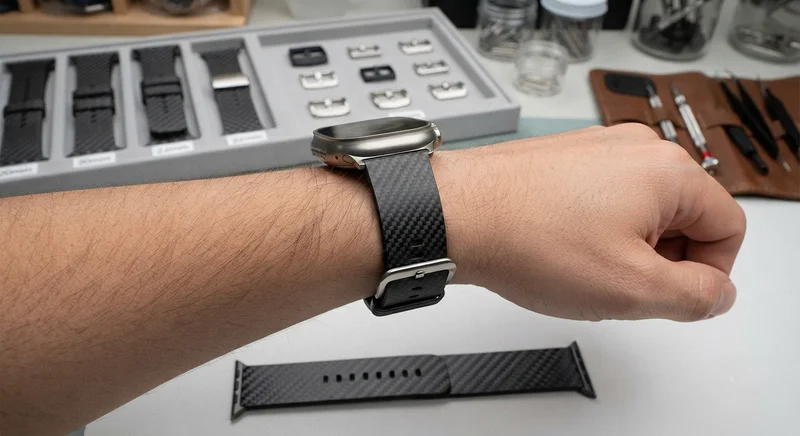
Carbon Fiber Watch Strap — 20mm/22mm Quick-Release
Premium carbon fiber watch strap with quick-release spring bars. Woven from T700 3K twill prepreg with a flexible resin system that conforms to the wrist. Available in 20mm and 22mm lug widths, compatible with Apple Watch, Samsung Galaxy Watch, Garmin, and traditional mechanical watches. Features a stainless steel buckle and carbon fiber keepers. The natural weave pattern makes each strap unique.

Carbon Fiber Fishing Rod Blank
High-quality carbon fiber fishing rod blank manufactured from multiple grades of Toray carbon fiber cloth. Available in a wide range of lengths, powers, and actions for freshwater and saltwater applications. Suitable for OEM rod building.

Carbon Fiber Plate — 3K Twill T700 1.5mm
Thin 1.5mm carbon fiber plate with 3K twill weave surface. Lightweight and stiff, commonly used for covers, panels, drone bodies, and applications requiring a premium aesthetic appearance.

Carbon Fiber Plate — 3K Twill T700 3.0mm
Medium-thickness 3.0mm carbon fiber plate offering significantly higher load capacity while maintaining attractive 3K twill finish. Suitable for structural brackets, reinforcement plates, and load-bearing panels.

Square Carbon Fiber Tube — 3K Twill T700
Square cross-section carbon fiber tube manufactured with 3K twill weave for torsional strength. Preferred for structural frames, trusses, and support columns where rectangular geometry offers design flexibility.