
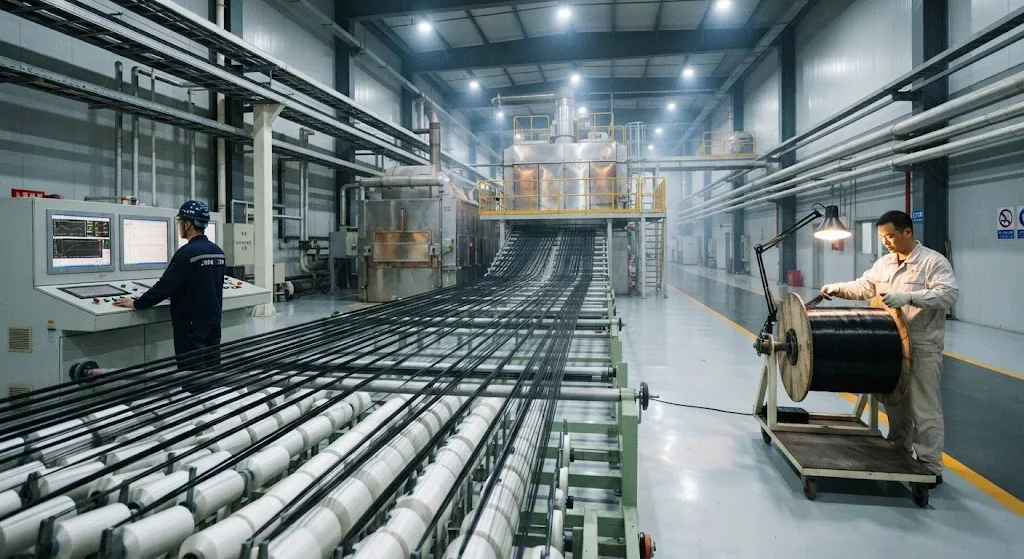
In May 2026, Shanghai Petrochemical — the refining and petrochemical subsidiary of Sinopec — confirmed that its two 48K large-tow carbon fiber lines had reached full production. Each line operates at more than 3,000 tonnes of annual capacity, which makes them China's largest single-line
Introduction
In May 2026, Shanghai Petrochemical — the refining and petrochemical subsidiary of Sinopec — confirmed that its two 48K large-tow carbon fiber lines had reached full production. Each line operates at more than 3,000 tonnes of annual capacity, which makes them China's largest single-line large-tow units, and the entire process train uses domestically developed equipment, from the polymerization stage to surface treatment. The milestone is significant beyond the company itself: it signals that Chinese industrial-grade carbon fiber production has shifted from import substitution projects to scale-out competition, with cost per tonne as the deciding metric.
This article explains the technical and commercial meaning of 48K large-tow production, connects it to the 60K tow that Shanghai Petrochemical introduced in 2025 to fill a domestic gap, and examines what the ramp-up means for wind energy, industrial applications, and carbon fiber pricing. For composites buyers, the takeaway is a clearer picture of China's supply stack and a benchmark for negotiating industrial carbon fiber contracts.
What 48K Large-Tow Means
The "K" number denotes the number of filaments per tow: 12K means 12,000 filaments, 24K means 24,000, and 48K means 48,000. Tow size is the single biggest cost driver in carbon fiber production because filament count determines how much fiber a line can process per unit time at a given spinning speed. Large-tow fiber (48K and above) is the cost-competitive workhorse of industrial applications: wind blade spar caps, pressure vessels, automotive structural parts, and pultruded profiles. Aerospace-grade small-tow (12K and below) remains at a significant cost premium because of tighter specifications and lower line throughput per filament.
For China specifically, large-tow capacity was the missing piece of the industrial chain for years. Domestic producers concentrated on 12K and 24K grades, while 48K material — the standard for high-volume wind and industrial customers — was supplied largely by international producers. The two full-production 48K lines change that picture, and they do so on equipment that challenges the previous assumption that large-tow lines required imported process technology.
The Full-Production Milestone and Its Equipment Story
The most important technical detail of the Shanghai Petrochemical ramp-up is that both lines are built on fully domestic equipment. Carbon fiber production equipment spans oxidation, carbonization, and surface treatment furnaces, and each stage has historically been a source of process know-how that Chinese producers licensed or imported. The 48K line's own-brand equipment shows that the domestication argument now extends to the high-throughput end of the process, where line speed and temperature uniformity directly determine tonnage and quality.
From a supply perspective, two lines at more than 3,000 tonnes each bring roughly 6,000-7,000 tonnes of new annual capacity online. To put that in context, global large-tow capacity during 2025 was estimated in the 60,000-80,000 tonne range. A single company adding this volume in one year is significant, and it is part of a broader wave of Chinese industrial-grade capacity that is pressing prices down across the market.
48K in the Context of 12K, 48K, and 60K
| Tow size | Filaments | Primary markets | Typical price tier | Production economics |
|---|---|---|---|---|
| 12K | 12,000 | Aerospace, premium sporting goods, medical | Premium | Lower throughput, tight specs |
| 24K | 24,000 | Industrial, automotive, some wind | Mid | Balanced throughput and spec control |
| 48K | 48,000 | Wind blades, pressure vessels, pultrusion | Low-mid | High throughput, the workhorse grade |
| 60K | 60,000 | Very high volume wind, mass industrial | Lowest | Maximum throughput, newest entrant |
The broad shift of wind blade spar caps toward large-tow carbon created the demand that made this capacity economically viable. Since the mid-2020s wind has been the largest single consumer of industrial carbon fiber, and 48K has become the default spec for pultruded spar cap plates used in 90-110-meter blades.
The timing of the ramp-up also matters for offshore wind. As turbines have moved past 12 MW, the carbon content per blade has climbed toward 8-10 tonnes, and the large-tow grades needed for pultruded spar caps are exactly what the new 48K and 60K lines produce. That alignment between the fastest-growing end-use segment and the newest capacity is what makes the Shanghai Petrochemical expansion strategically important rather than merely incremental.
The 60K Gap and the Offshore Wind Connection
Shanghai Petrochemical's 2025 launch of 60K tow addressed a specific market gap: China had no domestic 60K product, and the grade was needed for the very high-volume wind and industrial applications where maximum line throughput translates directly into lowest cost per tonne. The company states that the 60K product is supplied to CRRC for offshore wind spar caps, positioning it in the highest-volume, most price-sensitive segment of the market.
The significance of 60K domestication is twofold. First, it removes the last grade-level import dependence in the large-tow family. Second, it signals that Chinese producers are now innovating at the top end of the throughput spectrum rather than simply replicating international 48K standards — a faster and cheaper route to cost leadership than incremental process optimization.
Cost and Supply Implications for Composite Buyers
For composite part manufacturers, the practical consequences of this ramp-up are in procurement:
- Price pressure on industrial grades: New large-tow capacity entering the market softens prices for 48K and 60K material, which flows through to wind blade, pressure vessel, and pultrusion cost structures.
- Supply security: A domestic 48K and 60K source reduces lead times and import dependence for Chinese manufacturers, while international buyers gain a new benchmark supplier for industrial carbon fiber.
- Quality verification requirement: Scale-out production at more than 3,000 tonnes per line puts pressure on lot-to-lot consistency; buyers should strengthen incoming inspection for tensile strength distribution, modulus, and tow splices rather than relying on certificates alone.
It is worth noting that large-tow material is not a single commodity. 48K fiber optimized for wind spar caps differs from 48K for pressure vessel winding in surface treatment, sizing chemistry, and strength-to-modulus balance. Buyers should qualify material against their specific application rather than treating "48K" as interchangeable across suppliers.
Frequently Asked Questions
What does the 48K number in carbon fiber mean for real-world performance?
48K refers to 48,000 filaments per tow. For real-world performance, tow size itself does not change fiber-level tensile strength or modulus — those are set by precursor quality and process conditions. What tow size changes is process economics and application fit. Larger tows process more fiber per unit time, lowering cost, but require spreading equipment for thin laminates and are harder to impregnate completely in thick sections. For wind spar caps and pultruded profiles, 48K is the cost-performance sweet spot; for aerospace hand layup, the larger cross-section is impractical and 12K remains standard.
How does full-production 48K capacity affect carbon fiber prices?
New large-tow capacity softens prices in the industrial segment, primarily through increased supply and the lower cost base of high-throughput lines. The effect is most visible in 48K and 60K grades used for wind and industrial applications. However, the price response is not immediate or uniform: multi-year supply agreements, logistic costs, and grade-specific qualification requirements buffer spot market movement. Buyers locked into long-term contracts with price escalation clauses should review those clauses against the new supply reality when renewing.
Is 60K carbon fiber lower quality than 12K aerospace-grade fiber?
No — tow size is not a quality axis. A 60K tow can be manufactured to the same tensile strength and modulus as a 12K aerospace tow; what differs is the specification envelope and process economics. Aerospace material is produced to tighter statistical limits on strength distribution, modulus, void content, and defect rates because certification requirements demand it. Industrial 60K material targets strength and modulus adequate for wind and industrial loads with looser tolerances, which is why it can be produced at far lower cost. For its intended applications — wind spar caps, pressure vessels, pultrusion — 60K quality is fully sufficient, and performance is set by the laminate design rather than the filament count.
Conclusion
The full production of Shanghai Petrochemical's 48K large-tow lines marks a turning point in industrial carbon fiber supply: China's largest single-line capacity is now online, built entirely on domestically developed equipment, and the 60K grade launched in 2025 fills the last gap in the large-tow family. The practical effect for composite manufacturers and buyers is a lower cost base for wind and industrial carbon fiber, more supply security, and a new benchmark against which to negotiate material contracts.
For procurement teams qualifying large-tow material, the focus should be on application-specific specification rather than grade labels, with attention to surface treatment, sizing chemistry, and lot-to-lot consistency. Explore our industrial carbon fiber and large-tow product range, or contact our engineering team to discuss material qualification and supply planning for your application.
Part of topic
Related Articles
- Recycled Carbon Fiber Market Forecast 2030: Technology Maturity and Commercialization Path
- South Korea Carbon Fiber Market 2026: Hydrogen Economy and Shipbuilding Innovation
- Wind Turbine Blade Leading Edge Protection 2026: Polyurethane, Tape, and Metallic Shield Solutions
- China Carbon Fiber Overcapacity 2026: Price War Impact and Industry Consolidation
- India Carbon Fiber Market 2026: Wind Energy, Aerospace, and Defense Expansion
- PAN Precursor Market 2026: Acrylonitrile Supply and Carbon Fiber Cost Structure
Interested in Our Products?
Contact our team for competitive pricing and technical specifications.
Get a QuoteRelated Products
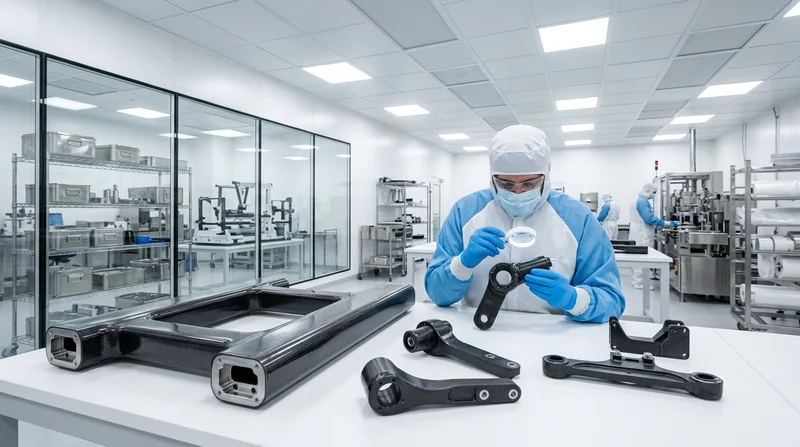
Custom Carbon Fiber Medical Device Components
Medical-grade carbon fiber components manufactured for imaging equipment, surgical instruments, and patient support systems. Carbon fiber's radiolucency (X-ray transparency) and high strength-to-weight ratio make it ideal for CT scanner beds, wheelchair frames, surgical robot arms, and MRI-compatible accessories. Biocompatible resin systems available.
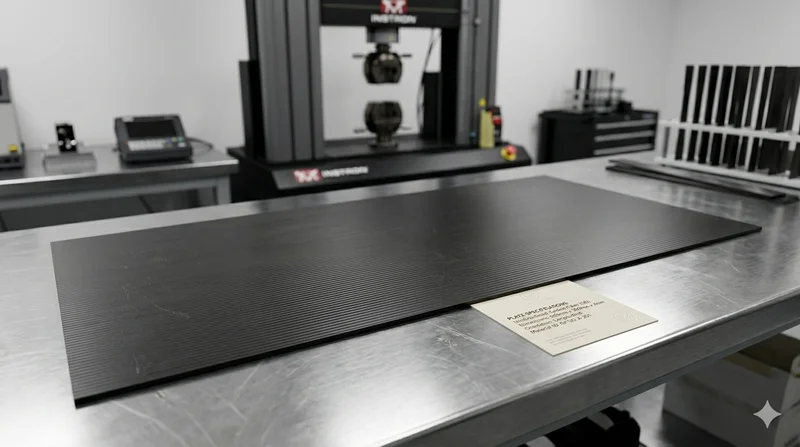
Carbon Fiber Plate — UD Unidirectional T700
Unidirectional carbon fiber plate with all fibers oriented in a single direction for maximum strength along the fiber axis. Essential for structural reinforcements, splints, and applications where load direction is predictable.
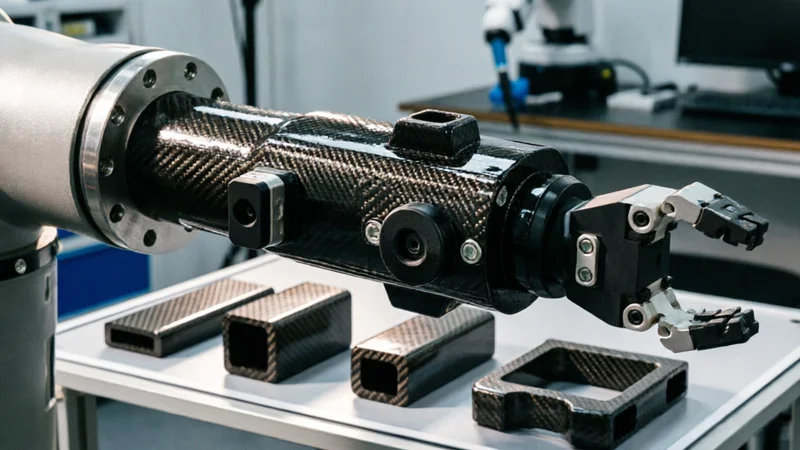
Carbon Fiber Robot End Effector Link — Custom Shape & Sensor Integration
Custom-shaped carbon fiber end effector links for robotic arms. Designed for automation integrators and research labs requiring lightweight, rigid connections between the robot wrist and gripper/tool. Can incorporate sensor mounting bosses, cable routing channels, and quick-change interfaces.

Custom Carbon Fiber Musical Instrument Parts
Carbon fiber components for musical instrument manufacturing offering superior dimensional stability, low weight, and consistent acoustic properties. We produce carbon fiber bows, guitar necks, violin chin rests, drum shells, and wind instrument bodies. Carbon fiber instruments are immune to humidity changes and temperature fluctuations that affect wooden instruments.
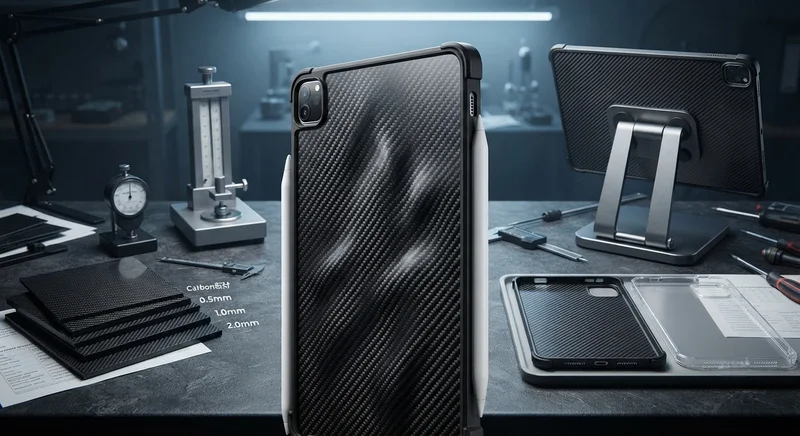
Carbon Fiber Tablet Case — Ultra-Light Protective Shell
Lightweight carbon fiber protective case for tablets and iPads. Molded from T700 3K prepreg with reinforced corner protection. Adds minimal weight while providing superior rigidity and drop protection compared to polycarbonate or silicone cases. Ideal for field workers, enterprise deployments, and professionals requiring durable tablet protection.