
Saudi Arabia is often discussed in composite industry circles as a future market, but the future is already partially here. The kingdom's Vision 2030 program has converted oil wealth into one of the largest construction pipelines on Earth, its renewable energy targets are among the most
Introduction
Saudi Arabia is often discussed in composite industry circles as a future market, but the future is already partially here. The kingdom's Vision 2030 program has converted oil wealth into one of the largest construction pipelines on Earth, its renewable energy targets are among the most ambitious in the Gulf, and a defense localization strategy is creating sovereign demand for advanced materials that did not exist five years ago. For carbon fiber suppliers, Saudi Arabia is no longer a geography to monitor but a market to qualify for, with three distinct demand channels that reward early positioning.
This article examines the three pillars of Saudi composite demand: the NEOM and giga-project construction pipeline that consumes carbon fiber in infrastructure, building, and marine applications; renewable energy targets that pull wind blade, hydrogen storage, and desalination demand; and defense localization under the General Authority for Military Industries (GAMI), which is steering spend toward domestic and qualified foreign suppliers. It concludes with the practical qualification steps suppliers should take before entering the market.
NEOM and the Giga-Project Construction Pipeline
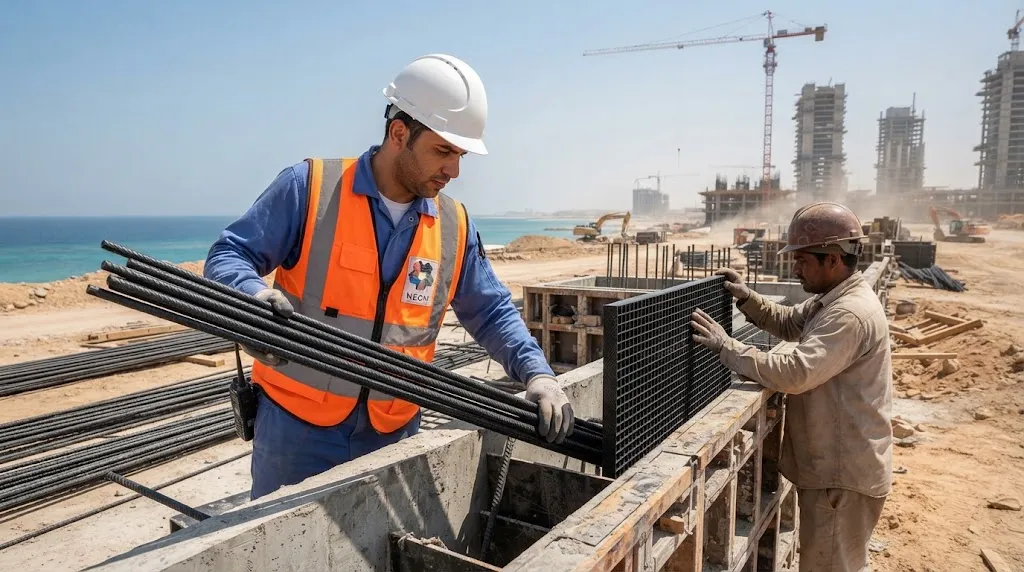
The scale of Saudi construction is difficult to overstate. NEOM alone is a planned multi-trillion-dollar development on the northwest coast, built around The Line — a 170-kilometer linear city — plus industrial, port, and tourism zones. Beyond NEOM, the Red Sea coast developments, Qiddiya entertainment city, and expanded religious tourism infrastructure add further volume. Carbon fiber enters this pipeline through several applications that have become proven in the last five years rather than speculative.
Corrosion-resistant carbon fiber reinforcement is the most established entry point. In the saline Gulf environment and in marine structures along the Red Sea, CFRP rebars and grids replace steel in concrete decks, waterfront facades, and desalination plant structures, where steel's corrosion lifespan is short. The table below summarizes the main application channels and their maturity:
| Application Channel | Typical Products | Demand Maturity | Main Drivers |
|---|---|---|---|
| Infrastructure reinforcement | CFRP rebar, grids, tendons | Proven in GCC projects | Corrosion, marine environment |
| Building and facade | CFRP profiles, grids, cladding panels | Growing | Weight, seismic and blast resistance |
| Marine and offshore | CFRP hatch covers, gratings, piping | Emerging | Saltwater, lightweight handling |
| Mobility and rail | CFRP floor panels, roofs, interiors | Early stage | Metro and rail expansion programs |
For suppliers, the construction channel offers volume but requires price competitiveness against steel and patience through qualification cycles. The differentiating factor is corrosion and lifecycle cost: in a region where maintenance is expensive and salt exposure constant, the total-cost-of-ownership argument for CFRP in infrastructure is unusually strong, which is why engineered building and marine applications are the most reliable demand anchors.
Renewable Targets: Wind, Hydrogen and Desalination
Saudi Arabia committed to sourcing 50 percent of its electricity from renewables by 2030, a target that implies tens of gigawatts of new solar and wind capacity. Wind development has accelerated along the Red Sea coast, where the Dumat Al Jandal project (400 MW) was the first utility-scale farm, and where coastal wind resources support additional projects in the thousands of megawatts. Utility-scale wind translates directly into composite demand: each modern turbine blade contains substantial carbon fiber in the spar cap, and blade lengths beyond 100 meters now use carbon fiber as standard practice to limit blade mass.
Hydrogen adds a second, fast-growing channel. NEOM's green hydrogen project at Oxagon is designed to produce up to 600 tonnes of green hydrogen per day using 4 GW of renewable power, and the kingdom's broader hydrogen strategy positions it as a major exporter to Europe and Asia by 2030. Green hydrogen export depends on storage and logistics: Type IV composite pressure vessels for trailers and tube skids, composite-lined storage solutions, and eventually large-scale vessel and pipeline components where carbon fiber's weight savings matter for transport efficiency. Desalination, the third channel, is less visible but steady: Saudi Arabia is the world's largest producer of desalinated water, and composite housings, piping, and structural parts resist the aggressive chloride environment far longer than metals.
- Wind blade spars: carbon spar caps in blades of 80-120 meters become standard, each blade consuming 2-6 tonnes of carbon fiber.
- Hydrogen storage: Type IV composite tanks for truck and tube trailers form the export logistics backbone.
- Desalination plant structures: CFRP piping, gratings, and housings outperform steel in chloride-rich service.
- Solar tracker and structure components: corrosion-resistant composite profiles support large-scale PV farms in desert conditions.
Defense Localization under GAMI
Defense localization is the youngest but most strategic demand channel. The General Authority for Military Industries (GAMI) is executing a Saudi Vision 2030 objective to localize more than 50 percent of military goods and services spending by 2030, up from roughly 2 percent a decade ago. This target creates a procurement environment in which foreign suppliers are welcome but expected to build domestic capability — through joint ventures, technology transfer, and local assembly — rather than simple importation.
The composite-relevant segments are aerospace structures, uncrewed systems, and ballistic protection. Saudi Arabia is developing sovereign uncrewed aerial vehicle programs and has announced investments in military aviation platforms, both of which consume aerospace-grade carbon fiber prepreg and fabrics. Ballistic and vehicle armor adds demand for woven and unidirectional carbon fiber panels in lightweight protection systems. For carbon fiber suppliers, the GAMI channel is not primarily about immediate tonnage; it is about forming partnerships early, understanding offset obligations, and positioning a qualified local supply chain before the large procurement programs mature.
Supplier Market Access and Local Content
Supplier access to the Saudi market is governed by a local content framework that extends well beyond defense. The National Content Program and related initiatives score procurement decisions on domestic value addition, so suppliers who establish local warehousing, assembly, or partnerships gain a measurable advantage in public and semi-public tenders. Saudization staffing requirements and certification against Saudi Standards, Metrology and Quality Organization (SASO) specifications add administrative steps that favor suppliers with regional presence and documentation readiness.
For composite materials, the practical implications are straightforward. Supplier qualification is not a single activity but a country-entry program that combines technical certification, local partnership, and compliance readiness. Suppliers that treat Saudi Arabia as a committed market — with stock, certification, and a local entity — convert these requirements from barriers into competitive moats, because the same obligations discourage competitors who enter opportunistically. The market rewards committed entrants with volume that compounds across the construction, renewable, and defense channels discussed above.
Frequently Asked Questions
How large is carbon fiber demand in Saudi Arabia today?
Domestic consumption is still modest in tonnage terms — on the order of hundreds of tonnes per year — but the demand pipeline is growing faster than almost any other market in the region. The large-volume driver is infrastructure and renewable projects, where carbon fiber enters through CFRP reinforcement, wind blade spars, and hydrogen storage rather than through a domestic aerospace manufacturing base, which is still being established.
What are the first applications a carbon fiber supplier should target in Saudi Arabia?
The most accessible applications are CFRP rebar and grids for infrastructure and marine structures, followed by composite piping, gratings, and housings for desalination and industrial plants. These have shorter qualification cycles than aerospace or defense and benefit directly from the corrosion argument that is strongest in the Gulf environment. Wind blade and hydrogen storage demand follow as the renewable program scales.
How does defense localization affect foreign carbon fiber suppliers?
GAMI's 50 percent localization target means foreign suppliers are expected to build domestic capability through joint ventures, technology transfer, or local assembly rather than pure import sales. Participation in defense programs is most viable for suppliers that can commit to a Saudi entity structure and qualify against military-grade specifications from the outset.
What role do carbon fiber composites play in Saudi hydrogen exports?
Green hydrogen export depends on transporting hydrogen as compressed gas, which requires lightweight high-pressure storage. Type IV composite pressure vessels, containing carbon fiber in the load-bearing liner, are the established technology for tube trailers and transport skids, and the scale of Saudi export ambitions makes this one of the fastest-growing composite applications in the kingdom.
Conclusion
Saudi Arabia presents a rare combination for composite suppliers: a construction pipeline large enough to anchor volume demand, renewable targets that create a fast-growing wind and hydrogen channel, and a defense localization policy that rewards early commitment with sovereign long-term contracts. The common thread across all three channels is durability — corrosion resistance, fatigue life, and weight savings — which plays directly to carbon fiber's strengths and to the region's harsh operating environment.
YongXian supplies carbon fiber fabrics, CFRP reinforcement products, and prepregs to infrastructure, energy, and defense customers worldwide. Explore our product range or contact our team to discuss specifications and qualification support for Saudi projects.
Part of topic
Related Articles
- Recycled Carbon Fiber Market Forecast 2030: Technology Maturity and Commercialization Path
- South Korea Carbon Fiber Market 2026: Hydrogen Economy and Shipbuilding Innovation
- Wind Turbine Blade Leading Edge Protection 2026: Polyurethane, Tape, and Metallic Shield Solutions
- China Carbon Fiber Overcapacity 2026: Price War Impact and Industry Consolidation
- India Carbon Fiber Market 2026: Wind Energy, Aerospace, and Defense Expansion
- PAN Precursor Market 2026: Acrylonitrile Supply and Carbon Fiber Cost Structure
Interested in Custom Carbon Fiber Products?
Contact our team for competitive pricing and technical specifications.
Get a QuoteRelated Products
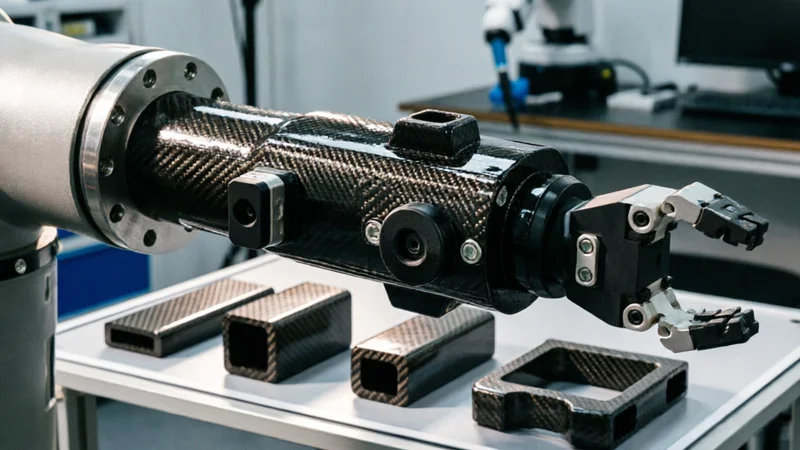
Carbon Fiber Robot End Effector Link — Custom Shape & Sensor Integration
Custom-shaped carbon fiber end effector links for robotic arms. Designed for automation integrators and research labs requiring lightweight, rigid connections between the robot wrist and gripper/tool. Can incorporate sensor mounting bosses, cable routing channels, and quick-change interfaces.
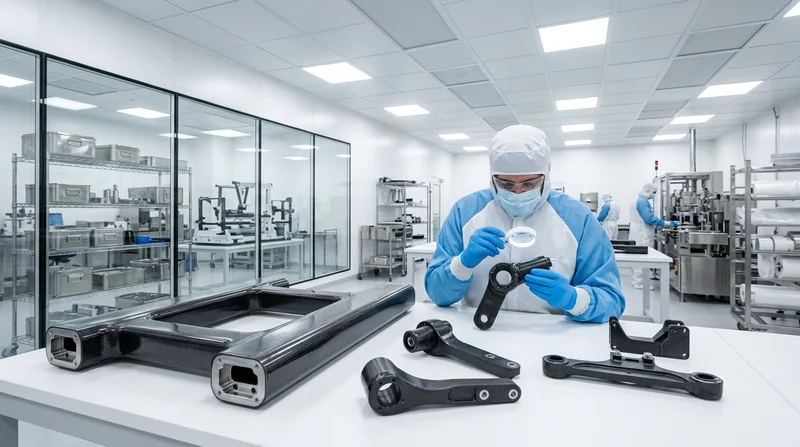
Custom Carbon Fiber Medical Device Components
Medical-grade carbon fiber components manufactured for imaging equipment, surgical instruments, and patient support systems. Carbon fiber's radiolucency (X-ray transparency) and high strength-to-weight ratio make it ideal for CT scanner beds, wheelchair frames, surgical robot arms, and MRI-compatible accessories. Biocompatible resin systems available.

Custom Carbon Fiber Musical Instrument Parts
Carbon fiber components for musical instrument manufacturing offering superior dimensional stability, low weight, and consistent acoustic properties. We produce carbon fiber bows, guitar necks, violin chin rests, drum shells, and wind instrument bodies. Carbon fiber instruments are immune to humidity changes and temperature fluctuations that affect wooden instruments.
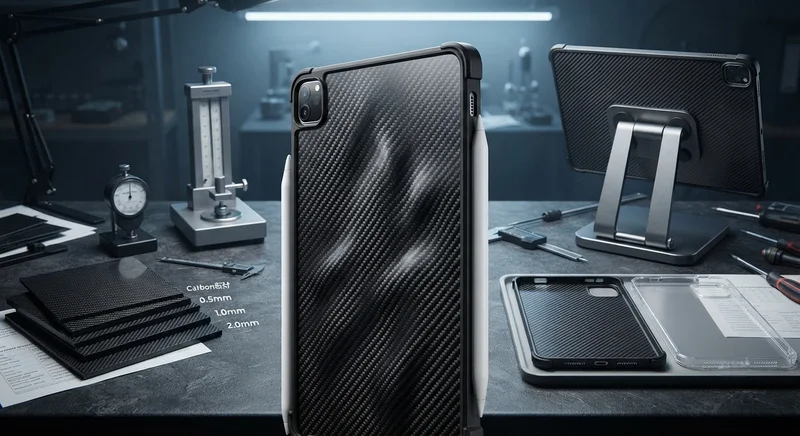
Carbon Fiber Tablet Case — Ultra-Light Protective Shell
Lightweight carbon fiber protective case for tablets and iPads. Molded from T700 3K prepreg with reinforced corner protection. Adds minimal weight while providing superior rigidity and drop protection compared to polycarbonate or silicone cases. Ideal for field workers, enterprise deployments, and professionals requiring durable tablet protection.
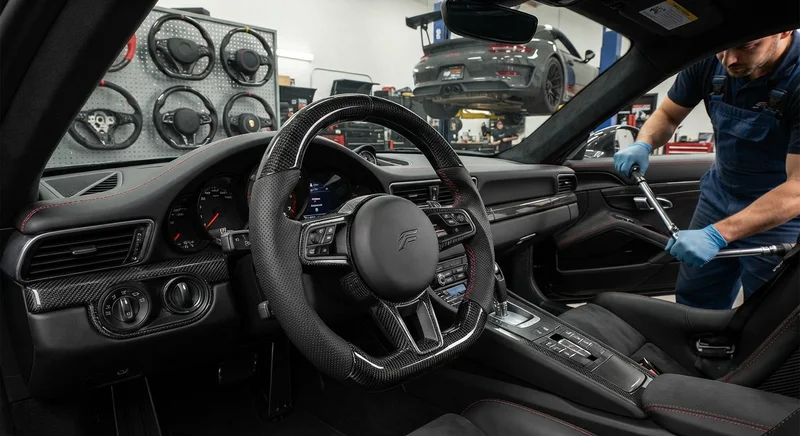
Carbon Fiber Steering Wheel — Custom Leather-Wrapped with CF Inlay
Custom carbon fiber steering wheel with genuine leather wrapping and carbon fiber inlay sections. Molded from T700 3K prepreg for maximum rigidity with a 30% weight reduction over OEM wheels. Available in D-shape (flat bottom) and round profiles. Direct bolt-on fitment for popular sports car and performance vehicle models. Custom stitching color and leather grade available.