
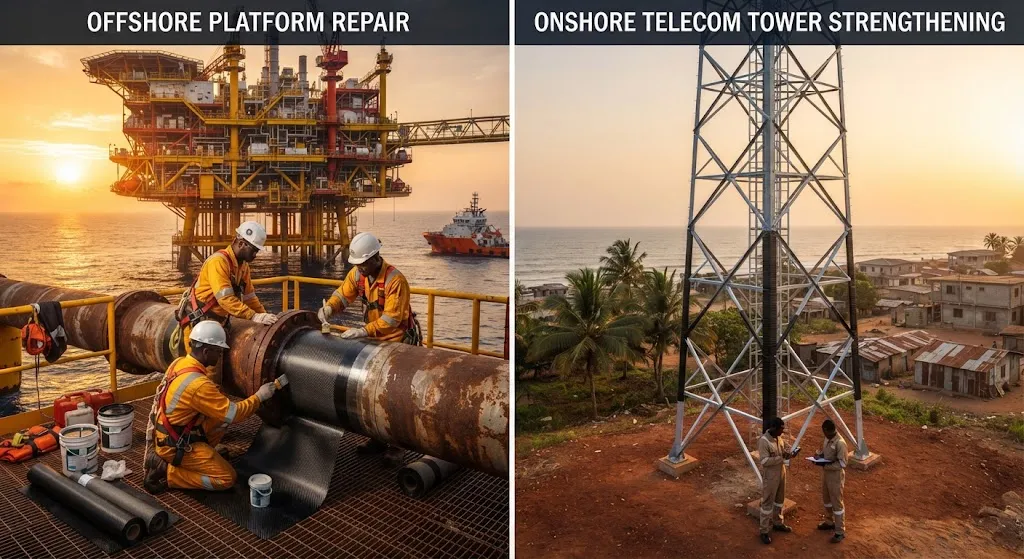
Ghana's oil & gas and telecom sectors are creating demand for carbon fiber composite solutions. This article examines CFRP applications in offshore platform components, pipeline rehabilitation, and telecom tower structures in West Africa.
Introduction
Ghana's expanding oil & gas industry and rapidly growing telecommunications network are creating new demand for advanced composite materials, particularly carbon fiber reinforced polymer (CFRP) solutions. As West Africa's second-largest oil producer and one of Africa's fastest-growing telecom markets, Ghana presents opportunities for CFRP applications that address the region's unique infrastructure challenges — harsh offshore environments, remote installations, and the need for rapid deployment.
Carbon fiber composites offer significant advantages over traditional materials in these applications: corrosion resistance in marine environments, weight reduction for easier transport and installation, and design flexibility for custom structural solutions. These benefits are particularly valuable in West Africa, where logistics challenges and limited heavy-lift equipment make material weight a critical consideration.
Oil & Gas Applications
Ghana's offshore oil & gas operations present several CFRP opportunities:
Platform structural repair: CFRP strengthening systems repair and reinforce corroded steel structures on offshore platforms, extending service life without the need for expensive replacement. External CFRP wraps and near-surface mounted (NSM) reinforcement bars restore structural capacity to damaged members.
Pipeline rehabilitation: CFRP composite repair systems provide cost-effective solutions for corroded subsea and topside pipelines, avoiding the production losses associated with full pipe replacement. These systems can be applied while pipelines remain in service.
Subsea structures: CFRP buoyancy modules, riser protectors, and subsea tooling components offer weight savings and corrosion resistance in demanding subsea environments. The ability to manufacture complex shapes enables optimized hydrodynamic performance.
Offshore wind foundations: As Ghana explores offshore wind energy, CFRP may play a role in lightweight foundation structures and transition pieces that reduce installation costs in deep water.
Telecom Applications
Ghana's telecom infrastructure expansion drives demand for CFRP solutions:
Tower strengthening: CFRP wraps and reinforcement systems strengthen existing telecom towers to support additional antenna loads as network capacity increases. This approach avoids the cost and disruption of tower replacement.
Monopole structures: CFRP monopole towers offer lightweight, corrosion-resistant alternatives to steel for telecom infrastructure. Their reduced weight simplifies transportation and installation in remote areas.
Antenna housings: CFRP radomes and antenna housings provide transparent electromagnetic performance with weather protection and structural integrity in tropical environments.
Market Development
Developing the Ghanaian carbon fiber market requires several enabling factors:
Technical expertise: Local engineering capabilities in composite design, manufacturing, and installation are essential for market development. Training programs and technology transfer partnerships can accelerate capability building.
Supply chain establishment: Reliable supply chains for CFRP materials — carbon fiber, resins, adhesives, and auxiliary materials — must be established to support local manufacturing and repair operations.
Quality standards: Adoption of international quality standards for composite materials and installations ensures reliability and safety in demanding oil & gas and telecom applications.
Conclusion
Ghana's oil & gas and telecom sectors present growing opportunities for carbon fiber composite solutions. By addressing the region's unique infrastructure challenges with advanced materials, Ghana can develop local expertise and supply chains that support both domestic needs and regional market expansion across West Africa.
Part of topic
Related Articles
- Recycled Carbon Fiber Market Forecast 2030: Technology Maturity and Commercialization Path
- South Korea Carbon Fiber Market 2026: Hydrogen Economy and Shipbuilding Innovation
- Wind Turbine Blade Leading Edge Protection 2026: Polyurethane, Tape, and Metallic Shield Solutions
- China Carbon Fiber Overcapacity 2026: Price War Impact and Industry Consolidation
- India Carbon Fiber Market 2026: Wind Energy, Aerospace, and Defense Expansion
- PAN Precursor Market 2026: Acrylonitrile Supply and Carbon Fiber Cost Structure
Interested in Our Products?
Contact our team for competitive pricing and technical specifications.
Get a QuoteRelated Products

Carbon Fiber Fishing Rod Blank
High-quality carbon fiber fishing rod blank manufactured from multiple grades of Toray carbon fiber cloth. Available in a wide range of lengths, powers, and actions for freshwater and saltwater applications. Suitable for OEM rod building.
Carbon Fiber Watch Strap — 20mm/22mm Quick-Release
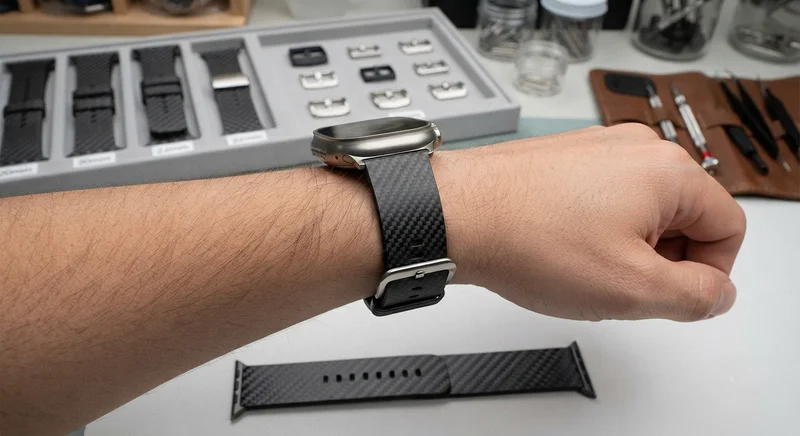
Premium carbon fiber watch strap with quick-release spring bars. Woven from T700 3K twill prepreg with a flexible resin system that conforms to the wrist. Available in 20mm and 22mm lug widths, compatible with Apple Watch, Samsung Galaxy Watch, Garmin, and traditional mechanical watches. Features a stainless steel buckle and carbon fiber keepers. The natural weave pattern makes each strap unique.

Carbon Fiber Plate — 3K Twill T700 1.5mm
Thin 1.5mm carbon fiber plate with 3K twill weave surface. Lightweight and stiff, commonly used for covers, panels, drone bodies, and applications requiring a premium aesthetic appearance.

Carbon Fiber Plate — 3K Twill T700 3.0mm
Medium-thickness 3.0mm carbon fiber plate offering significantly higher load capacity while maintaining attractive 3K twill finish. Suitable for structural brackets, reinforcement plates, and load-bearing panels.

Square Carbon Fiber Tube — 3K Twill T700
Square cross-section carbon fiber tube manufactured with 3K twill weave for torsional strength. Preferred for structural frames, trusses, and support columns where rectangular geometry offers design flexibility.