
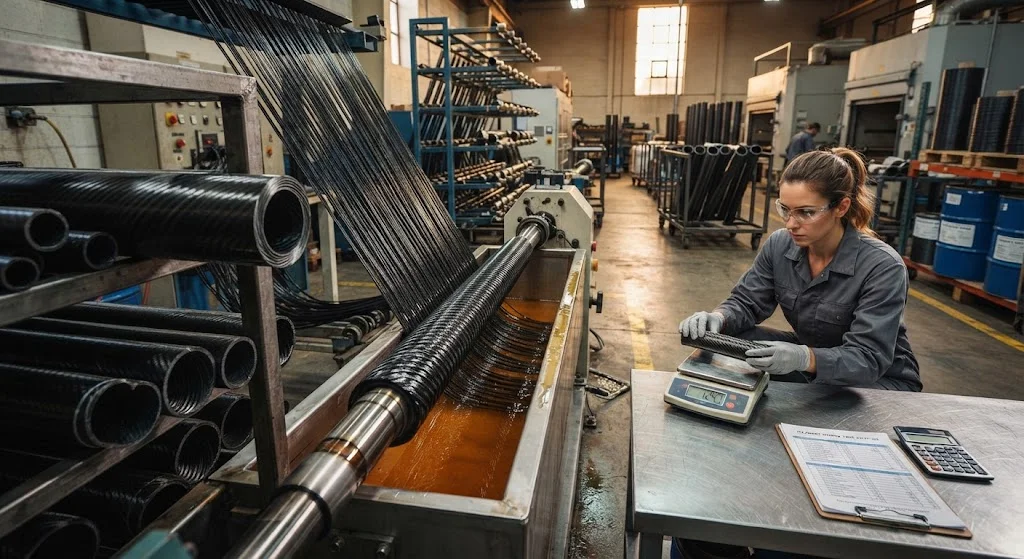
Understanding filament wound epoxy tubes cost is essential for any engineer or buyer specifying composite tubes for structural, pressure or drive-shaft applications. Unlike standard metal tube pricing, which follows commodity steel or aluminum prices, a filament wound epoxy tube is priced from a sta
Introduction
Understanding filament wound epoxy tubes cost is essential for any engineer or buyer specifying composite tubes for structural, pressure or drive-shaft applications. Unlike standard metal tube pricing, which follows commodity steel or aluminum prices, a filament wound epoxy tube is priced from a stack of manufacturing decisions: the fiber grade, the resin system, the winding angle schedule, the cure cycle and the order quantity. Two tubes with identical outer dimensions can differ in price by a factor of three simply because one is wound from T700 carbon tow and the other from E-glass. This article decomposes the cost of filament wound epoxy tubes into its material, process and overhead components, shows how volume changes the economics, and provides a transparent framework for estimating wound tube price per meter so that engineering teams can budget realistically and compare quotes on equal terms.
The Four Drivers of Filament Wound Epoxy Tubes Cost
Every filament wound epoxy tube quote can be traced back to four cost drivers: raw material, machine time, cure energy and tooling overhead. Raw material dominates because the fiber itself is the single most expensive input, and the resin system adds a secondary, smaller layer of cost. Machine time reflects how fast the winding head can deposit fiber and how many passes are needed to build wall thickness. Cure energy covers oven or resistive heating time, which scales with wall thickness and resin chemistry. Tooling overhead — the cost of mandrels, programming and setup — is amortized across the order, which is why small quantities carry a heavy per-piece penalty. A good cost model separates these four drivers, because each responds differently to changes in design and order volume.
| Cost driver | Typical share (carbon tube) | Typical share (glass tube) | Primary lever |
|---|---|---|---|
| Fiber material | 45-60% | 15-25% | Tow grade, areal weight |
| Resin system | 8-12% | 20-30% | Epoxy type, toughener content |
| Winding + cure labor | 15-20% | 20-30% | Winding speed, cure cycle |
| Tooling + overhead | 10-20% | 15-30% | Order volume, mandrel reuse |
The contrast between the two columns is revealing. In a carbon tube, the fiber is roughly half the cost, so grade selection is the dominant decision; in a glass tube, resin and labor become proportionally more important because the fiber is cheap. This is the first lesson of composite tube cost analysis: the same tube geometry can have a completely different cost structure depending on the reinforcement.
Material Cost: Fiber, Resin and Price per Meter
Fiber pricing drives the material line. Commercial-grade carbon tow such as T300 sells in the range of 15-25 USD per kilogram, standard-modulus T700 sits around 20-30 USD per kilogram, and intermediate-modulus grades can reach 40-60 USD per kilogram in small lots. E-glass roving, by contrast, costs roughly 1.5-3 USD per kilogram. Because fiber makes up about 60% of the tube wall by volume, the price difference propagates directly into the product. A practical way to compare is price per meter, which is easy to calculate once the laminate density and wall area are known.
- Weight estimate: a 40 mm OD carbon tube with 2 mm wall contains roughly 0.24 kg of material per meter at a 60% fiber volume fraction and 1.55 g/cm³ laminate density.
- Carbon material cost: at 25 USD/kg for T700-grade tow plus resin, the raw material alone lands near 8-10 USD per meter before processing.
- Glass material cost: the same geometry in E-glass costs about 1.5-2.5 USD per meter in raw material, because the fiber is an order of magnitude cheaper.
Resin choice matters less in absolute terms but more in process terms. Standard bisphenol-A epoxy costs 5-8 USD per kilogram, while toughened or flame-retardant systems can double that figure. A toughened resin is often specified for drive shafts and pressure tubes where fatigue performance is critical, adding perhaps 10-15% to the finished tube price. For a detailed comparison of suppliers and certification requirements, readers can consult our companion guide to filament wound epoxy tube suppliers.
Process Cost: Winding Time, Cure and Labor
The process line is where shop-floor efficiency shows up. Modern CNC filament winders deposit carbon tow at 30-60 meters per minute in helical passes, and a typical 1-meter tube with a 2 mm wall needs 20-40 passes depending on bandwidth and angle. Total winding time for one tube usually lands between 10 and 30 minutes; a machine that can run multiple mandrels simultaneously effectively divides this time across parts. Cure is the second time sink: standard epoxy systems cure in 2-4 hours at 120-150°C, while fast-cure systems cut that to 30-60 minutes at the price of a more expensive resin. Labor is the third element, covering mandrel preparation, winding supervision, demolding and finishing. Across a production lot, these process costs typically contribute 15-20% of a carbon tube's price and 20-30% of a glass tube's price.
The practical implication is that process cost is largely fixed per tube, so it behaves like a per-piece cost that shrinks in relative terms as volume grows — one of the reasons larger orders command lower unit prices even when material prices stay flat.
Volume Pricing: How Order Quantity Changes the Price
Order volume is the most powerful negotiation lever in filament wound epoxy tube pricing. Tooling cost is the mechanism: a custom mandrel set can cost 500-5,000 USD depending on diameter and tolerance, and setup plus first-article approval adds fixed hours of engineering time. These fixed costs are spread over the order, so the unit price falls steeply as quantity rises. The table below shows representative pricing tiers for a 40 mm OD, 2 mm wall, 1-meter tube, expressed as a percentage of the single-piece reference price.
| Order volume | Carbon tube (T700) | Glass tube (E-glass) | Typical lead time |
|---|---|---|---|
| 1-10 pieces (prototype) | 100% (reference) | 100% (reference) | 2-4 weeks |
| 11-100 pieces | 70-80% | 70-80% | 3-5 weeks |
| 101-1,000 pieces | 55-65% | 60-70% | 4-6 weeks |
| 1,000+ pieces (annual) | 45-55% | 55-65% | 6-10 weeks |
These ranges assume the same tooling and laminate. Annual contracts with reserved capacity can push carbon tubes below the 45% level, because the supplier amortizes tooling, programming and incoming inspection over a committed volume. For buyers, the message is to consolidate demand: ordering 300 tubes once per year instead of 25 tubes per month typically unlocks a lower price tier and shorter effective lead time.
Estimating Filament Wound Epoxy Tube Costs with a Simple Model
Procurement teams can build a serviceable estimate for wound tube price per meter in five steps without waiting for supplier quotes. First, compute the wall cross-section area from the outer and inner diameter. Second, multiply by laminate density (1.5-1.6 g/cm³ for carbon, 1.9-2.0 for glass) to get mass per meter. Third, apply a material cost factor per kilogram of finished laminate — for carbon, roughly 1.6-2.0 times the raw tow price, covering resin and process waste; for glass, roughly 2.5-3.5 times, since resin and labor share a larger portion. Fourth, add a processing and overhead allowance of 30-60% for low volumes, dropping toward 15-25% at high volumes. Finally, multiply by the volume tier factor from the table above. This model typically lands within 20% of a real quote, which is close enough for budgeting and for challenging outliers in supplier pricing.
- Validate assumptions against the supplier's material certificate: fiber grade, fiber volume fraction and resin type all change the mass and cost inputs.
- Ask for the quote broken into material and processing lines — transparent suppliers publish this split and it exposes hidden tooling charges.
- Compare price per meter rather than price per piece when diameters or lengths differ between vendors.
Frequently Asked Questions
Why is a carbon filament wound tube so much more expensive than a glass one?
The fiber is the reason. Carbon tow costs 15-30 USD per kilogram against 1.5-3 USD for E-glass roving, and fiber occupies roughly 60% of the tube wall by volume. For a 40 mm tube with 2 mm wall, the raw material alone lands near 8-10 USD per meter for carbon versus 1.5-2.5 USD for glass. The gap narrows at the finished-tube level because resin, processing and tooling are shared costs, but carbon tubes typically remain two to four times more expensive than equivalent glass tubes.
What is the minimum order quantity for custom filament wound epoxy tubes?
Most specialized tube winders accept prototype quantities of 1-10 pieces, but the unit price is highest at this level because tooling and setup are amortized over very few parts. Cost-effective custom production usually starts around 50-100 pieces, where the price typically drops 20-30% from the prototype tier. Some suppliers offer stock sizes at lower MOQs with off-the-shelf tooling, which is the cheapest entry point for standard diameters.
How much does tooling add to a filament wound epoxy tube project?
A custom mandrel set typically costs 500-5,000 USD depending on diameter, length, taper and surface finish requirements, and tooling is usually quoted as a one-time charge that stays with the buyer. At prototype volumes this can double the effective per-piece cost; at 1,000+ piece orders it becomes a minor line item. Buyers should always ask whether the quote includes tooling or assumes it as a separate fee, since this is the most common source of surprise in filament wound epoxy tubes cost.
Conclusion
Filament wound epoxy tubes cost is driven by fiber grade, resin system, process efficiency and order volume, with material dominating carbon tubes and processing mattering more in glass tubes. The most effective way to control cost is to separate the four drivers in every quote, consolidate order volume to unlock lower price tiers, and evaluate candidates on price per meter using the simple estimation model above. A supplier that openly breaks down material, processing and tooling lines is almost always the one that delivers predictable pricing over the long term.
If you are sourcing reinforcement for filament winding programs, browse our carbon fiber fabrics, tows and prepregs, or contact our engineering team for material selection and cost guidance tailored to your tube specification.
Part of topic
Related Articles
- Carbon Fiber Custom Parts: Small Batch vs High Volume Manufacturing Cost Comparison
- Microwave-Assisted Carbonization for Carbon Fiber: Energy Savings and Quality Improvement
- Carbon Fiber Laser Cutting and Trimming: Automation for High-Volume Production
- Pyrolysis Recycled Carbon Fiber: Mechanical Property Retention and Reuse Applications
- Carbon Fiber Bio-Composites: Natural Fiber Hybrid Reinforcement for Sustainable Applications
- RFID Tracking for Carbon Fiber Supply Chain: Traceability and Quality Assurance
Interested in Custom Carbon Fiber Products?
Contact our team for competitive pricing and technical specifications.
Get a QuoteRelated Products
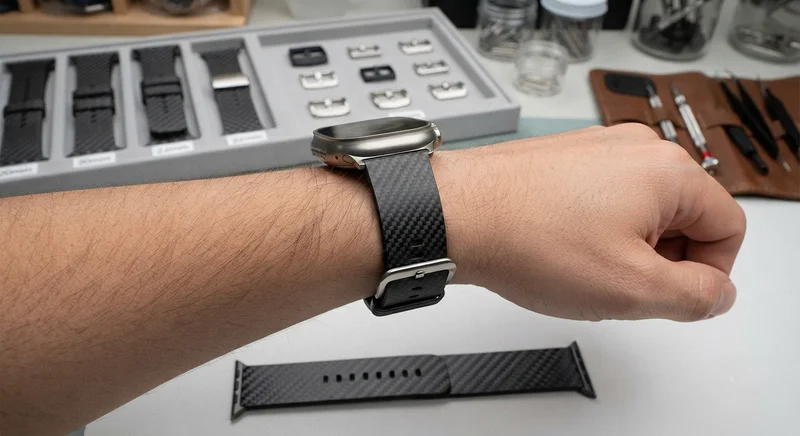
Carbon Fiber Watch Strap — 20mm/22mm Quick-Release
Premium carbon fiber watch strap with quick-release spring bars. Woven from T700 3K twill prepreg with a flexible resin system that conforms to the wrist. Available in 20mm and 22mm lug widths, compatible with Apple Watch, Samsung Galaxy Watch, Garmin, and traditional mechanical watches. Features a stainless steel buckle and carbon fiber keepers. The natural weave pattern makes each strap unique.
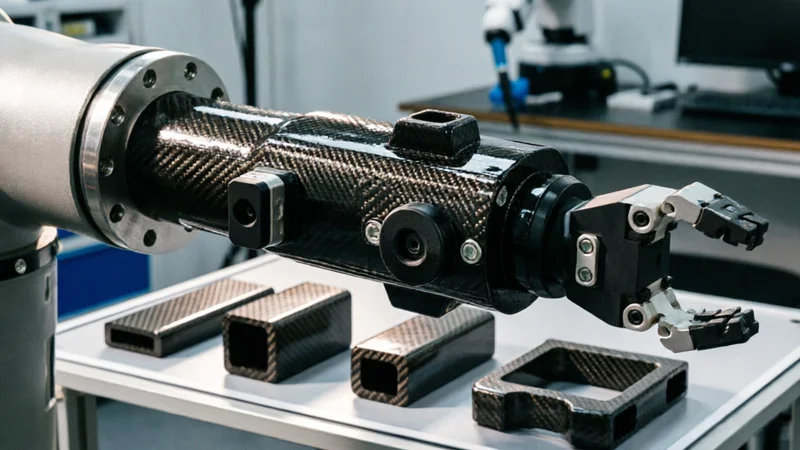
Carbon Fiber Robot End Effector Link — Custom Shape & Sensor Integration
Custom-shaped carbon fiber end effector links for robotic arms. Designed for automation integrators and research labs requiring lightweight, rigid connections between the robot wrist and gripper/tool. Can incorporate sensor mounting bosses, cable routing channels, and quick-change interfaces.

Custom Carbon Fiber Musical Instrument Parts
Carbon fiber components for musical instrument manufacturing offering superior dimensional stability, low weight, and consistent acoustic properties. We produce carbon fiber bows, guitar necks, violin chin rests, drum shells, and wind instrument bodies. Carbon fiber instruments are immune to humidity changes and temperature fluctuations that affect wooden instruments.
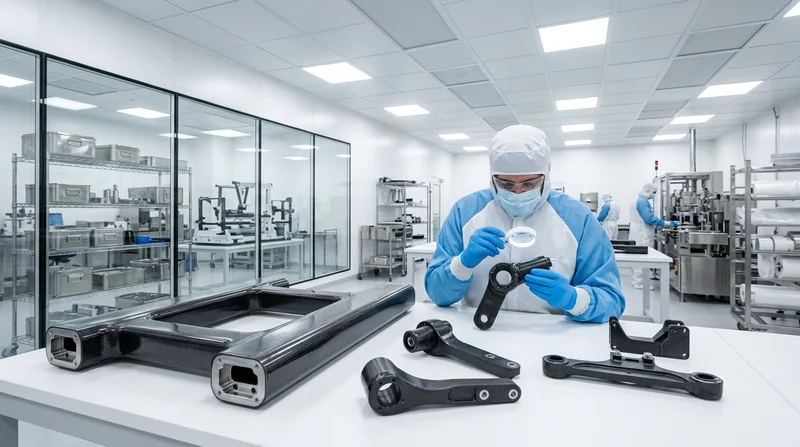
Custom Carbon Fiber Medical Device Components
Medical-grade carbon fiber components manufactured for imaging equipment, surgical instruments, and patient support systems. Carbon fiber's radiolucency (X-ray transparency) and high strength-to-weight ratio make it ideal for CT scanner beds, wheelchair frames, surgical robot arms, and MRI-compatible accessories. Biocompatible resin systems available.
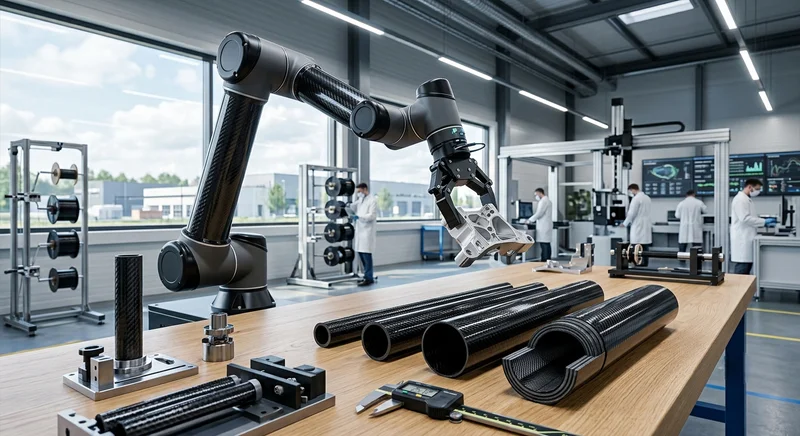
Carbon Fiber Robotic Arm Tube — High-Stiffness Lightweight Replacement
Precision-wound carbon fiber tubes for robotic arm links, replacing steel or aluminum in collaborative robots (cobots) and industrial manipulators. Achieve 3× the specific stiffness of aluminum with significant weight reduction, enabling faster acceleration and higher payload capacity.