
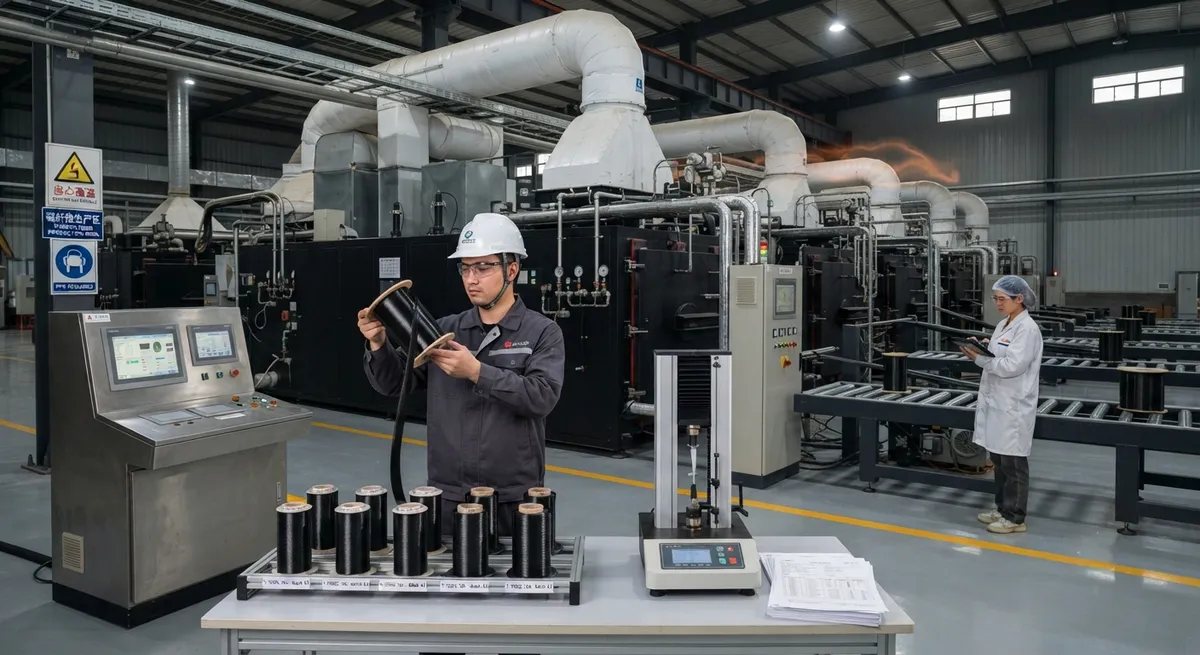
For three decades, the top rung of the carbon fiber ladder belonged to one company. Toray's T1100G, introduced in the mid-2010s, sits at the practical ceiling of PAN-based carbon fiber: around 7,000 MPa tensile strength with a 324 GPa modulus, a combination that made it the reference ma
Introduction
For three decades, the top rung of the carbon fiber ladder belonged to one company. Toray's T1100G, introduced in the mid-2010s, sits at the practical ceiling of PAN-based carbon fiber: around 7,000 MPa tensile strength with a 324 GPa modulus, a combination that made it the reference material for the highest-performance aerospace, defense, and space structures. In June 2026, that position was challenged head-on. Zhongfu Shenying Carbon Fiber started its SYT70 production line in Lianyungang with an announced capacity of 1,000 tonnes per year, claiming T1100-grade performance. The line is the most visible signal yet that high-end carbon fiber is becoming a contested, multi-supplier market.
This article unpacks what the SYT70 line actually represents — the technology, the specifications, the market position — and what it changes for buyers who have historically had little choice beyond Toray, Hexcel, and Mitsubishi for top-tier material.
Where T1100 Sits in the Carbon Fiber Hierarchy
Carbon fiber is graded by the strength-modulus envelope of the fiber. Commercial grades climb from T300 (3,530 MPa / 230 GPa) through T700 (4,900 MPa / 230 GPa) and T800 (5,880 MPa / 294 GPa) to the high-modulus and ultra-high-strength classes. T1100G was a step change because it combined ultra-high strength with only a modest modulus penalty, opening applications that demanded both.
| Grade | Tensile Strength (MPa) | Tensile Modulus (GPa) | Typical Use |
|---|---|---|---|
| T300 | 3,530 | 230 | General aerospace, secondary structures |
| T700 | 4,900 | 230 | Pressure vessels, wind blades, industrial |
| T800 | 5,880 | 294 | Primary aerospace structures |
| T1000G | 6,370 | 294 | High-performance aerospace |
| T1100G | 7,000 | 324 | Highest-performance aerospace, defense, space |
| SYT70 (claimed) | ~7,000 class | ~320 class | Targets the same envelope |
The significance is not just the numbers but the yield story behind them. Ultra-high-strength fiber is hard to make consistently: the strength of a PAN-based fiber is statistically limited by the largest flaw in a gauge length, so reaching 7,000 MPa reliably requires extreme process control through spinning, oxidation, carbonization, and surface treatment. Commercial production at scale is an engineering achievement, not a lab result.
The SYT70 Line: What We Know
Zhongfu Shenying's SYT70 line in Lianyungang was announced as a T1100-grade carbon fiber production line with an annual capacity of 1,000 tonnes. Several details matter for how the market should read the news:
- Capacity scale: 1,000 t/yr is a full industrial line, not a pilot — comparable to a single Toray T1100-class line and meaningful against global ultra-high-strength demand, which is measured in the low thousands of tonnes per year.
- Technology basis: The company's progression from SYT55 (T800-class) to SYT65 and now SYT70 mirrors the standard industry ladder, and the SYT70 builds on the wet-spinning and carbonization know-how accumulated across earlier lines.
- Commercial position: SYT70 is positioned as a direct alternative to T1100G for applications where supply security, price, or localization policy makes domestic material attractive.
The 1,000 t/yr figure matters for one more reason: it is large enough to influence pricing. Ultra-high-strength fiber has historically carried a substantial premium driven by scarcity and the concentrated supplier base. A credible second source at industrial scale is the first structural change to that pricing dynamic in years.
Why the Market Cares: Supply Security and Single-Source Risk
The high-end segment of the carbon fiber market has been unusually concentrated. For aerospace and defense applications requiring T1100-class or equivalent, buyers have historically qualified one or two suppliers, and the qualification process — material characterization, allowables generation, structural testing, and program certification — runs for years and costs millions. That lock-in is exactly why a new entrant at the top of the pyramid matters:
- Defense and aerospace programs gain a second qualified source, reducing single-supplier exposure in a material class with no easy substitutes.
- Hydrogen pressure vessel producers, who have been moving toward higher-strength fibers to thin vessel walls and raise gravimetric efficiency, gain a new option at the T1100 envelope.
- Export-restriction risk — historically a background concern for buyers reliant on Japanese fiber — becomes a managed risk with a non-Japanese industrial-scale source.
None of this happens overnight. Qualification timelines mean the SYT70 line's market impact will build through 2026-2028 rather than arrive immediately, but the direction of travel is now clear.
What Toray's Response Tells Us
Toray's own capacity decisions are the clearest read on how seriously the incumbent treats the challenge. The company has expanded its high-performance fiber capacity in recent years, including investment in T1100-class production, and continues to emphasize the differentiated performance of its fiber — higher consistency, superior handleability in prepreg, and a decades-long qualification history. The strategy is classic for a premium incumbent: compete on proven performance and total cost of ownership rather than on price.
That response is rational, but it also acknowledges the underlying shift. When a new entrant brings industrial-scale capacity to a niche that was defined by scarcity, the scarcity premium erodes. Incumbents can hold share through quality and certification depth, but the era of effectively single-source ultra-high-strength fiber is ending.
Frequently Asked Questions
Is Zhongfu Shenying's SYT70 actually equivalent to Toray T1100G?
SYT70 is positioned at the T1100 grade envelope — roughly the 7,000 MPa strength / 320 GPa modulus class — and is claimed as a direct alternative. Whether individual lots meet T1100G's full specification sheet, including consistency statistics, handleability, and prepreg behavior, is verified through the formal material qualification that aerospace and defense programs require. The commercially meaningful milestone is that an industrial-scale T1100-class source now exists outside Japan; equivalence for a given program is confirmed by qualification data, not by grade label alone.
Why does T1100-class fiber matter more than T700 or T800?
T700 is the workhorse of pressure vessels and industrial applications, and T800 covers most primary aerospace structures. T1100-class sits above both in the strength-modulus envelope, enabling the thinnest possible laminates and the highest structural efficiency — critical for defense, space, and the next generation of aircraft and hydrogen vessels where every kilogram of structure trades directly against payload or stored energy. It is also the segment with the most concentrated supplier base, so its dynamics are different from the volume markets.
How long does qualification of a new high-end carbon fiber take?
For aerospace structural use, qualification typically runs 3-5 years: material characterization and allowables generation, process qualification, component and subcomponent testing, and program-level certification. Defense programs can move faster but still count in years. Hydrogen pressure vessel qualification under UN/ISO standards is shorter — often 18-36 months — which is why the vessel market is usually the first to adopt a new industrial-scale source.
Will SYT70 change carbon fiber pricing for high-end grades?
Gradually, and at the margins first. The scarcity premium on ultra-high-strength fiber erodes as credible second sources reach industrial scale, and buyers gain negotiating leverage even before formal qualification completes. Prices in the segment are negotiated per contract with a mix of list and program pricing, so the effect shows up as more competitive bidding rather than a single market price move. For T700-class volume markets, the SYT70 line has little direct pricing effect.
Conclusion
The startup of Zhongfu Shenying's SYT70 line marks the end of the single-source era at the top of the carbon fiber pyramid. An industrial-scale T1100-class production source now exists outside the traditional Japanese and Western supplier base, giving aerospace, defense, and hydrogen programs a credible second source, shifting the scarcity premium, and resetting the commercial conversation around ultra-high-strength fiber. Full market impact will land through the qualification cycles of 2026-2028, but the strategic direction is now set.
For buyers and engineers evaluating material strategy, the practical question is how to position qualification roadmaps against an evolving supplier map. Review our carbon fiber tow and reinforcement range, or talk to our engineering team about grade selection, sourcing strategy, and qualification planning.
Part of topic
Related Articles
- Carbon Fibre Sheet Supplier UK: Sourcing Options and Specification Checklist
- Carbon Fiber Sheets Near Me Suppliers: Local Stock vs Factory Direct
- Filament Wound Epoxy Tubes: Industry Standards and Compliance Requirements
- Carbon Fiber Dealers Near Me: What a Good Dealer Actually Adds
- Carbon Fiber Supplies Near Me: Local Sourcing Without Compromising Spec
- Carbon Fiber for Sale: Online Platforms and Direct Sales Channel Comparison
Interested in Our Products?
Contact our team for competitive pricing and technical specifications.
Get a QuoteRelated Products
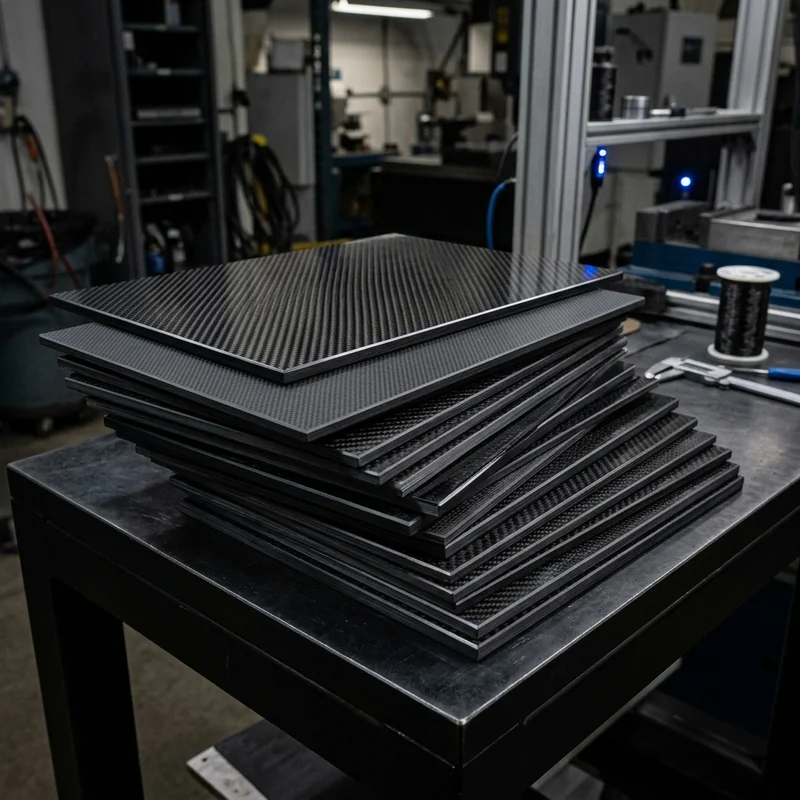
Carbon fiber standard plate-3k stripe
Lightweight, ultra-rigid standard sheets for drone fuselages, robot housings, facades and structural applications.

Carbon Fiber Plate — 3K Twill T700 3.0mm
Medium-thickness 3.0mm carbon fiber plate offering significantly higher load capacity while maintaining attractive 3K twill finish. Suitable for structural brackets, reinforcement plates, and load-bearing panels.

Carbon Fiber Plate — 3K Twill T700 1.5mm
Thin 1.5mm carbon fiber plate with 3K twill weave surface. Lightweight and stiff, commonly used for covers, panels, drone bodies, and applications requiring a premium aesthetic appearance.
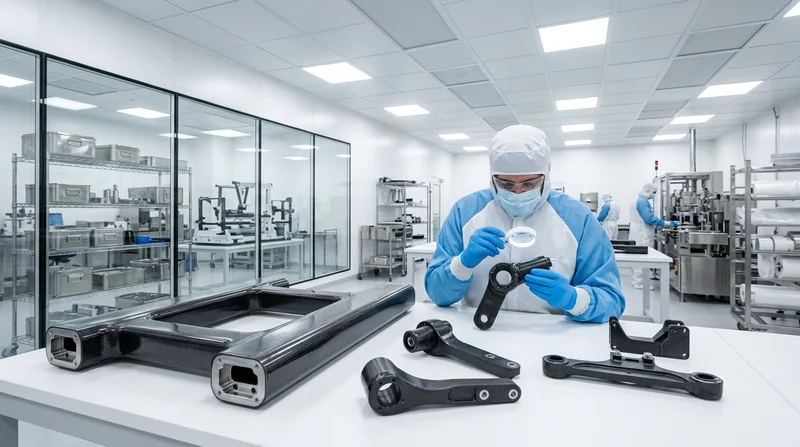
Custom Carbon Fiber Medical Device Components
Medical-grade carbon fiber components manufactured for imaging equipment, surgical instruments, and patient support systems. Carbon fiber's radiolucency (X-ray transparency) and high strength-to-weight ratio make it ideal for CT scanner beds, wheelchair frames, surgical robot arms, and MRI-compatible accessories. Biocompatible resin systems available.

Square Carbon Fiber Tube — 3K Twill T700
Square cross-section carbon fiber tube manufactured with 3K twill weave for torsional strength. Preferred for structural frames, trusses, and support columns where rectangular geometry offers design flexibility.