
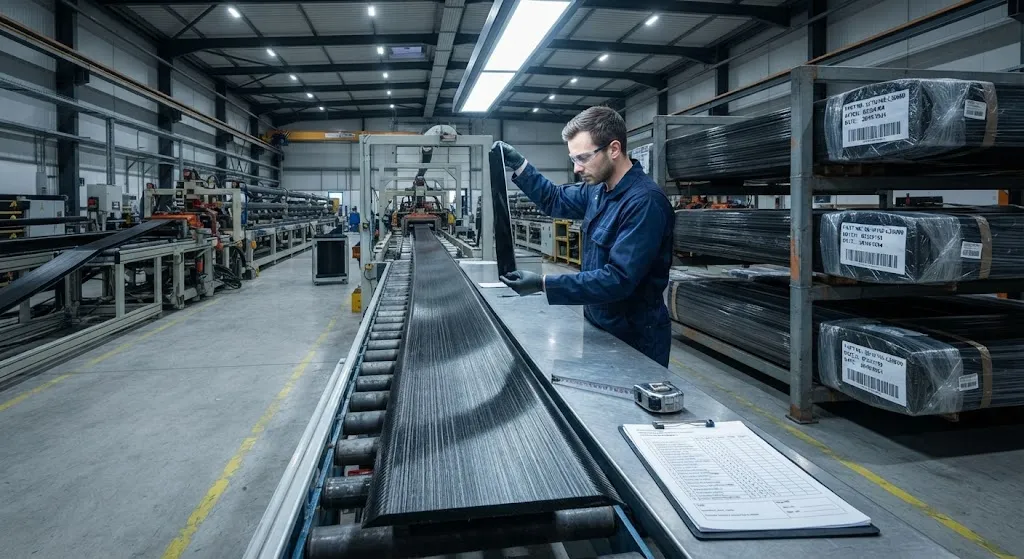
For most of the wind industry's scaling decade, the carbon fiber spar cap was a component inside a blade contract: blade manufacturers bought the complete rotor blade, and the spar cap arrived as part of a package. That is changing. Original equipment manufacturers such as Goldwind and
Introduction
For most of the wind industry's scaling decade, the carbon fiber spar cap was a component inside a blade contract: blade manufacturers bought the complete rotor blade, and the spar cap arrived as part of a package. That is changing. Original equipment manufacturers such as Goldwind and Envision are now unbundling the spar cap from the whole-blade agreement and procuring it as a separate line item, so they can negotiate the highest-value carbon sub-structure in a blade directly with specialist producers. The shift is a direct response to cost pressure, supply risk, and a simple observation — the spar cap carries roughly one-third of the material cost of a large blade while representing a small fraction of its volume.
For carbon fiber suppliers, the consequence is a new set of procurement requirements. Where a blade manufacturer once accepted a prepreg roll with a generic material certificate, the buyer now demands full traceability from precursor fiber back to the original tow lot, documented process parameters at every conversion step, and audited quality data that survives the entire logistics chain. This article examines how spar cap procurement has unbundled, what the new traceability demands actually require from suppliers, and why the commercial structure of the market is pushing capacity toward vertically integrated producers.
Why Spar Caps Are Being Unbundled
The unbundling of the spar cap has three drivers, and they compound each other. The first is cost transparency — a 100-meter blade carries a carbon spar cap weighing 8-12 tonnes, and at carbon fiber prices of 15-25 USD per kilogram, the cap alone can represent one-third of the blade's material value. When the cap is buried inside a blade contract, the OEM cannot see where that value is going or verify it against market pricing. Procuring it separately brings the line item into the open and exposes it to competitive bidding between pultrusion and prepreg suppliers.
The second driver is supply security. Carbon fiber for wind is a tight market, and a blade program can be paralyzed by a single tow lot failing qualification. An OEM that sources the spar cap directly can qualify multiple supply chains in parallel, stagger contracts, and hold a second-source option that is not available when the blade manufacturer owns the whole relationship. The third driver is technical control. The spar cap defines blade stiffness, fatigue life, and ultimate load capacity; when it is unbundled, the design authority can specify the laminate schedule, the fiber orientation, and the void content directly with the material producer instead of accepting a blade maker's internal standards.
- Cost transparency: separating the spar cap line item exposes material spend to competitive bidding and market benchmarking.
- Supply security: direct procurement lets OEMs qualify parallel supply chains and hold second-source options without exposing blade schedules.
- Technical control: the OEM specifies the laminate schedule and quality targets directly with the material producer rather than through a blade integrator.
Not every OEM is unbundling. Some blade manufacturers retain integrated spar cap supply as a commercial advantage, and the trend is most visible among Chinese OEMs — Goldwind and Envision being the most frequently cited — where the domestic supply base makes direct procurement practical. In Europe, unbundling has been slower because long-term framework agreements with blade suppliers remain the dominant commercial form.
Precursor Traceability: From Tow Lot to Prepreg Roll
The most demanding new requirement in spar cap procurement is precursor traceability. A blade OEM will not accept a prepreg or pultruded plank without documented evidence that traces the material back to its origin. The traceability chain is longer than most purchasers realize:
| Traceability Step | What Must Be Documented | Typical Evidence |
|---|---|---|
| Precursor tow lot | Tow lot ID, precursor manufacturer, melt-spin batch | Mill certificate, batch roller log |
| Fiber conversion | Oxidation and carbonization line, line speed, tension | Process historian data, line run log |
| Tensile test results | Mean tensile strength and modulus distribution | Single-tow test records, Weibull data |
| Size removal and surface treatment | Desizing, electrolytic treatment, sizing type and pickup | Sizing lot record, pickup weight check |
| Prepreg conversion | Resin system, areal weight, resin content target | Prepreg certificate, gel time checks |
| Pultrusion conversion | Resin bath, die temperature profile, line pull speed | Pultrusion run log, void content report |
| Final dispatch | Roll or plank lot, storage conditions, transport log | Dispatch certificate, temperature logger |
The rationale is twofold. First, blade fatigue qualification is anchored to the fiber distribution achieved at qualification; if a later production lot has an inferior tensile distribution, the full-scale fatigue performance of the blade is no longer supported by the evidence. Second, warranty exposure — a foundation or nacelle failure is costly enough, but an in-service spar cap failure is a catastrophic liability that justifies the cost of a complete documented chain. The industry benchmark now in discussion is a digital thread that links the tow lot to the blade serial number, an approach that has been piloted by several OEM quality organizations under names such as MarkWide and equivalent programs.
Consolidation Toward Vertically Integrated Suppliers
Traceability requirements have a structural side effect: they are much cheaper to satisfy for a producer that owns the entire chain. A vertically integrated supplier that produces precursor, converts it to carbon fiber, and converts that fiber to prepreg or pultruded plank maintains one clean data chain from melt to roll. A trader or converter that buys fiber on the open market must assemble evidence across several independent companies, each with its own record-keeping, batch numbering, and commercial interest in releasing data. The result is a market where procurement qualification is easier at the integrated producers, and this is concentrating volume toward them.
The economics reinforce the same direction. Integrated suppliers amortize the cost of quality systems, testing laboratories, and traceability infrastructure across a larger production base, and they can guarantee the fiber-mechanical property link that fragmented supply cannot. Meanwhile, the unbundling trend makes the spar cap a standalone competitive product, so pricing discipline and quality documentation compete on an equal footing — and the suppliers with the cleanest documentation win the large wind contracts. Over a three- to five-year horizon, this is expected to push a growing share of wind-grade carbon fiber capacity into fully integrated companies, with converters and traders confined to secondary markets and spot fill-in orders.
Commercial Structure of the New Market
The unbundled spar cap market is dividing into two commercial forms. In the first, the OEM runs a periodic pultruded plank or prepreg tender with fixed annual volumes, quality clauses tied to traceability audits, and penalties for documentation failure. In the second, the OEM places multi-year offtake agreements with one or two qualified integrated producers, locking capacity in exchange for volume pricing. The tender form maximizes price pressure but exposes the OEM to annual re-qualification risk; the offtake form stabilizes supply but reduces the competitive tension. Most major OEMs are now running a hybrid — a core offtake volume with a contestable overlay — and this hybrid structure is what suppliers must be prepared to serve.
For buyers evaluating a spar cap supplier, the practical checklist is short but exacting. Ask for the complete traceability chain before price discussions start, verify that the tensile distribution data covers the exact tow lots in the contract, audit the process historian rather than accepting printed certificates, and confirm the failure mode documentation for the laminate system proposed. These items separate a genuine integrated supplier from a trader presenting sourced material as its own production.
Frequently Asked Questions
Why are wind OEMs buying spar caps separately from blades?
Cost transparency is the primary reason — an 8-12 tonne carbon spar cap can represent one-third of a large blade's material value, and buying it as a separate line item exposes that value to competitive bidding. Direct procurement also lets the OEM qualify parallel supply chains for supply security and specify the laminate schedule directly with the material producer for technical control.
What does full precursor traceability actually require?
It requires documented evidence for every conversion step from the precursor tow lot to the finished prepreg roll or pultruded plank: mill certificates and batch logs for precursor, process historian data for carbonization, single-tow tensile test records, sizing records, prepreg or pultrusion run logs, and dispatch documentation. The emerging benchmark is a digital thread linking the tow lot to the blade serial number.
Why does traceability push the market toward vertically integrated suppliers?
A vertically integrated producer maintains one clean data chain from melt to roll, so the quality system and traceability infrastructure are amortized across the whole production base. A converter or trader assembling evidence across several independent companies faces higher cost and weaker control, which makes integrated producers materially easier to qualify and therefore favored for the large wind contracts.
How should a buyer evaluate a spar cap supplier's documentation?
Request the complete traceability chain before discussing price, verify that tensile distribution data covers the exact tow lots in the contract, audit the process historian rather than accepting printed certificates, and confirm the failure mode documentation for the proposed laminate system. These checks separate genuine integrated suppliers from traders reselling sourced material.
Conclusion
Wind spar cap procurement has moved from a component inside a blade contract to a standalone competitive product, and the change is reshaping the carbon fiber supply base. OEMs are unbundling the spar cap for cost transparency, supply security, and technical control; they are demanding precursor-to-prepreg traceability that reaches back to the original tow lot; and the combination is consolidating volume toward vertically integrated producers that can document the whole chain at acceptable cost. For suppliers, the lesson is clear — clean process data and an auditable digital thread are now competitive weapons, not administrative overhead.
YongXian supplies carbon fiber materials for wind energy applications, including reinforcement fabrics and engineering support for spar cap and blade programs. Explore our wind-grade product range or contact our engineering team to discuss traceability documentation and material certification for your spar cap sourcing program.
Part of topic
Related Articles
- Recycled Carbon Fiber Market Forecast 2030: Technology Maturity and Commercialization Path
- South Korea Carbon Fiber Market 2026: Hydrogen Economy and Shipbuilding Innovation
- Wind Turbine Blade Leading Edge Protection 2026: Polyurethane, Tape, and Metallic Shield Solutions
- China Carbon Fiber Overcapacity 2026: Price War Impact and Industry Consolidation
- India Carbon Fiber Market 2026: Wind Energy, Aerospace, and Defense Expansion
- PAN Precursor Market 2026: Acrylonitrile Supply and Carbon Fiber Cost Structure
Interested in Custom Carbon Fiber Products?
Contact our team for competitive pricing and technical specifications.
Get a QuoteRelated Products

Custom Carbon Fiber Medical Device Components
Medical-grade carbon fiber components manufactured for imaging equipment, surgical instruments, and patient support systems. Carbon fiber's radiolucency (X-ray transparency) and high strength-to-weight ratio make it ideal for CT scanner beds, wheelchair frames, surgical robot arms, and MRI-compatible accessories. Biocompatible resin systems available.
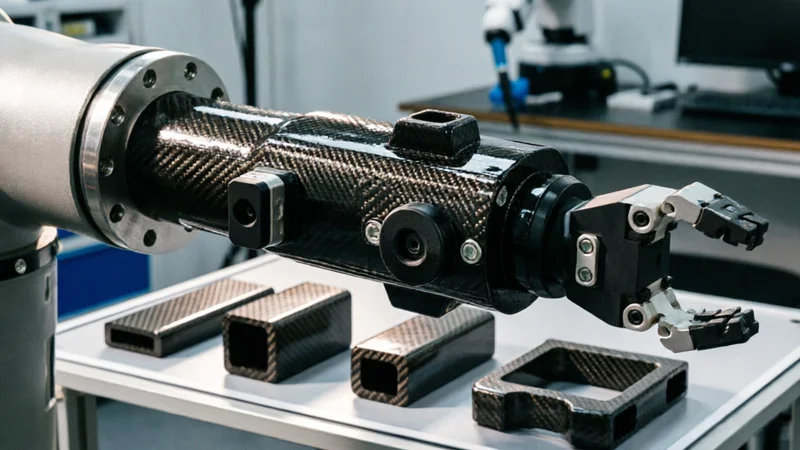
Carbon Fiber Robot End Effector Link — Custom Shape & Sensor Integration
Custom-shaped carbon fiber end effector links for robotic arms. Designed for automation integrators and research labs requiring lightweight, rigid connections between the robot wrist and gripper/tool. Can incorporate sensor mounting bosses, cable routing channels, and quick-change interfaces.

Custom Carbon Fiber Musical Instrument Parts
Carbon fiber components for musical instrument manufacturing offering superior dimensional stability, low weight, and consistent acoustic properties. We produce carbon fiber bows, guitar necks, violin chin rests, drum shells, and wind instrument bodies. Carbon fiber instruments are immune to humidity changes and temperature fluctuations that affect wooden instruments.
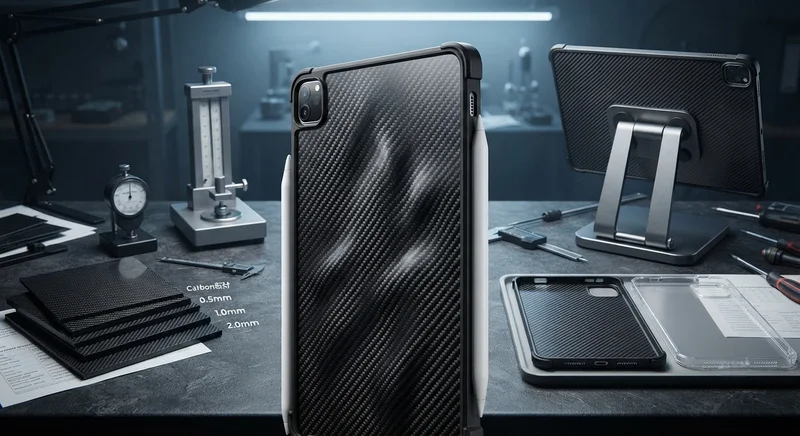
Carbon Fiber Tablet Case — Ultra-Light Protective Shell
Lightweight carbon fiber protective case for tablets and iPads. Molded from T700 3K prepreg with reinforced corner protection. Adds minimal weight while providing superior rigidity and drop protection compared to polycarbonate or silicone cases. Ideal for field workers, enterprise deployments, and professionals requiring durable tablet protection.
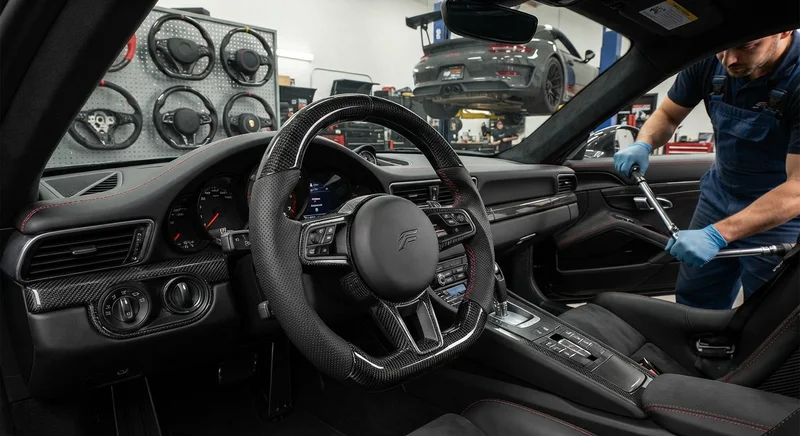
Carbon Fiber Steering Wheel — Custom Leather-Wrapped with CF Inlay
Custom carbon fiber steering wheel with genuine leather wrapping and carbon fiber inlay sections. Molded from T700 3K prepreg for maximum rigidity with a 30% weight reduction over OEM wheels. Available in D-shape (flat bottom) and round profiles. Direct bolt-on fitment for popular sports car and performance vehicle models. Custom stitching color and leather grade available.