
Underwater vehicles — from remotely operated vehicles (ROVs) and autonomous underwater vehicles (AUVs) to manned submersibles — demand hull materials that withstand extreme hydrostatic pressure while minimizing weight and volume. Traditional materials like steel, titanium, and aluminum
Introduction
Underwater vehicles — from remotely operated vehicles (ROVs) and autonomous underwater vehicles (AUVs) to manned submersibles — demand hull materials that withstand extreme hydrostatic pressure while minimizing weight and volume. Traditional materials like steel, titanium, and aluminum have served this role for decades, but carbon fiber reinforced polymer (CFRP) composites are increasingly preferred for next-generation submersible platforms. The combination of specific strength exceeding steel by a factor of five, complete immunity to saltwater corrosion, and the ability to tailor acoustic signatures through layup design makes CFRP uniquely suited to underwater vehicle applications.
The engineering challenges are substantial. At a depth of 6,000 meters, hydrostatic pressure reaches 60 MPa — roughly 600 atmospheres. The hull must resist buckling under this external pressure without adding excessive weight that reduces payload capacity or battery endurance. This article explains how CFRP composites address these challenges through optimized material selection, structural design, and qualification testing, providing practical guidance for manufacturers and technical buyers evaluating submersible hull solutions.
Why CFRP Outperforms Metals for Submersible Hulls
The shift from metals to composites in underwater vehicle design is driven by three fundamental advantages:
- Specific strength and stiffness: CFRP achieves tensile strengths of 1,500–2,500 MPa at densities of 1.55–1.60 g/cm³, yielding specific strength values 4–6 times higher than titanium alloy and 8–10 times higher than marine-grade steel. For a spherical pressure hull, this translates directly into wall thickness reduction and weight savings of 30–50%.
- Corrosion immunity: Unlike steel and aluminum, CFRP does not corrode in saltwater. This eliminates cathodic protection systems, reduces maintenance intervals, and extends operational life in marine environments from years to decades.
- Acoustic tunability: The fiber orientation, resin system, and layup sequence of a CFRP hull can be designed to achieve specific acoustic impedance values, enabling stealth characteristics for military applications or optimized sonar window performance for scientific vehicles.
The trade-offs include higher material cost, more complex quality assurance, and the need for specialized joints and penetrations that accommodate the anisotropic nature of composite laminates.
Material Selection for Deep-Rated Hulls
Not all carbon fiber grades are suitable for deep-rated submersible hulls. The hull must resist compressive buckling, which is governed by the compressive modulus and matrix-dominated properties rather than tensile strength. Key material considerations include:
| Property | Requirement for Submersible Hulls | Typical Specification | Impact on Design |
|---|---|---|---|
| Fiber compressive strength | High to resist buckling loads | 1,200–1,800 MPa (intermediate modulus) | Wall thickness reduction |
| Fiber modulus | High modulus for stiffness-critical designs | 294–394 GPa (IM to HM grade) | Buckling resistance |
| Matrix system | Toughened epoxy with high hydrostatic compression | Toughened aerospace-grade epoxy | Prevents microcracking under pressure |
| Fiber volume fraction | Maximized for compressive properties | 58–65% | Structural efficiency |
| Void content | Minimized to prevent pressure-induced collapse | Below 1.0% | Pressure integrity |
Intermediate modulus (IM) fibers such as Toray T800 or T1100 offer the best balance of compressive strength and stiffness for submersible hulls. High modulus (HM) fibers provide greater stiffness but sacrifice strain-to-failure, which is critical for impact resistance during launch and recovery operations. The resin system must maintain toughness under hydrostatic compression — standard aerospace epoxies may become brittle at depth, so submersible-grade resins are typically modified with rubber or thermoplastic toughening agents.
Hull Design and Layup Strategies
Submersible hulls typically adopt one of two geometric forms, each with distinct layup requirements:
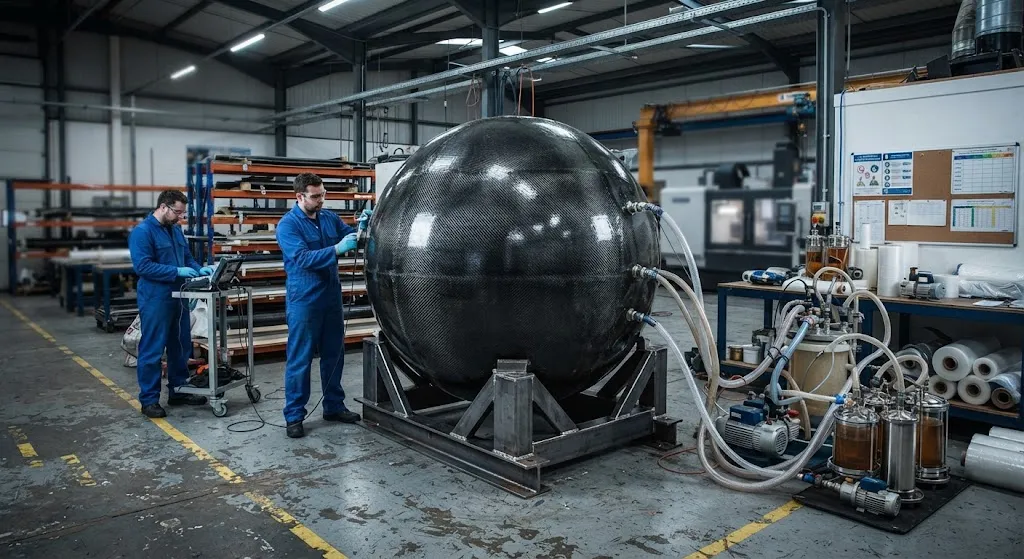
- Spherical hulls: The most pressure-efficient shape, used for deep-rated manned submersibles and free-falling landers. Spherical CFRP hulls use quasi-isotropic or near-quasi-isotropic layups ([0/±45/90]ns) to achieve uniform compressive resistance in all directions. Fiber placement accuracy is critical — deviations of even 0.5 mm can create local stress concentrations that initiate buckling failure.
- Cylindrical hulls with hemispherical end caps: Common for AUVs and ROVs where internal volume must accommodate battery packs, electronics, and payload. The cylindrical section carries hoop stress from external pressure, while the end caps handle axial compression. Layup optimization typically places 60–70% of plies in the hoop direction for the cylinder, with balanced quasi-isotropic caps.
Layup sequences for submersible hulls differ from aerospace applications in one important respect: the stacking sequence must account for through-thickness compressive properties, not just in-plane strength. Thick-section hulls (20–50 mm wall) may use 80–200 plies, requiring careful management of interlaminar stresses and thermal residual stresses from cure.
Pressure Testing and Qualification
Qualifying a CFRP submersible hull requires hydrostatic pressure testing that simulates the worst-case operational depth plus a safety margin:
- Proof pressure testing: Typically 1.25× operational depth pressure, held for a minimum of 30 minutes without leakage or visible deformation. This validates the structural margin for routine operations.
- Burst pressure testing: The hull is pressurized to failure to confirm that the actual burst depth exceeds the rated depth by the required safety factor (typically 1.5–2.0× for manned systems, 1.25–1.5× for unmanned vehicles).
- Cyclic pressure testing: Hulls undergo 500–2,000 pressure cycles between surface and operational depth to validate fatigue life, particularly important for vehicles that perform repeated dive profiles over multi-year deployments.
- Non-destructive inspection: Ultrasonic inspection, acoustic emission monitoring, and dimensional verification confirm void content, delamination, and geometric accuracy before and after pressure testing.
Standards such as DNV-GL Rules for Classification of Submersibles, IMCA D 062 for ROV systems, and ISO 13628 for subsea production systems provide the regulatory framework, while military programs add mission-specific qualification requirements.
Frequently Asked Questions
What is the maximum operational depth for CFRP submersible hulls?
The deepest-rated CFRP hulls have been tested to full ocean depth (11,000 meters) in research vehicles. Commercial AUVs and ROVs commonly operate at 3,000–6,000 meters with CFRP hulls. The practical limit depends on hull geometry, wall thickness, and resin system rather than the carbon fiber itself — at extreme depths, the challenge shifts from material strength to manufacturing quality and void control. A well-manufactured CFRP spherical hull can achieve theoretical burst depths exceeding 15,000 meters, but practical certification limits are governed by safety factors and inspection capabilities.
How do CFRP hulls compare to titanium in terms of cost and performance?
CFRP hulls offer 30–50% weight reduction compared to titanium at similar pressure ratings, but material cost per kilogram is 3–5× higher for aerospace-grade carbon fiber. However, the total system cost comparison favors CFRP when weight savings translate into larger payloads, longer battery life, or smaller launch vessels. For a 3,000-meter-rated AUV, CFRP hulls typically cost 20–40% more than titanium at the component level but reduce total vehicle weight enough to offset the premium through operational savings. Titanium retains advantages in impact resistance and ease of joining with metallic penetrations.
What are the main failure modes for CFRP submersible hulls under pressure?
The primary failure modes are buckling (elastic instability under external pressure), matrix microcracking (which creates permeation paths and reduces stiffness), and delamination at ply interfaces. Unlike tensile failure, which is fiber-dominated and predictable, pressure-induced failure is often matrix-dominated and sensitive to manufacturing defects. A void content increase from 1% to 3% can reduce buckling pressure by 10–15%. This is why submersible hull manufacturing demands tighter process control than typical aerospace composite production — including autoclave curing at 6–8 bar, real-time temperature monitoring, and 100% ultrasonic inspection.
Conclusion
CFRP composites offer transformative advantages for underwater vehicle hull structures: 30–50% weight savings over titanium, complete corrosion immunity, and tunable acoustic properties. The engineering challenges — resisting 60+ MPa hydrostatic pressure, managing through-thickness properties in thick laminates, and achieving near-zero void content — are addressable through proper material selection, layup design, and manufacturing process control. For manufacturers evaluating submersible hull solutions, the key considerations are fiber grade selection (IM over HM for compressive loads), resin toughness under hydrostatic pressure, and qualification testing against applicable classification standards.
For buyers evaluating CFRP hull suppliers, the critical questions are demonstrated pressure test data, void content certification, and experience with deep-rated qualification programs. Explore our carbon fiber products for high-performance pressure vessel and submersible applications, or contact our engineering team to discuss material selection and qualification support for your underwater vehicle program.
Related Articles
- Carbon Fiber Mooring for Floating Offshore Wind: Fatigue and Corrosion in Deep Water
- Carbon Fiber Bicycle Frame Optimization: Layup Design and Manufacturing for Competitive Racing
- Carbon Fiber CFRP Retrofit for Infrastructure: Bridge and Building Seismic Strengthening
- Carbon Fiber Medical Imaging Equipment: Lightweight Gantry and Couch Structures for MRI/CT
- Carbon Fiber EV Battery Enclosures: Crash Safety and Electromagnetic Shielding Design
- Carbon Fiber Structures for Low-Altitude Economy: UAV Airframes and eVTOL Components