
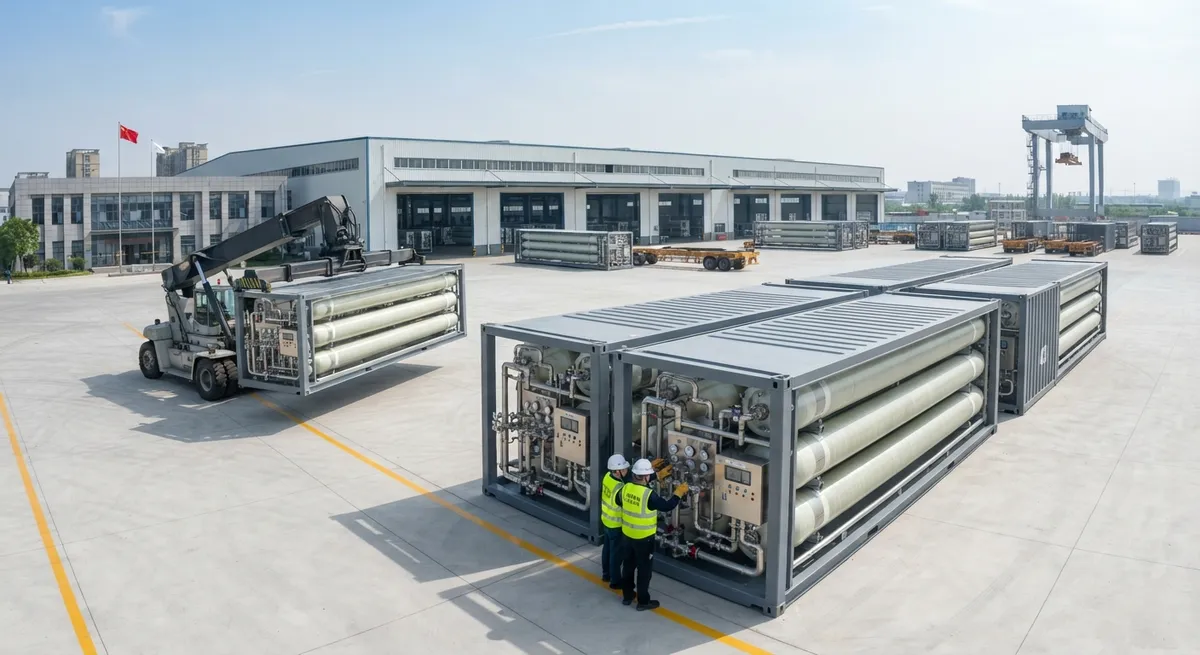
Hydrogen is rarely consumed where it is produced. Electrolysis plants, ammonia facilities, and industrial clusters sit far from the ports, factories, and refueling stations that need the gas, and moving hydrogen economically over distance has been a persistent bottleneck for the industr
Introduction
Hydrogen is rarely consumed where it is produced. Electrolysis plants, ammonia facilities, and industrial clusters sit far from the ports, factories, and refueling stations that need the gas, and moving hydrogen economically over distance has been a persistent bottleneck for the industry. Pipelines work for fixed, high-volume corridors but take years to build. Liquefaction is energy-intensive. The practical answer for flexible, medium-distance logistics is the container: a standard ISO box filled with high-pressure composite cylinders, loaded onto a truck, a railcar, or a ship, and delivered to wherever hydrogen is needed.
These systems are called Multi-Element Gas Containers (MEGCs), and they are entering a phase of industrial scale-up. In March 2026, Norwegian manufacturer Umoe Advanced Composites (UAC) began large-scale production at its new plant in Jiaxing, China — a 12,000-square-meter facility with potential annual capacity of up to 20,000 composite cylinders, roughly triple the company's previous global output. The first MEGCs built in China are already allocated to the Good Earth Green Hydrogen and Ammonia project in Australia, with further orders from a Power-to-X plant in Finland. This article examines what a Type IV MEGC is, how much hydrogen it carries, and what the Jiaxing scale-up means for the hydrogen supply chain.
What Is a Type IV MEGC?
A MEGC is an ISO container frame equipped with multiple pressure vessels, manifolded together so they fill and discharge as a single unit. The cylinders are Type IV composite vessels — a gas-tight polymer liner carrying a structural overwrap of resin-impregnated fiber — chosen for their low weight and high capacity. Where a single transport cylinder might hold a few hundred liters, a MEGC bundles nine to twenty-two vessels into one standardized module. Because the container meets ISO dimensions, it moves through the existing global intermodal system: a 20-foot unit on a truck, a 40-foot unit on a railcar or ship deck, with no special handling infrastructure.
UAC's standard range covers 20-foot, 40-foot, and 45-foot modules in standard and high-cube variants. A 20-foot MEGC packs nine cylinders with a combined water volume of 14,850 liters; a 40-foot high-cube unit carries 22 cylinders of 1,700 liters each for 37,400 liters of total storage volume. The cylinders operate at pressures up to 350 bar, and the module includes the manifold, valves, and safety systems needed for safe filling and delivery. The same hardware is suitable for compressed natural gas (CNG) and biogas, which gives operators a flexible asset that is not locked to hydrogen alone.
Umoe's Jiaxing Plant: Tripling Global Capacity
UAC's Jiaxing facility, completed in 2024 and brought into industrial production in early 2026, is the company's largest manufacturing base. Built to the same engineering and certification standards as its Norwegian operations, the 12,000-square-meter plant has potential annual capacity of up to 20,000 cylinders. UAC's CEO notes that the facility triples the company's global production capacity from day one, with potential for up to 24,000 cylinders per year across its Chinese and Norwegian operations. The plant also supports a special permit application that would allow UAC to supply the domestic Chinese market, extending its reach beyond exports.
The first deliveries demonstrate the global reach of containerized hydrogen logistics. The inaugural MEGCs produced in Jiaxing were shipped to the Good Earth Green Hydrogen and Ammonia (GEGHA) project in New South Wales, Australia — an integrated solar-powered hydrogen and ammonia facility being built by the Hiringa Sundown joint venture — comprising five units: two 20-foot and three 40-foot containers providing scalable storage for hydrogen transport and distribution. In parallel, UAC received an order from Finnish Power-to-X developer P2X Solutions for three 45-foot high-cube MEGCs for a hydrogen project in Finland, building on UAC's earlier deliveries of Type IV MEGCs for Hiringa Energy's first four hydrogen refueling stations in New Zealand.
How Much Hydrogen Can a MEGC Carry?
The capacity of a MEGC is defined by its cylinder count, cylinder volume, and operating pressure. The table below summarizes UAC's standard configurations at their rated pressures:
| Container configuration | Cylinders | Cylinder volume | Total water volume | H2 at 200 bar | H2 at 350 bar |
|---|---|---|---|---|---|
| 20' ISO standard | 9 | 1,650 L | 14,850 L | 222 kg | 356 kg |
| 20' ISO high cube | 11 | 1,650 L | 18,150 L | 271 kg | 435 kg |
| 40' ISO standard | 18 | 1,700 L | 30,600 L | 457 kg | 734 kg |
| 40' ISO high cube | 22 | 1,700 L | 37,400 L | 558 kg | 897 kg |
| 45' ISO high cube | 22 | 1,925 L | 42,350 L | 632 kg | 1,016 kg |
A single 40-foot MEGC at 350 bar therefore carries roughly 900 kilograms of hydrogen — enough to refuel a fleet of heavy-duty trucks for a day, or to supply an industrial site without a pipeline connection. Scaling a logistics operation means adding containers, not building infrastructure, which is the core economic appeal of the approach.
Glass Fiber vs. Carbon Fiber in Transport Cylinders
A point that surprises many specifiers is that UAC's Type IV transport cylinders are made with glass fiber, not carbon fiber. The choice is an economic one, and it highlights how material selection follows the application:
| Parameter | Glass fiber Type IV (transport) | Carbon fiber Type IV (vehicle) |
|---|---|---|
| Typical application | MEGC modules, station storage | Onboard vehicle tanks |
| Primary cost driver | Cost per kg H2 stored | Weight per kg H2 stored |
| Fiber cost | Low | High |
| Weight | Heavier per unit capacity | 40-70% lighter than steel |
| Operating pressure | Up to 350 bar | 350-700 bar |
| Best-fit logic | Fixed or wheeled storage, weight not critical | Payload- and range-critical mobility |
In a transport container, every kilogram of cylinder weight is carried by a truck or ship that is already moving the box, so the premium paid for carbon fiber buys little. Glass fiber delivers the lowest cost per kilogram of hydrogen stored, which is what matters in bulk logistics. In a vehicle, by contrast, every kilogram of tank weight reduces payload or range, and carbon fiber's weight advantage earns its higher price. For a carbon fiber supplier, the MEGC market is therefore not a direct fiber customer — but the vehicle tanks, station cascades, and high-pressure applications that grow alongside hydrogen logistics are.
Standards and Certification for Cross-Border Transport
Transporting pressurized hydrogen across borders is heavily regulated, and MEGC certification is part of the product's value. UAC's hydrogen transport modules are type-approved according to EN 12245, the European standard for fully wrapped composite gas cylinders, and comply with ADR, the European agreement on the international carriage of dangerous goods by road, and TPED, the EU's transportable pressure equipment directive. ISO containers are delivered in compliance with CSC requirements — the International Convention for Safe Containers — so they can be moved in the global container fleet. This stack of approvals is what allows a container built in Jiaxing to be filled in Australia and moved through multiple jurisdictions without re-qualification.
The Economics of Containerized Hydrogen Logistics
Containerized transport wins where pipelines and liquefaction do not. The economics are characterized by:
- Low entry threshold: A MEGC fleet scales by adding containers, so projects can start small and grow with demand instead of committing to pipeline capital.
- Intermodal flexibility: The same module moves by truck, rail, or ship, connecting ports, industrial zones, and refueling stations without dedicated infrastructure.
- Multi-gas optionality: Type IV MEGC hardware serves hydrogen, CNG, and biogas, so an asset bought for hydrogen retains value if the fuel mix shifts.
- Manufacturing scale: Facilities like Jiaxing, with 20,000-cylinder capacity, drive down cylinder cost through automation and volume — the same playbook that has worked in every other composite pressure vessel market.
Frequently Asked Questions
How much hydrogen does a 40-foot MEGC carry?
A 40-foot standard MEGC holds eighteen 1,700-liter Type IV cylinders for a total water volume of 30,600 liters, storing about 457 kilograms of hydrogen at 200 bar and 734 kilograms at 350 bar. The 40-foot high-cube version holds 22 cylinders and carries up to roughly 897 kilograms at 350 bar.
Why does Umoe use glass fiber instead of carbon fiber in its transport cylinders?
Because in transport containers the weight of the cylinders is carried by the truck or ship, so the premium for carbon fiber buys little value — the relevant metric is cost per kilogram of hydrogen stored, where glass fiber wins. Carbon fiber Type IV tanks are used where weight is critical, such as onboard vehicle tanks, where they can be 40-70 percent lighter than steel alternatives and operate at higher pressures.
What standards must a hydrogen MEGC meet for international transport?
Type IV MEGC modules are type-approved under EN 12245 and comply with ADR for road transport, TPED for transportable pressure equipment in the EU, and CSC for ISO container safety, allowing global movement by road, rail, and sea. National permits may also be required — UAC is pursuing a special permit to distribute within China, for example.
Conclusion
The start of large-scale production at UAC's Jiaxing plant marks a step change in the industrialization of hydrogen transport. Type IV MEGCs turn hydrogen logistics into a container problem — scalable, intermodal, and standardized — rather than an infrastructure problem, and the 20,000-cylinder capacity of the Jiaxing facility is a direct response to real orders for hydrogen and ammonia projects in Australia and Finland. As electrolyzer capacity grows around the world, containerized hydrogen transport will be one of the main channels connecting production to demand.
For companies in the composite pressure vessel and hydrogen supply chain, fiber selection, cylinder qualification, and supply planning are the decisive questions. Browse our carbon fiber and composite material range, or contact our engineering team to discuss materials and qualification support for your hydrogen storage and transport program.
Part of topic
Related Articles
- Carbon Fiber Tube for Sale: Comparing Listings and Avoiding Bad Specs
- Carbon Fiber Engine Parts: High-Temperature Performance for Racing and Performance Vehicles
- Carbon Fiber Body Parts: Automotive Exterior Panels and Structural Components
- Carbon Fiber Drone Body Manufacturing: Monocoque Design and Production Methods
- Carbon Fiber Drone Parts Supplier: FPV Frames, Arms and Structural Components
- Filament Wound Epoxy Tubes: Industrial Applications from Oil and Gas to Aerospace