
Hydrogen fuel cell buses and trucks are entering commercial service in growing numbers, and fleet operators are discovering that the storage tank is not a commodity component. It is a capital asset with a service life, an inspection regime, a maintenance burden, and an end-of-life cost
Introduction
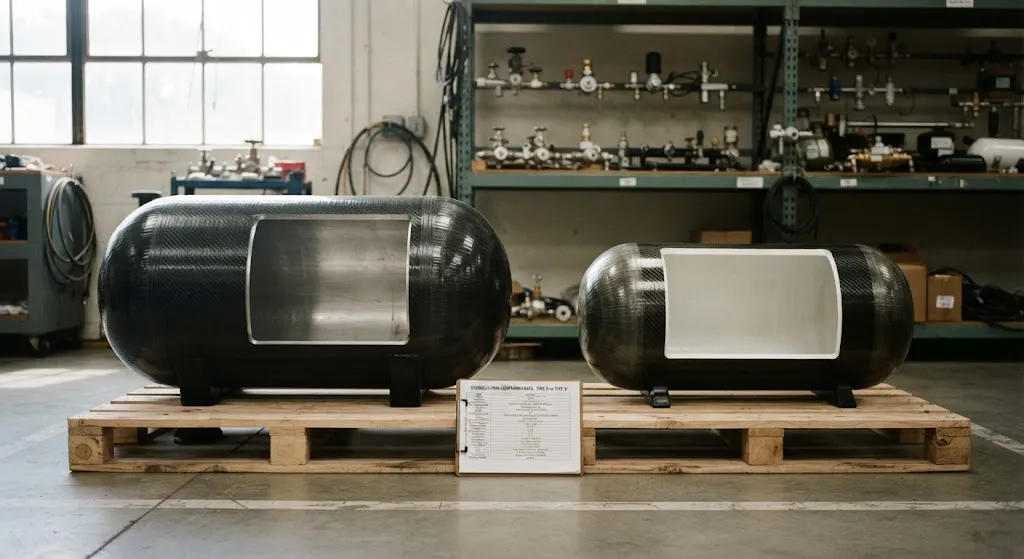
Hydrogen fuel cell buses and trucks are entering commercial service in growing numbers, and fleet operators are discovering that the storage tank is not a commodity component. It is a capital asset with a service life, an inspection regime, a maintenance burden, and an end-of-life cost — and those lifecycle costs differ sharply between the two dominant tank architectures. Type III tanks use a thin aluminum liner overwrapped with carbon fiber composite; Type IV tanks use a polymer liner with a full composite overwrap. The Type IV tank typically carries a higher sticker price, yet for heavy-duty duty cycles it delivers a substantially lower total cost of ownership.
This article quantifies that difference using published fleet data and manufacturer pricing for a representative transit bus application, identifies the cost categories that drive the gap, and defines the operating conditions under which the economics reverse.
Why TCO, Not Purchase Price, Decides
A hydrogen tank's purchase price represents only the first of five cost categories that a fleet will incur over its service life:
| Cost category | Type III | Type IV |
|---|---|---|
| Procurement (per tank) | Lower upfront | Higher upfront |
| Installation and integration | Heavier, more mounting structure | Lighter, simpler integration |
| Inspection and requalification | Shorter intervals, more tests | Longer intervals |
| Maintenance and replacement | Liner corrosion and embrittlement risk | Lower, but permeation monitoring |
| End-of-life disposal | Metal recovery value, higher handling | Composite disposal |
The purchase price gap — Type IV typically costs more per unit at low volume, but approaches or undercuts Type III at scale — is more than offset by the operating categories over a five-year horizon.
Five-Year TCO: Transit Bus Case Study
For a transit bus duty cycle of roughly 200–250 refuelings per year at 350 bar, the five-year TCO per tank breaks down as follows:
| Cost component | Type III (5-yr) | Type IV (5-yr) |
|---|---|---|
| Procurement (amortized) | $4,800–5,600 | $2,400–4,200 |
| Installation / integration | $1,200–1,800 | $500–900 |
| Inspection / requalification | $1,500–2,000 | $400–700 |
| Maintenance / replacement reserve | $1,600–2,400 | $300–600 |
| End-of-life handling | $400–600 | $200–400 |
| Total | $9,500–11,200 | $3,200–5,800 |
The resulting cost advantage for Type IV is roughly 60–66% over five years. The largest single contributor is not procurement but the inspection and maintenance categories, where Type III's aluminum liner imposes a materially heavier burden.
Where the 66% Advantage Comes From
Three factors drive the gap:
- Weight and integration: Type IV tanks are 25–40% lighter for the same usable capacity, which reduces mounting structure, frame reinforcement, and the parasitic energy penalty of carrying the tank itself. For a bus operating 60,000 km per year, that weight saving translates directly into fuel-cell efficiency and range.
- Inspection burden: Aluminum liners are subject to corrosion and, in hydrogen service, to embrittlement at the liner-composite interface. That drives shorter inspection intervals and more frequent requalification. Type IV's polymer liner is immune to galvanic corrosion and requires less frequent intervention, though it must be monitored for permeation.
- Maintenance and replacement reserves: Type III tanks are more likely to require early replacement or liner repair within the five-year window, and the reserve provisioned for that risk is substantial. Type IV's failure mode — liner cracking that produces a detectable leak before the composite fails — is more predictable and cheaper to manage.
Procurement price, the category operators focus on, is the smallest part of the difference.
Sensitivity: When Type III Wins
The 66% advantage is not universal. It narrows or reverses under three conditions:
- Very low utilization: A vehicle that refuels only a few dozen times per year accumulates fewer cycles, so the fatigue and inspection advantages of Type IV are realized more slowly. Below roughly 50 refuelings per year, the higher upfront cost of Type IV may not amortize within the ownership period.
- Permeation-critical duty: In enclosed or poorly ventilated applications, Type IV's higher baseline permeation rate through the polymer liner can require additional ventilation or monitoring, eroding part of the advantage.
- Very high pressure with short life: For 700 bar passenger-vehicle tanks with a short planned service life, Type III's manufacturing maturity and simpler certification can make it competitive.
For heavy-duty fleets operating daily duty cycles over five or more years, however, the Type IV advantage is robust.
Frequently Asked Questions
Is the 66% cost advantage based on purchase price or total cost of ownership?
It is a total cost of ownership figure covering five years of operation, including procurement, installation, inspection, maintenance reserves, and end-of-life handling. On purchase price alone, Type IV is often more expensive per unit at low volume; the advantage emerges only when lifecycle costs are included.
What is the single largest cost driver in the comparison?
Inspection and requalification, followed by maintenance and replacement reserves. Type III's aluminum liner is subject to corrosion and hydrogen embrittlement, which shortens inspection intervals and increases the risk of early replacement. These categories, not procurement, produce most of the gap.
When should a fleet choose Type III instead?
Type III remains competitive for very low-utilization vehicles (fewer than roughly 50 refuelings per year), for permeation-critical enclosed applications, and for short-life high-pressure passenger-vehicle tanks where manufacturing maturity matters more than lifecycle cost.
Conclusion
For heavy-duty hydrogen fleets, the tank decision should be made on total cost of ownership, not purchase price. Over a five-year duty cycle, Type IV tanks deliver roughly 60–66% lower TCO than Type III — a gap driven primarily by lighter integration, lower inspection burden, and reduced maintenance risk. Fleet operators evaluating storage should model all five cost categories against their actual duty cycle, and treat the Type III versus Type IV choice as a lifecycle decision rather than a procurement one.
For buyers sourcing carbon fiber hydrogen storage, the key questions are the demonstrated cycle life, the inspection requirements, and the total cost model behind the tank. Explore our carbon fiber products for hydrogen storage applications, or contact our engineering team to discuss tank selection and lifecycle economics for your fleet program.
Part of topic
Related Articles
- Carbon Fiber Mooring for Floating Offshore Wind: Fatigue and Corrosion in Deep Water
- Carbon Fiber Bicycle Frame Optimization: Layup Design and Manufacturing for Competitive Racing
- Carbon Fiber CFRP Retrofit for Infrastructure: Bridge and Building Seismic Strengthening
- Carbon Fiber Medical Imaging Equipment: Lightweight Gantry and Couch Structures for MRI/CT
- Carbon Fiber EV Battery Enclosures: Crash Safety and Electromagnetic Shielding Design
- Carbon Fiber Structures for Low-Altitude Economy: UAV Airframes and eVTOL Components