
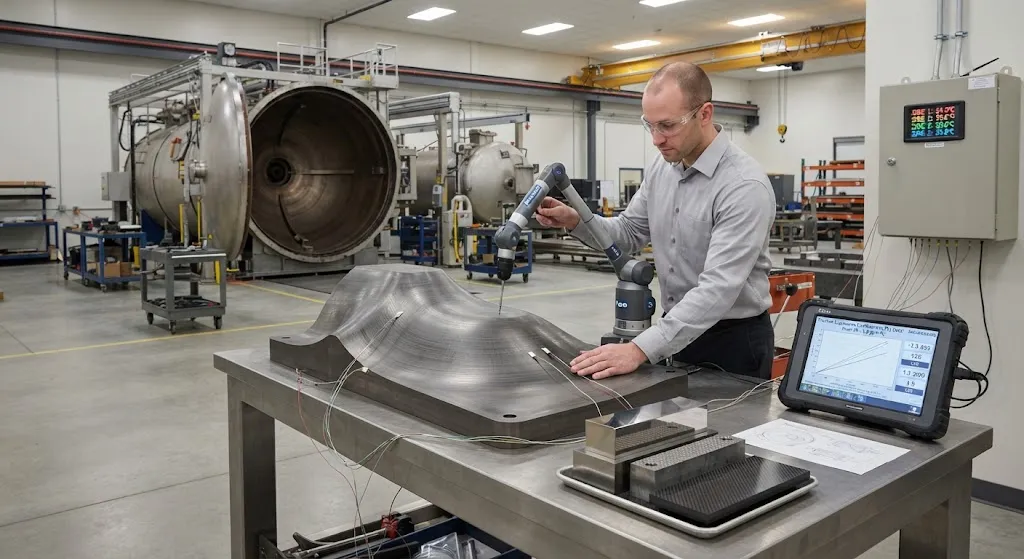
Every cured carbon fiber part carries the geometric signature of the tool it was cured on. During an autoclave cure at 180°C, the tool and the part expand at different rates: a metal tool grows with temperature, while a CFRP part grows only slightly in-plane because its reinforcement ho
Introduction
Every cured carbon fiber part carries the geometric signature of the tool it was cured on. During an autoclave cure at 180°C, the tool and the part expand at different rates: a metal tool grows with temperature, while a CFRP part grows only slightly in-plane because its reinforcement holds the dimensions nearly fixed. When the assembly cools back to room temperature, that difference in expansion becomes a permanent dimensional error locked into the part. On a meter-scale aerospace part this mismatch can reach roughly 0.3 millimeters — far beyond the tolerance band required for flight-critical interfaces.
Managing this error is the job of CTE engineering in tool design. The designer chooses a tool material whose coefficient of thermal expansion, combined with the geometry of the layup, produces an acceptable mismatch. Three families of tooling dominate: Invar 36, hardened tool steel, and CFRP tooling. Each occupies a different point on the cost-versus-tolerance tradeoff. This article quantifies those differences, explains the mechanism of CTE-driven error, and gives practical rules for selecting and designing production tools for autoclave cure.
Why CTE Mismatch Produces Dimensional Error
The mechanism is best understood as a differential contraction problem. The tool and the part are bonded across their interface during cure at high temperature. If the part were rigidly attached to the tool, it would be forced to follow the tool's shrinkage on cooling. A carbon fiber layup resists this because the fibers carry a very low coefficient of thermal expansion in their own direction, typically in the range of -1 to +0.5 ppm per degree Celsius in-plane for a balanced quasi-isotropic laminate, compared with roughly 12 ppm per degree Celsius for common mold steel.
The resulting error scales with three variables: the cure temperature difference from room temperature, the length of the part, and the difference between the CTE of the tool and the effective in-plane CTE of the laminate. The table below summarizes the practical numbers a designer works with:
| Tool Material | CTE (ppm/°C) | Relative Cost | Typical Tooling Life | 180°C Cure Mismatch on 1 m Part |
|---|---|---|---|---|
| Invar 36 | 1.2-1.6 | 3.5-5x steel | Multiple programs | 0.02-0.05 mm |
| Tool steel/CRES | 10-14 | 1x (baseline) | High, repairable | 0.12-0.18 mm |
| CFRP tooling | -0.5 to 0.5 (in-plane) | 1.5-2.5x steel | Limited, heat-cycle dependent | 0.01-0.03 mm |
Two engineering corrections modify these raw numbers. First, designers bias the tool dimensions at room temperature so that the part comes to size at the cure temperature. Second, for parts with a defined ply schedule, the coefficient can be computed from the laminate stacking rather than measured, allowing the tool to be compensated before machining. The remaining uncorrectable residual is the tolerance risk that the material selection must absorb.
Invar 36: The Standard-Bearer for Tight Tolerance
Invar 36 is a nickel-iron alloy containing roughly 36 percent nickel, engineered so that its thermal expansion nearly cancels over the working temperature range of an autoclave. Its CTE of about 1.2-1.6 ppm per degree Celsius is close enough to the near-zero in-plane CTE of a carbon fiber laminate that the mismatch on a meter-scale part at 180°C — on the order of 0.02-0.05 mm — is within the accuracy of many coordinate measuring machines.
This exceptional stability makes Invar the default choice for the most tolerance-critical aerospace parts: wing skins, spar caps, control surfaces, and cowl doors where closeout gaps and flushness requirements dominate. The penalties are cost and schedule. Invar billet is several times more expensive than tool steel, the material is more difficult to machine, and welded Invar tools require careful control of filler metal and heat input to prevent localized CTE drift. As a result, Invar is reserved for parts where the tolerance genuinely demands it rather than applied indiscriminately.
Tool Steel and CRES: Economics at the Cost of Compensation
Tool steel and corrosion-resistant steel (CRES) bring the CTE problem in reverse: a high coefficient of expansion that the designer must fully compensate. Because steel's 10-14 ppm per degree Celsius is an order of magnitude above the laminate's, the room-temperature tool geometry must be pre-biased so the part comes to draw at the cure temperature. This compensation is routine and well understood, but it leaves less margin for error and makes the tolerance sensitive to every source of process variation — cure temperature uniformity, vacuum bag pressure, and resin shrinkage.
Steel tools remain the workhorse for high-volume and less-tolerance-critical production. They are inexpensive, durable, repairable by welding, and thermally stable over hundreds of cycles. Many airframe producers use steel or CRES tools for parts within looser tolerances, then fall back on Invar or CFRP for the critical interfaces. The choice is a systems-level tradeoff: spend more on material to simplify compensation, or spend more on engineering to make a cheaper material meet tolerance.
CFRP Tooling: Matching the Part with a Composite Mold
CFRP tooling is a tool made from the same carbon fiber and resin system that the part will use, cured against a master, and then used to cure production parts. Because its in-plane CTE is near zero — matching the part — CFRP tools deliver very low mismatch, comparable to Invar, at lower material cost and weight. This is attractive for large, monolithic parts where a heavy steel tool would distort under its own weight, and for vacuum-bag-only or low-pressure processes.
The tradeoffs are operational. A CFRP tool has a limited heat-cycle life before microcracking degrades the surface and the tool must be refurbished or replaced. It is manufactured through a two-stage process — build the master, then build the tool — that carries its own schedule. Tool-to-master mismatch and tool-to-part CTE behavior must be validated with coupon and metrology programs. CFRP tooling is the strongest growth area in autoclave tooling because it directly addresses cost and weight, but it demands disciplined process control to be reliable over its service life.
Selecting the Right Tooling Material
The selection decision reduces to a handful of questions about the part, the production volume, and the tolerance budget:
- Tolerance criticality: If the part has closeout gaps, seal surfaces, or flushness requirements in the flight-critical range, Invar or CFRP tooling is justified; otherwise steel with compensation usually suffices.
- Part size and weight: Large monolithic panels favor light CFRP tools that resist sag, while small stiff parts tolerate heavier steel tools.
- Production volume and life: High-volume, long-running programs amortize the higher Invar cost; short runs on tight tolerance may still favor Invar for schedule certainty over Class-A surface rework.
- Process temperature: Near-180°C processes are within Invar and CFRP working ranges; higher-cure or bismaleimide systems at 200°C and above narrow the choice and may force Invar.
- Coefficient certainty: If the laminate coefficient can be computed from a controlled ply schedule, compensation is easier and cheaper materials become viable.
In practice the decision is rarely a single material. Hybrid tooling — a steel substructure carrying an Invar face sheet, or a machined steel tool with CFRP facings — is common, combining the economics of a rigid base with the tolerance characteristics of the correct surface material.
Design and Process Checks for CTE Control
Even the correct material will fail if the process does not protect the intent. The tool base must be designed so thermal gradients do not bow the working surface; venting and vacuum channels must allow uniform pressure; and the tool must be verified dimensionally at both room and cure-circulation temperatures so the compensation assumption holds across the operating envelope. Metrology of the first article against the CAD model, followed by a process capability study across multiple cure cycles, gives the confidence that a single tolerance number cannot provide. For CFRP tools, periodic surface inspection and thermal-cycle tracking are essential because degradation accumulates invisibly over the tool's life.
Frequently Asked Questions
Why does CTE mismatch matter more on large parts than small ones?
Dimensional error from thermal expansion scales with part length. CTE is expressed per unit length, so a mismatch of a few ppm per degree Celsius produces error proportional to the part's dimension. A 0.1-meter part carries an order of magnitude less absolute error than a 1-meter part under identical conditions, and a 4-meter wing skin carries four times the error of a 1-meter panel. As aircraft and wind turbine components grow, the same tool-material decision that was acceptable historically now fails to hold tolerance, forcing designers up the cost curve toward Invar and CFRP tooling.
Can I compensate entirely for a steel tool and avoid Invar?
Yes, within limits. Steel tool compensation works by biasing the room-temperature dimensions so the part comes to size at the cure temperature, and this is a routine, well-understood practice that meets tolerance on the majority of aerospace parts. The limitation is margin: compensated steel tools leave less room for process variation because every source of error — cure temperature drift, nonuniform pressure, resin shrinkage — lands on top of a large pre-biased coefficient. When the tolerance band is tight and the process has real scatter, the remaining residual pushes parts out of spec, which is precisely when designers switch to Invar or CFRP to recover margin.
How is a composite laminate's in-plane CTE determined for tool compensation?
Two routes exist. Analytically, the laminate CTE can be computed from the ply schedule, fiber and matrix properties, and laminate theory once the stacking sequence is defined; this is fast and useful during design. Empirically, coupons are cut from a representative laminate and measured in a dilatometer over the cure temperature range, giving a direct value that includes real processing variation. Most programs use the analytical value for initial tool bias and confirm or update it with coupon measurement during first-article validation. The in-plane value for balanced quasi-isotropic carbon fiber laminates typically falls between -1 and +0.5 ppm per degree Celsius.
Conclusion
CTE matching is the quiet discipline that determines whether a cured carbon fiber part meets its flight-critical dimensions. Invar 36 delivers the lowest mismatch for the most demanding interfaces, steel offers economy at the cost of full compensation and reduced margin, and CFRP tooling matches the part while cutting weight at the expense of service life. The correct choice depends on tolerance criticality, part size, volume, and coefficient certainty — and increasingly it is a hybrid of all three rather than a single material.
For engineers building autoclave tooling strategies, the practical path is to compute the laminate coefficient, define the real tolerance band, and select the material that holds margin across the process window. Explore our range of carbon fiber materials and laminates for tooling and structural applications, or contact our engineering team to discuss tool design and laminate coefficient characterization for your program.
Part of topic
Related Articles
- Bio-Based Carbon Fiber Precursors: Lignin and Polyethylene for Low-Cost Production
- Large-Tow Carbon Fiber Cost Analysis: 48K vs 60K Price-Performance Comparison
- Carbon Fiber-Resin Interface Bonding: Surface Treatment and Coupling Agent Optimization
- Digital Twin for Carbon Fiber Manufacturing: Real-Time Process Monitoring and Defect Prevention
- Thermoplastic Carbon Fiber Welding for Automotive: Ultrasonic and Induction Welding Process Windows
- Large-Tow Carbon Fiber Wet Spinning: Process Optimization for 48K/60K Production Efficiency
Interested in Our Products?
Contact our team for competitive pricing and technical specifications.
Get a QuoteRelated Products
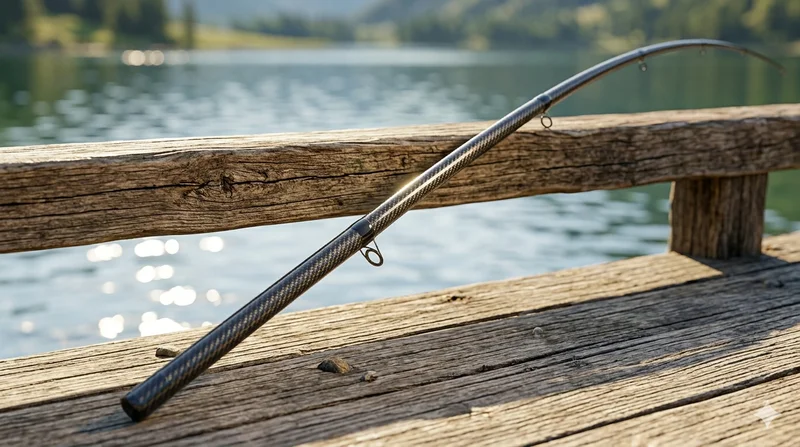
Carbon Fiber Fishing Rod Blank
High-quality carbon fiber fishing rod blank manufactured from multiple grades of Toray carbon fiber cloth. Available in a wide range of lengths, powers, and actions for freshwater and saltwater applications. Suitable for OEM rod building.

Carbon Fiber Plate — 3K Twill T700 1.5mm
Thin 1.5mm carbon fiber plate with 3K twill weave surface. Lightweight and stiff, commonly used for covers, panels, drone bodies, and applications requiring a premium aesthetic appearance.

Square Carbon Fiber Tube — 3K Twill T700
Square cross-section carbon fiber tube manufactured with 3K twill weave for torsional strength. Preferred for structural frames, trusses, and support columns where rectangular geometry offers design flexibility.
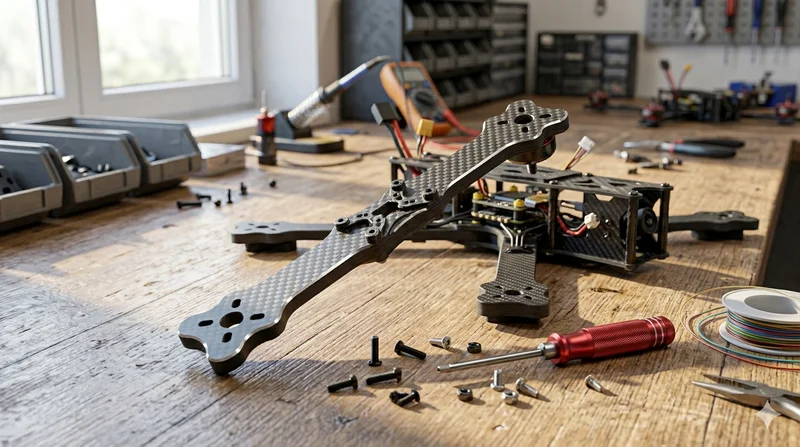
Carbon Fiber Drone Arm
Precision-molded carbon fiber drone arm combining unidirectional fiber for stiffness and woven layers for torsional strength. Designed for FPV, photography, and industrial drone platforms. Each arm is CNC-machined to exact specifications.
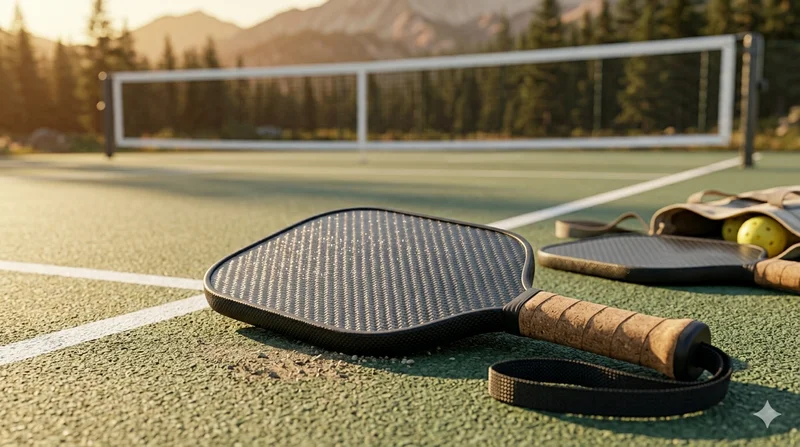
Carbon Fiber Pickleball Paddle
High-performance pickleball paddle with Toray T700 carbon fiber face and polypropylene honeycomb core. Delivers excellent power-to-weight ratio, spin generation, and vibration dampening for competitive play.