
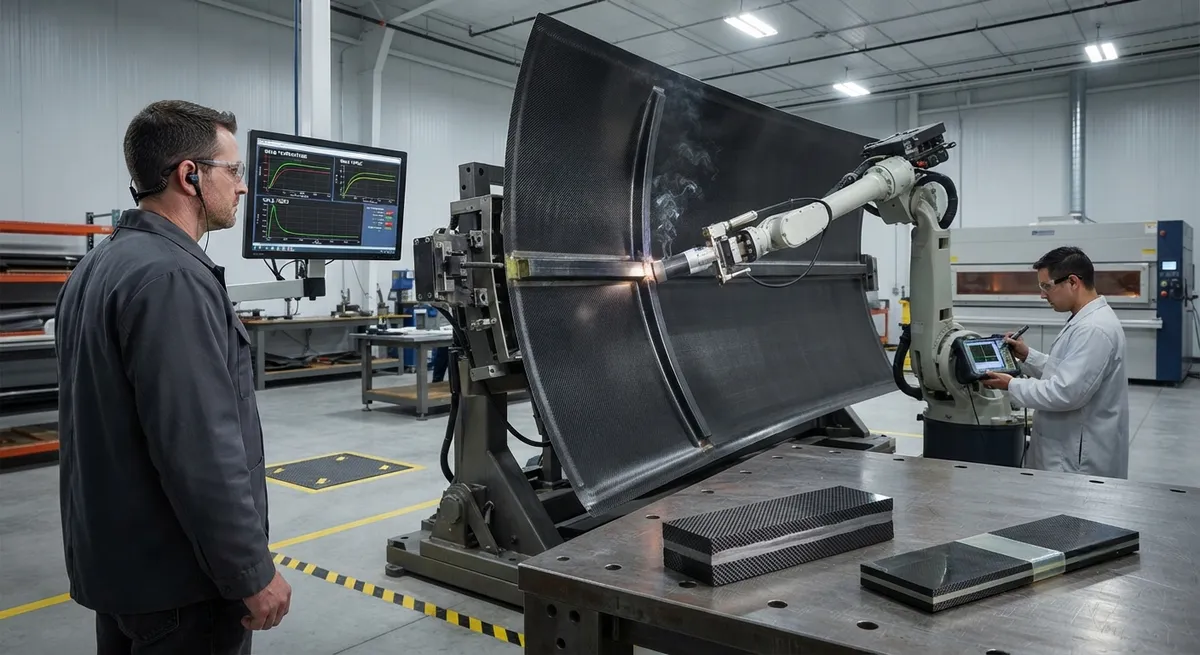
Thermoplastic composite joining has become the critical production question in modern aerospace manufacturing. Carbon fiber reinforced thermoplastics — the material of choice for next-generation fuselage barrels, wing components, and automotive body structures — can be joined two fundam
Introduction
Thermoplastic composite joining has become the critical production question in modern aerospace manufacturing. Carbon fiber reinforced thermoplastics — the material of choice for next-generation fuselage barrels, wing components, and automotive body structures — can be joined two fundamentally different ways: fusion welding, which melts the thermoplastic matrix at the joint interface, and adhesive bonding, which uses a separate adhesive layer to connect the parts. The choice between them determines production rate, inspectability, repair strategy, and final joint performance.
This article compares the two technologies across the criteria that matter most to engineers and buyers: joint strength and damage tolerance, process speed and automation potential, inspectability and certification, and lifecycle cost. It provides a data-driven framework for choosing the right joining method for aircraft and automotive thermoplastic structures.
How Each Joining Method Works
The two methods are based on fundamentally different physics. Understanding the difference is essential to interpreting their performance trade-offs:
- Fusion welding: Heat melts the thermoplastic matrix at the faying surfaces, and pressure consolidates the molten polymer so that, on cooling, the two parts become a single continuous material. No foreign substance is introduced at the joint line. Induction, resistance, ultrasonic, and laser welding are the main process variants.
- Adhesive bonding: A thermoset or thermoplastic adhesive is applied between the prepared part surfaces and cured or solidified to bond them. The joint contains a distinct adhesive layer with its own mechanical properties, and surface preparation — grit blasting, plasma treatment, or primer application — is critical to bond quality.
Fusion welding is only possible for thermoplastic matrices, because thermosets cannot be re-melted. Adhesive bonding works for both thermoset and thermoplastic composites, which is why the joining strategy often influences material selection at the design stage, not just at the assembly stage.
Joint Performance Comparison
Joint strength and damage tolerance are the first criteria engineers evaluate. The table below compares typical single-lap shear strength and related properties for welded and adhesively bonded thermoplastic joints:
| Property | Fusion Welded Joint | Adhesively Bonded Joint | Notes |
|---|---|---|---|
| Lap shear strength | 30-45 MPa | 25-40 MPa | Welding typically 10-20% higher |
| Failure mode | Cohesive (in the material) | Adhesive or substrate | Welding avoids adhesion failure risk |
| Moisture sensitivity | Low | High | Adhesive absorbs moisture, degrades hot-wet strength |
| Impact resistance | Good | Good | Toughened adhesives approach welding |
| Fatigue performance | Excellent | Good | No weak interface in welded joints |
| Temperature capability | Matrix-limited | Adhesive-limited | Adhesives usually fail at lower temperature |
Welded joints consistently achieve higher lap shear strength because the load path crosses no separate material interface — the joint is the parent material itself. Adhesive joints are more sensitive to surface preparation quality, moisture uptake, and service temperature, all of which reduce design allowables. However, adhesive bonding offers a critical advantage: it can join thermoset and thermoplastic parts, and it tolerates geometric mismatch better than welding.
Process Speed and Automation
Production rate is where the two methods diverge most sharply, especially for the high-rate manufacturing targets of modern aircraft programs:
| Factor | Fusion Welding | Adhesive Bonding |
|---|---|---|
| Cycle time per joint | Seconds to minutes | Minutes to hours (cure) |
| Surface preparation | Minimal (degrease only) | Extensive (abrasion, plasma, primer) |
| Cure or cooling step | Cooling only, no chemical cure | Full adhesive cure cycle required |
| Automation potential | Very high | Moderate |
| In-line monitoring | Built-in (temperature, pressure) | Indirect (bondline thickness, cure state) |
Welding eliminates the two slowest steps in adhesive bonding: surface preparation and adhesive cure. A welded joint can be produced in a fraction of the time, and the process parameters — temperature, pressure, and welding time — are directly measurable, enabling closed-loop quality control. This is why programs targeting high production rates, such as single-aisle aircraft fuselage barrel sections, are evaluating welding as the baseline joining process. Adhesive bonding remains competitive for lower-rate applications, complex geometries, and joints where welding access is impractical.
Inspectability and Certification
Certification requirements are shaped by the ability to inspect a joint and prove it is sound. This is the most consequential difference between the two methods for aerospace:
- Welded joints: The joint is material-to-material with no foreign layer, so conventional ultrasonic inspection can detect voids, kissing bonds, and disbonds reliably. Because the process is parametric and monitorable, statistical process control can demonstrate joint quality without 100% inspection in some applications.
- Adhesive bonds: Certification authorities have long treated structural adhesive bonds as difficult to certify for primary structure, because NDT cannot yet reliably detect weak adhesion (poor chemical adhesion that passes mechanical inspection). This has driven the aerospace industry to require process control, proof-loading, and cautious design allowables for bonded primary structure.
The inspectability advantage of welding is substantial: the absence of a distinct bondline removes the weakest link that adhesive certification must work around. Programs such as the next generation of commercial aircraft thermoplastic fuselage concepts cite weld inspectability as a key driver for choosing fusion joining over bonding for primary structure.
Lifecycle Cost and Repair
Beyond the factory, the two methods differ in maintenance and repair economics:
- Welded structure repair: Damaged thermoplastic structure can be re-welded or welded-patched with the same process, restoring parent-material properties. Repair is fast and does not require adhesive shelf-life management.
- Bonded structure repair: Repairs require adhesive mixing, surface preparation, and cure cycles, and the repaired bondline inherits the certification challenges of bonded joints.
- Disassembly: Welded joints can be re-melted for controlled disassembly; bonded joints generally cannot be separated without damage.
For high-volume automotive applications, welding's shorter cycle time translates directly into lower cost per joint. For aerospace, the reduced inspection burden and simpler repair can lower both initial manufacturing cost and through-life support cost, though welding equipment is specialized and the process demands higher precision in tooling.
Frequently Asked Questions
Is welding always stronger than adhesive bonding for thermoplastics?
In most cases, yes, fusion welding produces higher lap shear strength than adhesive bonding, typically 10-20% higher for comparable joints. The reason is structural: a welded joint has no separate adhesive layer, so the load path remains entirely within the parent material, eliminating the adhesion interface as a failure location. Welded joints also suffer less from moisture and temperature degradation. However, welding is not always the better engineering choice. Adhesive bonding can join thermoset parts to thermoplastic parts, tolerates larger geometric mismatch, and can distribute load over large bond areas more forgivingly. For joints where the adherends are thin or where disassembly is never needed, bonding can be perfectly adequate and cheaper to tool. The right answer depends on the application, not a blanket rule.
Why is welded thermoplastic structure easier to certify than bonded structure?
Certification difficulty in adhesive bonding stems from the inability of nondestructive testing to reliably detect weak adhesion — a bond that passes ultrasonic inspection but fails chemically can still separate in service. This forces conservative design allowables and stringent process control for bonded primary structure. Welded joints are material-to-material with no adhesive layer, so conventional ultrasonic methods can detect voids, porosity, and disbonds in the weld zone with confidence. In addition, welding parameters such as temperature, pressure, and consolidation time are directly measurable during the process, enabling closed-loop monitoring and statistical process control. Together these give certifying authorities much stronger evidence of joint integrity for welded structures.
Which welding process is best for thermoplastic composite aircraft parts?
There is no single best process; the choice depends on joint geometry and production volume. Induction welding is well suited to long continuous joints such as fuselage skin-to-stringer and skin-to-frame joints, because it works without direct heating-element contact and can be automated with robots. Resistance welding is simple and inexpensive but leaves an embedded heating element at the joint. Ultrasonic welding offers very short cycle times and is ideal for spot welds, brackets, and small to medium joints. Laser welding provides precise heat input and high speeds for lap joints with accessible edges. Production programs typically combine processes: continuous ultrasonic welding for stringers, induction welding for long frame joints, and spot welding for assembly tacking. The best approach is to design the joint geometry around the welding process early, rather than selecting a process after the design is frozen.
Can adhesive bonding be used at all for primary aircraft structure?
Yes, it is used widely in current aircraft — most composite primary structure in service today is bonded, including many fuselage and empennage assemblies. The key is that certification demands either a robust process-control approach or a damage-tolerant design philosophy where the structure is designed to survive a complete bondline failure. Modern programs combine rigorous surface preparation control, in-process monitoring, proof-testing of critical joints, and generous design allowables. The trade-off is weight and cost: bondlines must be sized conservatively, and the process-control burden is heavy. For thermoplastic structures, welding removes much of this burden because the inspectability story is stronger, which is why next-generation thermoplastic fuselage concepts favor welding for the largest, most safety-critical joints.
Conclusion
The choice between welding and adhesive bonding for thermoplastic composites is a systems decision that reaches far beyond joint strength. Welding delivers higher lap shear strength, faster cycle times, better inspectability, and simpler repair, making it the leading candidate for high-rate aerospace and automotive production. Adhesive bonding retains advantages in joining dissimilar materials, accommodating geometric mismatch, and tooling simplicity for lower-rate applications. The winning strategy is to decide the joining method early and design the parts, tooling, and process controls around it.
For engineers evaluating joining technology for new thermoplastic programs, start with the production rate target and certification constraints, then select the process — or process combination — that fits. Explore our carbon fiber products and thermoplastic composite capabilities, or contact our engineering team to discuss joining process selection and joint qualification for your aircraft or automotive program.
Part of topic
Related Articles
- Carbon Fiber Drone Blades and Propellers: Stiffness, Balance and Noise Reduction
- Fiberglass Filament Wound Tubes: Cost-Effective Alternative to Carbon Fiber
- Filament Wound Epoxy Tube Design: Wall Thickness, Fiber Angle and Load Optimization
- Filament Wound Epoxy Tubes: Testing Standards and Quality Assurance
- Filament Wound Epoxy Tubes Manufacturing: Process and Quality Control
- Filament Wound Fiberglass Tube: Process Parameters and Performance vs Carbon Fiber
Interested in Our Products?
Contact our team for competitive pricing and technical specifications.
Get a QuoteRelated Products

Carbon Fiber Plate — 3K Twill T700 1.5mm
Thin 1.5mm carbon fiber plate with 3K twill weave surface. Lightweight and stiff, commonly used for covers, panels, drone bodies, and applications requiring a premium aesthetic appearance.
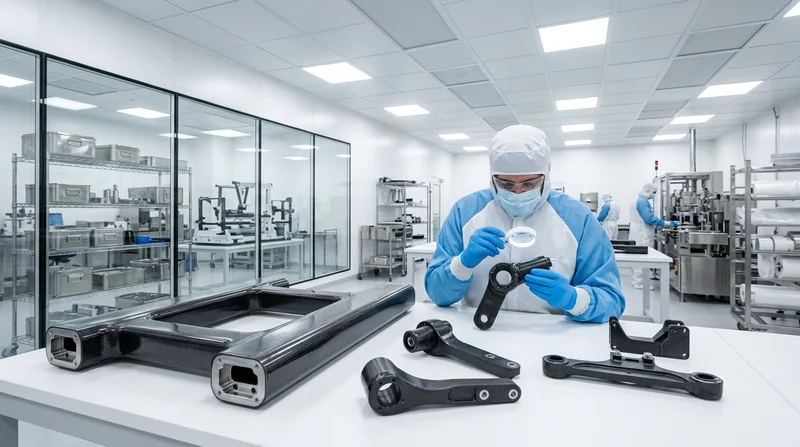
Custom Carbon Fiber Medical Device Components
Medical-grade carbon fiber components manufactured for imaging equipment, surgical instruments, and patient support systems. Carbon fiber's radiolucency (X-ray transparency) and high strength-to-weight ratio make it ideal for CT scanner beds, wheelchair frames, surgical robot arms, and MRI-compatible accessories. Biocompatible resin systems available.
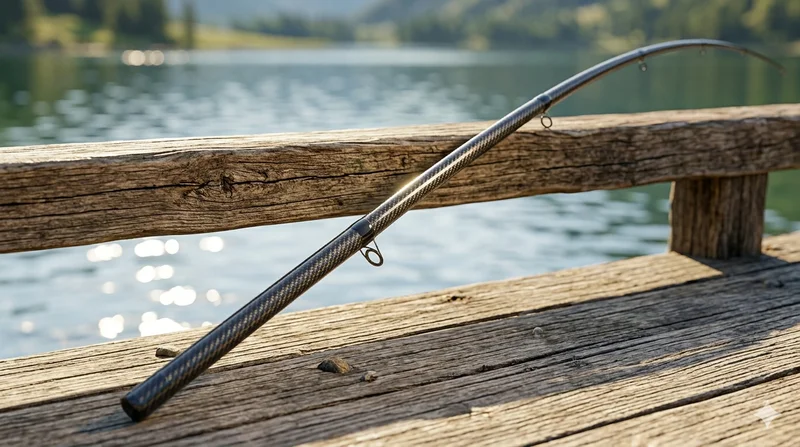
Carbon Fiber Fishing Rod Blank
High-quality carbon fiber fishing rod blank manufactured from multiple grades of Toray carbon fiber cloth. Available in a wide range of lengths, powers, and actions for freshwater and saltwater applications. Suitable for OEM rod building.

Square Carbon Fiber Tube — 3K Twill T700
Square cross-section carbon fiber tube manufactured with 3K twill weave for torsional strength. Preferred for structural frames, trusses, and support columns where rectangular geometry offers design flexibility.
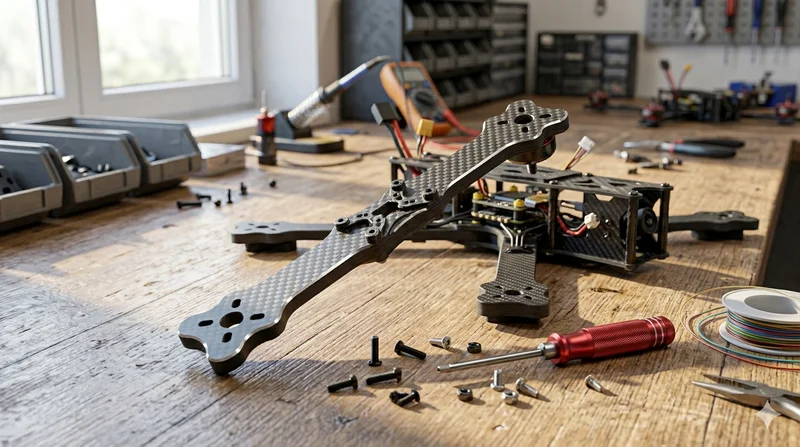
Carbon Fiber Drone Arm
Precision-molded carbon fiber drone arm combining unidirectional fiber for stiffness and woven layers for torsional strength. Designed for FPV, photography, and industrial drone platforms. Each arm is CNC-machined to exact specifications.