
Erosion of the leading edge is the quiet drain on wind farm revenue. The edge operates at the highest relative speed of any blade surface, and rain, hail, sand and insects gradually turn its smooth profile into a rough, pitted zone that degrades aerodynamic efficiency for the remaining
Introduction
Erosion of the leading edge is the quiet drain on wind farm revenue. The edge operates at the highest relative speed of any blade surface, and rain, hail, sand and insects gradually turn its smooth profile into a rough, pitted zone that degrades aerodynamic efficiency for the remaining life of the blade. Published studies link a mature erosion state to annual energy production losses of 1-2 percent, and cumulative lifetime penalties of 5-25 percent for untreated edges at harsh sites. On a modern 5-megawatt turbine producing roughly 11 gigawatt-hours per year, one percent of lost production is a six-figure revenue loss by the end of the blade's life.
The industry has responded with a patchwork of tape, coating and filler repairs, all applied in the field and all with a limited service interval. The EU RECREATE project has demonstrated a fundamentally different option: a factory-made leading edge, preformed as a separate component and attached with a detachable bonding system, that can be exchanged on site without removing the blade. This article quantifies the erosion penalty, compares the current repair routes, and assesses the economics of treating the leading edge as a replaceable wear part.
How Erosion Degrades Annual Energy Production
Erosion damage begins as microscopic pits where water droplets strike the edge at tip speeds of 70-100 meters per second. The pitting grows into roughness that thickens the boundary layer, increases drag and reduces lift, lowering the aerodynamic efficiency of the outboard blade section where most of the torque is generated. The progression is not linear, and the losses compound because the damaged edge remains in service for years until repair access is scheduled. Typical stages are summarized below:
| Erosion stage | Typical onset | AEP penalty | Observation |
|---|---|---|---|
| Initiation (pitting) | 2-4 years | Below 0.5% | Visible only on close inspection |
| Roughness growth | 4-8 years | 1-3% | Trailing noise and performance shortfall |
| Mature erosion | 6-12 years | 3-7% | Deep pits, fiber exposure |
| Severe damage | 8-15 years | 5-25% | Delamination, structural repair triggered |
Two observations follow from the table. First, the financial damage accumulates mainly in the mature and severe stages, when the blade is still structurally sound and fully able to generate power — the erosion penalty is pure lost revenue, not wear of a failed part. Second, because the damage is concentrated on a narrow strip, the rest of the blade carries no efficiency penalty at all, which is exactly the situation where replacing the strip restores performance without touching the healthy structure.
The Current Repair Landscape and Its Limits
Every existing repair route is a field operation with a limited interval. The most common approaches are:
- Elastomeric tape: polyurethane tapes applied to the outboard edge shield the surface for 2-4 years, then peel or erode and must be stripped and reapplied.
- Coating reapplications: polymer-based erosion protection coats are built up on site, requiring surface preparation, weather windows and curing time, with effective lives of 3-5 years.
- Filler and gelcoat repairs: localized pitting is ground out and refilled; fast and cheap but short-lived, often repeated annually at severe sites.
- Full edge shell replacement: the entire edge zone is cut away and a new shell is bonded in place; this is the high-end repair, often requiring blade removal on offshore turbines.
The structural weakness of this landscape is the access cost. A single blade on an offshore turbine takes weeks of planning and six-figure sums to bring down, so tape and coating repairs are often deferred until the erosion has compounded across several years. The industry needs an option that restores the erodible surface to factory condition in a scheduled maintenance window, without a crane and without the variability of field-applied coatings.
The Replaceable Leading Edge Concept
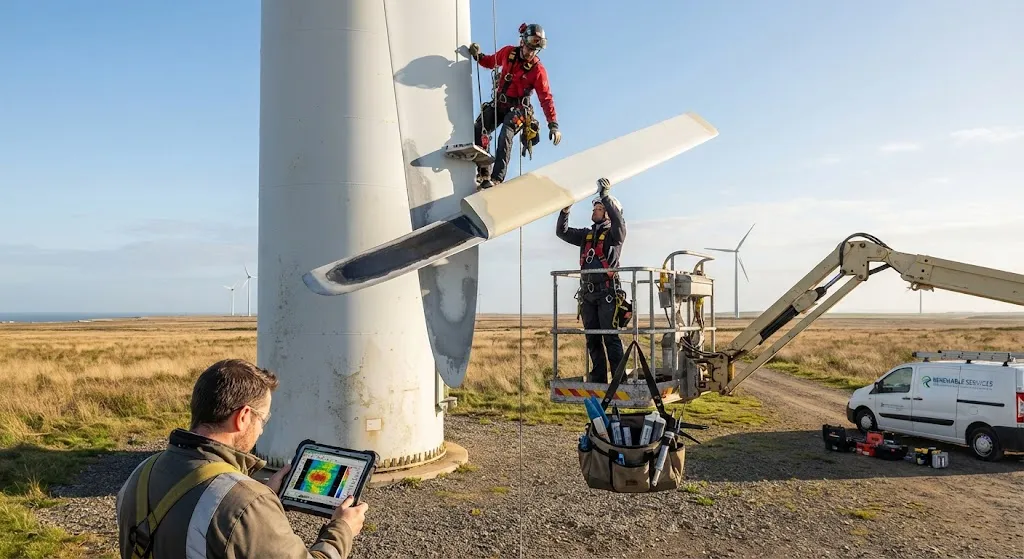
The RECREATE demonstration answers that need by moving the erosion protection from a field-applied coating to a factory-made component. The leading edge is preformed — in the demonstrator, from a natural-fiber thermoplastic — and attached to the blade shell with a detachable adhesive bond designed for on-site release. The exchange sequence is designed around a normal maintenance visit:
- Inspect and document: the bonded edge is scanned and photographed, and the interface condition is recorded before release.
- Release the bond: the detachable adhesive interface is separated with tooling access along the edge, avoiding any cutting of the blade shell.
- Fit the replacement: a factory preformed edge matched to the shell contour is positioned and bonded with a fresh adhesive layer.
- Verify and re-certify: bond quality checks are performed before the blade returns to service, using the same acceptance criteria as original manufacture.
The concept converts the leading edge into a maintained wear part with a known exchange interval, in the same way that aircraft operate with replaceable erosion strips on radomes and engine cowls. Because the exchange is performed on site in one to two days, it fits the regular inspection schedule of the turbine rather than becoming a separate crane operation.
Economics of Replaceable Edges
The cost comparison between strategies is dominated by one number: how often a crane has to visit. The table below compares the typical life-cycle position of the four main routes for an onshore 5-megawatt turbine with a severe erosion site:
| Strategy | Interval | Downtime per event | Cost level | Performance recovery |
|---|---|---|---|---|
| Field tape repair | 2-4 years | 1-2 days, on site | Low | Partial, repeatable |
| Coating reapplication | 3-5 years | 2-5 days, on site | Low-moderate | Partial, repeatable |
| Full edge shell replacement | 10-15 years | 2-6 weeks, blade off often | High | Full |
| Detachable replaceable edge | 8-12 years | 1-2 days, on site | Moderate | Full, repeatable |
The arithmetic favors the detachable edge in two ways. First, it returns the blade to full aerodynamic condition without a blade-off event, so the full efficiency benefit is captured immediately and repeatedly. Second, because the exchange happens in a planned maintenance window, the revenue lost to downtime is limited to hours rather than days or weeks. Over a 25-year life the strategy avoids the deferred-erosion compounding of tape and coating routes while costing far less than repeated shell replacements, and the factory-built edge removes the quality variability that limits the life of field-applied systems.
Design and Inspection Considerations
Translating the demonstrated concept into fleet operation requires attention to four engineering details:
- Shear load transfer: the adhesive bond carries the edge's aerodynamic and thermal loads into the shell, so the bonded area and adhesive choice follow structural sizing, not just sealing practice.
- Peel protection: the edge trailing lip must be protected against lift-off by airflow; tape overlays or mechanical edge strips guard the bond line.
- Thermal cycling: the edge and the shell expand at different rates across the operating temperature range; the interface must tolerate the differential with adhesive flexibility and controlled overlap.
- Inspection points: access ports along the edge allow bond-line inspection and moisture checks during routine visits, feeding the data that decides whether an edge is exchanged or retained.
These details are well within existing composite engineering practice — the same physics governs bonded aerodynamic surfaces in aviation — and they are the difference between a demonstrator and a certified maintenance product. The natural-fiber thermoplastic demonstrator adds one further benefit: the removed edge can be repaired, remanufactured or recycled through the circular routes available to thermoplastic composites, so the maintenance cycle itself produces minimal waste.
Frequently Asked Questions
How often does a leading edge actually need replacement?
The useful life of a field-applied system on a severe site is typically 2-5 years before meaningful performance loss, while a structurally bonded edge shell can remain effective for 10-15 years. A detachable replaceable edge is designed to sit at the long end of that range, with exchange planned at 8-12 year intervals or when bond-line inspection flags deterioration. Site conditions matter more than calendar time: rainfall intensity, hail frequency and tip speed determine erosion rate, so operators set intervals from their own inspection data rather than a fixed schedule.
Can the edge be exchanged without removing the blade from the turbine?
Yes — that is the defining advantage of the detachable design. The exchange uses rope access or a small work platform, the same access regime used for tape repairs, with the bonded edge released at its interface and a preformed replacement fitted in one to two days. No crane, no blade removal and no transport of a full-length structure are required, which is what removes the largest cost block from the maintenance event. The design constraint is that the interface and tooling must be engineered for on-site access in the first place, which is why the concept is being validated in the RECREATE demonstration before fleet release.
Do replaceable edges cost more than conventional repairs?
On a first-exchange basis the detachable edge costs more than a tape or coating cycle, because it is a manufactured component with a structural interface. On a life-cycle basis it is typically cheaper in severe sites: it avoids the one or two blade-off events that tape and coating routes eventually incur, recovers full aerodynamic performance instead of partial, and removes the scheduling compounding of repeated field repairs. The clearest case is offshore, where a single blade exchange can cost more than the replaceable edge system across a whole fleet's lifetime. The upfront premium is an insurance policy against the deferred-erosion revenue loss that untreated edges accumulate.
Conclusion
Leading edge erosion is the largest avoidable efficiency loss in the blade's 20-30 year life, and it has been managed with field repairs that can never fully restore the factory aerodynamics. The replaceable edge demonstrated by RECREATE treats the erosion zone as a manufactured wear part: factory preformed, detachable on site, exchanged in a planned maintenance window and restored to full performance without a crane or a blade-off event. The economic comparison against tape, coating and shell-replacement routes shows the concept winning on life-cycle cost exactly where erosion is worst — severe onshore sites and offshore farms — and the design considerations that govern bond, peel, thermal cycling and inspection are all within established composite engineering practice.
For operators and maintenance providers, the practical shift is from field-applied coatings to a component-based maintenance plan with a defined exchange interval. Review our carbon fiber profiles and structural products used in blade applications, or contact our engineering team for material data and design support for replaceable edge and erosion-protection programs.
Related Articles
- Carbon Fiber Mooring for Floating Offshore Wind: Fatigue and Corrosion in Deep Water
- Carbon Fiber Bicycle Frame Optimization: Layup Design and Manufacturing for Competitive Racing
- Carbon Fiber CFRP Retrofit for Infrastructure: Bridge and Building Seismic Strengthening
- Carbon Fiber Medical Imaging Equipment: Lightweight Gantry and Couch Structures for MRI/CT
- Carbon Fiber EV Battery Enclosures: Crash Safety and Electromagnetic Shielding Design
- Carbon Fiber Structures for Low-Altitude Economy: UAV Airframes and eVTOL Components