
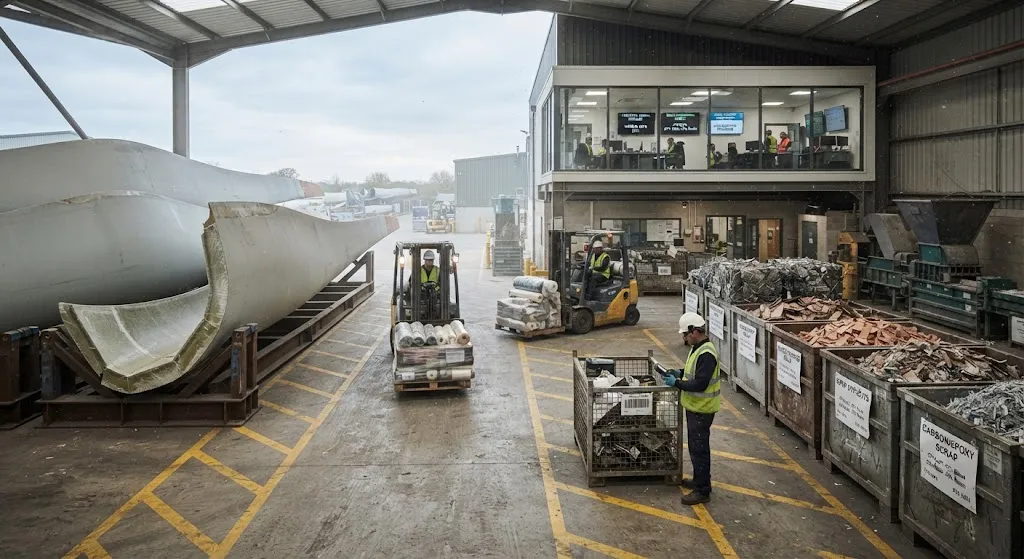
Composite recycling regularly fails on the spreadsheet before it fails in the plant. Pilot facilities recycle materials successfully, demonstrate clean fiber recovery, and still lose money, because the economics of a recycling business are shaped by throughput, gate fees, and output pri
Introduction
Composite recycling regularly fails on the spreadsheet before it fails in the plant. Pilot facilities recycle materials successfully, demonstrate clean fiber recovery, and still lose money, because the economics of a recycling business are shaped by throughput, gate fees, and output pricing — not by process elegance. When industry analysts and recyclers model a standalone recycling plant that must cover capital expenditure, energy, labor, and logistics, the break-even input volume consistently lands in the range of 40,000-50,000 tonnes per year. Below that, fixed costs dominate and the plant runs at a structural loss.
Reaching that volume is a waste-sourcing problem, and it is fundamentally different from sourcing a feedstock like scrap metal. Composite waste is fragmented across three distinct streams — manufacturing scrap, end-of-life parts, and offcuts — with different chemistries, contamination levels, and logistics. No single stream, including retired wind turbine blades, can supply 40,000 tonnes a year on its own in a financially sane way today. This article lays out the throughput arithmetic, the aggregation strategy that makes the numbers work, and the role the Digital Product Passport plays in making mixed composite waste processable at scale.
The Throughput Arithmetic
The economics can be framed as a simple volume equation. A recycling line has largely fixed capital and operating costs; revenue comes from gate fees paid by waste owners plus the sale of recycled fiber and energy byproducts. The model below shows how unit economics change with scale:
| Annual input (tonnes) | Typical capex (EUR) | Total cost per tonne | Gate fee per tonne | Material revenue per tonne | Plant economics |
|---|---|---|---|---|---|
| 5,000 | 5-10 million | 320-420 | 150-200 | 80-150 | Structural loss |
| 20,000 | 15-25 million | 190-260 | 150-200 | 80-150 | Breakeven at best |
| 50,000 | 30-45 million | 130-170 | 150-200 | 80-150 | Positive margin |
Two dynamics drive the improvement. First, capital and energy costs per tonne fall steeply as operations run continuously rather than in campaigns. Second, a large plant can run multiple output lines — reinforcement-grade fiber, thermoplastic compounds, and construction aggregates — each with its own offtake contract, smoothing the price risk that a single-product plant carries.
Why Retired Blades Alone Cannot Feed the Plant
Wind turbine blades are the most visible composite waste stream, which makes them the natural first instinct as a feedstock anchor. The reality is different. Even with the European fleet decommissioning wave accelerating, usable blade waste is lumpy: a row of turbines produces several hundred tonnes in a few weeks, then nothing for months. Transporting blades is expensive — they are large, over-dimensional, and increasingly handled as whole or split sections — so collection cost depends on distance to the plant more than on the material itself.
Regulatory pressure is also still converging on composite waste. Landfill bans and extended producer responsibility schemes for blades vary by country and are being phased in at different speeds. Waiting for the regulatory tide means running a plant on optimism; the recyclers that reach 40,000-50,000 tonnes do so by treating blade waste as one committed stream among several, not as the entire basis of the business.
Multi-Stream Aggregation
The solution is deliberate aggregation of every composite waste stream that can be processed with the same line. The practical portfolio looks like this:
- Production scrap and offcuts: the most attractive stream — clean, chemically known, generated continuously at fabricators, and already collected today at a cost. Trim waste from prepreg cutting and pultrusion can carry recycle-ready characterization.
- End-of-life parts: blades, boats, and industrial tanks on fixed demolition schedules. They are the largest tonnage but the least predictable arrival profile.
- Manufacturing post-industrial waste: rejected parts, expired-prepreg, and tooling trim that accumulate at qualified suppliers with documented material history.
Each stream has a different chemistry and contamination profile, which brings logistics and preprocessing complexity but also diversity: when one stream is quiet, the others keep the line running. Aggregation across streams is what converts a volatile waste supply into a bankable feedstock contract.
Behind the tonnage target lies a contracting structure that banks can model. A bankable feedstock agreement typically pairs a take-or-pay commitment from a waste owner with tonnage bands that let the recycler plan line utilization, plus a quality specification that allocates preprocessing risk — who sorts, who tests, who absorbs the cost of a contaminated batch. These contracts convert the aggregation strategy into revenue certainty: the recycler knows income from gate fees and material sales months ahead, which is what underwrites the capital raise for a 40,000-tonne plant. Recyclers report that negotiation of these agreements, more than the technology itself, determines whether the model reaches the positive-margin row of the table above.
The Digital Product Passport as the Data Backbone
Mixed composite waste is only valuable if it can be sorted and batched into consistent chemistry. A feedstock of unknown resin systems, fiber types, and additives cannot be run through a thermolysis or solvolysis line at controlled quality. The European Union's Digital Product Passport (DPP), being phased in through the Ecodesign for Sustainable Products Regulation, is the mechanism that will solve this: every covered product carries structured composition data that travels with it through its life.
For recyclers, DPP data turns suspicion into specification. A batch of blades with documented resin chemistry, fiber content, and sizing can be priced, batched, and processed with predictable output quality. The same dataset lets waste owners prove recycling compliance to regulators and lets compounders qualify recycled content without re-validating every load. In the scale-economics model, the DPP is not a compliance burden — it is the information layer that makes 40,000-50,000 tonnes of mixed input processable at all.
Frequently Asked Questions
Why can't a smaller recycling plant be profitable with premium output pricing?
Premium pricing for recycled fiber exists, but the addressable volume at premium prices is limited and dominated by early-adopter programs. A 5,000-tonne plant that sells every kilogram at a premium still carries 320-420 euros of cost per tonne against a ceiling of roughly 300 euros of combined gate fee and material revenue in realistic markets. Scale is not a preference in this industry; it is the only mechanism that pushes cost below revenue. Reaching scale, in turn, requires multiple waste streams, which is why aggregation and the throughput target are discussed together.
How does the Digital Product Passport change recycling economics?
Before the DPP, a recycler receiving a container of used blades had to assume worst-case chemistry, budget for extra analysis, and price the gate fee accordingly. With DPP composition data, the same input is known before it arrives: resin type, fiber fraction, additives, and even the original manufacturing process. This collapses analytical cost, allows pre-batching of compatible chemistry, and lets output quality be predicted rather than guessed. The result is a direct reduction in cost per tonne and a stronger offtake position for the recycled product.
Is recycled carbon fiber from aircraft or automotive entering these same streams?
Yes, and it strengthens the volume case. Aerospace and automotive end-of-life and production waste adds higher-value carbon fiber to the aggregated input, improving the blended material revenue. The same thermolysis or solvolysis line that handles glass-dominated blade waste can process carbon waste in segregated batches, because the chemistry is documented per batch rather than uniform across the plant. The aggregation model is stream-agnostic: what matters is documented composition, continuous arrival, and enough total tonnage to amortize the line.
Conclusion
Composite recycling becomes a bankable business only when annual throughput reaches the 40,000-50,000 tonne range, and that volume cannot come from any single waste stream. The practical strategy is multi-stream aggregation — production scrap, offcuts, and end-of-life parts — backed by the Digital Product Passport as the data layer that makes mixed input processable at controlled quality. For waste owners and buyers watching this space, the signal is simple: recyclers with secured multi-stream feedstock agreements and DPP-enabled batching are the ones that will survive the consolidation the model predicts.
For companies managing composite waste or sourcing recycled-content reinforcement, review our fabric and reinforcement range for recycled-input options, or contact our team to discuss feedstock and offtake alignment with a qualified recycling partner.
Part of topic
Related Articles
- Recycled Carbon Fiber Market Forecast 2030: Technology Maturity and Commercialization Path
- South Korea Carbon Fiber Market 2026: Hydrogen Economy and Shipbuilding Innovation
- Wind Turbine Blade Leading Edge Protection 2026: Polyurethane, Tape, and Metallic Shield Solutions
- China Carbon Fiber Overcapacity 2026: Price War Impact and Industry Consolidation
- India Carbon Fiber Market 2026: Wind Energy, Aerospace, and Defense Expansion
- PAN Precursor Market 2026: Acrylonitrile Supply and Carbon Fiber Cost Structure
Interested in Custom Carbon Fiber Products?
Contact our team for competitive pricing and technical specifications.
Get a QuoteRelated Products
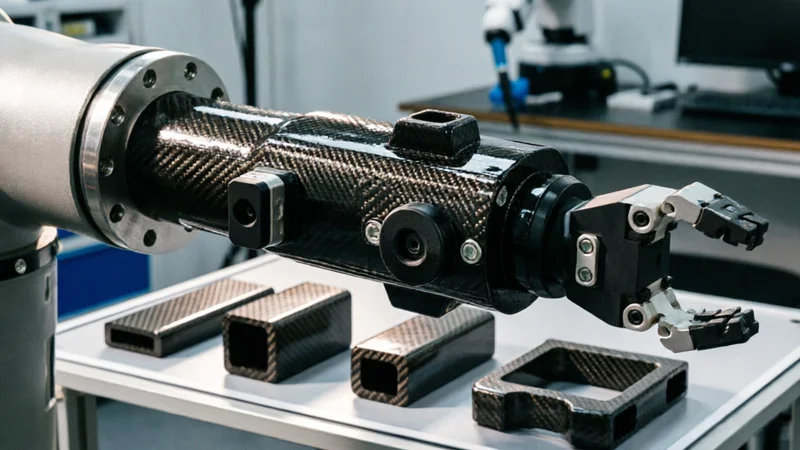
Carbon Fiber Robot End Effector Link — Custom Shape & Sensor Integration
Custom-shaped carbon fiber end effector links for robotic arms. Designed for automation integrators and research labs requiring lightweight, rigid connections between the robot wrist and gripper/tool. Can incorporate sensor mounting bosses, cable routing channels, and quick-change interfaces.

Custom Carbon Fiber Musical Instrument Parts
Carbon fiber components for musical instrument manufacturing offering superior dimensional stability, low weight, and consistent acoustic properties. We produce carbon fiber bows, guitar necks, violin chin rests, drum shells, and wind instrument bodies. Carbon fiber instruments are immune to humidity changes and temperature fluctuations that affect wooden instruments.
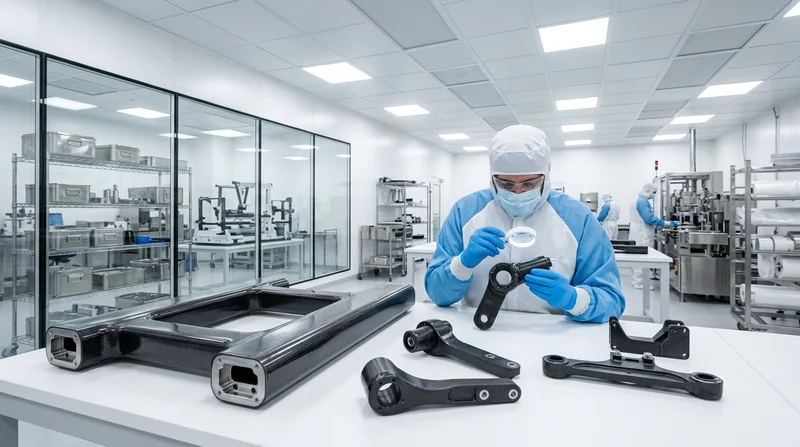
Custom Carbon Fiber Medical Device Components
Medical-grade carbon fiber components manufactured for imaging equipment, surgical instruments, and patient support systems. Carbon fiber's radiolucency (X-ray transparency) and high strength-to-weight ratio make it ideal for CT scanner beds, wheelchair frames, surgical robot arms, and MRI-compatible accessories. Biocompatible resin systems available.

Custom Carbon Fiber Drone Arm — Lightweight & Vibration-Damping
High-modulus carbon fiber drone arms designed for industrial, agricultural, and surveying UAVs. Replace heavy aluminum arms with our custom-molded CFRP arms — 40-60% lighter with superior vibration damping for stable flight and sharper imaging.
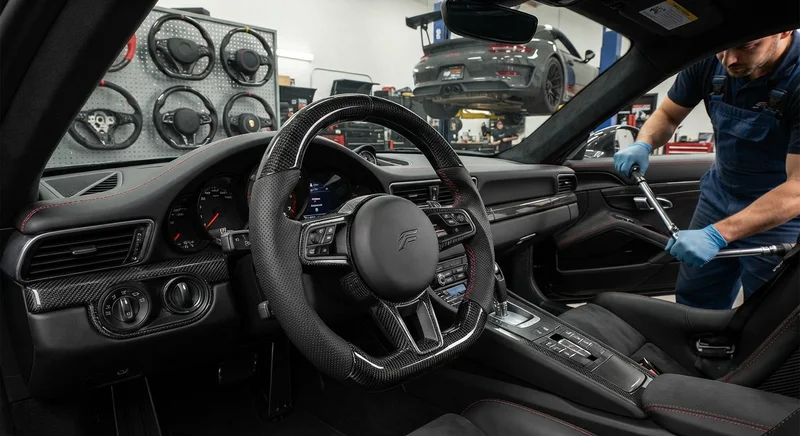
Carbon Fiber Steering Wheel — Custom Leather-Wrapped with CF Inlay
Custom carbon fiber steering wheel with genuine leather wrapping and carbon fiber inlay sections. Molded from T700 3K prepreg for maximum rigidity with a 30% weight reduction over OEM wheels. Available in D-shape (flat bottom) and round profiles. Direct bolt-on fitment for popular sports car and performance vehicle models. Custom stitching color and leather grade available.