
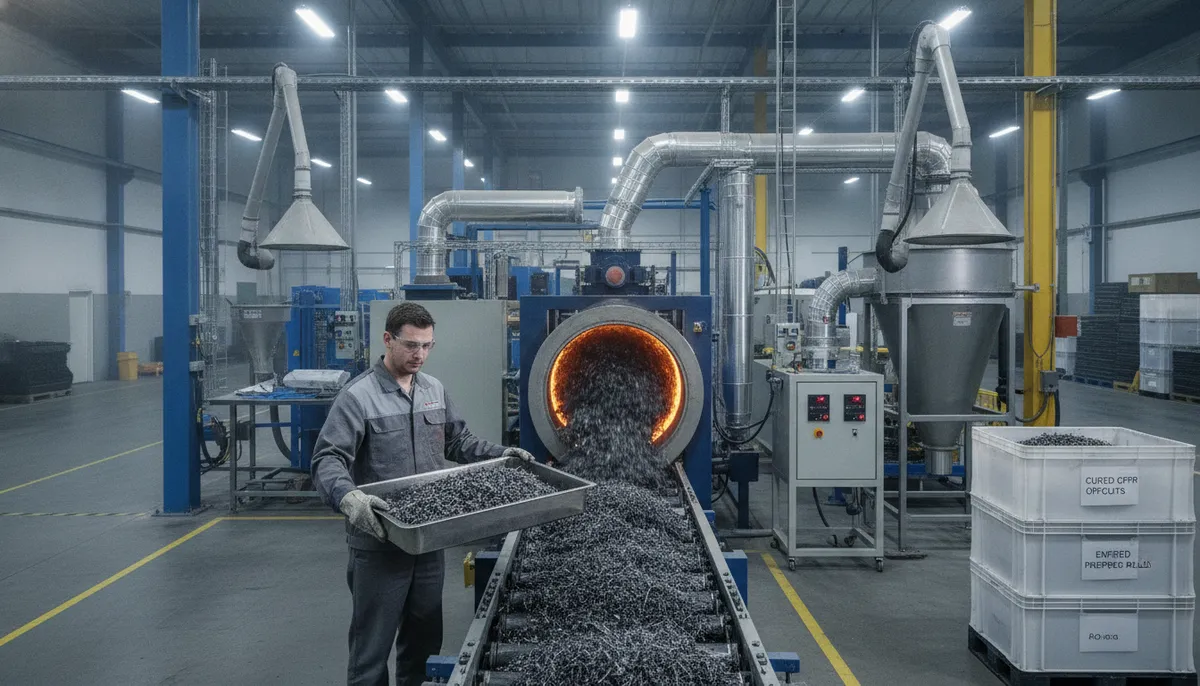
Carbon fiber is expensive to make, and that expense is exactly why recycling it matters. A tonne of virgin aerospace-grade tow costs tens of thousands of dollars, yet until recently almost all post-industrial scrap — offcut prepreg, manufacturing trim, and expired-out-of-life material —
Introduction
Carbon fiber is expensive to make, and that expense is exactly why recycling it matters. A tonne of virgin aerospace-grade tow costs tens of thousands of dollars, yet until recently almost all post-industrial scrap — offcut prepreg, manufacturing trim, and expired-out-of-life material — ended in landfill. The promise of recycled carbon fiber (rCF) is that a material worth nearly its weight in gold during production could be recovered and resold at a fraction of virgin cost, closing a loop that the carbon fiber industry has been promising for two decades.
Reality has been slower than the promise. Global CFRP recycling capacity is estimated at only 6,120 tonnes per year, a rounding error next to the more than 200,000 tonnes of virgin carbon fiber produced annually worldwide. The material works — pyrolysis and solvolysis processes recover fibers that retain 85-95 percent of virgin tensile properties — yet recovered fiber pricing, property scatter, and the cost of qualification keep rCF confined to non-structural and semi-structural niches. This article breaks down the economics: where the capacity is, what recovered fiber actually costs, how it is qualified, and under what conditions recycled fiber becomes a rational material choice rather than a marketing claim.
The Capacity Reality: 6,120 Tonnes Against a Global Base
The recycling industry's installed capacity must be understood in context. Global virgin carbon fiber production capacity passed 200,000 tonnes per year across Toray, Teijin, SGL, Mitsubishi Chemical, Hexcel, and the Chinese producers (Zhongfu Shenying, Jilin, Guangwei, and others), and annual CFRP production generates tens of thousands of tonnes of new scrap from dry fiber trim, expired prepreg, and cured offcuts. Against that flow, recycling capacity of roughly 6,120 tonnes per year recovers only a few percent of the scrap stream. The landscape is concentrated in a small number of commercial plants:
| Recycler / Process | Notable Capacity Claim | Input Feedstock | Output Form |
|---|---|---|---|
| Fairmat (France, mechanochemical) | Up to 3,500 t/yr planned (Bouguenais facility) | Cured CFRP scrap, expired prepreg | Recycled CF flakes, pellets, nonwoven |
| Gen 2 Carbon (UK, fluidised bed) | Multiple plants, output undisclosed | Cured CFRP, mixed scrap | Short recycled fiber, mat products |
| ELG Carbon Fibre (UK, pyrolysis) | ~2,000 t/yr class plant | Dry fiber waste, cured CFRP | Chopped fiber, milled fiber, nonwoven |
| SGL Carbon / Mitsubishi (pyrolysis) | Pilot-to-commercial lines | Offcut prepreg, production waste | Recycled tow, nonwoven mats |
| European pilots (Carbocon, cfk valley) | 10-100 t/yr plants | Regional production scrap | R&D grade fiber, feedstocks |
Several important conclusions follow. First, much of the announced capacity is aspirational: Fairmat's 3,500-tonne Bouguenais line is a target, not today's throughput, and real utilization across the sector is far below nameplate. Second, the feedstock matters more than the process — clean dry fiber waste is almost as valuable as virgin chopped fiber, while contaminated cured scrap costs more to process than the recovered material can sometimes fetch. Third, the sector's bottleneck is demand, not feedstock or chemistry: workshops can produce recycled fiber, but end users must qualify it, and qualification is exactly where the economics get difficult.
Pricing: What Recycled Fiber Actually Costs
The commercial argument for rCF has always been price. Virgin carbon fiber sells at a wide spread depending on grade: industrial-grade 50K tow at roughly $15-$30/kg, aerospace-grade tow at $40-$100/kg or more. Recovered fiber starts from material that was already paid for, so it is priced at a discount that must still cover the recycling process, energy, and logistics:
| Product Form | Virgin Price Range (USD/kg) | rCF Typical Price (USD/kg) | Effective Discount |
|---|---|---|---|
| Chopped fiber (3-12 mm) | $20-$45 | $12-$25 | 30-50% |
| Milled fiber (powder) | $15-$35 | $8-$18 | 35-50% |
| Nonwoven mat (recycled) | $18-$40 (virgin mat) | $10-$22 | 30-45% |
| Recycled tow / long fiber | $25-$60 | $18-$35 | 25-40% |
These discounts look attractive, but the effective cost to the buyer is higher than the sticker price. Recycled fiber arrives with higher property scatter, which forces designers to use larger safety factors; it is sold in fewer physical forms, which limits how it can be processed; and it often requires separate qualification, drying, and handling lines. When total cost of ownership is modeled — purchasing price plus qualification effort plus design allowables — the real competitiveness window for rCF is currently limited to three cases: non-structural and semi-structural parts where weight saving matters more than pedigree; cost-down replacements where the part is over-speced for virgin fiber anyway; and sustainability-driven programs where the buyer receives a carbon footprint or regulatory credit that offsets the qualification premium.
Property Retention: The Technical Baseline
For recycled fiber to be priced as a structural material rather than a filler, it must retain usable mechanical properties. Across the commercial pyrolysis and solvolysis processes, recovered fiber typically shows:
- Tensile strength retention of 85-95 percent of virgin values for clean feedstock (dry fiber and prepreg offcuts), dropping to 70-85 percent for cured scrap with surface contamination.
- Tensile modulus retention near 100 percent, because modulus is a bulk property of the fiber crystal structure and is largely unaffected by the thin, reactive surface layer.
- Reduced strain to failure and higher scatter, driven by surface flaws, residual sizing burn-off, and length degradation during the recovery process.
- Compression and interfacial shear degraded more than tension, because the recovered surface no longer has the original sizing chemistry optimized for the resin system.
- Cured scrap yields shorter fibers than dry scrap, which lowers reinforcement aspect ratio and caps the achievable strength in the final composite.
The practical consequence is that recycled fiber is easiest to justify in injection-molded compounds, nonwovens, compression-molded semi-structural parts, and as a percentage replacement in virgin compounds — applications where short fiber lengths and modest allowables are already the design norm. Where continuous fiber performance is required, rCF currently competes poorly with virgin, which is why the most successful recyclers sell into markets that need chopped and milled fiber rather than unidirectional tape.
Qualification: The Cost That Decides Commercialization
Qualification is where recycled fiber economics are won or lost. A virgin material qualification to aerospace databases such as NCAMP or OEM material specifications can cost hundreds of thousands of dollars in testing, and recycled fiber faces a structural disadvantage: its properties depend on the feedstock batch, so every new scrap source can change the material's statistics. The realistic qualification ladder for rCF is staged:
- Stage 1 — supplier control: the recycler must demonstrate screening of incoming feedstock by fiber type, tow size, sizing chemistry, and contamination, because these determine the output properties.
- Stage 2 — non-structural qualification: automotive or commodity applications that qualify the material for interior, acoustic, or non-load-bearing parts at low testing cost and high volume.
- Stage 3 — semi-structural qualification: parts such as floor panels, covers, and brackets where modulus values and batch consistency are verified but certification margin demand is moderate.
- Stage 4 — structural qualification: load-bearing aerospace or safety-critical parts, feasible only with dedicated equipment, dedicated feedstock streams, and full allowables development — rarely economical for generic rCF.
This ladder explains the observed market split: every serious recycler has found volume in stages 2 and 3, while stage 4 remains the territory of a handful of qualified programs, usually with a captive virgin supplier in the loop. The economics also favor design-in rather than substitution: a part designed from the start for recycled short-fiber material avoids the cost of re-qualifying a virgin design, and this design-in route is where the strongest rCF business cases are built today.
When Recycled Fiber Is the Rational Choice
Stepping back from individual cases, the market economics of recycled carbon fiber resolve into a clear decision framework. Recycled fiber is the rational choice when at least two of the following hold:
- Short-fiber format is acceptable: the application uses chopped, milled, or nonwoven reinforcement, so the length penalty of recovery does not cost structural performance.
- Property scatter is affordable: the part is oversized or the load case is mild enough that 10-15 percent lower strength allowables do not force a heavier, more expensive design.
- Sustainability value is monetized: the buyer gains a tangible benefit — customer contracts, carbon accounting, EU or auto-industry recycled-content targets — that offsets the qualification premium.
- Feedstock is captive and clean: the recycler controls a steady stream of dry fiber or expired prepreg, so batch statistics stay stable and processing cost stays low.
Where these conditions fail — continuous fiber, tight allowables, no sustainability premium, mixed contaminated feedstock — virgin fiber remains the economically rational choice, and that is not a failure of recycling but a correct allocation of resources: compounders, nonwovens, automotive semi-structural parts, and design-in programs are the niches that build volume, stabilize batch statistics, and gradually widen the window toward structural applications.
Frequently Asked Questions
How much of the carbon fiber scrap stream is actually recycled today?
Only a small fraction. Global installed recycling capacity is roughly 6,120 tonnes per year, while the carbon fiber supply chain generates on the order of tens of thousands of tonnes of scrap annually from dry fiber trim, expired prepreg, and cured offcuts — and the global installed virgin fiber base is above 200,000 tonnes per year. Recovered output is therefore a few percent of the scrap stream, and even that capacity is not fully utilized because recycled fiber demand is constrained by qualification requirements and price competition from virgin material.
Does recycled carbon fiber have the same mechanical properties as virgin fiber?
Not identical, but close for clean feedstock. Pyrolysis and solvolysis recovery typically retains 85-95 percent of virgin tensile strength and near 100 percent of tensile modulus, because modulus is governed by the fiber's internal crystal structure while strength depends heavily on the thin surface layer, which is degraded during recovery. The larger practical difference is variability: recycled fiber shows higher scatter from batch to batch, lower strain to failure, and degraded compression and interfacial shear performance. Designers therefore use more conservative allowables, which partially cancels the price discount.
Why is recycled carbon fiber still more expensive than the marketing suggests?
Because the headline price per kilogram excludes the costs that follow the purchase. Recycled fiber costs less per kilogram at the dock, but its higher property scatter forces larger safety factors; it is offered in fewer physical forms, which may require new processing steps or separate handling lines; and it must often be qualified separately from the buyer's existing virgin material specification. When purchasing price, qualification testing, design allowables, and processing integration are added together, the total cost of ownership advantage of rCF narrows to specific niches — short-fiber formats, semi-structural parts, and programs where recycled content carries a monetized sustainability value. In continuous-fiber structural applications, virgin material usually remains the lower total-cost choice.
Which companies are leading commercial carbon fiber recycling?
The most prominent commercial operators today include Fairmat in France, which operates a mechanochemical recycling facility at Bouguenais with a stated target of up to 3,500 tonnes per year and supplies recycled carbon flakes, pellets, and nonwovens; Gen 2 Carbon in the UK, which runs fluidised-bed recycling plants for cured CFRP scrap; ELG Carbon Fibre (now part of Mitsubishi Chemical), one of the longest-running pyrolysis recyclers with a roughly 2,000-tonne-per-year class plant in the UK; and pyrolysis pilot lines at SGL Carbon and Mitsubishi Chemical. The sector remains concentrated: a handful of plants carry most of the world's real throughput, and much announced capacity is still under construction or operating below nameplate.
Conclusion
The economics of recycled carbon fiber are real but narrow. Capacity of roughly 6,120 tonnes per year is a small fraction of the scrap stream, recovered fiber pricing carries a 25-50 percent discount that is partially consumed by scatter, qualification, and integration costs, and the rational use cases are short-fiber formats, semi-structural parts, and monetized sustainability programs. The growth path for rCF runs through designing for recycled material from the start, stabilizing batch statistics with clean captive feedstock, and widening the economics window niche by niche.
For buyers evaluating recycled fiber, the disciplined approach is to compare total cost of ownership — not price per kilogram — against virgin material, and to demand documentary proof of feedstock control, property statistics, and qualification status. Explore our carbon fiber sheet, fabric, and unidirectional laminate products with published mechanical properties and full batch traceability, or contact our engineering team for material qualification support and cost benchmarking between virgin and recycled options.
Part of topic
Related Articles
- Carbon Fibre for Sale: Reading Listings, Grades and Lead Times
- Carbon Fiber Near Me: Why Local Sourcing Beats Cross-Border for Prototyping
- Carbon Fiber Rod Blanks: Supply Chain and Custom Cutting Services
- Carbon Fiber Tube Shop: Selecting the Right Supplier for Custom and Standard Tubes
- Carbon Fiber Sheet Price: Factors Affecting Cost per Square Meter
- Carbon Fibre Sheet Supplier UK: Sourcing Options and Specification Checklist
Interested in Our Products?
Contact our team for competitive pricing and technical specifications.
Get a QuoteRelated Products
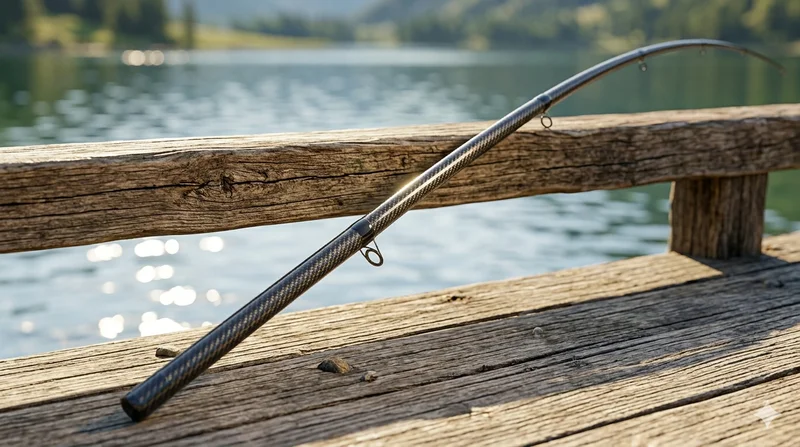
Carbon Fiber Fishing Rod Blank
High-quality carbon fiber fishing rod blank manufactured from multiple grades of Toray carbon fiber cloth. Available in a wide range of lengths, powers, and actions for freshwater and saltwater applications. Suitable for OEM rod building.

Carbon Fiber Plate — 3K Twill T700 1.5mm
Thin 1.5mm carbon fiber plate with 3K twill weave surface. Lightweight and stiff, commonly used for covers, panels, drone bodies, and applications requiring a premium aesthetic appearance.

Carbon Fiber Plate — 3K Twill T700 3.0mm
Medium-thickness 3.0mm carbon fiber plate offering significantly higher load capacity while maintaining attractive 3K twill finish. Suitable for structural brackets, reinforcement plates, and load-bearing panels.
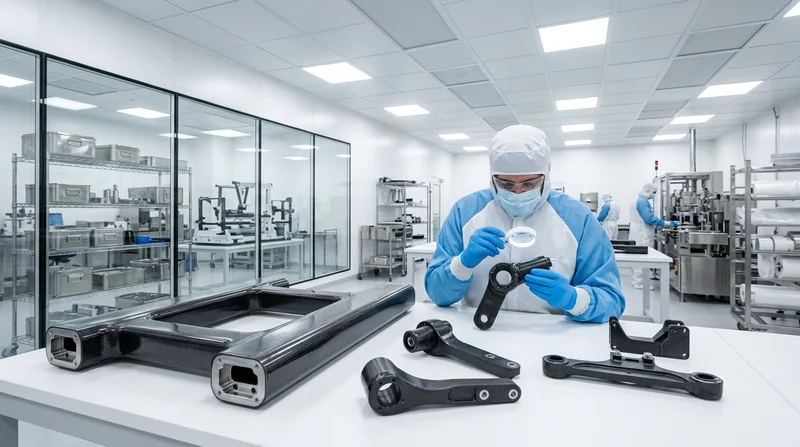
Custom Carbon Fiber Medical Device Components
Medical-grade carbon fiber components manufactured for imaging equipment, surgical instruments, and patient support systems. Carbon fiber's radiolucency (X-ray transparency) and high strength-to-weight ratio make it ideal for CT scanner beds, wheelchair frames, surgical robot arms, and MRI-compatible accessories. Biocompatible resin systems available.

Square Carbon Fiber Tube — 3K Twill T700
Square cross-section carbon fiber tube manufactured with 3K twill weave for torsional strength. Preferred for structural frames, trusses, and support columns where rectangular geometry offers design flexibility.