
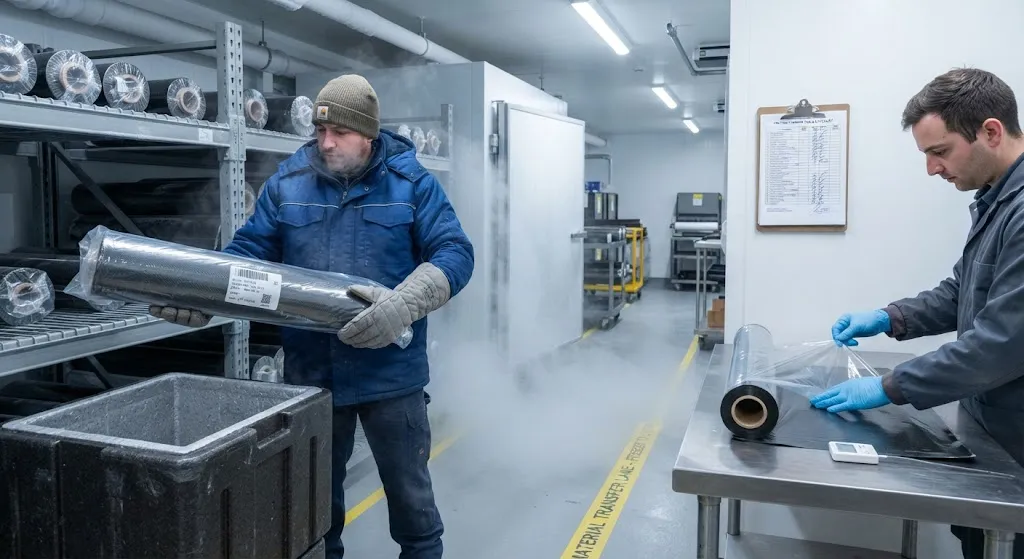
Every roll of prepreg in a composites factory is a small race against chemistry. The resin that will eventually become the cured matrix is designed to stay dormant at minus 18 degrees Celsius, but the moment the roll leaves the freezer the cure reaction resumes at a slow, measurable rat
Introduction
Every roll of prepreg in a composites factory is a small race against chemistry. The resin that will eventually become the cured matrix is designed to stay dormant at minus 18 degrees Celsius, but the moment the roll leaves the freezer the cure reaction resumes at a slow, measurable rate. The material has a finite budget of room-temperature time — its out-life — and every minute spent cutting, transporting, kitting or waiting consumes that budget. When the budget runs out before the layup is complete, the part is either scrapped or shipped with degraded mechanical performance that nobody can fully quantify afterwards.
This article treats prepreg out-life as what it actually is: a production-control problem with a material-science foundation. We compare how real material families differ in their out-life behavior, walk through the cold-chain practices that protect the usable window, explain when re-testing can legitimately extend a roll's life and when it cannot, and finish with the data practices that let a shop convert life tracking into a measured waste-reduction program instead of a compliance chore.
Out-Life and Shelf Life: Definitions That Matter
The two terms are routinely conflated, and the conflation is expensive. Shelf life is the total calendar time a roll may be stored under the specified frozen condition, typically 6-12 months for aerospace prepregs. Out-life — sometimes called handling life or tack life — is the accumulated time the material may spend at room or workshop temperature, after which the resin has advanced too far to cure reliably. Out-life is the number that drives daily scheduling; shelf life is the number that drives purchasing. The table below shows how the two budgets vary across representative material families:
| Material family | Typical RT out-life | Shelf life at -18 C | Dominant aging mechanism |
|---|---|---|---|
| Standard 350 F-cure aerospace epoxy | 10-21 days | 6-12 months | Resin advancement, exotherm rise |
| 250 F-cure epoxy prepregs | 20-30 days | 6-12 months | Resin advancement, tack change |
| Fast-cure automotive epoxy systems | 3-7 days | 3-6 months | Cross-linking at room temperature |
| Out-of-autoclave and toughened prepregs | 10-20 days | 9-12 months | Volatiles uptake, tack loss |
| Cyanate ester / high-temperature systems | 15-30 days | 12 months or more | Moisture uptake, network advance |
Two practical lessons sit in this table. First, the out-life number on a datasheet is a worst-case bookkeeping value, not a guarantee — the same roll behaves differently in a humid Malaysian workshop in July than in a dry German one in February, and qualified shops keep their own measured baselines. Second, tack and out-life are not the same curve: many prepregs lose tack long before they lose structural viability, which means the workshop and the engineering department must agree on which limit is driving the disposition decision.
Cold-Chain Practice: Protecting the Window
The out-life budget starts being spent the moment a roll leaves the freezer, and cold-chain practice is about deciding deliberately when that clock starts. A roll that is extracted for a single cut and then returned spends part of its budget on that trip; a roll extracted for a full working day spends far more. The disciplined shop treats every freezer exit as a tracked event with an owner, a reason and a re-entry record. Temperature discipline extends beyond the freezer itself: transfer in insulated boxes with phase-change packs, thawing while sealed in moisture-barrier film to prevent condensation on the resin, and resealing with desiccant before re-freezing are the steps that guard both out-life and shelf life.
The subtle failures are the expensive ones. A roll that freezes while warm from workshop exposure picks up internal moisture that later shows up as voids and porosity in cure. A thawed roll that sits unsealed for an hour adsorbs humidity that changes tack and bleed characteristics. Shops that treat the freezer as a simple storage box lose batches to these chronic failures, while shops that treat the entire transfer chain as a controlled process see fresh-roll behavior out of rolls near the end of their budgeted life.
Re-Test Gates and Shelf-Life Budgets
Re-testing is the formal mechanism that separates disciplined life extension from wishful thinking. Most prepreg suppliers offer re-test programs under which a roll whose shelf life is approaching expiry can be sampled, tested for residual reactivity and mechanical properties, and granted an extension — often in 3-month increments — if it passes. The key boundary is that re-testing can extend shelf life but emphatically does not reset accumulated out-life. Out-life spent on the workshop floor is spent forever; the supplier's re-test verdict concerns the frozen-storage clock alone.
- FIFO by freeze date, not by receipt date: budget tracking starts at the documented freeze date, so inbound rolls are dated correctly even when a distributor has held them warm for days.
- One freezer exit record per roll: out-life is accumulated, not refreshed; a central register sums exit times and flags a roll thirty minutes into its final day.
- Re-test early, not late: samples are drawn before the declared shelf-life date, so a failed re-test still leaves usable frozen time to consume the roll normally.
- Disposition authority: only the qualified engineering sign-off can downgrade a roll to tooling or non-structural use; purchasing and production agree in writing on the waste threshold.
- Batch-level release testing after re-freeze: when a roll re-enters the freezer after partial workshop use, its next release is treated as a fresh test event rather than a continuum.
Read together, these practices turn the shelf-life budget into a rolling, auditable ledger. That ledger is what makes it possible to answer the two questions every plant manager eventually asks: how much material do we scrap because of expired life, and how much room-temperature time did that scrapped roll actually consume before it left the freezer?
Frequently Asked Questions
What is the difference between out-life and shelf life?
Shelf life is the total time prepreg may be stored frozen, typically 6-12 months, and it is governed by how long the resin remains usable at minus 18 degrees Celsius. Out-life is the accumulated time the material spends at room or workshop temperature, after which the resin has advanced too far to cure to spec — commonly 10-30 days for standard aerospace epoxy systems and as short as 3-7 days for fast-cure automotive grades. Shelf life drives purchasing and inventory policy; out-life drives daily cut planning and kitting. The two budgets must be tracked separately because a roll near its shelf-life end still has its full out-life ahead of it, and vice versa.
Can re-testing extend the life of prepreg past its expiry date?
Yes, within limits. Most prepreg suppliers operate re-test programs under which a roll approaching its shelf-life date is sampled, tested and granted a time-limited extension — commonly 3 months at a time — if its residual reactivity and mechanical properties remain within specification. Re-testing extends the frozen-shelf-life clock only; it cannot restore out-life that was already consumed at room temperature. The extension is also conditional: the roll must have been stored correctly and continuously frozen, and the re-test evidence must come from the supplier's approved procedure rather than an internal guess.
How should a shop track out-life across many rolls and shifts?
The practical answer is a central register updated at every freezer exit: each roll carries its freeze date, its accumulated room-temperature time, and an owner for each cold-chain event. Shops typically log exit and return times at the door, sum the out-life per roll in the register, and flag rolls that enter their final out-life day. Beyond the paper trail, discipline matters more than tools: a roll that is logged correctly but left on a bench overnight is still lost, and a register that is maintained well still depends on a defined disposition authority to pull the roll from the line when the clock expires.
Conclusion
Out-life management is the unglamorous discipline that separates a wasteful composites shop from a precise one. The core moves are simple to state and hard to sustain: track shelf life for purchasing, track out-life for production, protect every freezer exit with real cold-chain practice, use supplier re-test gates to extend the frozen clock, and keep the whole system in a register that makes waste visible in numbers. None of it requires new chemistry or exotic equipment — it requires treating time, like material, as a budgeted input that someone owns.
If your prepreg program needs tighter cold-chain and life-budget control, review our carbon fiber prepreg and material options or contact our engineering team to discuss roll planning, re-test procedures and waste-reduction programs.
Part of topic
Related Articles
- Bio-Based Carbon Fiber Precursors: Lignin and Polyethylene for Low-Cost Production
- Large-Tow Carbon Fiber Cost Analysis: 48K vs 60K Price-Performance Comparison
- Carbon Fiber-Resin Interface Bonding: Surface Treatment and Coupling Agent Optimization
- Digital Twin for Carbon Fiber Manufacturing: Real-Time Process Monitoring and Defect Prevention
- Thermoplastic Carbon Fiber Welding for Automotive: Ultrasonic and Induction Welding Process Windows
- Large-Tow Carbon Fiber Wet Spinning: Process Optimization for 48K/60K Production Efficiency
Interested in Custom Carbon Fiber Products?
Contact our team for competitive pricing and technical specifications.
Get a QuoteRelated Products
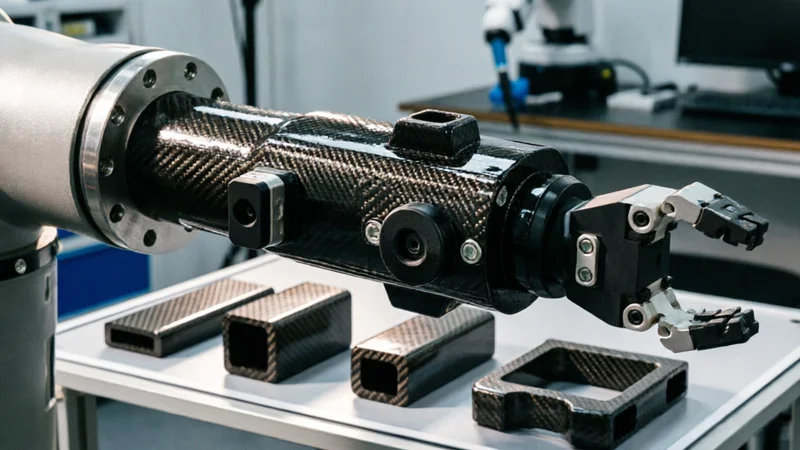
Carbon Fiber Robot End Effector Link — Custom Shape & Sensor Integration
Custom-shaped carbon fiber end effector links for robotic arms. Designed for automation integrators and research labs requiring lightweight, rigid connections between the robot wrist and gripper/tool. Can incorporate sensor mounting bosses, cable routing channels, and quick-change interfaces.

Custom Carbon Fiber Musical Instrument Parts
Carbon fiber components for musical instrument manufacturing offering superior dimensional stability, low weight, and consistent acoustic properties. We produce carbon fiber bows, guitar necks, violin chin rests, drum shells, and wind instrument bodies. Carbon fiber instruments are immune to humidity changes and temperature fluctuations that affect wooden instruments.

Carbon Fiber Tablet Case — Ultra-Light Protective Shell
Lightweight carbon fiber protective case for tablets and iPads. Molded from T700 3K prepreg with reinforced corner protection. Adds minimal weight while providing superior rigidity and drop protection compared to polycarbonate or silicone cases. Ideal for field workers, enterprise deployments, and professionals requiring durable tablet protection.

Custom Carbon Fiber Medical Device Components
Medical-grade carbon fiber components manufactured for imaging equipment, surgical instruments, and patient support systems. Carbon fiber's radiolucency (X-ray transparency) and high strength-to-weight ratio make it ideal for CT scanner beds, wheelchair frames, surgical robot arms, and MRI-compatible accessories. Biocompatible resin systems available.

Carbon Fiber Robotic Arm Tube — High-Stiffness Lightweight Replacement
Precision-wound carbon fiber tubes for robotic arm links, replacing steel or aluminum in collaborative robots (cobots) and industrial manipulators. Achieve 3× the specific stiffness of aluminum with significant weight reduction, enabling faster acceleration and higher payload capacity.