
Deepwater oil and gas production pushes every riser system to the limit of what steel can deliver. In water depths beyond 1,500 meters, the weight of steel risers drives up floater payload, requires larger buoyancy modules, and imposes fatigue demands that accelerate with every meter of
Introduction
Deepwater oil and gas production pushes every riser system to the limit of what steel can deliver. In water depths beyond 1,500 meters, the weight of steel risers drives up floater payload, requires larger buoyancy modules, and imposes fatigue demands that accelerate with every meter of depth. Carbon fiber composite risers address these limits directly: by cutting riser weight by 40-60 percent, composites allow smaller floating production units, reduce top tension, and extend fatigue life in the steel catenary riser (SCR) configuration that dominates modern deepwater field layouts.
For composite material suppliers, the oil and gas sector has been a slow-burning opportunity that is now reaching commercial thresholds. After two decades of qualification programs, composite production risers and SCRs are entering pilot and first-project deployment, concentrated in the West African and Brazilian deepwater basins where new fields justify the engineering investment.
Why Weight Matters in Deepwater Risers
A riser is the pipe that connects a subsea well or manifold on the seabed to the floating production unit at the surface. In deep water, the riser system is one of the heaviest items on the floater, and its weight has a cascading effect through the entire facility design:
- Top tension: Every kilogram of riser weight must be supported by tensioners at the deck level, consuming hull payload that could otherwise carry process equipment or oil storage.
- Buoyancy: Steel risers require distributed buoyancy modules along their length, which add cost, drag and installation complexity.
- Payload economics: At 2,000-meter water depth, a single steel SCR can weigh hundreds of tonnes, forcing the selection of a larger, more expensive hull.
Composite risers break this cascade by reducing the pipe's linear weight dramatically. A carbon fiber composite riser typically weighs 40-60 percent less than an equivalent steel riser of the same internal diameter and pressure rating, which translates directly into reduced top tension, smaller buoyancy requirements and, in some cases, the ability to use a smaller floating unit for the same field.
Composite Production Risers
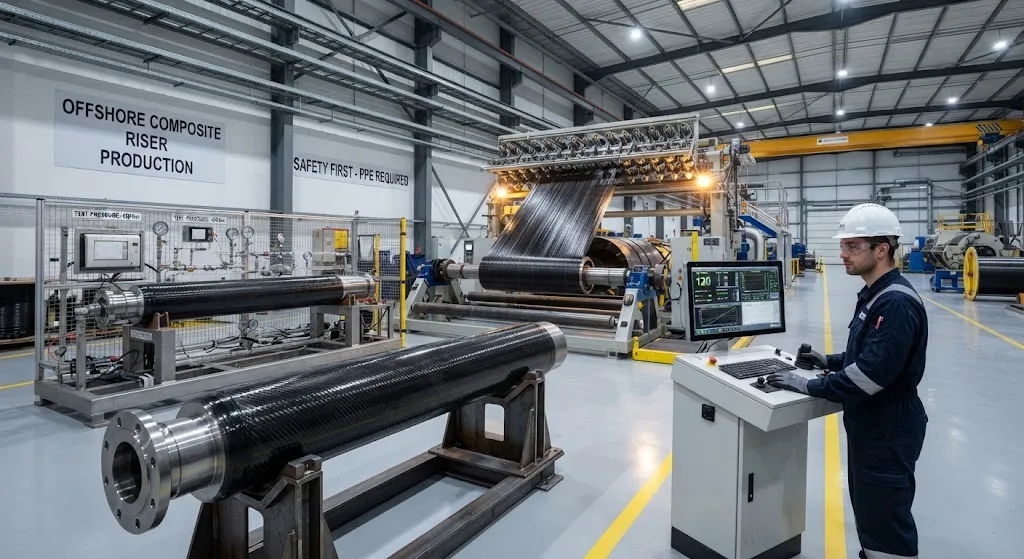
Composite production risers carry produced hydrocarbons from the seabed to the surface under high pressure and elevated temperature. The dominant construction is a fiber-reinforced thermoplastic pipe, often with a carbon fiber structural layer overwrapped on a thermoplastic liner, selected for its combination of strength, chemical resistance and fatigue performance.
The key engineering parameters for composite production risers are summarized below:
| Parameter | Composite riser | Equivalent steel riser |
|---|---|---|
| Weight saving vs steel | 40-60 percent | Baseline |
| Design pressure | Up to 690 bar (10 ksi) | Up to 690 bar |
| Max service temperature | 90-120 °C typical | 120-150 °C |
| Fatigue performance | 5-20x steel in tests | Design-life governed |
| Corrosion resistance | Inherent, no chemical inhibition needed | Requires corrosion allowance and inhibition |
| Water depth target | 1,000-3,000 m | Depends on payload budget |
The thermoplastic matrix, typically a polyamide or PEEK-family material reinforced with carbon fiber, gives the riser its fatigue and chemical resistance, while the carbon fiber provides the structural stiffness and strength. Qualification to industry standards such as API 17J for unbonded flexible pipe and emerging composite-specific standards is the gate that has historically slowed deployment.
Steel Catenary Risers and Fatigue
SCRs are steel pipes hanging in a catenary curve from the floater to the seabed. They are simple, robust and widely used, but they suffer from fatigue sensitivity at the touchdown zone, where wave-induced floater motions concentrate bending cycles. As water depth and production rates increase, SCR fatigue life becomes a design-limiting factor.
Hybrid and composite SCRs address this by replacing the steel pipe body with a composite structure that has dramatically better fatigue performance. Tests and qualification programs have demonstrated fatigue lives 5-20 times those of equivalent steel SCRs, which allows operators to either extend field life or use more flexible floater operating envelopes. The composite SCR also eliminates weld-related fatigue initiation sites that plague steel risers, since the pipe is manufactured continuously rather than assembled from girth-welded sections.
West African and Brazilian Drivers
Commercial deployment is concentrated where the economics are strongest. West Africa and Brazil share the combination that makes composite risers attractive: deep water, challenging sea states, and a project pipeline of new fields that can absorb qualification engineering costs.
- West Africa: Deepwater fields offshore Nigeria, Ghana and Angola operate at 1,500-3,000 meters with high production temperatures. Operators with mature steel riser experience are evaluating composite SCRs for reduced fatigue risk and the payload savings that allow existing hull designs to host more risers or heavier equipment.
- Brazil: The pre-salt basins use some of the world's largest floating production units, with extensive SCR systems. The combination of water depths above 2,000 meters and long-distance tie-backs makes composite risers a candidate for weight relief and fatigue extension on the most demanding lines.
- Guyana and Suriname: Newer basins in the region are entering the same qualification-and-pilot cycle, applying lessons from West African and Brazilian programs at an earlier stage of field development.
The pattern across these basins is consistent: composite risers are introduced first on the most demanding lines where steel fatigue or payload limits bite hardest, then expanded once operational data accumulates.
Qualification and Certification Path
Deployment of composite risers in production service requires a layered qualification approach that composite suppliers must be prepared to support:
- Material qualification: Fiber, matrix and laminate systems must be qualified to project-specific loading and environmental conditions, including long-term exposure to produced fluids, gas permeation and elevated temperature.
- Full-scale testing: Prototype risers undergo pressure cycling, fatigue testing and tensile testing at full scale, often with internal pressure and external hydrostatic pressure applied simultaneously.
- Standards alignment: The industry is converging on DNV and API guidelines for composite risers, with operators running joint industry projects to consolidate requirements ahead of wide deployment.
- Manufacturing verification: Continuous, repeatable production with documented process control is required because riser lengths run to hundreds of meters with no joints at critical sections.
This qualification burden is one reason composite riser adoption has been slower than the initial hype of the late 1990s predicted, but the engineering groundwork laid over the past decade has turned the remaining question from feasibility to cost competitiveness.
Frequently Asked Questions
How much weight do composite risers actually save versus steel?
Carbon fiber composite risers typically weigh 40-60 percent less than equivalent steel risers of the same internal diameter and pressure rating. For a steel riser that weighs 100 tonnes in a 2,000-meter water column, the composite equivalent is roughly 40-60 tonnes. That saving cascades through the facility: lower top tension, smaller tensioners, reduced buoyancy module requirements, and in some field development cases, the ability to specify a smaller floating production unit.
Why is fatigue life so much better for composite SCRs than steel SCRs?
Steel SCRs concentrate fatigue damage at the touchdown zone and at girth welds, where wave-induced motions create high bending stress cycles. Composite SCRs eliminate girth welds entirely because the pipe is manufactured continuously, removing weld defects as fatigue initiation sites. The carbon fiber structure also has inherently better resistance to repeated loading, and qualification tests have demonstrated fatigue lives 5-20 times those of equivalent steel risers, which lets operators extend field life or operate with wider floater motion envelopes.
Why has composite riser adoption taken so long?
Risers are safety-critical infrastructure, and operators require demonstration-level proof that a composite riser will survive decades of service under high pressure, elevated temperature and produced-fluid exposure. That proof requires material qualification, full-scale fatigue and pressure testing, and alignment on certification standards, which took years to develop. The payback is now real enough that West African and Brazilian deepwater projects are moving from qualification to pilot and first-project deployment.
Conclusion
Composite risers deliver the two properties that matter most in deepwater production: weight savings of 40-60 percent that cascade through floater design, and fatigue lives that remove the steel catenary riser's most stubborn limitation. As West African, Brazilian and Guyanese deepwater projects mature, composite production risers and SCRs are crossing from qualification programs into commercial deployment, creating a new and demanding application for high-performance carbon fiber. For composite suppliers, the opportunity is real but disciplined: qualification support, full-scale test capability and continuous manufacturing quality are the entry tickets.
YongXian supplies carbon fiber tows and reinforcement materials for high-pressure pipe and riser applications. Explore our carbon fiber product range or contact our engineering team to discuss material systems for your deepwater riser program.
Related Articles
- Carbon Fiber Mooring for Floating Offshore Wind: Fatigue and Corrosion in Deep Water
- Carbon Fiber Bicycle Frame Optimization: Layup Design and Manufacturing for Competitive Racing
- Carbon Fiber CFRP Retrofit for Infrastructure: Bridge and Building Seismic Strengthening
- Carbon Fiber Medical Imaging Equipment: Lightweight Gantry and Couch Structures for MRI/CT
- Carbon Fiber EV Battery Enclosures: Crash Safety and Electromagnetic Shielding Design
- Carbon Fiber Structures for Low-Altitude Economy: UAV Airframes and eVTOL Components