
Onshore blade repair is a workshop problem: the blade comes down, the damage is assessed on the bench, and the repair is made under a roof with lights, power and stable temperature. Offshore, none of that holds. The blade stays on the turbine — transport costs and crane availability mak
Introduction
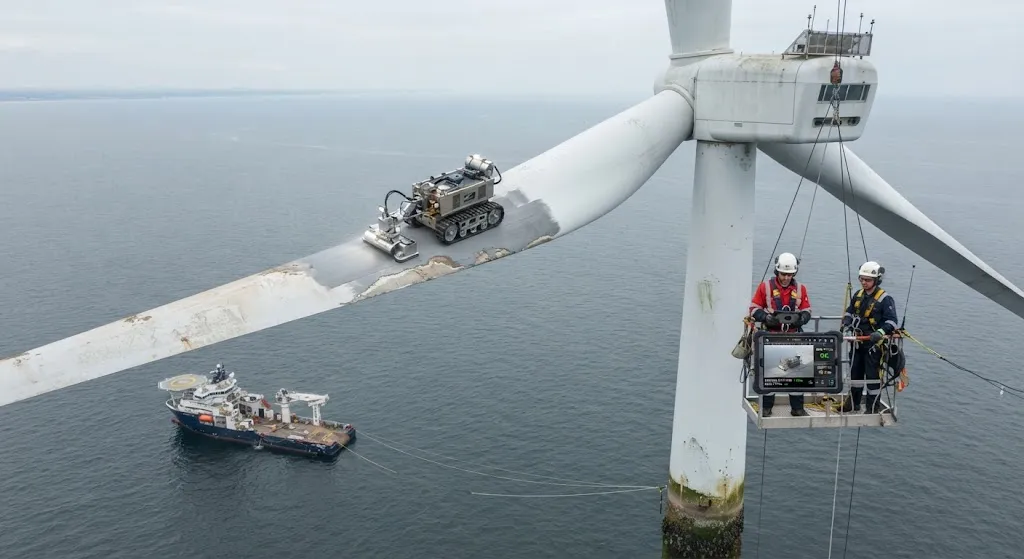
Onshore blade repair is a workshop problem: the blade comes down, the damage is assessed on the bench, and the repair is made under a roof with lights, power and stable temperature. Offshore, none of that holds. The blade stays on the turbine — transport costs and crane availability make blade-down campaigns prohibitive — so repair is performed in place, at height, in a marine environment, inside a weather window counted in hours. The methods that make this possible are wet patch repair, low-pressure infusion repair and robotic access, and choosing among them is a decision about weather, chemistry and access rather than just laminate strength.
Why Offshore Repair Is a Different Discipline
Every difference between offshore and onshore repair traces back to logistics and environment. Removing a blade from an offshore turbine demands a jack-up vessel or a heavy-lift crane vessel, plus downtime for the turbine and weather limits on the lift itself — a campaign that can cost orders of magnitude more than the repair work in question. The economics force in-situ repair as the default, and in-situ repair inherits the site's constraints:
- Weather windows: laminating, infusion and cure all have temperature, humidity and wind limits; offshore windows are short, uncertain and seasonal.
- Access: the repair crew works from a suspended platform or a workboat transfer, on a blade that moves with the structure — no bench, no roof, no stable floor.
- Chemistry at sea: resins must cure at ambient offshore temperatures and tolerated humidity, which favors certain chemistries over factory-style cure schedules.
- Time value: every day of turbine downtime is lost energy revenue, so repair schedules optimize for fast return to service, not just for strength.
These constraints make method selection the core engineering decision: the cheapest method that returns the blade to service within its weather window, with acceptable strength and inspectability.
The Three Offshore Repair Routes
Offshore blade repair is a menu of three main methods, each matched to damage size and access. The table below compares them at the level an offshore O&M team uses to plan a campaign:
| Method | Typical Damage | Setup at Sea | Cure Constraints | Strength Recovery |
|---|---|---|---|---|
| Wet patch repair | Gelcoat cracks, small laminate damage, leading-edge erosion | Hand layup of pre-cut plies with wet resin | Ambient cure resin, temperature and humidity limits | Good for cosmetics and shallow damage |
| Low-pressure infusion repair | Larger laminate damage, through-thickness voids | Bagged patch with infusion resin drawn under low pressure | Longer gel time; vacuum source needed | High, close to original laminate |
| Pre-cured patch bonding | Structural damage in load-bearing areas | Shop-made patch bonded with adhesive film or paste | Adhesive cure, often heated blankets | Highest, with engineered bondline |
| Robotic access assist | Leading-edge erosion, large-area coatings, recurring repairs | Wall-climbing robot or suspended system applies and inspects | Same chemistry, executed by machine | Consistent, data-logged application |
In practice many offshore campaigns combine methods: a wet patch for fast cosmetic restoration, infusion where the laminate is genuinely damaged, a pre-cured patch where the structure is load-bearing, and robotic systems where repetitive large-area work makes manual application impractical.
Wet Patch and Infusion Chemistry at Sea
Wet patch repair is the workhorse of offshore campaigns because it is simple and fast: pre-cut reinforcement plies are wetted with resin and laid onto the prepared damage site, then compacted by hand or with a small roller. Its limits are the same as its virtues: hand layup quality depends on the applicator, and ambient cure resins must tolerate offshore temperatures and humidity that a factory never sees. Repair-grade vinylester and epoxy systems with long gel times and forgiving cure windows are preferred, and cure verification often uses simple temperature and hardness checks on site rather than a controlled oven cycle.
Low-pressure infusion repair upgrades the same site into a bagged process: the damaged laminate is covered with peel ply, infusion media and a vacuum bag, and resin is drawn through under low pressure. The payoff is a denser, void-free repair that recovers more of the original laminate's strength — valuable where the damage reaches through the laminate or where the shell carries real load. The offshore price is complexity: a vacuum source, longer gel and infusion times, and a weather window long enough to let the resin fully fill and cure before the bag is removed.
Robotic Access at Sea
The most visible recent development in offshore repair is robotic access. Wall-climbing robots with adhesion systems survey and repair blade surfaces in place, reducing the human exposure on suspended platforms and extending the accessible area of the blade in a single deployment. The value is threefold: consistency — a machine applies coating or patch material with repeatable thickness and coverage; data — inspection sensors and application logs are recorded per repair; and productivity — large-area leading-edge erosion, the most common offshore damage, is addressed in a fraction of the manual time.
Robotic systems do not replace the chemistries; they execute them. The same wet patch and infusion materials are applied by machine heads that meter, lay and compact them, and the repair qualification still relies on the same bonding and cure physics. What robotics change is access economics: repairs that were marginal because of height, exposure or repetition become viable, and recurring damage like erosion is moved from annual manual campaigns to scheduled robotic passes.
Validating Repairs at Sea
A repair is only worth keeping if it can be validated, and validation offshore happens under the same constraints as the repair itself. The standard sequence is visual inspection, then a tap test or ultrasonic scan of the repaired zone, followed by cure verification of the resin before the turbine is released for service. Damage-tolerance thinking applies: a repair must restore sufficient strength with a defined margin, and its inspection must be repeatable so that the same scan performed months later can confirm the repair is holding.
The practical trend is to build validation into the robotic pass: a robot that applies erosion coating can also scan the blade and log the result, so inspection data and repair data live in the same record. For operators, this traceability is as valuable as the strength recovery, because it converts a repair from a one-off event into a documented, comparable asset state.
Frequently Asked Questions
Why are blades not routinely taken down for offshore repair?
Because the logistics dwarf the repair. Removing a blade from an offshore turbine requires a jack-up or heavy-lift vessel, a multi-day campaign with crane and crew, turbine downtime and strict weather limits on the lift itself — a cost that can exceed the repair work by orders of magnitude and is only justified for major structural events. Routine damage — erosion, cracks, small laminate defects — is far cheaper to repair in place at height, which is why the wet patch, infusion and robotic methods exist and why offshore contracts are built around in-situ repair capability.
When is low-pressure infusion repair preferred over a wet patch?
When the damage is structural rather than cosmetic. A wet patch restores surface integrity and shallow laminate well, but its strength recovery is limited by hand compaction and achievable fiber volume. Low-pressure infusion draws resin through the full thickness of the damaged zone under vacuum, producing a denser repair that recovers more of the original laminate properties — the right choice where damage reaches deep into the shell or where the repaired area carries real bending or fatigue load. The premium is complexity and a longer weather window, so O&M teams reserve infusion for damage that earns it.
What role do wall-climbing robots actually play in blade repair today?
Robots today handle the repetitive, large-area and exposure-limited work that is impractical or unsafe manually. The clearest current application is leading-edge erosion repair: robots survey the edge, clean and prepare the surface, apply coating or patch material with controlled thickness and log the result. They also support inspection passes that scan and document the blade. They do not yet replace manual methods for complex localized structural repairs — a deep through-laminate damage site or a load-bearing patch still needs skilled hands and infrared or vacuum processes — but their role in the repair mix is growing as access economics decide more campaigns.
How is an offshore repair certified as safe for service?
Through the same logic as onshore but executed in situ: visual inspection of the repair, nondestructive testing of the repaired zone — typically ultrasonic or tap testing — and verification that the resin reached full cure under site conditions. Structural repairs follow the blade manufacturer's damage limits: below threshold, standard repair procedures apply; above it, the repair design is reviewed and often approved by the OEM. Documentation matters as much as strength, because the repair becomes part of the blade's asset record for the remaining service life, and its inspectability must hold for years, not until the next campaign.
Conclusion
Offshore blade repair is a discipline shaped by logistics and environment before it is shaped by laminate mechanics. Wet patch repair, low-pressure infusion and robotic access each solve a different slice of the offshore problem — speed for cosmetic and shallow damage, thickness recovery for structural damage, and machine reliability for repetitive large-area work — and all of them are executed inside weather windows that onshore teams never have to respect. The methods converge on the same standard: a repair that returns the blade to service quickly, restores acceptable strength and can be validated and documented at sea.
For blade owners and O&M contractors planning offshore repair campaigns, matching repair method to damage class and weather window is the highest-leverage decision in the operation. Review our carbon fiber materials and repair-grade products, or contact our engineering team to discuss materials for in-situ blade repair programs.
Related Articles
- Carbon Fiber Mooring for Floating Offshore Wind: Fatigue and Corrosion in Deep Water
- Carbon Fiber Bicycle Frame Optimization: Layup Design and Manufacturing for Competitive Racing
- Carbon Fiber CFRP Retrofit for Infrastructure: Bridge and Building Seismic Strengthening
- Carbon Fiber Medical Imaging Equipment: Lightweight Gantry and Couch Structures for MRI/CT
- Carbon Fiber EV Battery Enclosures: Crash Safety and Electromagnetic Shielding Design
- Carbon Fiber Structures for Low-Altitude Economy: UAV Airframes and eVTOL Components