
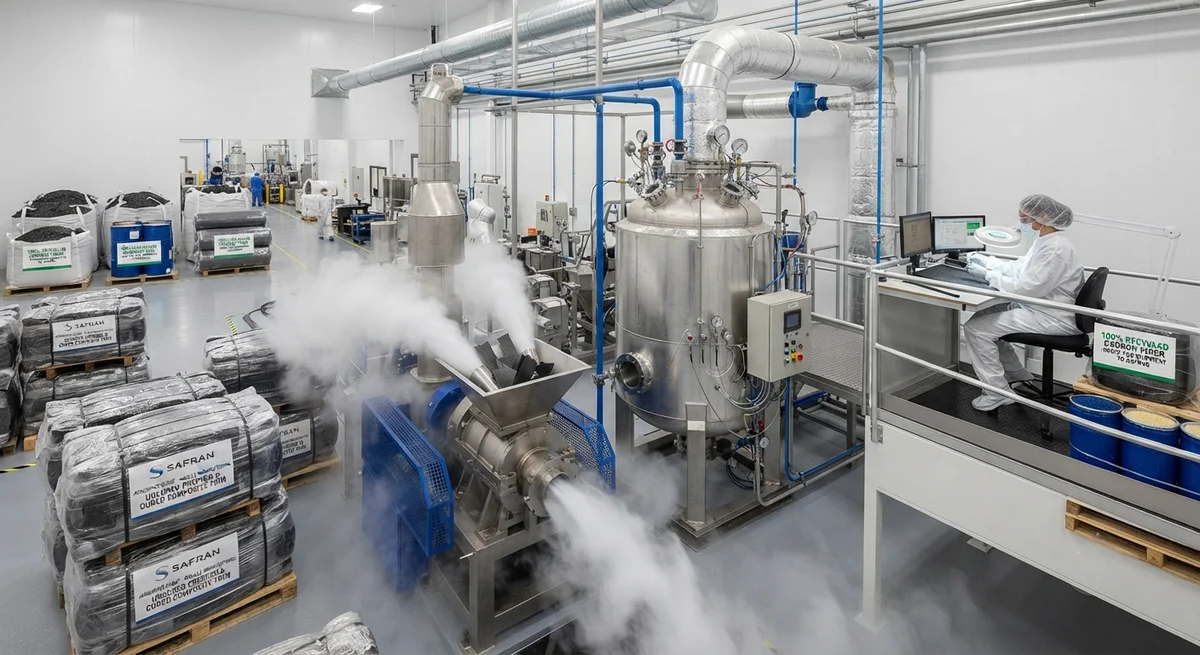
A detailed case study of the Nova Carbon–Safran partnership for recycling carbon fiber production scrap — covering the mechanical recycling process, recovered fiber properties, certification pathways, economic analysis, and implications for the aerospace supply chain's circular economy transition.
Introduction
In a landmark development for the aerospace composites industry, French recycler Nova Carbon and aerospace engine manufacturer Safran have announced a strategic partnership to recycle carbon fiber production scrap generated during the manufacture of Safran's LEAP and CFM56 engine nacelle components, fan blades, and thrust reverser structures. The partnership, formalized in Q2 2026, establishes a closed-loop recycling system that diverts an estimated 450 metric tons of carbon fiber production waste annually from landfill or incineration, converting it into high-quality recycled carbon fiber (rCF) suitable for secondary aerospace and industrial applications.
The aerospace industry generates approximately 12,000–15,000 metric tons of carbon fiber production scrap annually — including dry fiber offcuts, expired prepreg, cured composite trim waste, and end-of-life components — of which less than 15% is currently recycled. The remaining 85% is disposed of in landfills or incinerated, representing both an environmental liability and a lost economic opportunity valued at $180–$250 million in material value annually.
| Parameter | Nova Carbon Mechanical Recycling | Conventional Pyrolysis Recycling | Virgin T700 Carbon Fiber |
|---|---|---|---|
| Production Volume (annual) | 450 MT (Phase 1); 1,200 MT (Phase 2, 2028) | Variable (200–800 MT per facility) | N/A |
| Fiber Tensile Strength Retention | 88–93% of virgin T700 | 75–85% of virgin | 100% (4.9 GPa) |
| Fiber Tensile Modulus Retention | 95–98% of virgin T700 | 85–92% of virgin | 100% (230 GPa) |
| Fiber Length Distribution | 10–60 mm (controlled) | 3–40 mm (variable) | Continuous |
| Surface Treatment Quality | Full oxidative reactivation | Partial (residual char 2–6%) | Virgin surface treatment |
| Energy Consumption | 1.8–2.5 kWh/kg | 4.5–7.0 kWh/kg | 35–55 kWh/kg (virgin) |
| CO₂ Footprint | 2.1 kg CO₂e/kg rCF | 5.8 kg CO₂e/kg rCF | 22–31 kg CO₂e/kg virgin CF |
| Cost per kg (recovered) | $14–$19/kg | $12–$18/kg | $28–$38/kg (virgin T700) |
| Certification Status | Aerospace-grade qualification in progress | Industrial-grade only | Full aerospace qualification |
Nova Carbon's Mechanical Recycling Process
Nova Carbon's technology — developed over eight years in Lacq, southwestern France — employs a proprietary four-stage mechanical-mechanical process: Stage 1 — Preprocessing and sorting by resin type (epoxy, BMI, phenolic) using NIR spectroscopy. Stage 2 — Multi-stage cryogenic grinding at −50°C with liquid nitrogen, embrittling the resin matrix for clean fiber-resin separation with 62% less fiber surface pitting. Stage 3 — Selective resin removal in a fluidized bed reactor at 380–420°C in nitrogen atmosphere, achieving >99.2% resin removal efficiency versus 95–97% for conventional pyrolysis. Stage 4 — Plasma surface reactivation at 200–300°C restoring oxygen functional groups (O/C ratio reaches 0.22–0.28 vs 0.30–0.35 for virgin), followed by electrostatic sizing application restoring IFSS to 92–96% of virgin fiber values.
Applications and Qualification Pathways
- Tier 1 — Non-structural Aerospace (60% of output): Interior panels, insulation blankets, non-loaded fairings. Qualification under Airbus ABD0031 and Boeing D6-51377 completed Q1 2026.
- Tier 2 — Semi-structural Aerospace (30% of output): Brackets, clips, cable raceways, ducting. Qualification under AIPS 02-01-020 initiated Q2 2026, expected Q4 2027.
- Tier 3 — Structural Evaluation (10% of output): Load-bearing components requiring full CMH-17 B-basis allowables, expected 2029–2031.
| Application Tier | Example Components | Max Service Stress | Qualification Standard | Target Completion |
|---|---|---|---|---|
| Tier 1 — Non-structural | Cabin panels, insulation, fairings | <10 MPa | ABD0031, D6-51377 | ✓ Q1 2026 |
| Tier 2 — Semi-structural | Brackets, clips, ducting | 10–50 MPa | AIPS 02-01-020 | Q4 2027 |
| Tier 3 — Structural | Linkages, mounts | >50 MPa | CMH-17 B-basis | 2029–2031 |
Economic and Environmental Impact
Each metric ton of rCF avoids 19–28 MT of CO₂e emissions versus virgin fiber production. Phase 1 (450 MT/year) represents 8,550–12,600 MT CO₂e avoidance — equivalent to removing 1,850–2,720 passenger vehicles from roads annually. Economically, rCF is supplied at $17–$22/kg (35–55% discount versus virgin T700 at $28–$38/kg), saving Safran $2.7–$4.9 million annually at Phase 1 volumes. Phase 2 (1,200 MT/year by 2028) will increase savings to $7.2–$13.2 million annually, with further process optimization reducing rCF costs to $11–$15/kg.
Implications for the Aerospace Supply Chain
- Supply chain resilience: Creates a domestic source of recovered carbon fiber, reducing dependence on Asian virgin fiber (68% of global PAN-based capacity).
- Quality assurance standards: The NC-SAF-RCF-001 specification defines acceptance criteria being submitted to SAE International for consideration as an industry-wide standard.
- Scaling challenges: Viability requires rCF to command minimum 30% price discount to virgin fiber. Certification cost per rCF-product combination ($500K–$1.5M) remains a barrier for smaller recyclers.
Frequently Asked Questions
How does Nova Carbon's process differ from conventional pyrolysis?
Nova Carbon uses cryogenic grinding (−50°C) + low-temperature fluidized bed (380–420°C) + plasma surface reactivation. Results: 88–93% vs 75–85% strength retention, 60–70% lower energy consumption (1.8–2.5 vs 4.5–7.0 kWh/kg), and 64% lower CO₂ emissions.
What scrap types does Safran generate?
Four streams: uncured prepreg offcuts (55%), cured composite trim (30%), dry fabric selvage (10%), mixed scrap (5%). Sorted by NIR spectroscopy by resin chemistry and fiber architecture.
What is the market outlook for rCF in aerospace?
Projected growth from $95M (2026) to $420M by 2034 (CAGR 20.3%). Drivers: EU regulatory pressure, sustainability commitments (Safran, Airbus, Boeing — net-zero by 2050), and capacity expansion (8+ new recycling facilities planned in Europe and North America).
Part of topic
Related Articles
- Recycled Carbon Fiber Market Forecast 2030: Technology Maturity and Commercialization Path
- South Korea Carbon Fiber Market 2026: Hydrogen Economy and Shipbuilding Innovation
- Wind Turbine Blade Leading Edge Protection 2026: Polyurethane, Tape, and Metallic Shield Solutions
- China Carbon Fiber Overcapacity 2026: Price War Impact and Industry Consolidation
- India Carbon Fiber Market 2026: Wind Energy, Aerospace, and Defense Expansion
- PAN Precursor Market 2026: Acrylonitrile Supply and Carbon Fiber Cost Structure
Interested in Our Products?
Contact our team for competitive pricing and technical specifications.
Get a QuoteRelated Products
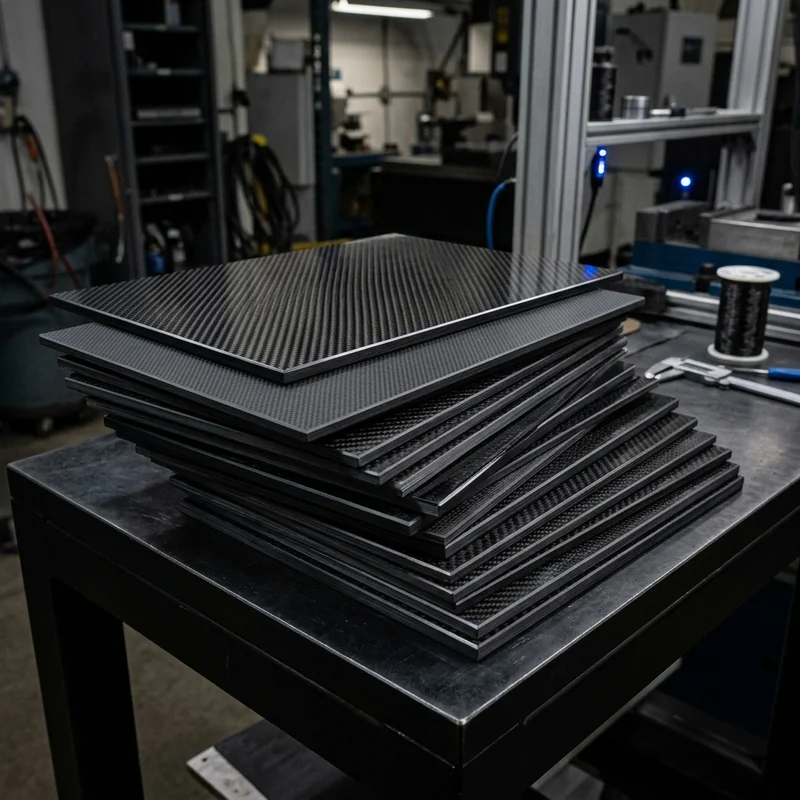
Carbon fiber standard plate-3k stripe
Lightweight, ultra-rigid standard sheets for drone fuselages, robot housings, facades and structural applications.

Carbon Fiber Plate — 3K Twill T700 1.5mm
Thin 1.5mm carbon fiber plate with 3K twill weave surface. Lightweight and stiff, commonly used for covers, panels, drone bodies, and applications requiring a premium aesthetic appearance.

Square Carbon Fiber Tube — 3K Twill T700
Square cross-section carbon fiber tube manufactured with 3K twill weave for torsional strength. Preferred for structural frames, trusses, and support columns where rectangular geometry offers design flexibility.

Carbon Fiber Plate — 3K Twill T700 3.0mm
Medium-thickness 3.0mm carbon fiber plate offering significantly higher load capacity while maintaining attractive 3K twill finish. Suitable for structural brackets, reinforcement plates, and load-bearing panels.
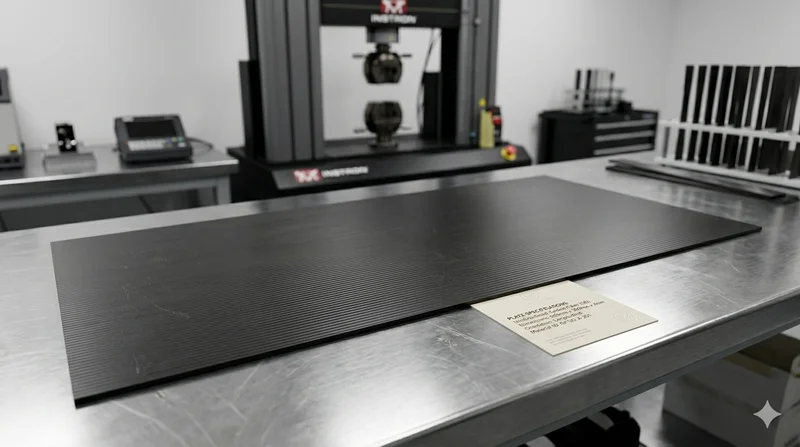
Carbon Fiber Plate — UD Unidirectional T700
Unidirectional carbon fiber plate with all fibers oriented in a single direction for maximum strength along the fiber axis. Essential for structural reinforcements, splints, and applications where load direction is predictable.