The global wind energy supply chain is experiencing significant disruption as nickel prices on the London Metal Exchange (LME) have climbed to $22,840 per tonne — a level not seen since the 2023 supply crunch. For wind turbine blade manufacturers, this price movement is not an isolated
Introduction
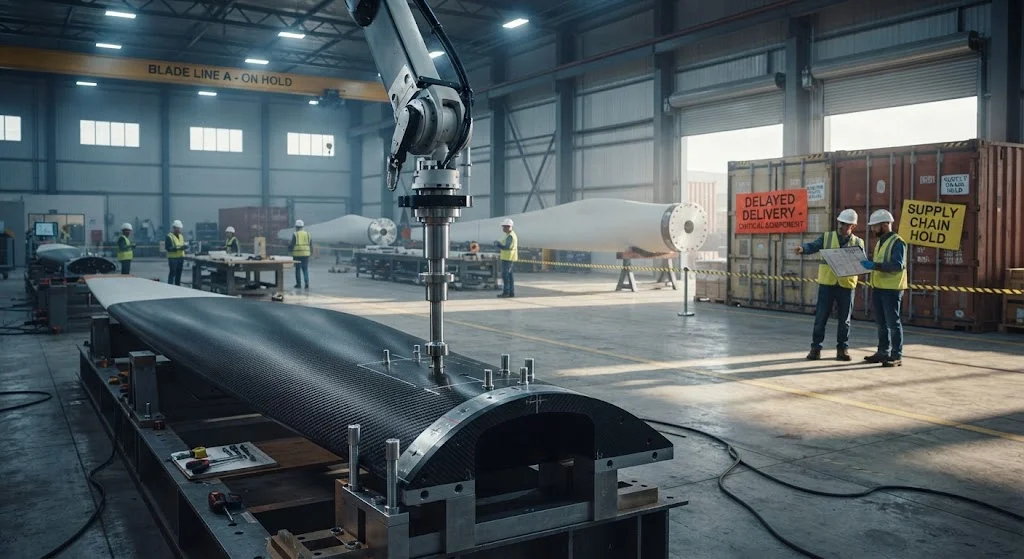
The global wind energy supply chain is experiencing significant disruption as nickel prices on the London Metal Exchange (LME) have climbed to $22,840 per tonne — a level not seen since the 2023 supply crunch. For wind turbine blade manufacturers, this price movement is not an isolated commodity fluctuation but rather a structural shift that reverberates through alloy procurement, component fabrication timelines, and ultimately the cost equation for carbon fiber spar caps and shear webs. The 20-week lead time extension now quoted by major blade OEMs reflects a supply chain under genuine strain, where raw material constraints are meeting surging demand from both offshore and onshore wind projects.
This article examines the mechanisms through which nickel price escalation impacts blade manufacturing, analyzes the specific alloy components most affected, and provides actionable guidance for carbon fiber buyers seeking to navigate the resulting procurement challenges. Understanding these dynamics is essential for blade manufacturers, wind farm developers, and composite material suppliers planning production schedules through 2027.
Nickel Price Dynamics and Market Drivers
The current nickel price surge is driven by a convergence of supply constraints and demand growth that has fundamentally altered the market balance:
- Indonesian export policy tightening: Indonesia, which accounts for approximately 55% of global nickel mine production, has implemented progressive export restrictions to encourage domestic processing. The 2025 nickel ore export ban extension has reduced raw material availability for European and American alloy producers.
- EV battery demand competition: The electric vehicle sector's growing appetite for nickel-intensive battery chemistries (NMC 811, NMC 622) has created a demand floor that did not exist five years ago. Battery-grade nickel sulfate now commands a $3,000-4,000 per tonne premium over Class 1 nickel.
- Wind energy capacity acceleration: Global wind installations are projected to reach 120 GW in 2026, up from 98 GW in 2025. Each megawatt of installed wind capacity requires 15-25 tonnes of steel and alloys containing nickel, creating incremental demand of 300,000-500,000 tonnes annually.
- Strategic stockpiling: European defense and aerospace programs have increased nickel strategic reserves by 40% since 2024, further tightening available supply for industrial applications.
Blade Alloy Components Most Affected
Nickel-containing alloys play critical roles in wind turbine blade systems, particularly in components that must withstand cyclic loading and corrosive offshore environments:
| Component | Nickel Alloy Type | Ni Content (%) | Cost Impact ($/blade set) | Lead Time Change |
|---|---|---|---|---|
| Root insert bolts | Inconel 718 | 50-55% | + $2,800-3,500 | 14 → 20 weeks |
| Pitch bearing rings | M50 steel | 3-4% | + $1,200-1,800 | 12 → 18 weeks |
| Hub connection bolts | L87 bolt alloy | 1.5-2.5% | + $800-1,200 | 10 → 16 weeks |
| Nacelle frame inserts | Duplex stainless | 5-8% | + $1,500-2,200 | 16 → 22 weeks |
| Offshore corrosion barriers | Hastelloy C-276 | 57-63% | + $4,000-6,000 | 18 → 26 weeks |
| Lifting hardware | 4340 modified | 1.5-2.0% | + $400-600 | 8 → 14 weeks |
The most significant cost and lead time impacts are concentrated in Inconel 718 root insert bolts and Hastelloy corrosion barriers — components where nickel represents the majority of the alloy composition and where there are limited substitution options without compromising fatigue performance or corrosion resistance.
Carbon Fiber Procurement Implications
The nickel-driven supply chain disruption creates secondary effects for carbon fiber procurement that blade manufacturers must anticipate:
- Production schedule compression: Extended alloy lead times force blade OEMs to lock production schedules earlier, which in turn requires earlier carbon fiber commitments. The typical 8-10 week carbon fiber procurement window is being compressed to 4-6 weeks as manufacturers seek to maintain assembly line continuity.
- Spar cap timing coordination: Carbon fiber spar caps must arrive synchronized with root insert bolt delivery. A 6-week delay in Inconel bolts can idle spar cap inventory, increasing working capital requirements by $150,000-300,000 per delayed blade set.
- Material substitution pressure: Some blade designers are evaluating reduced-nickel alloy alternatives for non-critical components, which may alter attachment interface specifications and require carbon fiber layup modifications to accommodate different bolt patterns or insert geometries.
- Inventory buffer requirements: Blade OEMs are increasing safety stock levels for both alloy components and carbon fiber materials, with typical buffer inventories rising from 4 weeks to 8-10 weeks of production requirements.
Lead Time Extension Analysis
The current 20-week average lead time for blade alloy components represents a structural shift rather than a temporary disruption. Several factors suggest this extended timeline will persist through 2027:
- Capacity utilization: European specialty alloy producers are operating at 85-90% capacity utilization, with limited ability to add shifts or overtime without significant capital investment.
- Qualification barriers: Alternative alloy suppliers require 6-12 months for material qualification and testing before blade OEMs can approve production use, creating a natural delay in supply response.
- Logistics complexity: Nickel alloy components often require temperature-controlled shipping and specialized handling, adding 1-2 weeks to delivery timelines compared to standard steel components.
- Contractual commitments: Long-term supply agreements between alloy producers and EV battery manufacturers have locked up significant production capacity, limiting spot market availability for wind energy applications.
Mitigation Strategies for Blade Manufacturers
Industry participants are implementing several strategies to manage nickel price volatility and lead time extensions:
- Dual sourcing qualification: Blade OEMs are qualifying 2-3 alternative suppliers for critical nickel alloy components, accepting higher qualification costs to reduce single-source dependency.
- Forward purchasing contracts: Multi-year fixed-price contracts for nickel alloys are becoming standard practice, with typical commitment periods extending from 12 months to 24-36 months.
- Design optimization: Some manufacturers are redesigning root connection systems to reduce Inconel content, using hybrid bolt configurations that combine high-nickel alloys in critical load paths with lower-nickel alternatives in secondary connections.
- Carbon fiber pre-commitment: Securing carbon fiber capacity 12-16 weeks ahead of production requirements ensures material availability even when alloy delays compress the overall production schedule.
Frequently Asked Questions
How does the nickel price increase affect total wind blade manufacturing cost?
The direct cost impact of the current nickel price surge ranges from $8,000-12,000 per blade set for a typical 5 MW offshore turbine, representing a 3-5% increase in total blade manufacturing cost. However, the indirect costs — including working capital increases from extended inventories, production schedule delays, and qualification testing for alternative suppliers — can add an additional $15,000-25,000 per blade set when fully accounted. For a 100-turbine offshore wind farm, this translates to $2.3-3.7 million in incremental project cost, which may be partially offset by hedging strategies or contract renegotiation with turbine OEMs.
What are the viable alternatives to high-nickel alloys in blade components?
Substitution options depend on the specific component and loading requirements. For root insert bolts, high-strength low-alloy steel (HSLA) with 1-2% nickel content can replace Inconel 718 in some applications, reducing nickel content by 95% while maintaining 80-85% of the fatigue performance. However, this substitution requires blade redesign to accommodate larger bolt diameters and may increase blade root weight by 15-20%. For corrosion barriers in offshore applications, there are no direct substitutes for Hastelloy that maintain equivalent performance in salt spray environments, making these components most vulnerable to sustained nickel price increases.
How should carbon fiber procurement adapt to alloy lead time extensions?
Carbon fiber buyers should implement a "pull-forward" procurement strategy, committing to material purchases 12-16 weeks before scheduled blade production rather than the traditional 8-10 week window. This approach carries higher working capital costs (approximately $50,000-80,000 per blade set in inventory carrying charges) but provides a buffer against production line disruptions. Additionally, blade manufacturers should negotiate flexible delivery schedules with carbon fiber suppliers that allow ±2 week delivery windows, providing resilience when alloy component delivery dates shift.
Conclusion
The nickel price surge to $22,840 per tonne and resulting 20-week lead time extensions represent a structural challenge for the wind blade supply chain that will persist through 2027. Blade manufacturers must adapt their procurement strategies for both nickel alloys and carbon fiber materials to maintain production continuity in this constrained environment. The winners will be those who secure supply commitments early, qualify alternative sources, and implement inventory strategies that balance cost against production security. As wind energy capacity continues to accelerate, the ability to navigate raw material supply constraints will increasingly differentiate successful blade manufacturers from those facing costly production disruptions.
For wind blade manufacturers and carbon fiber buyers evaluating supply strategies in this volatile market, understanding the nickel-carbon fiber procurement interconnection is essential. Explore our carbon fiber product range for wind energy applications, including large-tow carbon fiber optimized for blade spar caps, or contact our team to discuss supply agreement structures that provide delivery flexibility during supply chain disruptions.
Part of topic
Related Articles
- Recycled Carbon Fiber Market Forecast 2030: Technology Maturity and Commercialization Path
- South Korea Carbon Fiber Market 2026: Hydrogen Economy and Shipbuilding Innovation
- Wind Turbine Blade Leading Edge Protection 2026: Polyurethane, Tape, and Metallic Shield Solutions
- China Carbon Fiber Overcapacity 2026: Price War Impact and Industry Consolidation
- India Carbon Fiber Market 2026: Wind Energy, Aerospace, and Defense Expansion
- PAN Precursor Market 2026: Acrylonitrile Supply and Carbon Fiber Cost Structure
Interested in Custom Carbon Fiber Products?
Contact our team for competitive pricing and technical specifications.
Get a Quote