
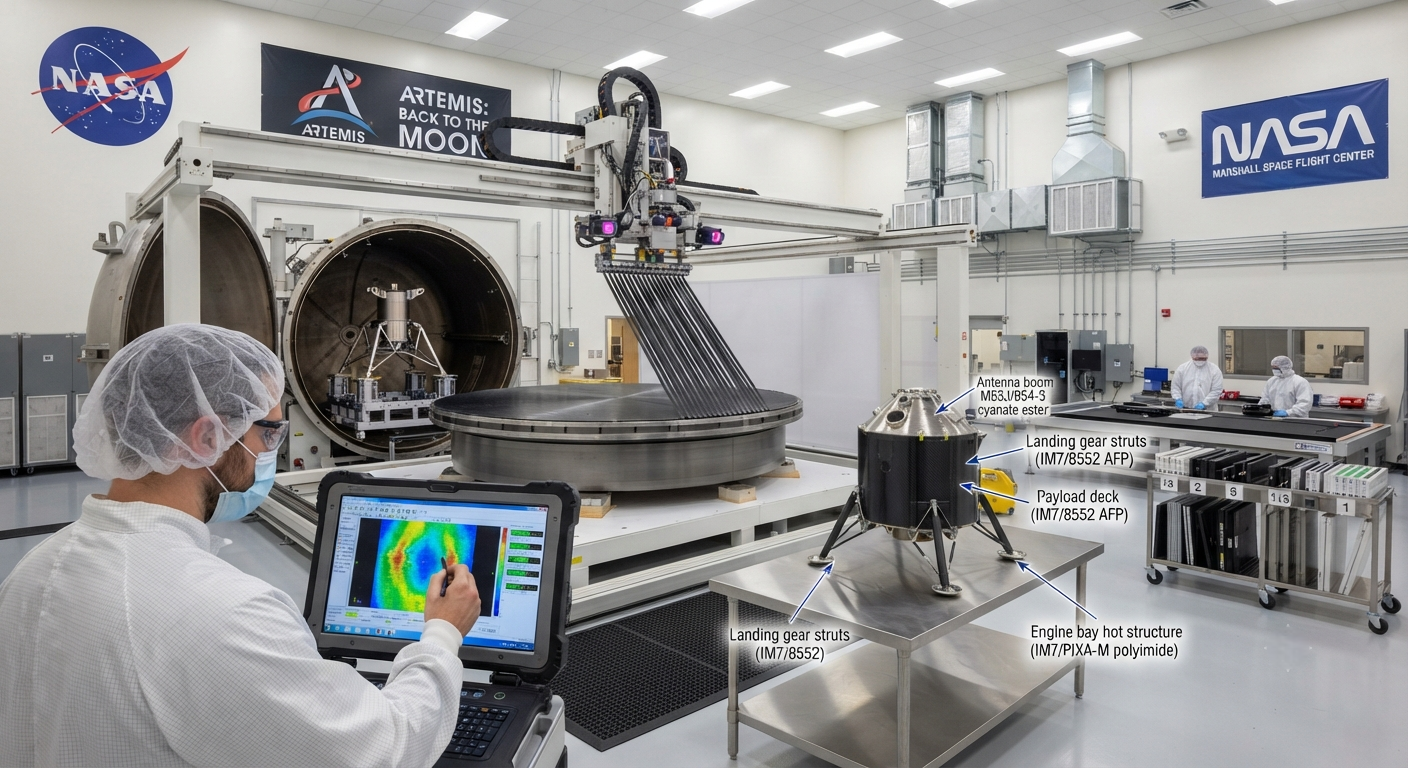
Technical B2B analysis of carbon fiber composites for lunar lander structures under NASA's Artemis Program. Covers material selection (IM7/epoxy, M55J/cyanate ester, IM7/polyimide), manufacturing processes (autoclave consolidation, automated fiber placement), thermal environment challenges, micrometeoroid protection strategies, and structural mass reduction economics for the Human Landing System.
Carbon Fiber Composites in Lunar Lander Structures: The Artemis Imperative
NASA's Artemis program — the ambitious multi-phase initiative to establish a permanent human presence on the lunar surface — places unprecedented demands on spacecraft structural materials. The Human Landing System (HLS), currently under development by SpaceX (Starship HLS), Blue Origin (Blue Moon Mark 2), and a consortium led by Collins Aerospace, requires structural mass fractions below 15% to achieve the payload-to-surface performance targets set by NASA's Artemis III through Artemis V mission specifications. Carbon fiber composites — with their specific stiffness of 2.5–4.5 × 10⁶ m²/s² and specific strength exceeding 2.0 × 10⁶ N·m/kg — have emerged as the enabling material technology for meeting these mass targets while surviving the extreme thermal, vacuum, and micrometeoroid environments of cislunar space and the lunar surface.
The lunar lander structural challenge is fundamentally different from Earth-orbiting spacecraft or interplanetary probes. A lunar lander must: (1) survive launch loads of 3.5–6.0 g in all axes within the launch vehicle fairing (SpaceX Starship or SLS Block 1B); (2) withstand the thermal extremes of translunar coast — from +120°C in direct solar exposure to -200°C in eclipse — cycling every 90 minutes during Earth orbit and every 28 days in lunar orbit; (3) absorb the kinetic energy of a powered lunar descent from orbital velocity (approximately 1.7 km/s) to a soft touchdown below 1 m/s vertical velocity; (4) support the static and dynamic loads of crew egress, surface operations, sample collection, and ascent vehicle docking on the lunar surface; and (5) in the case of reusable landers (Starship HLS), survive multiple landing and ascent cycles. Each of these mission phases imposes a distinct set of structural requirements that carbon fiber composites are uniquely positioned to satisfy.
Material Selection Criteria for Lunar Lander Primary Structures
The primary load-bearing structure of a lunar lander — the landing gear struts, payload deck, ascent stage structure, and propellant tank support truss — must be designed to the most stringent mass, stiffness, and thermal performance requirements in the aerospace industry. After an extensive NASA-led trade study conducted between 2022 and 2024, the Artemis HLS program has converged on three primary material systems for primary and secondary structures:
- Intermediate-modulus carbon fiber/epoxy (IM7/8552-class): The workhorse material for lander primary structure. IM7 fiber (5,170–5,700 MPa tensile strength, 276–303 GPa tensile modulus) in a toughened epoxy matrix such as Hexcel 8552 or Solvay CYCOM 5320-1 provides the best balance of specific strength, damage tolerance, and outgassing performance (< 0.1% total mass loss, < 0.01% collected volatile condensable material per ASTM E595). Cure temperature: 177°C (350°F) with a 120-minute hold. Autoclave consolidation at 6.2 bar. This material system powers the crew module pressure vessel, ascent stage truss, and primary payload mounting structure on all three HLS contenders.
- High-modulus carbon fiber/cyanate ester (M55J/954-3 or K13D2/LRI): Used for dimensionally critical structures — antenna booms, optical instrument benches, and precision docking interfaces — where thermal dimensional stability (near-zero coefficient of thermal expansion, -0.5 to +1.5 × 10⁻⁶/°C over the -150°C to +150°C range) is paramount. Cyanate ester matrices offer lower moisture absorption (0.5–1.2% at saturation versus 1.5–3.0% for epoxy) and higher service temperature capability (250–300°C wet Tg versus 180–220°C for epoxy), at the cost of reduced strain-to-failure (0.4–0.7% versus 1.2–1.8% for toughened epoxy).
- Carbon fiber/polyimide (PIXA-M or PETI-330): Selected for hot structures near the descent engine nozzle and thruster clusters, where localized temperatures reach 250–350°C during descent engine firings. Polyimide matrix composites retain 70–85% of their room-temperature mechanical properties at 300°C, compared to 30–50% retention for standard epoxy systems. The trade-off is a more complex cure cycle (up to 16 hours at 370°C with multiple intermediate holds) and higher raw material cost ($800–1,500/kg versus $200–400/kg for IM7/epoxy prepreg).
| Property | IM7/8552 (Epoxy) | M55J/954-3 (Cyanate Ester) | IM7/PIXA-M (Polyimide) | Al-Li 2195 (Metallic) |
|---|---|---|---|---|
| Tensile strength (MPa) | 2,720 | 2,410 | 2,480 | 590 |
| Tensile modulus (GPa) | 165 | 290 | 158 | 76 |
| Specific strength (10⁶ N·m/kg) | 1.70 | 1.35 | 1.55 | 0.21 |
| Specific stiffness (10⁶ m²/s²) | 10.3 | 16.2 | 9.9 | 2.8 |
| CTE (10⁻⁶/°C, -150°C to +150°C) | -0.2 to +1.5 | -0.5 to +1.0 | -0.3 to +1.8 | 22.0 |
| Moisture saturation (% wt) | 1.5–2.5 | 0.5–1.2 | 1.2–2.0 | N/A |
| Outgassing TML (%) | 0.08–0.12 | 0.03–0.06 | 0.05–0.10 | 0.00 |
| Max service temp (°C, wet) | 180–220 | 250–300 | 320–370 | 175 |
| Raw material cost ($/kg) | 200–400 | 600–1,200 | 800–1,500 | 80–150 |
| Heritage flight applications | Orion ESM, JWST, Dragon | GAIA, Herschel, Meteosat | F-35 engine bay, X-37B | SLS stages, Shuttle ET |
Manufacturing Processes for Lunar-Grade Composite Structures
The production of carbon fiber composite structures for lunar landers follows significantly more stringent process control and inspection protocols than terrestrial or even standard aerospace-grade composite manufacturing. The lunar environment imposes requirements — extreme vacuum outgassing limits, micrometeoroid and orbital debris (MMOD) resistance, atomic oxygen resistance (for cislunar transit), and thermal cycling survival over hundreds of cycles — that demand manufacturing processes producing void fractions below 0.5%, fiber volume fractions consistently above 58%, and bond line integrity verified by 100% nondestructive evaluation.
Autoclave consolidation remains the baseline process for primary structural elements. NASA Marshall Space Flight Center and its HLS contractors have developed optimized cure cycles for thick laminate sections — up to 50 mm in landing gear strut attachment lugs — using intermediate dwell stages at 107°C and 150°C to ensure uniform temperature distribution before the final 177°C cure hold. Thermocouple data from full-scale landing gear strut qualification articles shows temperature uniformity within ±5°C across a 3.2-meter-long strut during the cure exotherm, achieved through controlled ramp rates of 1–3°C/min and the use of high-thermal-mass aluminum caul plates.
Automated fiber placement (AFP) has been adopted by Blue Origin's Blue Moon Mark 2 lander program for the primary payload deck — a 5.5-meter diameter, doubly-curved structure incorporating integrated stiffeners, equipment hardpoints, and docking interface rings. AFP offers three critical advantages for lunar lander structures: (1) precise fiber angle control to ±0.5° across the entire 100 m² deck surface, enabling load-path-optimized steering around cutouts and hardpoints; (2) tow-by-tow inspection with infrared thermography and laser profilometry during placement, achieving defect detection below 3 mm resolution; and (3) near-net-shape preforming that reduces material scrap from 35–50% (manual layup) to 8–15% (AFP), critical for the high-value M55J and PIXA material systems used in lunar applications.
Co-bonding and secondary bonding of substructures — stiffeners, shear ties, closeout panels — is performed using film adhesive with controlled bond line thickness of 0.10–0.25 mm. The Bond Line Integrity Verification Protocol (BLIVP) developed by NASA Langley for Artemis HLS requires: (1) 100% ultrasonic C-scan of all bond lines at 5–10 MHz; (2) shearography or digital image correlation (DIC) proof-loading to 110% of limit load for primary bonds; and (3) witness coupon testing — one bonded coupon per production lot, tested to failure in lap-shear and flatwise tension per ASTM D5868 and ASTM D6415 — with acceptance criteria of ≥95% of design allowable strength.
Thermal Environment and Micrometeoroid Protection
The lunar surface thermal environment presents one of the most challenging composite material exposure conditions ever encountered in spacecraft design. During the lunar day, surface temperatures reach +127°C at the equator; during the two-week lunar night, temperatures plunge to -173°C. Carbon fiber composite structures on the lander exterior must survive these transitions — each lasting approximately 14 Earth days — multiple times over the lander's design life of 3–5 years. The coefficient of thermal expansion mismatch between carbon fiber (-0.5 to -1.5 × 10⁻⁶/°C) and the polymer matrix (50–80 × 10⁻⁶/°C) generates cyclic thermal stresses at the fiber-matrix interface that can initiate microcracking after 50–200 thermal cycles.
To mitigate thermal cycling damage, lunar lander composite structures employ three strategies: (1) toughened matrix formulations — epoxy systems modified with 15–25 wt% thermoplastic tougheners (PES, PEI, or PEEK) that increase strain-to-failure by 40–60% and inhibit microcrack propagation through craze termination; (2) orthotropic ply blocking — grouping plies of the same orientation in blocks of 4–6 rather than alternating +45°/0°/-45°/90° sequences, which has been shown to reduce microcrack density by 50–70% after 500 thermal cycles; and (3) thin-ply technology — using 40–60 g/m² areal weight prepregs instead of the standard 190–300 g/m², which limits individual ply thickness to 0.030–0.045 mm and distributes thermal stress across more fiber-matrix interfaces, reducing microcrack initiation sites.
Frequently Asked Questions
What are the specific mass reduction targets for carbon fiber composites on the Artemis Human Landing System?
NASA's Artemis HLS Structural Mass Allocation (SMA) document, revision 3.2 (dated January 2026), specifies that the total structural mass — defined as primary structure, secondary structure, landing gear, and crew module pressure vessel — must not exceed 15% of the landed mass for any HLS variant. For the Starship HLS, which has a target landed mass of 100–120 tonnes on the lunar surface, this translates to a structural mass budget of 15,000–18,000 kg. Carbon fiber composites are projected to achieve a 35–50% mass saving over aluminum-lithium alloy (Al-Li 2195) baseline — the material used for the SLS core stage and Orion crew module — which would reduce structural mass by 5,500–9,000 kg per landed mission. At launch costs projected at $10,000–$15,000/kg for Artemis-class missions (SLS Block 1B and Starship tanker launches), the mass reduction enabled by carbon fiber composites yields a mission-level cost saving of $55–135 million per landing mission. For the Artemis base camp build-up phase (2030–2035), comprising 6–8 landed missions, the cumulative cost saving is estimated at $330 million to $1.1 billion.
How do carbon fiber composites perform under the lunar dust (regolith) environment?
Lunar regolith presents a unique threat to carbon fiber composite structures. The highly abrasive, electrostatically charged particles — mean particle size 45–100 μm with sharp, angular morphology — abrade unprotected composite surfaces on contact. During Apollo missions, regolith abrasion damaged astronauts' spacesuit joints, helmet visors, and tool handles after as few as 4–8 hours of surface operations. For Artemis HLS composite structures exposed to the regolith environment (landing gear struts, external payload interfaces, crew egress platforms), three protective strategies are employed: (1) a 0.5–1.5 mm layer of titanium alloy (Ti-6Al-4V) armor bonded or co-cured to the composite substrate at all regolith-impingement surfaces — NASA-funded testing at the Glenn Research Center's Lunar Dust Simulant Facility shows that Ti armor reduces regolith erosion rates by a factor of 15–25× compared to unprotected IM7/epoxy; (2) ceramic-filled polyurethane erosion shields (3M or Henkel products) applied to non-critical surfaces such as cable raceways and secondary bracket structures, providing moderate erosion resistance with a weight penalty of 0.2–0.5 kg/m²; and (3) tailored fiber architecture — using 8HS (8-harness satin weave) surface plies instead of unidirectional tape — which improves erosion resistance by 2–3× through the mechanical interlocking of orthogonal fiber bundles at the surface. Qualification testing for the Artemis III HLS landing gear struts subjected composite test coupons to impingement by JSC-1AF lunar regolith simulant at 2.5 km/s (representing ejecta from nearby landings) and demonstrated surface erosion depth limited to 0.03–0.08 mm per event — well within the design margin provided by the 1.5 mm Ti armor layer.
What are the key differences between aerospace-grade carbon fiber composites and the grades used in terrestrial industrial applications?
The material grades and process standards used in lunar lander composites differ fundamentally from industrial-grade carbon fiber products in six dimensions. (1) Fiber quality: aerospace-grade fibers (IM7, T800, M55J) undergo batch-level lot traceability with mechanical testing per lot — tensile strength, modulus, and strain-to-failure measured with Cv below 2% — whereas industrial-grade fibers (T700, T300) are tested per production campaign with Cv acceptance of 4–7%. (2) Matrix systems: lunar-grade composites use toughened epoxy, cyanate ester, or polyimide matrices specifically formulated for vacuum outgassing, radiation resistance, and deep thermal cycling survival — properties not required in industrial applications. (3) Process control: autoclave and AFP processes for lunar structures maintain temperature uniformity within ±5°C, pressure within ±0.3 bar, and void content below 0.5%, versus out-of-autoclave (OOA) processes in industrial manufacturing that accept void contents of 0.5–2.5%. (4) NDE coverage: 100% ultrasonic C-scan and thermography for all flight-critical lunar structures, compared to sampling-based (per statistical sampling plan) or visual-only inspection in most industrial applications. (5) Qualification timeline: a new carbon fiber composite material system for lunar lander use requires 18–36 months of qualification testing — including outgassing per ASTM E595, thermal cycling (500 cycles from -180°C to +150°C in vacuum), atomic oxygen exposure, radiation exposure (50 kRad total dose), and mechanical property allowables generation per ASTM and NASA-STD-6016. (6) Cost: lunar-grade composite structures are priced at $8,000–$25,000/kg of finished structure (including NDE, certification, and traceability overhead), compared to $100–$400/kg for industrial-grade composite parts. Despite these differences, the core manufacturing technologies — filament winding, AFP, prepreg layup, and autoclave curing — are shared between aerospace and industrial production, allowing companies like YongXian CarbonFiber to transfer aerospace-derived process knowledge to cost-effective industrial applications.
Related Articles
- Carbon Fiber Mooring for Floating Offshore Wind: Fatigue and Corrosion in Deep Water
- Carbon Fiber Bicycle Frame Optimization: Layup Design and Manufacturing for Competitive Racing
- Carbon Fiber CFRP Retrofit for Infrastructure: Bridge and Building Seismic Strengthening
- Carbon Fiber Medical Imaging Equipment: Lightweight Gantry and Couch Structures for MRI/CT
- Carbon Fiber EV Battery Enclosures: Crash Safety and Electromagnetic Shielding Design
- Carbon Fiber Structures for Low-Altitude Economy: UAV Airframes and eVTOL Components