
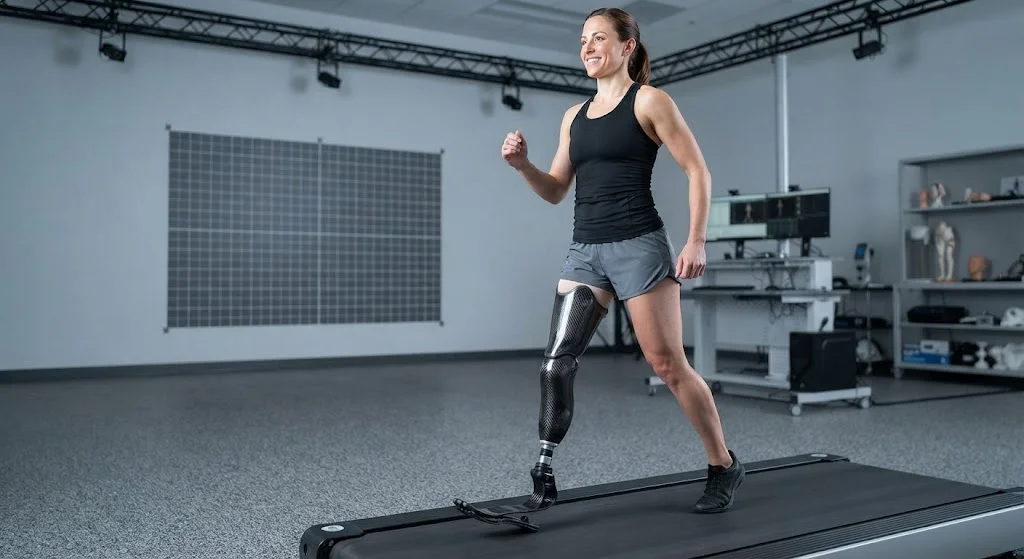
Carbon fiber composites are transforming prosthetic limb design through superior strength-to-weight ratios, fatigue resistance, and customizable stiffness profiles. This article examines carbon fiber applications in lower-limb and upper-limb prosthetics, covering socket interfaces, structural pylons, energy-storing feet, and myoelectric hand components.
Introduction
Prosthetic limb technology has undergone a remarkable transformation over the past two decades, driven largely by advances in composite materials engineering. Carbon fiber reinforced polymer (CFRP) composites have emerged as the material of choice for high-performance prosthetic devices, offering an optimal combination of low weight (density 1.5-1.6 g/cm³ vs. 7.8 g/cm³ for steel), high specific strength (tensile strength 1,500-2,500 MPa at 20% of steel weight), tunable stiffness through fiber orientation control, and excellent fatigue resistance exceeding 10 million loading cycles without significant property degradation.
For the estimated 40 million amputees worldwide who require prosthetic devices, the material choice directly impacts quality of life: lighter prostheses reduce metabolic energy expenditure during walking by 8-15%, stiffer designs improve force transmission for athletic activities, and fatigue-resistant materials extend device lifespan from 2-3 years to 5-7 years. This article examines the specific carbon fiber applications, design methodologies, and manufacturing considerations that define modern prosthetic limb engineering.
Lower-Limb Prosthetic Structures
Carbon fiber composites dominate the high-performance lower-limb prosthetic market, with applications spanning the entire kinetic chain from socket to ground contact:
- Socket interfaces: The prosthetic socket — the critical interface between residual limb and prosthesis — increasingly uses carbon fiber reinforcement in thermoplastic or thermoset shells. Carbon fiber laminates (2-4 plies, [0/±45] orientation) provide 40-60% higher stiffness than fiberglass equivalents at 30-40% less weight, improving load transfer efficiency while reducing pressure points. Custom-molded sockets with localized carbon fiber reinforcement achieve 85-95% patient satisfaction rates for comfort and function.
- Structural pylons: The pylon connecting socket to foot mechanism is the primary load-bearing structural element. Carbon fiber tube pylons (wall thickness 1.5-3.0 mm, diameter 25-35 mm) weigh 150-300 grams compared to 400-800 grams for titanium equivalents, while providing superior fatigue resistance. Torque loading during walking generates combined axial-bending stresses that carbon fiber composites handle through tailored fiber orientations — typically [0/±45/90] layups providing balanced stiffness in axial, bending, and torsional modes.
- Energy-storing feet: The most commercially visible carbon fiber prosthetic application, energy-storing feet (ESF) use curved carbon fiber leaf springs that store elastic energy during stance phase and release it during push-off, mimicking the function of biological ankle muscles. Design parameters include spring rate (typically 2-5 N/mm), deflection range (20-40 mm), and energy return efficiency (60-85%). Popular designs like the Össur Cheetah and Ottobock Triton use 15-25 unidirectional carbon fiber plies in precisely oriented curves to achieve specific stiffness profiles.
- Microprocessor-controlled knees: Advanced prosthetic knees incorporating carbon fiber structural housings and internal carbon fiber leaf springs combine material performance with electronic control. The carbon fiber components provide structural integrity while the microprocessor adjusts damping in real-time based on gait phase detection, improving walking stability by 30-40% compared to passive mechanical knees.
| Component | Carbon Fiber Configuration | Weight Reduction vs. Metal | Performance Improvement | Cycles to Failure |
|---|---|---|---|---|
| Socket shell | 2-4 ply laminate, [0/±45] | 30-40% | 40-60% higher stiffness | >10 million |
| Structural pylon | Tube, [0/±45/90] | 55-70% | Superior fatigue resistance | >10 million |
| Energy-storing foot | Curved UD laminate, 15-25 plies | 60-75% | 60-85% energy return | >5 million |
| Knee housing | Injection molded CFRTP | 20-30% | Integrated electronics mounting | >10 million |
Upper-Limb Prosthetic Applications
Carbon fiber applications in upper-limb prosthetics focus on weight reduction and cosmetic naturalness while maintaining functional strength:
- Myoelectric hand prostheses: Advanced myoelectric hands (Ottobock bebionic, Össur i-Limb) use carbon fiber structural frames and finger linkages to minimize weight while maximizing grip force. Carbon fiber hand frames weigh 300-500 grams (vs. 600-900 grams for aluminum), reducing shoulder fatigue during extended use. The specific strength of carbon fiber enables thinner structural walls, allowing more realistic hand proportions and improved cosmetic appearance.
- Transradial and transhumeral structural components: Carbon fiber socket and adapter systems for arm prosthetics provide lightweight, rigid connections between residual limb and terminal device. Carbon fiber adapter cuffs (wall thickness 1.0-2.0 mm) weigh 50-100 grams while providing the torsional rigidity needed for precise tool manipulation and object handling tasks.
- Body-powered cable systems: Carbon fiber cable housings and routing components reduce friction and weight in body-powered prosthetic systems, improving mechanical efficiency by 15-25% compared to steel cable housings. The smooth surface finish of carbon fiber tube interiors (Ra <0.8 μm) reduces cable friction coefficients by 30-40%.
Design Methodologies
Prosthetic limb design requires integration of biomechanical requirements with carbon fiber manufacturing constraints:
- Finite element analysis (FEA): Prosthetic components undergo FEA simulation for walking, running, stair climbing, and impact loading conditions. Typical safety factors range from 2.0-3.0 for daily walking activities to 4.0-6.0 for athletic applications. Stress analysis must account for combined loading (axial + bending + torsion) that characterizes prosthetic gait patterns.
- Fiber orientation optimization: Prosthetic components use tailored fiber orientations to match anisotropic stiffness profiles to biomechanical requirements. Energy-storing feet require high axial stiffness for load bearing combined with controlled bending compliance for energy storage — achieved through precisely oriented unidirectional carbon fiber plies in curved configurations.
- Comfort optimization: Socket design incorporates pressure mapping data from patient trials to optimize carbon fiber reinforcement placement. Regions of high pressure receive additional carbon fiber plies to increase stiffness and reduce deflection, while low-pressure regions use minimal reinforcement to maintain flexibility and comfort.
Manufacturing Considerations
Prosthetic component manufacturing balances performance requirements with production economics:
- Autoclave curing: High-performance prosthetic components (energy-storing feet, structural pylons) typically use autoclave-cured prepreg systems achieving void content below 1% and fiber volume fractions of 55-60%. Cure cycles: 120-180°C at 3-6 bar pressure for 2-4 hours. Autoclave processing provides the most consistent quality but adds $50-100 per component in processing costs.
- Vacuum bag only (VBO): Cost-sensitive prosthetic applications use VBO processing with room-temperature cure or out-of-autoclave prepreg systems. VBO achieves 2-4% void content at 30-50% lower processing cost, suitable for non-structural cosmetic components and low-load structural elements.
- Resin transfer molding (RTM): High-volume prosthetic feet production increasingly uses RTM with carbon fiber preforms, achieving 45-55% fiber volume fraction with 1-3% void content at cycle times of 15-30 minutes. RTM enables near-net-shape production, reducing machining and finishing costs by 40-60%.
- Additive manufacturing: 3D-printed carbon fiber reinforced nylon (Markforged, Anisoprint) is emerging for prosthetic socket fabrication and custom adapter components, enabling patient-specific geometries with 24-48 hour turnaround times.
Rehabilitation and Clinical Outcomes
Carbon fiber prosthetic components demonstrate measurable clinical benefits compared to traditional materials:
- Metabolic energy expenditure: Studies show 8-15% reduction in oxygen consumption during walking with carbon fiber prostheses compared to fiberglass or aluminum equivalents, translating to reduced fatigue and increased activity duration for daily users.
- Gait symmetry: Carbon fiber energy-storing feet improve gait symmetry scores by 15-25% compared to solid-ankle cushioned-heel (SACH) feet, reducing compensatory movements that can lead to back pain and joint problems in the sound limb.
- Patient satisfaction: Clinical surveys consistently show 85-95% satisfaction rates for carbon fiber prosthetic components, with weight reduction and cosmetic appearance rated as the most valued features.
Conclusion
Carbon fiber composites have become the enabling material for modern prosthetic limb design, providing the strength-to-weight ratio, fatigue resistance, and design flexibility needed to restore mobility and improve quality of life for amputees worldwide. As manufacturing costs decrease and production technologies mature, carbon fiber prosthetic components will become increasingly accessible to the estimated 40 million people globally who require prosthetic devices, extending the benefits of advanced composite materials from elite athletes to daily users.
YongXian CarbonFiber
YongXian manufactures carbon fiber tubes, sheets, and custom composite parts from our Dezhou, China factory. With over 15 years of composite manufacturing experience, we supply carbon fiber components to aerospace, automotive, energy, and industrial customers worldwide.
Contact us for custom carbon fiber solutions.
Part of topic
Related Articles
- Carbon Fiber Mooring for Floating Offshore Wind: Fatigue and Corrosion in Deep Water
- Carbon Fiber Bicycle Frame Optimization: Layup Design and Manufacturing for Competitive Racing
- Carbon Fiber CFRP Retrofit for Infrastructure: Bridge and Building Seismic Strengthening
- Carbon Fiber Medical Imaging Equipment: Lightweight Gantry and Couch Structures for MRI/CT
- Carbon Fiber EV Battery Enclosures: Crash Safety and Electromagnetic Shielding Design
- Carbon Fiber Structures for Low-Altitude Economy: UAV Airframes and eVTOL Components