
The maritime industry is entering a hydrogen inflection point. The International Maritime Organization's revised greenhouse gas strategy mandates net-zero emissions from international shipping by around 2050, with intermediate targets of at least 20% reduction by 2030 and 70% by 2040 co
Introduction
The maritime industry is entering a hydrogen inflection point. The International Maritime Organization's revised greenhouse gas strategy mandates net-zero emissions from international shipping by around 2050, with intermediate targets of at least 20% reduction by 2030 and 70% by 2040 compared to 2008 levels. Hydrogen — either as a direct fuel or as a feedstock for green ammonia and methanol — is emerging as the primary decarbonization pathway for deep-sea vessels. For CFRP tank manufacturers, this transition creates a structural demand shift from niche prototype work to series production of certified hydrogen containment systems.
Offshore hydrogen storage presents unique engineering challenges that differ fundamentally from land-based applications. Tanks must withstand wave-induced dynamic loads, salt-spray corrosion, temperature cycling from Arctic to tropical routes, and the permeation characteristics of hydrogen at pressures up to 350 bar. Carbon fiber reinforced polymer composites are the material of choice for meeting these combined requirements while minimizing deadweight — a critical factor for vessel range and cargo capacity.
IMO Type-C Tank Design Requirements
The International Gas Carrier Code (IGC Code) classifies hydrogen tanks on gas carriers as Type-C pressure vessels — cylindrical or spherical tanks designed to international pressure vessel standards. Type-C tanks operate at pressures above 0.7 bar gauge and are the only classification permitted for bulk hydrogen transport on commercial vessels. The design must satisfy several simultaneous requirements:
- Pressure containment: Design pressure typically 300-350 bar for compressed hydrogen gas, with a safety factor of 2.4 on burst pressure per IGC Code Chapter 4.
- Cyclic fatigue: Tanks must endure a minimum of 10,000 pressure cycles from 5% to 100% of design pressure without crack initiation, plus wave-induced bending cycles over a 20-year service life.
- Permeation control: Hydrogen permeation rate must remain below 0.1% of tank volume per 24 hours at maximum operating temperature (typically 45°C for tropical routes).
- Impact resistance: Tanks must survive a 5 kg dropped-object impact at 2.5 m without breach, per IGC Code 4.5.2.
- Cryogenic compatibility: For liquid hydrogen (LH₂) applications at −253°C, the composite matrix must maintain fiber-matrix bond integrity through thousands of thermal cycles.
These requirements drive a specific CFRP tank architecture: a thin stainless steel or Invar liner for permeation control, overwrapped with carbon fiber epoxy laminate designed to carry all structural loads. The fiber orientation is optimized using a multi-axial layup schedule — typically 60% hoop, 30% helical, and 10% axial plies — to balance internal pressure loads with bending and vibration.
CFRP Tank Construction: Material and Process Selection
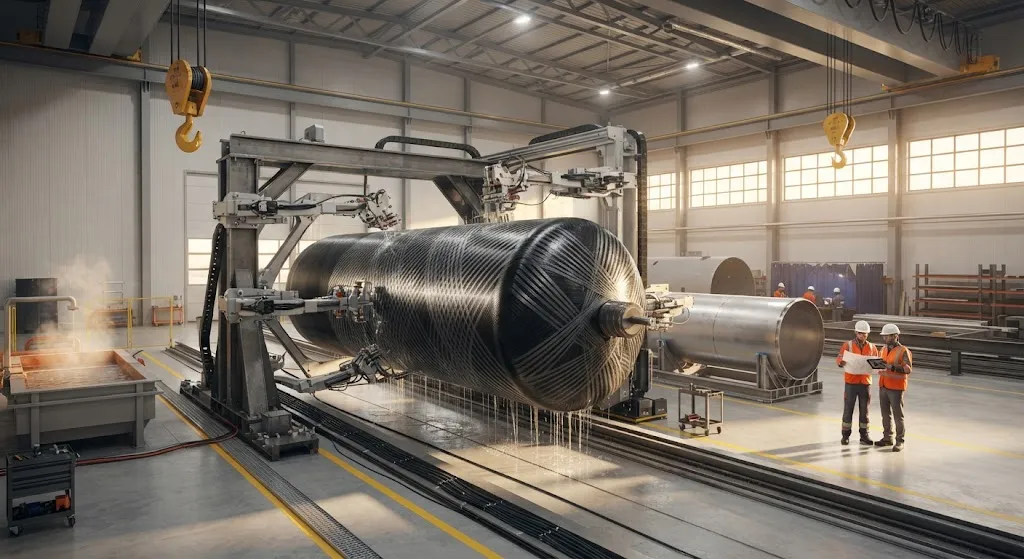
Maritime hydrogen CFRP tanks are manufactured using two primary processes: filament winding and automated fiber placement (AFP). The choice depends on tank geometry, volume requirements, and certification pathway.
| Parameter | Filament Winding | Automated Fiber Placement (AFP) |
|---|---|---|
| Tank geometry | Cylindrical with domed ends | Cylindrical, conical, or complex contours |
| Typical diameter | 0.5–3.0 m | 0.3–4.0 m |
| Fiber volume fraction | 60–65% | 58–63% |
| Wall thickness tolerance | ±0.3 mm | ±0.15 mm |
| Production rate | 2–4 tanks/day | 1–2 tanks/day |
| Waste rate | 5–10% | 1–3% |
| Typical tow | 24K–48K | 12K–24K |
For fleet-scale deployment (100+ tanks per year), filament winding offers the highest throughput and lowest cost per unit. For specialized geometries or tanks with integrated fittings and penetrations, AFP provides superior layup accuracy and repeatability. Both processes use intermediate-modulus carbon fiber (tensile modulus 290–320 GPa) with toughened epoxy resin systems qualified to marine environmental exposure standards.
The liner material is equally critical. Stainless steel 316L provides excellent corrosion resistance and weldability but adds 15–20% to tank weight. Invar 36 (Fe-Ni alloy) offers near-zero coefficient of thermal expansion, making it preferred for cryogenic LH₂ tanks despite higher material cost. Polymer liners (high-density polyethylene or polyamide) are under development for compressed hydrogen but face long-term permeation challenges at maritime operating temperatures.
Certification Pathway: Classification Society Requirements
Every maritime hydrogen tank must receive type approval from a classification society before installation on a vessel. The major societies — Lloyd's Register, DNV, Bureau Veritas, and the American Bureau of Shipping — each maintain specific rules for composite pressure vessels. The certification process follows a structured sequence:
- Design review: Finite element analysis of the tank under combined pressure, thermal, and dynamic loading. Must demonstrate margin above IGC Code requirements.
- Material qualification: Coupon-level testing of the specific CFRP laminate (tensile, compression, shear, interlaminar fracture toughness) at both ambient and operating temperatures.
- Burst testing: Full-scale tank tested to burst at minimum 2.4× design pressure. Results must fall within ±10% of predicted burst pressure from the FEA model.
- Fatigue testing: 10,000+ pressure cycles plus environmental conditioning (salt spray, UV exposure, thermal cycling) per the society's composite materials guideline.
- Permeation testing: Hydrogen gas loss measured over 72 hours at maximum operating temperature, with results below the IGC Code threshold.
Classification timelines typically span 18–24 months from initial design submission to type approval certificate. Pre-engagement with the classification society during the design phase is strongly recommended — design changes after material qualification require re-testing and can add 6–12 months to the certification schedule.
Market Drivers and Application Segments
The maritime hydrogen storage market is segmenting into three primary application areas, each with distinct CFRP tank requirements:
- Hydrogen carriers (LH₂ ships): Large-scale cryogenic tanks (5,000–40,000 m³) for transoceanic hydrogen transport. Japan's Ship and Ocean Foundation has funded several LH₂ carrier prototypes, and classification societies have published interim guidelines. CFRP content per vessel ranges from 50–150 tonnes depending on tank count and insulation system.
- Dual-fuel LNG/H₂ vessels: Mid-term transition solution using modified LNG tanks with hydrogen co-firing. CFRP reinforcement for existing tank structures and new inner liner systems.
- Short-sea and port hydrogen supply: Smaller Type-C tanks (10–200 m³) on coastal vessels and barges for delivering hydrogen to offshore platforms, island communities, and port fueling stations. These tanks operate at higher pressures (350 bar) but lower volumes, favoring AFP manufacturing for precision.
The total addressable market for maritime hydrogen CFRP tanks is projected to reach $2.8–4.5 billion by 2035, with annual production volumes of 2,000–3,500 tanks. Early movers include Norwegian shipping company Wallenius Wilhelmsen (ordering LH₂-ready car carriers), Japanese NYK Line (LH₂ carrier development), and European ferry operators retrofitting vessels for hydrogen co-fueling.
Frequently Asked Questions
What is the typical lead time for ordering a maritime-certified CFRP hydrogen tank?
Lead times vary by manufacturer and certification status. For an already type-approved tank design, production lead time is typically 4–8 months depending on order size. For a new custom design requiring first-time classification, add 18–24 months for the certification process. Most classification societies offer a fast-track pathway for designs based on previously approved tank architectures with documented performance history. Early engagement with both the tank manufacturer and classification society is critical for meeting vessel delivery schedules.
How does CFRP tank cost compare to stainless steel for maritime hydrogen storage?
On a per-liter basis, CFRP tanks are typically 2.5–3.5× more expensive than stainless steel tanks at current production volumes. However, the total cost of ownership analysis must include weight savings: a CFRP hydrogen tank weighs 60–70% less than an equivalent stainless steel tank, which translates directly to increased cargo capacity or reduced fuel consumption. For a large LNG carrier converting to hydrogen co-firing, the weight savings can recover the tank cost premium within 3–5 years of operation. As production volumes increase toward 2,000+ tanks per year, CFRP tank costs are projected to fall by 30–40%, narrowing the gap significantly.
What are the main failure modes for CFRP hydrogen tanks in marine service?
What are the main failure modes for CFRP hydrogen tanks in marine service?
The three primary failure modes are: (1) matrix microcracking from cyclic pressure loading, which increases permeation rates before structural failure, (2) fiber breakage from impact or overload events, which can cause catastrophic burst, and (3) corrosion of the metallic liner if the composite shell is breached and saltwater contacts the liner surface. Classification society testing specifically addresses all three modes through burst testing, fatigue cycling, and impact resistance requirements. In-service inspection programs typically include annual ultrasonic scanning of the composite shell and biennial liner integrity testing using pressurized helium leak detection.
Conclusion
Maritime hydrogen storage represents one of the highest-value application segments for carbon fiber composites in the coming decade. The combination of IMO decarbonization mandates, classification society certification frameworks, and the unique engineering demands of offshore hydrogen containment creates a structural market that rewards early technical investment. CFRP tanks — whether manufactured by filament winding or automated fiber placement — are the enabling technology for safe, efficient, and certification-compliant hydrogen storage at sea.
For vessel operators, shipyards, and hydrogen logistics companies evaluating CFRP tank solutions, early engagement with both material suppliers and classification societies is essential. Browse our carbon fiber product range for intermediate-modulus grades suited to pressure vessel applications, or contact our engineering team for technical consultation on maritime hydrogen tank design and material qualification.
Part of topic
Related Articles
- Carbon Fiber Mooring for Floating Offshore Wind: Fatigue and Corrosion in Deep Water
- Carbon Fiber Bicycle Frame Optimization: Layup Design and Manufacturing for Competitive Racing
- Carbon Fiber CFRP Retrofit for Infrastructure: Bridge and Building Seismic Strengthening
- Carbon Fiber Medical Imaging Equipment: Lightweight Gantry and Couch Structures for MRI/CT
- Carbon Fiber EV Battery Enclosures: Crash Safety and Electromagnetic Shielding Design
- Carbon Fiber Structures for Low-Altitude Economy: UAV Airframes and eVTOL Components