
For over a century the marine propeller shaft, or shaft line, has been a solid steel component: a long bar of corrosion-resistant steel or bronze connecting the engine to the propeller, supported along its length by bearings. It works, but it carries every torque pulse, every bend, and
Introduction
For over a century the marine propeller shaft, or shaft line, has been a solid steel component: a long bar of corrosion-resistant steel or bronze connecting the engine to the propeller, supported along its length by bearings. It works, but it carries every torque pulse, every bend, and every vibration from both the engine and the propeller. In recent years, composite propeller shafts made from carbon fiber have moved from experimental demonstration to installed retrofit programs, driven by three measurable advantages over steel: vibration damping, corrosion resistance, and acoustic quieting.
These benefits matter most in specific vessel types. Passenger ferries and cruise ships value reduced noise and vibration for comfort and for minimizing passenger disturbance. Patrol boats, research vessels, and mine countermeasure craft benefit from a lower magnetic and acoustic signature. For any steel-shaft vessel suffering from chronic corrosion, coating failure, or persistent shaft whipping vibration, a composite line offers an alternative that addresses all three problems at once. This article explains how composite propeller shafts work, quantifies their advantages, and reviews the design and qualification path for a successful retrofit.
How a Composite Shaft Line Works
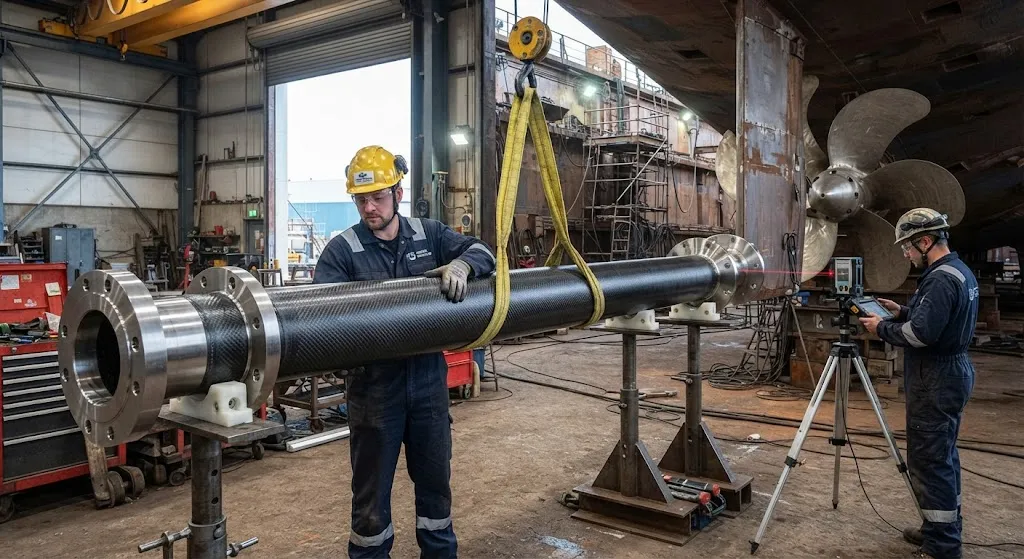
A composite marine propeller shaft is typically a carbon fiber reinforced polymer tube, produced by filament winding or roll wrapping, with metallic flanges bonded or adhesively joined at each end to connect to the engine flywheel and the propeller hub. Because carbon fiber composites are anisotropic, the laminate is designed so that the dominant fiber direction carries the torque load, while off-axis plies provide bending stiffness and resist buckling under the compressive loads from propeller thrust.
The key design difference from steel is that a composite shaft is torsionally more flexible than a solid steel bar of the same dimensions. This flexibility is not a weakness; it is the source of the vibration-damping benefit. The composite line acts as a torsional spring that decouples the engine's torque pulses from the propeller, smoothing the load and reducing the propagation of torsional vibration through the line. The shaft can also be designed more compliant in bending, which changes the critical speed characteristics and often allows operation above the original whirling speed limit of a steel line.
Vibration Damping and Torsional Behavior
The vibration benefits of a composite shaft arise from a combination of lower mass, higher internal material damping, and tunable torsional stiffness. Carbon fiber composites have material damping an order of magnitude or more greater than steel, so vibrational energy that a steel line would transmit to the hull and transmit to the propeller is absorbed within the material itself and converted to heat. In practice this damps several distinct sources of onboard disturbance:
- Torsional vibration: Lower torsional stiffness and high internal damping reduce the amplitude of torque pulses reaching the propeller, smoothing the load on the shaft line and its couplings.
- Whirling vibration: The composite's internal losses, combined with tuned critical speeds, suppress the classic "shaft whip" that can occur at certain speeds.
- Structure-borne noise: Less vibrational energy is transmitted through the bearings to the hull, reducing the noise radiating from the shaft tunnel into accommodation spaces.
The result is measurable in service data and by testing on retrofit programs. Propeller-induced pressure pulses and whirling vibration, which cause classic "shaft whip" at certain speeds, are damped by the composite's internal losses and by the ability to tune the shaft's critical speeds away from the engine's firing frequency and the propeller's blade-pass frequency. The table below summarizes the key differences between steel and composite shaft lines:
| Attribute | Steel / Bronze Shaft | CFRP Shaft Line | Typical Benefit |
|---|---|---|---|
| Density (g/cm³) | 7.8 / 8.9 | 1.5-1.6 | ~75-80% weight reduction |
| Material damping (loss factor) | ~0.001-0.01 | 0.02-0.05 | 10-50x more vibration absorption |
| Corrosion resistance in seawater | Oxidizes / leaches copper | Inherently resistant | No coating required |
| Tensile strength (MPa) | 400-900 | 1,000-2,000 (fiber direction) | Higher per unit weight |
| Torsional stiffness | High | Tunable, generally lower | Favors torsional decoupling |
| Magnetic signature | High | Very low | Reduced for MCM craft |
| Maintenance | Frequent inspection, coating repair | Low, limited inspection | Reduced lifecycle cost |
Corrosion Resistance and Lifecycle Cost
Seawater is hostile to steel. Marine propeller shafts suffer from pitting, stress corrosion, and crevice corrosion at the bearing and seal areas, and galvanic corrosion where the shaft couples to dissimilar metals. Traditional solutions — alloy selection, sacrificial anodes, and regular coating repair — add cost and require the vessel to be dry-docked periodically. A carbon fiber shaft line is inherently immune to corrosion: carbon fiber reinforced polymer does not oxidize in seawater, and when properly sealed, the composite tube removes entire classes of corrosion failure from the maintenance picture.
This has a direct lifecycle-cost benefit. The composite shaft needs no coating, no cathodic protection at the shaft itself, and far fewer hours of shaft inspection. In vessels where the steel shaft is a recurring corrosion and maintenance problem, the retrofit can pay back through reduced dry-docking frequency, lower repair labor, and fewer unscheduled failures at sea. The lighter shaft also reduces bearing loads and, in some designs, allows the shaft line to be run dry (oil-free) in a water-lubricated stern tube, eliminating oil leakage and its environmental compliance burden.
Retrofit Design and Qualification Considerations
Replacing a steel shaft with a composite line is not a direct swap; it requires engineering to define the new line and verify it in service. The critical steps are torque and thrust capacity verification against the engine and propeller duty; torsional vibration analysis to confirm the critical speeds and vibration amplitudes stay within limits across the operating range; whirling (lateral vibration) analysis to set bearing spacing and confirm acceptable running; and corrosion and electrical isolation to prevent galvanic coupling between the carbon fiber and neighboring metal components.
Qualification also requires attention to the connection detail between carbon and metal, since the flange joint is the most highly loaded and least forgiving part of the line. Adhesive bonding with a machined metallic flange, or a mechanical clamp-fitting with a metallic insert, must be proven under fatigue and torque overload. Classification societies such as Lloyd's Register, DNV, Bureau Veritas, and ABS have issued guidance or class notations for composite propeller shafts, and a retrofit program will typically require an approval-in-principle and a class survey. A chemical, marine, and fouling assessment is needed because a carbon/epoxy shaft operating in seawater must be sealed against moisture ingress that would slowly degrade the matrix.
Frequently Asked Questions
Are composite propeller shafts strong enough for marine duty?
Yes, when properly designed. A carbon fiber reinforced shaft has a tensile strength of 1,000-2,000 MPa in the fiber direction, far exceeding the 400-900 MPa of typical marine steel or bronze, and its higher specific strength allows a lighter shaft for the same torque capacity. The design challenge is not raw strength but the correct sizing of the laminate for the combined torque, thrust, and bending loads, and the reliable transfer of that load into the metal flanges. With proper laminate design and proven metal-to-composite joints, composite shafts are approved and operating in service.
How much weight and vibration can a composite shaft save?
A carbon fiber shaft line is typically 75-80% lighter than the equivalent steel or bronze shaft, because the composite's density is roughly one-fifth that of steel. The weight saving reduces bearing loads and hull vibration transmission. On vibration, the higher material damping of carbon fiber absorbs an order of magnitude more vibrational energy than steel, and the tunable torsional stiffness allows designers to move critical speeds away from the engine's firing frequency and the propeller blade-pass frequency. Service testing on retrofit programs reports noticeably lower measured vibration and noise in the shaft tunnel.
Is a carbon fiber shaft retrofit a direct replacement for a steel shaft?
Not a direct swap, but the physical dimensions can often be matched closely to fit the existing bearings and couplings. The retrofit is an engineering project: the shaft line must be re-laid-out with new bearing positions to suit the composite's bending stiffness and critical speeds, the flanges must be re-engineered for the metal-to-composite joint, and a full torsional and lateral vibration analysis is required. Because of these details, a retrofit typically needs classification society approval and a class survey, but the overall vessel structure, engine, and propeller can remain unchanged.
What are the main limitations or downsides of composite shafts?
The principal limitations are qualification effort, environmental sensitivity, and initial cost. A composite shaft line requires detailed engineering, torsional and whirling analysis, classification approval, and sealed moisture protection — more upfront design work than a standard off-the-shelf steel shaft. The carbon/epoxy material must be protected from seawater ingress and from excessive operating temperatures, and the metal-to-composite joints need careful inspection. Initial cost is typically higher than steel, though lower maintenance and reduced vibration can offset this over the vessel's life. These factors make composite shafts most attractive for vessels where corrosion, vibration, or acoustic signature are priority problems.
Why does a composite shaft reduce acoustic and magnetic signature?
The acoustic benefit comes from the composite's high material damping, which absorbs and dissipates vibrational energy that would otherwise radiate as structure-borne noise into the hull and water, and from the reduced whirling vibration at the shaft. The composite's lower mass also reduces the energy transmitted through bearing mounts. The magnetic signature benefit comes from replacing a large ferrous steel shaft with carbon fiber, which has negligible magnetic permeability; this matters for mine countermeasure and naval craft that must minimize magnetic and acoustic signatures to avoid detection.
Conclusion
Composite marine propeller shafts convert an historical steel weak point into a controllable, engineered component with three concrete advantages: an order of magnitude higher vibration damping, complete immunity to seawater corrosion, and dramatically reduced acoustic and magnetic signature. For passenger comfort, for corrosion-prone fleets, and for naval and mine countermeasure craft, a carbon fiber shaft line addresses chronic problems that steel cannot fully solve. The lighter shaft also reduces bearing and hull loads over the entire service life.
For vessel operators and naval architects considering a retrofit, the practical path is to engage in a full shaft-line study covering torque capacity, torsional and whirling vibration, joint design, sealing, and classification approval before committing to hardware. Explore our marine-grade carbon fiber tubes and structural laminates, or contact our engineering team to discuss shaft line material and design for your vessel.
Related Articles
- Carbon Fiber Mooring for Floating Offshore Wind: Fatigue and Corrosion in Deep Water
- Carbon Fiber Bicycle Frame Optimization: Layup Design and Manufacturing for Competitive Racing
- Carbon Fiber CFRP Retrofit for Infrastructure: Bridge and Building Seismic Strengthening
- Carbon Fiber Medical Imaging Equipment: Lightweight Gantry and Couch Structures for MRI/CT
- Carbon Fiber EV Battery Enclosures: Crash Safety and Electromagnetic Shielding Design
- Carbon Fiber Structures for Low-Altitude Economy: UAV Airframes and eVTOL Components