Liquid hydrogen offers unmatched gravimetric energy density, but storing it at −253°C makes every gram of heat and every molecule of gas matter. A composite LH2 tank has a carbon fiber overwrap for structural strength and a polymer liner for gas containment, yet neither layer alone deci
Introduction
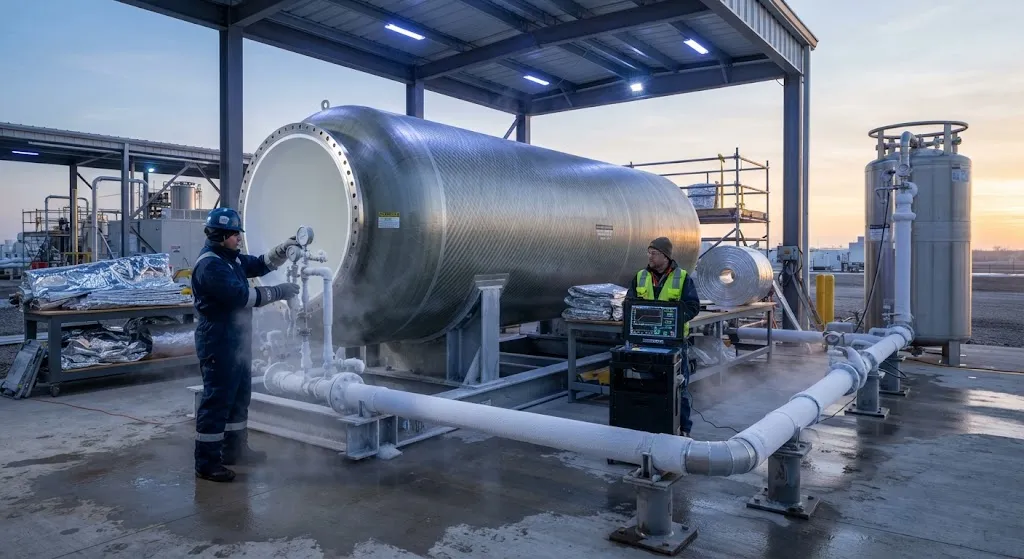
Liquid hydrogen offers unmatched gravimetric energy density, but storing it at −253°C makes every gram of heat and every molecule of gas matter. A composite LH2 tank has a carbon fiber overwrap for structural strength and a polymer liner for gas containment, yet neither layer alone decides whether the fuel survives a week, a month, or a launch campaign. The decisive engineering happens in the thermal and permeation systems: insulation that limits heat ingress to a handful of watts, and barriers that keep hydrogen — the smallest and most mobile molecule in existence — from escaping through the wall.
This article focuses on the two failure drivers that dominate real LH2 tank programs: boil-off from heat leak and loss through permeation. For each, we examine the governing physics, the materials and architectures used in practice, and the measurable performance targets that buyers should demand. Where previous guides cover tank manufacturing and winding parameters, the scope here is the storage system that surrounds the composite vessel — and the insulation and barrier choices that determine its economics.
Why LH2 Storage Is a Heat and Leak Problem
Liquid hydrogen sits only 20 Kelvin above absolute zero, and its latent heat of vaporization is low — about 446 kJ per kilogram. In practical terms this means a small, continuous heat input converts hydrogen into gas quickly, and once vaporized the gas occupies roughly 800 times the volume of the liquid. Two physical constants shape every design decision:
- Extreme temperature gradient: The wall spans from ambient (up to 300 K on the outside) to −253°C inside, creating a temperature difference of more than 550 K across the insulation.
- Extreme mobility: The hydrogen molecule is only about 0.3 nanometers across, smaller than any other gas molecule, so it migrates through polymer liners and microcracks far faster than helium, nitrogen, or methane.
Because both heat and gas move through the same system boundaries, insulation and barrier design are inseparable. A permeation barrier that works at ambient temperature may fail once thermal contraction opens microcracks at −253°C, and an insulation system that is perfect thermally can still be defeated by a liner that lets hydrogen diffuse into the vacuum annulus.
Boil-Off Control: Cutting Heat Ingress to the Minimum
Heat reaches the liquid hydrogen through three paths, each requiring a different countermeasure. The table below shows the typical contribution of each path and the engineering response:
| Heat leak path | Typical share of heat ingress | Mitigation |
|---|---|---|
| Radiation | 40-60% | Multilayer insulation with low-emissivity foils and reflective shields |
| Conduction | 20-30% | Thermal standoffs, slender supports, and fiber-reinforced spacers |
| Residual gas convection | 5-15% | Vacuum annulus below 10⁻⁴ mbar combined with getter materials |
| Piping and penetrations | 5-15% | Extended fill/drain necks and cryogenic multi-duct systems |
The engineering objective is a total heat leak below about 1-3 watts per square meter of tank surface. At that level, a well-insulated composite tank achieves boil-off rates of 0.5-1% per day — meaning 99% of the hydrogen remains after a full day of storage and roughly 95% remains after a week. Actively cooled systems that remove this heat with cryocoolers achieve essentially zero boil-off regardless of insulation quality, at the cost of electrical power and added mass.
Permeation Barriers: Stopping the Smallest Molecule
Hydrogen permeation is the second dominant loss mechanism, and for composite tanks it is the more insidious one. The polymer liner is the primary barrier; it must be dense, continuous, and free of pinholes at cryogenic temperature. Polyamide and liquid-crystal-polymer liners are common choices because of their low permeability and resistance to microcracking, but no neat polymer blocks hydrogen completely. The practical toolkit includes:
- Thick, pinhole-free liners: Rotomolded or compression-molded liners 2-5 mm thick reduce the steady-state permeation flux by extending the diffusion path.
- Inorganic barrier coatings: Thin sputtered or chemical-vapor-deposited layers of silica, alumina, or diamond-like carbon cut permeability by 10-100 times where the liner surface can tolerate a rigid coating.
- Microcrack control in the overwrap: Because cracks in the composite give hydrogen a fast path around the liner, toughened epoxy, thermal-shock-resistant resin systems, and void contents below 1% are prerequisites, not options.
Permeation is quantified with a leak-rate specification, typically 10⁻⁶ to 10⁻⁸ mbar-L/s across the complete tank, verified with helium and hydrogen mass-spectrometry testing. Buyers should treat permeation data at 20 K as a contractual requirement, because ambient-temperature values overstate performance by orders of magnitude — the polymer matrix contracts, stiffens, and embrittles as the tank cools.
Space-Grade Insulation Architectures
Three insulation families dominate LH2 storage, and the choice between them is a trade between boil-off rate, weight, and cost. The comparison below summarizes typical performance:
| Insulation system | Effective conductivity (W/m/K) | Boil-off performance | Weight impact | Typical use |
|---|---|---|---|---|
| Vacuum jacket + MLI | 10⁻⁴ to 10⁻³ | 0.5-1% per day | High (15-25% of tank mass) | Aerospace launch vehicles |
| Vacuum + aerogel blanket | 0.01-0.02 | 1-2% per day | Moderate | Terrestrial mobile storage |
| Spray-on foam (SOFI) | 0.02-0.04 | 3-6% per day | Low | Launch vehicle boosters |
| Vacuum + perlite powder | 0.001-0.003 | 1-2% per day | High | Large fixed bulk tanks |
Multilayer insulation is the space-grade standard: alternating layers of double-aluminized Mylar and silk net or polyester spacers, typically 20-60 layers for LH2 service. It delivers the lowest conductivity of any passive system when the vacuum is intact, which is why every upper-stage and orbital depot design relies on it. Aerogel blankets trade some performance for robustness — they survive partial vacuum loss and rough handling far better than foil stacks — making them attractive for ground transport tanks that are refilled, moved, and occasionally dropped. Spray-on foam is the launch-vehicle compromise: cheapest and lightest per square meter, but with ten times the heat leak of a good MLI system.
Qualification and Performance Verification
A credible LH2 tank program verifies both loss mechanisms before committing to production. The standard sequence covers thermal cycling between ambient and −253°C, helium leak testing of the assembled tank, boil-off measurement in a calorimetric test stand, and vacuum integrity checks over months of hold time. For aerospace programs, acoustic and vibration testing is added to confirm that the insulation survives launch loads without degrading. Two numbers summarize system quality for a buyer: the daily boil-off percentage and the permeation leak rate at cryogenic temperature. Both should be delivered as measured data from a prototype, not as design estimates.
Frequently Asked Questions
How much hydrogen is lost to boil-off in a composite LH2 tank each day?
With a high-quality vacuum-jacketed multilayer insulation system, daily boil-off is typically 0.5-1% of the stored mass, meaning at least 99% remains after 24 hours and about 95% after one week. A spray-on-foam insulated tank loses 3-6% per day instead. The absolute number depends on surface-to-volume ratio, so small tanks lose proportionally more than large ones — a 5 m³ tank may hold for two weeks while a 500 m³ unit holds for months with the same insulation quality. Adding an active cryocooler removes the incoming heat entirely and achieves zero boil-off, which is why long-duration space missions and high-value ground depots integrate active cooling despite its power and weight cost.
Why does hydrogen leak through a polymer liner when steel tanks do not leak?
Hydrogen is the smallest gas molecule, with a kinetic diameter of roughly 0.3 nanometers, and it diffuses through polymer materials through a solution-diffusion mechanism — the gas dissolves into the polymer surface and migrates along the molecular network. Steels block this because the interstitial spaces in the metal lattice are too small for hydrogen atoms to pass at practical rates. No polymer liner is completely impermeable, so composite tanks rely on thick liners, inorganic barrier coatings, and microcrack control in the overwrap to bring the total leak rate below 10⁻⁶ mbar-L/s. The threat grows at cryogenic temperature if thermal contraction opens microcracks, which is exactly why cryogenic-grade resin toughness is a non-negotiable design requirement.
Is a zero-boil-off LH2 tank realistic, and what does it cost?
Yes — zero boil-off is demonstrated technology. A cryocooler intercepts the heat that would otherwise vaporize the hydrogen, rejecting it at ambient temperature using electrical power. For a 100 kW-class ground storage depot, the cryocooling plant draws roughly 300-500 kW of electricity and adds significant capital cost, so the breakeven depends on how valuable the saved hydrogen is. For long-duration aerospace missions where every kilogram of residual propellant extends mission life, zero boil-off is worth almost any mass and power penalty. For routine terrestrial storage with daily turnover, passive insulation at 0.5-1% daily boil-off is almost always the economic optimum, and active cooling is reserved for strategic reserves and launch pad operations.
Conclusion
Composite LH2 tanks succeed or fail on two numbers: the daily boil-off percentage and the cryogenic permeation rate. Both are controlled at the system level — through multilayer insulation and vacuum for heat, and through liners, barrier coatings, and microcrack-free overwraps for gas — rather than by the composite structure alone. The physics is unforgiving: a temperature span of more than 550 K and a molecule that penetrates nearly everything demand engineering discipline across every subsystem.
For engineers and buyers planning an LH2 storage program, the practical next steps are demanding measured boil-off and permeation data at cryogenic temperature, specifying vacuum integrity and insulation weight targets, and selecting composite materials that remain microcrack-free below −200°C. Explore our carbon fiber product range for cryogenic pressure vessel applications, or contact our engineering team to discuss material selection and qualification support for your LH2 tank program.
Part of topic
Related Articles
- Carbon Fiber Mooring for Floating Offshore Wind: Fatigue and Corrosion in Deep Water
- Carbon Fiber Bicycle Frame Optimization: Layup Design and Manufacturing for Competitive Racing
- Carbon Fiber CFRP Retrofit for Infrastructure: Bridge and Building Seismic Strengthening
- Carbon Fiber Medical Imaging Equipment: Lightweight Gantry and Couch Structures for MRI/CT
- Carbon Fiber EV Battery Enclosures: Crash Safety and Electromagnetic Shielding Design
- Carbon Fiber Structures for Low-Altitude Economy: UAV Airframes and eVTOL Components
Interested in Carbon Fiber Tubes?
Contact our team for competitive pricing and technical specifications.
Get a Quote