
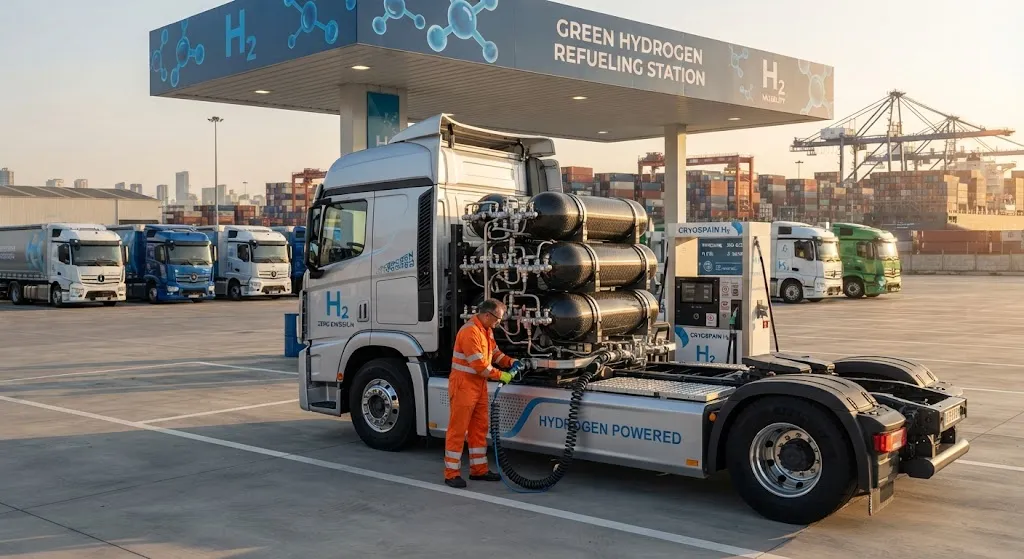
Hydrogen fuel cell technology is transitioning from pilot demonstrations to commercial fleet deployment at a pace that is reshaping the heavy-duty transport sector. Industry projections indicate that the global fleet of hydrogen-powered heavy-duty vehicles — including trucks, buses, and
Introduction
Hydrogen fuel cell technology is transitioning from pilot demonstrations to commercial fleet deployment at a pace that is reshaping the heavy-duty transport sector. Industry projections indicate that the global fleet of hydrogen-powered heavy-duty vehicles — including trucks, buses, and port equipment — will surpass 50,000 units by 2027, up from approximately 12,000 units in early 2025. This 4x growth in two years represents one of the fastest adoption curves in commercial vehicle history, and carbon fiber reinforced polymer (CFRP) Type IV hydrogen storage tanks are the critical enabling technology making it possible.
For CFRP manufacturers, this growth creates both opportunity and urgency. Each hydrogen heavy-duty vehicle requires 4-8 composite storage tanks with a combined carbon fiber content of 200-400 kilograms, representing a new demand stream that did not exist five years ago. This article analyzes the market drivers behind the 50,000-unit projection, explains the technical specifications for automotive-grade CFRP tanks, and outlines the supply chain readiness required to meet this demand.
Market Drivers for Hydrogen Heavy-Duty Fleet Growth
Several converging factors are accelerating hydrogen fuel cell adoption in heavy-duty transport beyond initial projections:
- Regulatory mandates: The European Union's Alternative Fuels Infrastructure Regulation (AFIR) requires hydrogen refueling infrastructure along core TEN-T corridors by 2030, creating demand certainty for fleet operators. China's hydrogen strategy targets 50,000 fuel cell vehicles by 2025, with heavy-duty trucks as the primary application.
- Corporate decarbonization targets: Major logistics operators — including Amazon, DHL, and UPS — have committed to zero-emission fleet transitions by 2030-2035. Hydrogen fuel cells offer range advantages over battery-electric for long-haul applications, making them essential for meeting aggressive decarbonization timelines.
- Total cost of ownership convergence: Hydrogen fuel cell heavy-duty vehicles are approaching total cost of ownership parity with diesel trucks in regions with established hydrogen infrastructure. At $8-12/kg hydrogen (projected 2027 price), fuel cell trucks achieve operating cost competitiveness for high-utilization fleet applications.
- Refueling infrastructure expansion: Over 1,200 hydrogen refueling stations are planned or under construction globally for 2026-2027, with concentration along major freight corridors in Europe, China, California, and South Korea. Infrastructure availability removes the chicken-and-egg barrier that limited early adoption.
CFRP Type IV Tank Technical Specifications
Hydrogen storage in heavy-duty vehicles requires Type IV composite tanks — all-polymeric liners with carbon fiber composite overwraps — that meet stringent automotive safety and performance standards:
| Specification | Heavy-Duty Requirement | Current CFRP Capability | Gap Status |
|---|---|---|---|
| Operating pressure | 700 bar (10,000 psi) | 700 bar qualified | Met — production proven |
| Burst pressure ratio | ≥ 2.25x (1,575 bar minimum) | 2.5-3.0x typical | Exceeds requirement |
| Gravimetric density | ≥ 5.5% H₂ by weight | 5.8-6.5% achieved | Met for premium tanks |
| Cycle life (fill/drain) | ≥ 20,000 cycles | 15,000-25,000 cycles | Range depends on design |
| Hydrogen permeation rate | < 6 cc/day at 700 bar | 2-4 cc/day typical | Met |
| Impact resistance (drop test) | No rupture after 3m drop | Qualification testing passed | Met |
| Operating temperature range | -40°C to +85°C | -40°C to +85°C qualified | Met |
The primary technical challenge for heavy-duty applications is tank size and fill time. Trucks require 30-60 kg of hydrogen storage (versus 5-6 kg for passenger cars), necessitating tanks with 150-300 liter volumes that must fill in under 15 minutes. This demands optimized CFRP layup designs that balance structural integrity with thermal management during rapid pressurization.
CFRP Supply Chain Implications
The projected 50,000-unit fleet by 2027 creates significant demand for carbon fiber composite materials:
- Carbon fiber demand: At 200-400 kg CF per vehicle, the 50,000-unit fleet requires 10,000-20,000 metric tons of automotive-grade carbon fiber annually — representing approximately 8-15% of current global carbon fiber production capacity. This demand must be met while maintaining supply to existing aerospace and wind energy customers.
- Tow specification requirements: Automotive-grade CFRP tanks primarily use 24K-50K tow PAN-based carbon fiber with intermediate modulus (250-350 GPa) and tensile strength of 4,900-5,500 MPa. The tow size and modulus requirements differ from aerospace specifications, creating opportunities for dedicated automotive fiber producers.
- Resin system evolution: Tank manufacturers are migrating from thermoset epoxy to thermoplastic resin systems (PEEK, PA) for improved recyclability and faster cycle times. This shift creates demand for carbon fiber compatible with thermoplastic processing — a technical specification that not all fiber producers can currently meet.
- Production capacity expansion: Leading CFRP tank manufacturers — including Hexagon Purus, Worthington Industries, and Hexagon Composites — have announced capacity expansions totaling 150,000+ tanks per year by 2027, requiring corresponding upstream carbon fiber capacity investments.
Regional Deployment Patterns
Hydrogen heavy-duty fleet deployment is concentrated in regions with aligned policy support, infrastructure investment, and industrial capacity:
- China: Leading global deployment with 15,000+ fuel cell trucks and buses projected by 2027. State subsidies for fuel cell vehicles in designated city clusters (Beijing-Tianjin-Hebei, Shanghai, Guangdong) drive adoption, with domestic CFRP tank production scaling rapidly through partnerships between Weichai Power and Chinese carbon fiber producers.
- Europe: 8,000-12,000 heavy-duty fuel cell vehicles projected by 2027, concentrated in Germany, France, and the Netherlands. The EU Hydrogen Bank and IPCEI Hydrogen funding programs are accelerating both vehicle deployment and refueling infrastructure.
- North America: 5,000-8,000 units projected, primarily in California (driven by CARB mandates) and emerging corridors in Texas and the Midwest. Hyzon Motors, Nikola, and Hyundai are the primary fleet suppliers.
- South Korea and Japan: 3,000-5,000 units combined, with Hyundai and Toyota leveraging existing fuel cell technology from passenger car programs into commercial vehicle applications.
Frequently Asked Questions
How does CFRP Type IV hydrogen tank cost compare to diesel fuel tanks for heavy-duty vehicles?
CFRP Type IV hydrogen tanks currently cost $800-1,500 per kilogram of hydrogen storage capacity, compared to $50-100 per kg capacity for diesel fuel tanks. This 10-15x cost premium is partially offset by fuel cell system economics over vehicle lifetime, but remains the primary barrier to total cost of ownership parity. Industry roadmaps target $400-600 per kg capacity by 2030 through manufacturing scale-up and carbon fiber cost reduction. For fleet operators evaluating hydrogen adoption today, the tank cost premium must be evaluated against regulatory compliance requirements, carbon credit values, and total cost of ownership projections that include fuel cost savings and maintenance reduction.
What is the recyclability outlook for CFRP hydrogen tanks at end of vehicle life?
CFRP hydrogen tanks present both challenges and opportunities for end-of-life recycling. The composite structure — thermoplastic liner with carbon fiber overwrap — is technically recyclable through established pyrolysis and solvolysis processes, recovering carbon fiber with 80-90% of virgin mechanical properties. However, the presence of high-pressure hydrogen residue requires specialized decommissioning procedures before recycling can begin. Industry initiatives including the European Composite Recycling Initiative are developing standardized decommissioning and recycling protocols specifically for hydrogen storage tanks, with pilot recycling facilities expected to begin operations in 2028-2029. The value of recovered carbon fiber from decommissioned hydrogen tanks could partially offset end-of-life disposal costs.
How do CFRP hydrogen tanks perform in extreme cold weather conditions?
CFRP Type IV hydrogen tanks are qualified for operation from -40°C to +85°C, meeting the extreme temperature requirements for heavy-duty vehicle applications. In cold weather, the primary operational consideration is the heat generated during rapid hydrogen compression — which actually benefits cold-weather operation by warming the tank. However, the thermoplastic liner material must maintain ductility at low temperatures to prevent embrittlement. PEEK and specialized polyamide liners demonstrate adequate impact resistance down to -40°C, while standard HDPE liners may require temperature mitigation strategies below -30°C. Fleet operators in Nordic regions and northern China have validated CFRP tank performance in sustained sub-zero operations, confirming qualification test results.
Conclusion
The projection of 50,000+ hydrogen heavy-duty vehicles by 2027 represents a pivotal moment for both the transport sector and the CFRP industry. Carbon fiber composite Type IV hydrogen storage tanks are the enabling technology that makes zero-emission long-haul transport viable, and the demand surge creates both market opportunity and supply chain pressure for automotive-grade carbon fiber. The technical requirements — 700 bar operating pressure, 20,000+ cycle life, and 5.5%+ gravimetric hydrogen density — are proven and production-ready, but meeting the scale of demand requires significant upstream investment in carbon fiber capacity and automotive-qualified production systems.
For CFRP manufacturers evaluating entry into the hydrogen mobility supply chain, the critical success factors are automotive-grade fiber qualification, thermoplastic-compatible product development, and production capacity committed to the automotive cycle time and cost requirements. Explore our automotive-grade carbon fiber range including specifications for Type IV hydrogen storage applications, or contact our mobility team to discuss CFRP material solutions for your hydrogen tank manufacturing program.
Part of topic
Related Articles
- Carbon Fiber Mooring for Floating Offshore Wind: Fatigue and Corrosion in Deep Water
- Carbon Fiber Bicycle Frame Optimization: Layup Design and Manufacturing for Competitive Racing
- Carbon Fiber CFRP Retrofit for Infrastructure: Bridge and Building Seismic Strengthening
- Carbon Fiber Medical Imaging Equipment: Lightweight Gantry and Couch Structures for MRI/CT
- Carbon Fiber EV Battery Enclosures: Crash Safety and Electromagnetic Shielding Design
- Carbon Fiber Structures for Low-Altitude Economy: UAV Airframes and eVTOL Components