
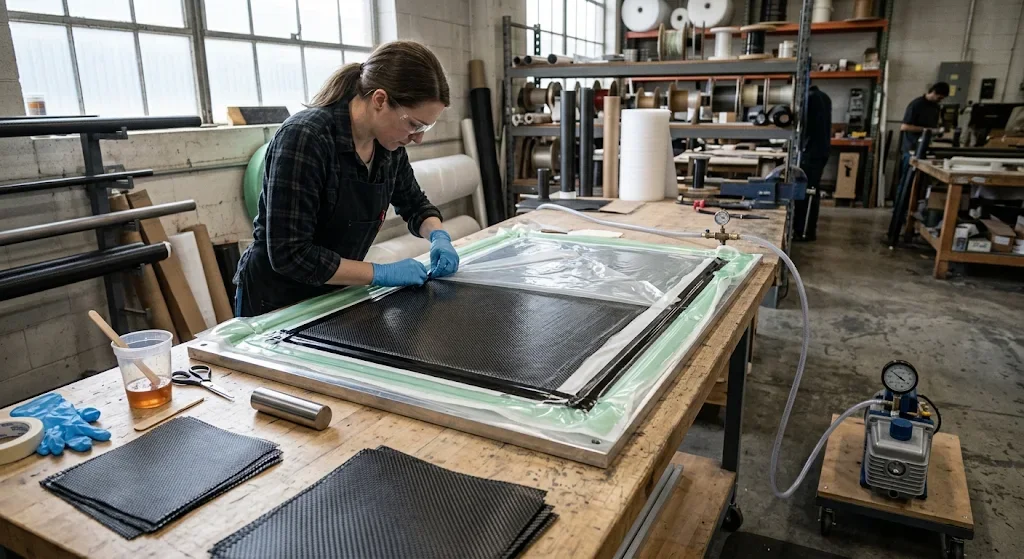
Learning how to make carbon fiber sheet starts with understanding that quality comes from process control, not just from using carbon cloth. Vacuum bagging is one of the most accessible methods for producing flat laminates with better fiber compaction and lower void content than a simple hand layup
Introduction
Learning how to make carbon fiber sheet starts with understanding that quality comes from process control, not just from using carbon cloth. Vacuum bagging is one of the most accessible methods for producing flat laminates with better fiber compaction and lower void content than a simple hand layup left open to air. For makers, labs, and small production teams, this method can produce a usable sheet of carbon fiber for brackets, covers, test coupons, and cosmetic panels. The goal is a flat, well-wet laminate with consistent thickness and clean edges after trimming.
This guide covers vacuum bagging basics for flat sheets. It is not a substitute for professional training or certified aerospace procedures, but it gives a practical workflow for planning materials, stacking layers, pulling vacuum, and inspecting the cured panel. If your project requires tight tolerances or structural certification, buying the best carbon fiber sheet from a qualified supplier may be more efficient than building every panel in-house.
Materials and Setup for Vacuum Bagging
Before starting, prepare a flat mold surface such as tempered glass, a polished aluminum plate, or a sealed composite tool. The surface must be clean, level, and treated with an appropriate release system. Carbon dust and resin waste should be handled with proper ventilation and personal protection.
| Item | Purpose | Practical Note |
|---|---|---|
| Carbon fiber fabric | Reinforcement layers | 3K twill for appearance; plain weave for stability |
| Epoxy resin system | Matrix and bonding | Match pot life to layup size |
| Release agent / film | Prevents sticking | Test on mold before full layup |
| Peel ply | Creates bondable/textured surface | Useful if panel will be bonded later |
| Breather cloth | Air path under vacuum | Extend to vacuum port area |
| Vacuum bag and sealant tape | Encloses layup | Check corners for leaks |
| Vacuum pump and gauge | Compaction pressure | Monitor for pressure drop |
Plan the laminate schedule first: number of plies, fiber orientation, target thickness, and trim allowance. A written plan reduces mistakes once resin is mixed.
Step-by-Step: How to Make Carbon Fiber Sheet
The basic vacuum bagging workflow is straightforward, but timing matters. Mix only the amount of resin you can apply within the working time, and keep the layup area organized.
- Prepare the mold: Clean the surface, apply release agent, and let it flash or cure as specified.
- Cut plies: Cut carbon fabric slightly oversized. Label orientation if using unidirectional or quasi-isotropic stacks.
- Wet out layers: Apply resin evenly and wet each ply. Avoid dry spots, but also avoid pooling excess resin.
- Stack the laminate: Place plies in the planned sequence. Use a roller or squeegee gently to remove trapped air.
- Add peel ply and breather: Cover the laminate so air and excess resin can move toward the vacuum path.
- Bag and seal: Place the vacuum bag, install the port, and seal all edges. Pull vacuum slowly and inspect for leaks.
- Cure: Maintain vacuum through the resin’s cure window. Follow the resin manufacturer’s temperature and post-cure recommendations.
- Demold and trim: Remove the panel after cure, then trim edges with appropriate cutting tools and dust control.
If the panel will be used as a visible part, pay extra attention to surface preparation and first-ply placement. Cosmetic defects often come from mold contamination, bridging in the bag, or uneven resin distribution.
Quality Checks and Common Problems
A cured sheet of carbon fiber should be inspected before use. Visual checks can catch many issues, but critical parts may require thickness measurements or further testing.
| Issue | Likely Cause | Prevention |
|---|---|---|
| Dry spots | Insufficient wet-out | Improve resin application and ply timing |
| Resin-rich areas | Too much resin or poor bleed path | Measure resin and use proper breather layout |
| Voids / pinholes | Air trapped or vacuum leak | Debulk, check seals, maintain vacuum |
| Warping | Uneven layup or cure conditions | Use balanced stack and stable mold temperature |
| Poor surface finish | Mold prep or bag bridging | Improve release prep and bagging technique |
Record each run: fabric type, resin mix ratio, room temperature, vacuum level, and cure schedule. This makes the next sheet more repeatable.
DIY Sheet vs. Buying the Best Carbon Fiber Sheet
Making your own panel is useful for prototypes, learning, and custom sizes. However, it is not always the lowest-cost or lowest-risk option. Buying the best carbon fiber sheet for your application can save time when you need consistent thickness, known fiber orientation, clean cosmetic finish, or documented material properties.
Choose DIY when the geometry is simple and the project can tolerate iteration. Choose a supplier-made sheet when the part is structural, customer-facing, or time-sensitive. For many teams, the practical approach is to prototype with an in-house laminate and then source production sheets or custom plates from an experienced manufacturer.
Frequently Asked Questions
Is vacuum bagging necessary to make a carbon fiber sheet?
Vacuum bagging is not the only method, but it improves compaction and can reduce trapped air compared with an open hand layup. It is a practical step up for flatter, more consistent panels.
What fabric is easiest for a first sheet of carbon fiber?
Many beginners start with 3K twill or plain weave because it handles predictably and produces a familiar carbon appearance. The best choice still depends on the part’s stiffness, thickness, and finish requirements.
Can I use a DIY carbon fiber sheet for structural parts?
Only with caution. Structural use requires controlled materials, process consistency, and appropriate testing. If safety or certification is involved, use qualified materials and validated manufacturing methods.
Conclusion
Knowing how to make carbon fiber sheet with vacuum bagging basics helps you control the key variables: mold preparation, resin wet-out, ply schedule, vacuum integrity, and cure. The process can produce useful flat laminates for prototypes and custom work, but it also requires discipline and safety awareness. When your project needs repeatable quality or faster delivery, compare your in-house results with a professionally made sheet of carbon fiber. Explore YongXian carbon fiber products or contact us for custom sheet options.
Part of topic
Related Articles
- Prusament PETG Carbon Fiber: Print Settings and Mechanical Behavior
- Small Carbon Fiber Rods: Diameters, Stock Lengths, and Uses
- How to Create Carbon Fiber Parts: Tooling Choices Compared
- A sheet of carbon fiber: Anatomy of Cloth, Resin, and Cure
- Full Carbon Fiber Plates: 100% Laminate vs Hybrid Layups
- How to Make Carbon Fiber Parts: Wet Layup to Autoclave
Interested in Our Products?
Contact our team for competitive pricing and technical specifications.
Get a QuoteRelated Products

Custom Carbon Fiber Bicycle Frame
Full-custom carbon fiber bicycle frame manufactured to your geometry specifications. We produce road, gravel, mountain, and track frames using high-modulus carbon fiber layups optimized for each riding discipline. Monocoque construction with internal cable routing, available with disc or rim brake mounts.

Round Carbon Fiber Tube — 3K Plain Weave T700
Standard round carbon fiber tube manufactured from Toray T700 grade fiber with 3K plain weave. Offers balanced strength and stiffness for general industrial applications including robotics, automation, sports equipment, and aerospace structures.

Carbon Fiber Trekking Pole
Lightweight carbon fiber trekking pole manufactured from high-grade carbon fiber tube. Weighs only 160g per pole while providing superior shock absorption and durability for hiking, trail running, and backpacking.

Carbon Fiber Pickleball Paddle
High-performance pickleball paddle with Toray T700 carbon fiber face and polypropylene honeycomb core. Delivers excellent power-to-weight ratio, spin generation, and vibration dampening for competitive play.

Square Carbon Fiber Tube — 3K Twill T700
Square cross-section carbon fiber tube manufactured with 3K twill weave for torsional strength. Preferred for structural frames, trusses, and support columns where rectangular geometry offers design flexibility.