
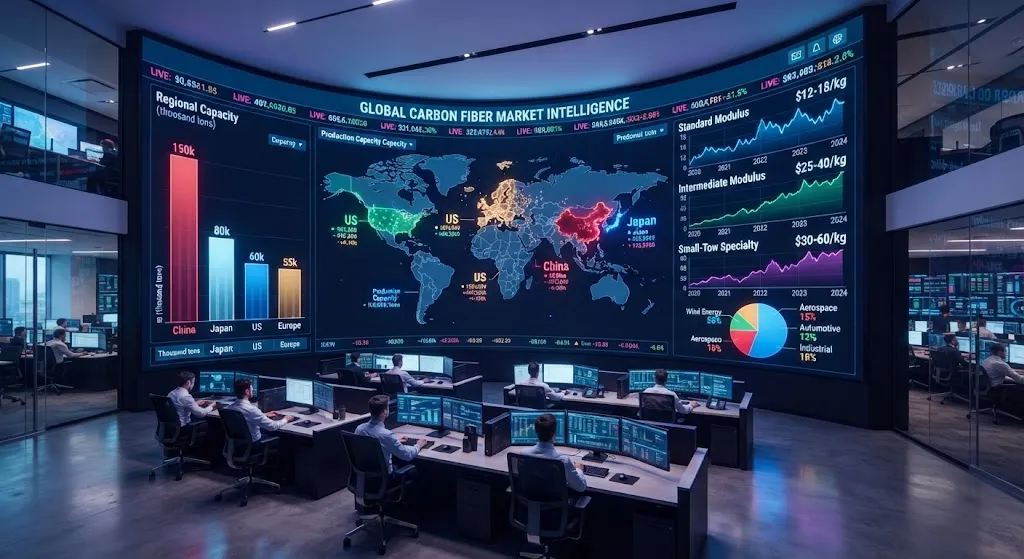
The global carbon fiber market in 2026 reaches approximately 180,000 tons of production capacity, driven by wind energy, aerospace, and automotive demand. This comprehensive market analysis examines capacity分布, pricing trends, and regional competitive dynamics.
Introduction
The global carbon fiber market in 2026 represents a dynamic industry at the intersection of multiple high-growth sectors. Total production capacity has reached approximately 180,000 tons annually, with utilization rates of 75-80% indicating a market approaching supply-demand balance after years of tight conditions. The market is valued at approximately $4.5 billion at the fiber level, with downstream composite materials and components adding significant downstream value.
The industry structure has evolved significantly over the past five years, with Chinese producers now accounting for approximately 40% of global capacity, up from 20% in 2020. This shift has profound implications for pricing, technology development, and supply chain dynamics across the global carbon fiber value chain.
Production Capacity by Region
Global carbon fiber production capacity in 2026 is distributed across several key regions:
China: Chinese producers have expanded aggressively, reaching approximately 72,000 tons of annual capacity. Major producers include Zhongfu Shenying, Jilin Carbon Valley, and CFRC, with production concentrated in Jiangsu, Jilin, and Guangdong provinces. Chinese capacity is primarily large-tow (24K-50K) fiber for wind energy and industrial applications.
Japan: Japanese producers — Toray, Teijin, and Mitsubishi — maintain approximately 45,000 tons of capacity, focused on high-performance fibers for aerospace and industrial applications. Japan remains the technology leader in intermediate modulus and high modulus fibers.
United States: US production capacity of approximately 25,000 tons is concentrated at Hexcel and Solvay (formerly Cytec), serving aerospace and defense applications. The US market is characterized by high-value, specialized products rather than volume competition.
Europe: European capacity of approximately 20,000 tons includes SGL Carbon, Mitsubishi Chemical (former AKSA), and Syensqo (formerly Solvay), serving automotive, wind energy, and industrial applications. European producers emphasize sustainability and circular economy capabilities.
Other regions: India, South Korea, and Taiwan collectively account for approximately 18,000 tons of capacity, primarily serving regional industrial markets.
Demand Drivers
Carbon fiber demand in 2026 is driven by several key sectors:
Wind energy: Consuming approximately 55% of global carbon fiber production, the wind energy sector remains the dominant demand driver. Blade length growth and increasing carbon fiber intensity in blade structures continue to push demand higher, with annual growth rates of 8-12%.
Aerospace: Commercial and military aerospace consume approximately 15% of production, with demand recovering strongly as air travel returns to pre-pandemic levels and new aircraft programs incorporate increasing percentages of composite materials.
Automotive: Automotive applications consume approximately 12% of production, driven by electric vehicle lightweighting and increasing adoption of CFRP components in premium and mass-market vehicles.
Industrial and other: Industrial applications — pressure vessels, sporting goods, construction, and emerging applications — account for approximately 18% of demand, with pressure vessels for hydrogen storage showing the highest growth rates.
Pricing Dynamics
Carbon fiber pricing in 2026 reflects the evolving market structure:
Large-tow standard modulus: Pricing for large-tow (24K-50K) standard modulus fiber has stabilized at $12-18/kg after significant increases in 2022-2024. Chinese competition has moderated price increases, but supply constraints and energy costs maintain pricing above historical levels.
Intermediate modulus: Intermediate modulus fibers command premiums of $25-40/kg, reflecting higher production complexity and limited capacity. Aerospace and high-performance industrial applications sustain demand for these products.
Small-tow specialty: Small-tow (1K-12K) specialty fibers for premium applications maintain pricing of $30-60/kg, with limited price competition due to high barriers to entry and specialized applications.
Regional Competitive Dynamics
The competitive landscape varies significantly by region:
China vs. established producers: Chinese producers compete primarily on cost, offering large-tow fiber at prices 20-30% below Japanese and US producers. This has compressed margins for established producers while expanding the overall market through lower pricing.
Technology competition: Japanese producers maintain technology leadership in high-performance fibers, with continuous investment in next-generation fibers for aerospace and advanced industrial applications.
Sustainability differentiation: European producers are emphasizing sustainability credentials — recycled carbon fiber, bio-based precursors, and low-carbon production processes — as market differentiators.
Conclusion
The global carbon fiber market in 2026 is characterized by growing capacity, evolving regional dynamics, and increasing application diversity. As the industry matures, competition will intensify, driving innovation in both material technology and production efficiency. The ability to balance cost competitiveness with performance requirements and sustainability objectives will determine the success of individual producers in this dynamic market.
Part of topic
Related Articles
- Recycled Carbon Fiber Market Forecast 2030: Technology Maturity and Commercialization Path
- South Korea Carbon Fiber Market 2026: Hydrogen Economy and Shipbuilding Innovation
- Wind Turbine Blade Leading Edge Protection 2026: Polyurethane, Tape, and Metallic Shield Solutions
- China Carbon Fiber Overcapacity 2026: Price War Impact and Industry Consolidation
- India Carbon Fiber Market 2026: Wind Energy, Aerospace, and Defense Expansion
- PAN Precursor Market 2026: Acrylonitrile Supply and Carbon Fiber Cost Structure
Interested in Our Products?
Contact our team for competitive pricing and technical specifications.
Get a QuoteRelated Products

Carbon Fiber Fishing Rod Blank
High-quality carbon fiber fishing rod blank manufactured from multiple grades of Toray carbon fiber cloth. Available in a wide range of lengths, powers, and actions for freshwater and saltwater applications. Suitable for OEM rod building.

Carbon Fiber Watch Strap — 20mm/22mm Quick-Release
Premium carbon fiber watch strap with quick-release spring bars. Woven from T700 3K twill prepreg with a flexible resin system that conforms to the wrist. Available in 20mm and 22mm lug widths, compatible with Apple Watch, Samsung Galaxy Watch, Garmin, and traditional mechanical watches. Features a stainless steel buckle and carbon fiber keepers. The natural weave pattern makes each strap unique.

Carbon Fiber Plate — 3K Twill T700 1.5mm
Thin 1.5mm carbon fiber plate with 3K twill weave surface. Lightweight and stiff, commonly used for covers, panels, drone bodies, and applications requiring a premium aesthetic appearance.

Carbon Fiber Plate — 3K Twill T700 3.0mm
Medium-thickness 3.0mm carbon fiber plate offering significantly higher load capacity while maintaining attractive 3K twill finish. Suitable for structural brackets, reinforcement plates, and load-bearing panels.

Square Carbon Fiber Tube — 3K Twill T700
Square cross-section carbon fiber tube manufactured with 3K twill weave for torsional strength. Preferred for structural frames, trusses, and support columns where rectangular geometry offers design flexibility.