
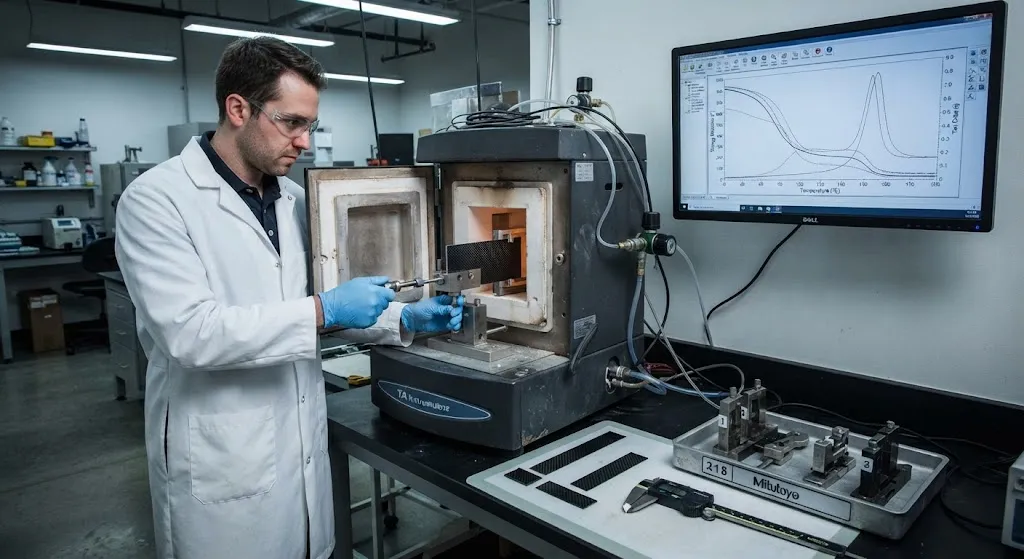
Dynamic mechanical analysis (DMA) is the most widely used technique for determining the glass transition temperature (Tg) of carbon fiber composites and quantifying their viscoelastic properties. For composite manufacturers and quality laboratories, Tg is more than a material data point
Introduction
Dynamic mechanical analysis (DMA) is the most widely used technique for determining the glass transition temperature (Tg) of carbon fiber composites and quantifying their viscoelastic properties. For composite manufacturers and quality laboratories, Tg is more than a material data point: it defines the maximum service temperature of the resin system, verifies that cure was complete, and correlates with mechanical performance under hot-wet conditions. DMA measures how a composite responds to a small oscillating deformation across a temperature range, separating the response into an elastic (storage) and a viscous (loss) component that together reveal the material's molecular state.
Getting a reliable Tg value is not automatic: the result depends on the test mode, frequency, heating rate, specimen geometry, and which feature of the DMA curves you report. This article explains the fundamentals of DMA for carbon composites, compares the three standard Tg determination criteria, and provides practical parameter guidance for qualification and production control testing.
How DMA Works
A DMA instrument clamps a small composite specimen and applies a sinusoidal force while ramping the temperature. The specimen deforms in phase with the applied force if it is purely elastic, or lags behind if it is viscoelastic. By measuring the amplitude and phase of the deformation, the instrument computes three fundamental quantities:
- Storage modulus (E'): The elastic component of stiffness — a measure of energy stored and recovered per cycle. E' tracks how stiff the composite remains as temperature rises.
- Loss modulus (E''): The viscous component — energy dissipated as heat during molecular motion. E'' peaks where molecular segment mobility is highest.
- Tan delta (loss factor): The ratio E''/E' — a dimensionless damping indicator that is extremely sensitive to the glass transition.
The most common test modes for carbon composites are single-cantilever and dual-cantilever bending for laminate specimens, three-point bending for stiff panels, and tension mode for thin unidirectional coupons. Shear modes (torsion or sandwich) are used when the shear-dominated behavior of the matrix needs isolation. Each mode produces slightly different Tg values because the stress state in the specimen differs, so comparable datasets must use the same mode.
Glass Transition Temperature: Three Standard Criteria
There is no single "correct" Tg — the value depends on which feature of the DMA trace you designate. Standards such as ASTM D7028 and ISO 6721 define three widely used criteria, each answering a slightly different engineering question:
| Criterion | Definition | Typical Value Order | Best Used For |
|---|---|---|---|
| Onset of storage modulus drop | Intersection of tangents drawn to the E' curve at the start of the transition | Lowest Tg | Conservative service temperature limit under load |
| Peak of loss modulus | Temperature at maximum E'' | Middle Tg | Physical aging and cure state monitoring |
| Peak of tan delta | Temperature at maximum tan delta | Highest Tg | Full transition characterization; correlates with long-term dimensional stability |
For a typical aerospace epoxy cured at 180 degrees Celsius, these three criteria on the same specimen might read approximately 160 degrees, 175 degrees, and 195 degrees Celsius respectively. Reporting which criterion was used is mandatory for comparing data between suppliers, batches, or laboratories — a Tg quoted as "tan delta peak" is not comparable to one quoted as "E' onset."
How Test Parameters Influence Results
Because the glass transition is a kinetic phenomenon involving molecular mobility, measurement parameters shift the observed Tg systematically. Understanding these effects lets laboratories produce repeatable data and interpret supplier values correctly:
- Frequency: Tg increases as test frequency rises because the material has less time to relax. A rule of thumb is approximately 6-8 degrees Celsius Tg increase per decade of frequency; a specimen tested at 1 Hz and 10 Hz can differ by 6-10 degrees.
- Heating rate: Faster heating rates shift Tg higher (commonly 2-5 degrees per doubling of rate) and reduce the sharpness of the transition. Standard rates are 2-5 degrees Celsius per minute for composites.
- Specimen geometry: Thick specimens with low thermal conductivity develop temperature gradients that blur the transition; thin specimens in the 1-4 mm range give sharper, more consistent transitions.
- Fixture compliance: Loose clamps or worn fixtures add apparent compliance that distorts E' values, especially in the glassy state; regular calibration with a reference specimen is essential.
- Clamping force: Insufficient clamp torque allows specimen slippage, producing erratic low E' readings. Verify that the torque is applied consistently across specimens.
For production control, the laboratory should lock frequency and heating rate to fixed values (typically 1 Hz and 3 degrees per minute) so that batch-to-batch Tg shifts reflect material change rather than measurement drift.
DMA vs DSC: Complementary Techniques
Differential scanning calorimetry (DSC) also measures glass transition, and composite laboratories usually run both techniques because they answer different questions. DMA is 10-100 times more sensitive to the glass transition than DSC, making it the preferred method for lightly cured or advanced materials where small changes in degree of cure must be resolved. DSC, however, measures the heat flow associated with the transition and provides a direct input for cure kinetics modeling and residual reactivity (the exotherm remaining after incomplete cure).
| Technique | What It Measures | Sensitivity to Tg | Main Use in Composites |
|---|---|---|---|
| DMA | Stiffness and damping change across transition | Very high (10-100x DSC) | Service temperature, cure verification, viscoelastic characterization |
| DSC | Heat flow (endotherm/exotherm) | Moderate | Cure kinetics, degree of cure, residual reactivity |
| TMA | Dimensional change (CTE) | Low | Expansion behavior and thermal stress analysis |
Many aerospace programs specify a minimum "wet Tg" — the Tg measured after moisture saturation — because water plasticizes the epoxy matrix and can depress Tg by 20-40 degrees Celsius. Verification of wet Tg requires conditioning specimens at controlled humidity or immersion before testing, followed by the same DMA protocol used for the dry measurement.
Practical Qualification Workflow
A robust material qualification program using DMA follows a structured sequence:
- Define the criteria: Select the Tg criterion (E' onset, E'' peak, or tan delta peak) that matches the product requirement and document it in the specification.
- Fix the protocol: Lock mode, frequency, heating rate, specimen size, and clamping procedure; write them into the test method so auditors can reproduce results.
- Characterize the baseline: Test three batches of qualified material to establish the mean and scatter window for acceptance testing.
- Verify cure state: For production parts, compare DMA Tg against the fully cured reference; a Tg deficit of more than 10-15 degrees indicates incomplete cure and triggers process investigation.
- Check environmental effects: Re-test after moisture conditioning and after thermal cycling to confirm service margins, especially if temperature and humidity limits are design drivers.
- Document and trend: Archive traces with the pass/fail decision and trend Tg over batches to detect resin system or process drift before parts go out of spec.
Instrument validation matters as much as sample preparation: annual calibration against a reference polymer, routine air-bearing and furnace checks, and a documented correlation run between at least two instruments (when multiple DMA machines serve one lab) keep cross-laboratory data comparable.
Frequently Asked Questions
Which Tg criterion should I report for my carbon fiber composite?
Report the criterion that matches your engineering need and always name it. For a conservative service-temperature limit under structural load, use the onset of the storage modulus drop (ASTM D7028 defines this approach for polymer matrix composites). For cure-state monitoring and batch quality control, the loss modulus peak is sensitive and stable. For a complete characterization of the transition that correlates with long-term dimensional stability, report the tan delta peak. The key discipline is consistency: never mix criteria within one dataset, and always state the frequency and heating rate alongside the Tg value.
Why does my DMA Tg differ from the Tg reported by my material supplier?
The most common reasons are different test criteria, different frequency, different heating rate, and different moisture content. A supplier quoting "tan delta peak at 10 Hz" will report a value 20-40 degrees higher than a laboratory measuring "E' onset at 1 Hz" on the same material. Specimen dimensions, fixture type, and clamping torque also contribute smaller differences. To reconcile values, replicate the supplier's exact protocol on a reference specimen, then document the offset between their protocol and yours so future comparisons are meaningful.
How do I use DMA to verify that a composite part is fully cured?
Cure verification relies on the relationship between Tg and degree of cure: as cure progresses, Tg rises toward a plateau at the theoretical fully cured value. Measure the DMA Tg of a production part and compare it with the Tg of the reference fully cured specimen tested under the same protocol. A deficit of 10-15 degrees or less is generally acceptable for an aerospace-grade epoxy; a larger deficit suggests under-cure and warrants process investigation before the part is released. Using the E'' peak criterion usually gives the clearest cure-state discrimination, and running an additional DSC scan for residual exotherm confirms the conclusion.
What should I do if my DMA results show high scatter between specimens?
High scatter almost always traces to controllable variables before it points to material problems. Check, in order: specimen thickness uniformity and fiber volume variation, clamp torque consistency and fixture condition, heating rate and frequency settings between runs, moisture content differences (condition specimens identically), and specimen slippage during the test. Run a paired dataset on a reference material to isolate instrument drift from material variance. If scatter persists after these checks, increase specimen count per batch and use the E' onset criterion, which is less sensitive to specimen-to-specimen differences than tan delta peak values.
Conclusion
DMA testing is the cornerstone of carbon composite material qualification, providing the glass transition temperature and viscoelastic properties that govern service temperature limits, cure verification, and hot-wet performance. The technique's power lies in its sensitivity, but that sensitivity makes disciplined testing mandatory: fixed mode, frequency, and heating rate, a clearly designated Tg criterion, validated fixtures, and documented environmental conditioning. When these controls are in place, DMA data becomes a reliable bridge between material suppliers, manufacturing process windows, and design allowables.
Whether you are qualifying a new resin system, verifying production cure, or auditing an incoming material batch, DMA protocols built around these principles produce defensible, repeatable results. Explore YongXian's carbon fiber materials for your qualification program, or contact our technical team for material data, test documentation, and application support.
Related Articles
- How Are Carbon Fiber Parts Made: Complete Guide
- Filament Wound Tube: Complete Guide
- Filament Wound FRP Pipe: Complete Guide
- Filament Wound Epoxy Tubes: Complete Guide
- Pultruded Carbon Fibre Rods: Cross-Sectional Properties and Standard Sizes
- Carbon Fiber Tube Fittings and Connectors: Joining Solutions for Structural Assemblies
Interested in Our Products?
Contact our team for competitive pricing and technical specifications.
Get a QuoteRelated Products

Carbon Fiber Fishing Rod Blank
High-quality carbon fiber fishing rod blank manufactured from multiple grades of Toray carbon fiber cloth. Available in a wide range of lengths, powers, and actions for freshwater and saltwater applications. Suitable for OEM rod building.

Carbon Fiber Plate — 3K Twill T700 3.0mm
Medium-thickness 3.0mm carbon fiber plate offering significantly higher load capacity while maintaining attractive 3K twill finish. Suitable for structural brackets, reinforcement plates, and load-bearing panels.
Custom Carbon Fiber Medical Device Components
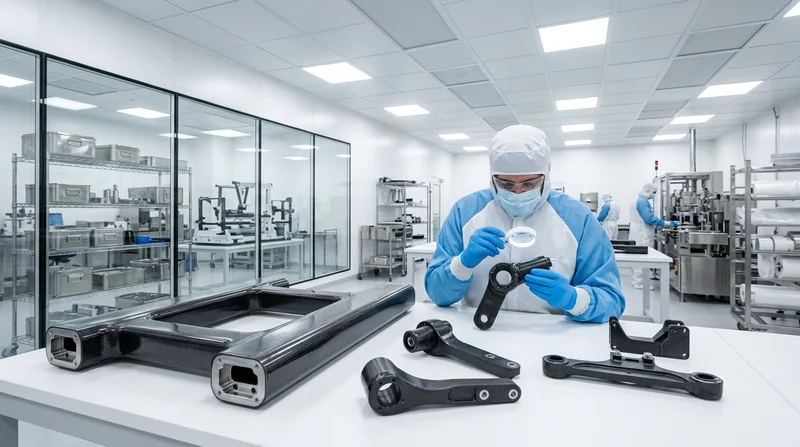
Medical-grade carbon fiber components manufactured for imaging equipment, surgical instruments, and patient support systems. Carbon fiber's radiolucency (X-ray transparency) and high strength-to-weight ratio make it ideal for CT scanner beds, wheelchair frames, surgical robot arms, and MRI-compatible accessories. Biocompatible resin systems available.

Carbon Fiber Plate — 3K Twill T700 1.5mm
Thin 1.5mm carbon fiber plate with 3K twill weave surface. Lightweight and stiff, commonly used for covers, panels, drone bodies, and applications requiring a premium aesthetic appearance.

Square Carbon Fiber Tube — 3K Twill T700
Square cross-section carbon fiber tube manufactured with 3K twill weave for torsional strength. Preferred for structural frames, trusses, and support columns where rectangular geometry offers design flexibility.