
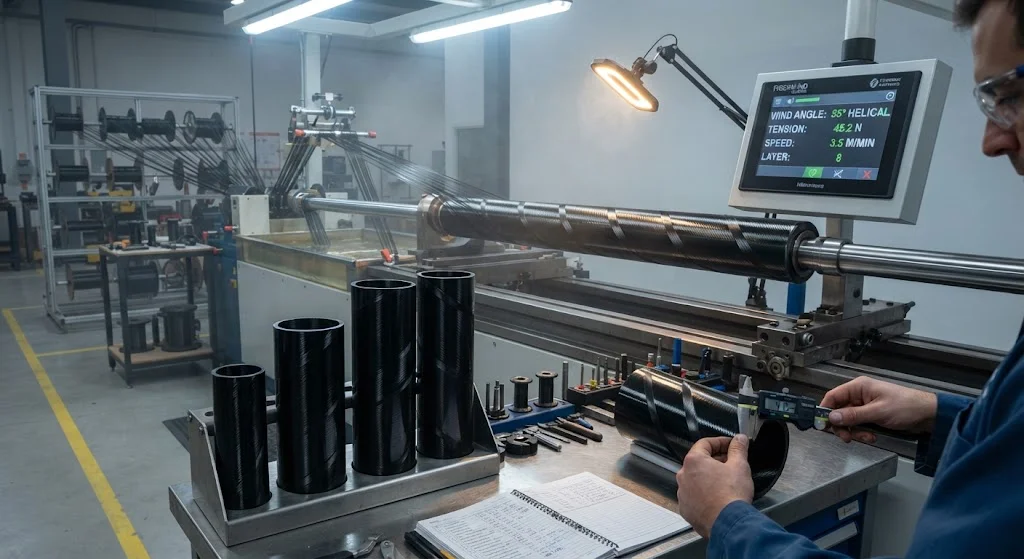
A filament wound tube is a composite cylinder manufactured by winding continuous fibre strands around a rotating mandrel at controlled angles and bonding them with resin. The process places the fibres exactly where the load demands — hoop fibres around the circumference for internal pressure, helica
Introduction
A filament wound tube is a composite cylinder manufactured by winding continuous fibre strands around a rotating mandrel at controlled angles and bonding them with resin. The process places the fibres exactly where the load demands — hoop fibres around the circumference for internal pressure, helical fibres along the length for bending and axial loads — which is why filament wound tubes achieve strength-to-weight ratios that machined metal tubes cannot match. Carbon fibre versions reach tensile strengths of 2,500-3,500 MPa in the fibre direction at a density around 1.6 g/cm³, making them the default choice for drive shafts, struts, pressure vessels, drone arms and sporting goods.
This guide covers how filament wound tubes are made, which fibres and resins suit which applications, the mechanical property ranges buyers can expect, a direct comparison with pultruded and roll-wrapped tubes, and the quality checks to run when evaluating filament wound tube suppliers.
How Filament Winding Works
Filament winding is a highly automated process with three defining characteristics: the mandrel, the winding pattern, and the resin system. Continuous fibre tows are pulled from creels, passed through a resin bath, and laid onto a rotating mandrel by a moving carriage. The carriage angle relative to the mandrel axis determines the fibre orientation: angles close to 90° to the axis create hoop reinforcement, while lower angles create helical reinforcement that carries axial and bending loads. After winding, the tube is cured — in an oven, at room temperature, or in an autoclave for high-performance parts — and the mandrel is extracted, leaving a hollow tube with a smooth bore.
The three dominant winding patterns are:
- Hoop winding: fibres are wound nearly perpendicular to the tube axis, maximising burst strength for internal pressure. Used for pressure pipes and gas cylinders.
- Helical winding: fibres run at angles of 10-60° to the axis, balancing axial and circumferential strength. This is the standard for drive shafts and structural tubes.
- Polar winding: fibres pass over the ends of the mandrel, producing a tube with reinforced end fittings — common for pressure vessels where the domed ends must carry the load.
Modern winding machines combine patterns in multi-axis layups, so a single tube can carry hoop layers for pressure, helical layers for bending, and longitudinal layers for axial stiffness in one continuous process.
Fibre and Resin Options
The fibre and resin selection determines the performance and cost of a filament wound tube. The table below summarises the standard options:
| Fibre | Tensile Strength | Modulus | Density | Typical Use |
|---|---|---|---|---|
| Carbon (standard, T700-class) | 4,900 MPa | 230 GPa | 1.80 g/cm³ | Drive shafts, struts, drone arms |
| Carbon (high-modulus, M-class) | 4,000-4,500 MPa | 390-440 GPa | 1.85 g/cm³ | Space structures, ultra-stiff shafts |
| E-glass | 3,400 MPa | 72 GPa | 2.55 g/cm³ | Chemical pipes, low-cost industrial tubes |
| Aramid (Kevlar-class) | 3,000 MPa | 112 GPa | 1.44 g/cm³ | Impact-resistant, high-damping tubes |
Resin choice matters as much as fibre. Epoxy is the default for structural tubes, offering 60-80 MPa tensile strength, good fatigue life and stable properties up to 120-180°C. Polyester and vinyl ester reduce cost for glass-fibre industrial pipes and improve chemical resistance. For high-temperature aerospace tubes, cyanate ester or bismaleimide systems extend service limits beyond 200°C. A filament wound tube's performance is defined jointly by fibre, resin, and the winding angles — never by one material alone.
Filament Wound Tube Mechanical Properties and Comparison
The property ranges below are realistic for a filament wound carbon tube at 60-70% fibre volume fraction, and they explain why this manufacturing route dominates structural tube applications. A 50 mm diameter, 2 mm wall carbon tube wound at a 45° helical angle typically delivers 400-600 MPa hoop and axial strength with a modulus of 60-90 GPa in both directions. For comparison, the same geometry in 6061-T6 aluminium gives 310 MPa yield strength at 2.7 g/cm³ — the carbon tube is roughly 40% lighter for equivalent stiffness and several times stronger in the fibre direction.
| Property | Filament Wound Carbon | Pultruded Carbon | Roll-Wrapped Carbon |
|---|---|---|---|
| Fibre orientation control | Full, angle-by-angle | Fixed along axis | Mainly circumferential |
| Hoop strength (burst) | Excellent | Low | Good |
| Axial strength | Good (helical layers) | Excellent | Low-moderate |
| Typical wall thickness | 1-25 mm | 1-5 mm | 0.5-3 mm |
| Length capability | Practically unlimited | Continuous | Mandrel-limited |
| Best application | Pressure + structural | Long, straight beams | Thin cosmetic/sport tubes |
Pultruded tubes are cheaper for long, constant-section beams because the process is continuous, but their fibres run only along the axis, so hoop strength is limited. Roll-wrapped tubes are economical for thin-walled cosmetic and sporting tubes, but the fabric wrap restricts fibre orientation. Filament winding is the only process of the three that can tune hoop and axial properties independently — the reason it is the standard for anything that must carry pressure or torque.
Applications of Filament Wound Tubes
Filament wound tubes serve industries that need high strength at low weight, often under pressure or torque:
- Automotive drive shafts: carbon filament wound shafts cut driveline inertia and weight by 50-60% versus steel, improving acceleration and fuel economy.
- Pressure vessels and gas cylinders: hoop and polar winding contain internal pressure at a fraction of steel weight; Type IV hydrogen tanks use this process for the structural shell.
- Drone and robotics arms: the combination of stiffness, damping and light weight improves payload and flight time.
- Aerospace struts and actuators: helical-wound tubes carry flight loads with documented fatigue lives.
- Sporting goods: fishing rods, arrow shafts, hockey sticks and bicycle forks use filament wound or hybrid-wound carbon tubes for consistent stiffness.
- Chemical and water pipes: glass-reinforced filament wound pipes resist corrosion at a fraction of stainless steel cost.
Winding Angle and Performance Tuning
The winding angle is the single most powerful design lever for a filament wound tube because it trades hoop strength against axial strength continuously. A tube wound entirely at 90° is strongest against internal pressure but weak in bending, while a tube wound at 15° carries axial loads well but bursts under modest pressure. Most structural tubes use a balanced angle of 45°, which equalises hoop and axial strength and is the practical default for drive shafts and struts. Designers fine-tune the angle to the actual load case — steeper angles for pressure-dominated parts, shallower angles for bending-dominated parts — and combine layers at different angles when both load types matter. This tunability is unique to filament winding and is the main reason it remains the process of choice for tubes that must carry combined pressure and torque.
Quality Checks When Buying
Whether you need a single custom tube or production volumes, verify the following with filament wound tube suppliers:
- Winding pattern documentation: the supplier should state the winding angles and layer sequence — these define the mechanical properties.
- Fibre volume fraction: ask for the fibre volume fraction (typically 55-70%); higher fibre content means more strength for the same diameter.
- Material certificates: request fibre and resin batch certificates so the performance is repeatable across orders.
- Dimension tolerance: confirm the outer diameter and wall-thickness tolerances that your assembly requires.
- Testing data: for structural parts, request burst, torsional or fatigue test data rather than theoretical values.
Whether you are comparing filament wound tube suppliers near you or buying from the United States, confirm the supplier's inspection documentation and packaging standards — a well-made tube that arrives damaged is no better than a poorly made one.
Frequently Asked Questions
What is the difference between a filament wound tube and a pultruded tube?
Filament wound tubes are made by winding fibres around a rotating mandrel at controlled angles, which allows independent tuning of hoop and axial strength — essential for pressure and torque applications. Pultruded tubes are made by pulling continuous fibres through a heated die, which is cheaper and continuous for long beams, but the fibres run only along the axis, so pultruded tubes have low hoop strength. Choose filament winding for pressure, torsion or multi-directional loading; choose pultrusion for long, straight, axially loaded sections.
How strong is a carbon filament wound tube?
A typical carbon filament wound tube at 60-65% fibre volume fraction delivers 400-600 MPa hoop and axial strength with a modulus of 60-90 GPa, depending on the winding angle. The fibre-direction tensile strength of the carbon itself is 4,000-4,900 MPa, but in a wound tube the effective properties depend on the layup. For pressure applications, burst strength is the governing figure and is maximised by hoop layers; for bending, helical layers at 45° give the best balance.
Can filament wound tubes be made to custom dimensions?
Yes. Filament winding is inherently custom: the mandrel diameter sets the inner diameter, the number of layers sets the wall thickness, and the winding program sets the fibre angles. Typical production covers inner diameters from 10 mm to over 1 metre, wall thicknesses from 1 mm to 25 mm, and lengths from a few centimetres to many metres. Custom tooling cost is low compared with injection or compression moulding, which makes filament wound tubes attractive for medium-volume custom runs.
Conclusion
A filament wound tube earns its place in demanding applications because the process places fibres exactly where loads occur: hoop layers for pressure, helical layers for bending and torque, and polar layers for domed ends. With carbon, glass or aramid fibres and the right resin system, a wound tube outperforms machined metal on strength-to-weight ratio and outperforms pultruded and roll-wrapped tubes where multi-directional strength matters. Verify the winding pattern, fibre volume fraction and test data with your supplier, and the tube will deliver its rated performance for the life of the part.
YongXian supplies filament wound carbon tubes in custom diameters, wall thicknesses and winding patterns for drive shafts, drone arms, struts and pressure components. View our carbon fibre tube range or request a quote with your required dimensions and load case.
Related Articles
- How Are Carbon Fiber Parts Made: Complete Guide
- Filament Wound FRP Pipe: Complete Guide
- Filament Wound Epoxy Tubes: Complete Guide
- Pultruded Carbon Fibre Rods: Cross-Sectional Properties and Standard Sizes
- Carbon Fiber Tube Fittings and Connectors: Joining Solutions for Structural Assemblies
- Carbon Fiber Plate Insert: Threaded Insert Design for Composite Structures