
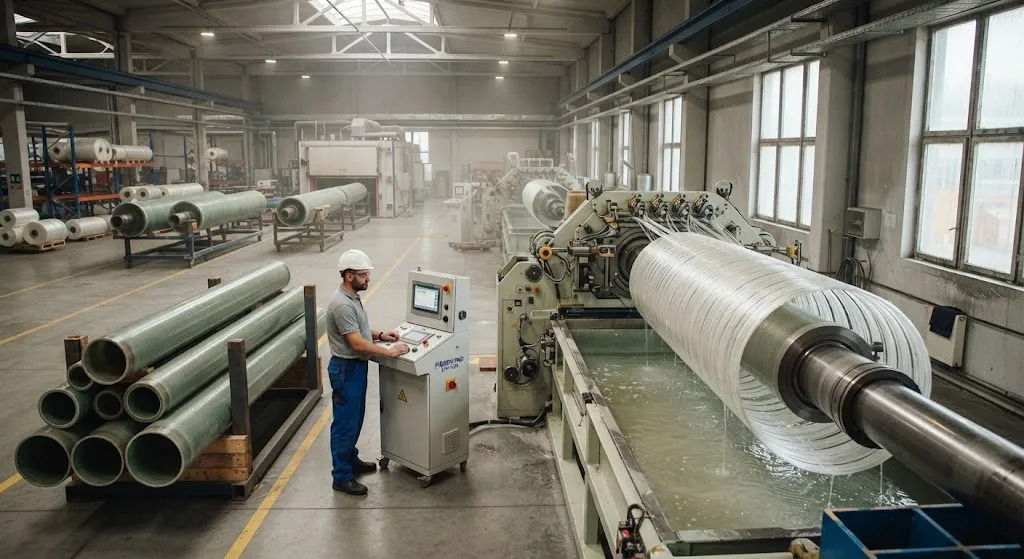
Filament wound FRP pipe is a composite pipe produced by winding continuous glass fiber rovings around a rotating steel mandrel and curing them with a thermosetting resin. The winding process lays the fiber at controlled angles, which gives the pipe high hoop strength against internal pressure, excel
Introduction
Filament wound FRP pipe is a composite pipe produced by winding continuous glass fiber rovings around a rotating steel mandrel and curing them with a thermosetting resin. The winding process lays the fiber at controlled angles, which gives the pipe high hoop strength against internal pressure, excellent corrosion resistance across a wide range of chemicals, and a weight that is typically only 20-25% of a steel pipe with the same pressure rating. For engineers and procurement teams evaluating filament wound FRP pipe for water, wastewater, chemical or desalination projects, the practical questions are about pressure class, resin selection, jointing method and the reliability of the supplier behind the quotation.
This guide explains how filament wound FRP pipe is manufactured, how material grades change performance, how it compares with alternative pipe materials, and which specifications and cost factors matter when you order.
How Filament Wound FRP Pipe Is Manufactured
The filament winding process for FRP pipe is continuous, automated and repeatable. Glass rovings are pulled from creels through a resin bath, then wound onto a rotating mandrel by a carriage that travels along the pipe length. After the full wall thickness is built up in multiple passes, the pipe is cured, the mandrel is extracted, and the pipe is cut to length with machined or bell-and-spigot ends. The four main steps are:
- Resin impregnation: E-glass or H-glass rovings pass through a bath of polyester, vinyl ester or epoxy resin with a controlled glass content of 55-75% by weight.
- Helical and hoop winding: the carriage lays fiber at 50-70 degrees for longitudinal strength and adds near-hoop layers at 80-89 degrees for pressure resistance, building the wall in a programmed sequence.
- Curing: the wound pipe is cured at 80-160 degrees Celsius, either in an oven or with heated mandrels, depending on the resin system.
- Finishing: the pipe is extracted from the mandrel, cut to length, and fitted with coupling, bell, or flange ends ready for field jointing.
Because the fiber is continuous and oriented by design, filament wound FRP pipe has predictable stiffness in both the hoop and axial directions, which is exactly what pressure-rated piping needs. The same winding platform can produce diameters from 50 mm to over 3,000 mm and pressure classes from gravity flow up to PN25 or higher.
Material Grades and Resin Selection
The resin system determines the corrosion envelope and temperature rating of filament wound FRP pipe, while the glass type determines stiffness and strength. The table below summarizes the common combinations and their typical service windows.
| Resin System | Glass Type | Typical Temperature Rating | Typical Use |
|---|---|---|---|
| Isophthalic polyester | E-glass | Up to 60-70 degrees C | Water supply, sewage, general industrial |
| Vinyl ester | E-glass or H-glass | Up to 90-100 degrees C | Chemical process, flue gas, aggressive media |
| Epoxy | E-glass or H-glass | Up to 110-120 degrees C | High-temperature service, oil and gas, potable water |
For potable water duty, epoxy or food-grade vinyl ester systems with certified liner layers are preferred because they keep the water in contact only with a chemically inert surface. For wastewater and stormwater, isophthalic polyester is usually sufficient and more economical. For chemical plants handling solvents, acids or alkalis, vinyl ester and epoxy systems extend the service life significantly, which is why the resin grade — not just the pipe diameter — should be written into the specification.
Filament Wound FRP Pipe vs. Steel, Ductile Iron and Concrete
Most comparisons of filament wound FRP pipe are made against steel, ductile iron and reinforced concrete because these are the traditional pressure and gravity pipe materials. The differences are substantial and consistent.
| Property | Filament Wound FRP | Steel / Ductile Iron | Concrete |
|---|---|---|---|
| Weight relative to steel | 20-25% | 100% | 200-300% |
| Corrosion resistance | Excellent, no lining needed | Requires coating and cathodic protection | Susceptible to chemical attack |
| Hydraulic smoothness (roughness) | 0.01-0.03 mm | 0.05-0.1 mm | 0.3-0.6 mm |
| Joint types | Adhesive, bell-and-spigot, flanged | Welded, flanged, mechanical | Gasketed, mortared |
| Service life | 50+ years with proper design | 20-50 years with maintenance | 50-100 years |
| Installed cost trend | Lowest in corrosive soils | Moderate to high | High due to weight and excavation |
The two advantages that usually decide projects are corrosion resistance and installation cost. FRP pipe needs no external coating, no cathodic protection and no heavy lifting equipment in the trench, so the total installed cost in aggressive soils is often 20-40% lower than steel despite a higher material price per meter. The smoother internal surface also reduces pumping energy: a filament wound FRP pipe can carry 20-30% more flow than a concrete pipe of the same nominal diameter at the same head loss.
Pressure Classes and Stiffness Ratings
Filament wound FRP pipe is specified by two independent numbers: the pressure class and the stiffness class. Pressure class (PN) defines the maximum internal working pressure, with common ratings from PN1 for gravity lines to PN16, PN20 and PN25 for pressurized networks. Stiffness class defines the resistance to external soil and traffic loads, with SN2500, SN5000 and SN10000 being the standard values in N/m². A pipe can be high pressure and low stiffness, or low pressure and high stiffness, depending on the winding schedule. Buyers should specify both values rather than assuming a single grade covers the application, and the supplier should confirm the pipe meets the relevant standard, such as AWWA C950, ISO 14692 or EN 1796, depending on the project location.
Jointing Methods for Filament Wound FRP Pipe
Field jointing is where most FRP pipe projects succeed or fail. The common methods are:
- Adhesive-coupled joints: a coupling sleeve is bonded over the pipe ends with structural adhesive; fast, reliable and the most common method for water and wastewater lines.
- Bell-and-spigot with gasket: a molded bell end and a gasket-sealed spigot allow rapid push-fit assembly, popular for gravity and low-pressure drainage.
- Flanged joints: factory-bonded flanges with bolted connections, used where the pipe connects to pumps, valves, tanks or metallic equipment.
Whatever the method, the joint must match the pressure class of the pipe, and adhesive joints should be made by trained crews with proper surface preparation. A well-made joint on filament wound FRP pipe is as strong as the pipe body, which is why installers with documented experience are worth more than a slightly lower labor rate.
Cost Factors and What to Expect
The price of filament wound FRP pipe is driven by diameter, pressure class, resin system and stiffness. Upgrading from polyester to vinyl ester or epoxy typically adds 20-40% to the pipe cost, and higher pressure classes add wall thickness and glass content. For buyers comparing filament wound FRP pipe suppliers, the quoted unit price is only part of the picture: freight on long lengths, jointing materials, installation labor and warranty terms all belong in the comparison. Minimum order quantities are usually modest because mandrel tooling is per-diameter, and most established manufacturers quote short production runs without excessive setup fees.
Frequently Asked Questions
How long does filament wound FRP pipe last?
With correct design, resin selection and installation, filament wound FRP pipe is typically rated for 50 years or more of service. The corrosion resistance comes from the resin matrix and the integral liner, so the service life depends more on matching the resin system to the transported media than on the pipe wall itself. Projects using vinyl ester or epoxy systems in aggressive chemical duty regularly exceed 30 years of documented service.
Is filament wound FRP pipe suitable for potable water?
Yes. Filament wound FRP pipe with an appropriate food-grade liner is approved for potable water service and is widely used in municipal water networks. The liner keeps the water in contact with an inert resin surface, and the pipe meets standards such as EN 1796 and NSF/ANSI 61 for drinking water contact. When ordering for potable duty, specify the liner requirement explicitly so the manufacturer certifies the correct system.
Can filament wound FRP pipe be installed above ground?
Yes. Filament wound FRP pipe can be installed above ground as long as it is designed for the loads — UV-resistant resin systems or protective coatings handle sunlight exposure, and the pipe must be supported at appropriate intervals to prevent sagging. Above-ground FRP piping is common in chemical plants, water treatment facilities and industrial utilities, where its corrosion resistance avoids the maintenance burden of painted steel.
Conclusion
Filament wound FRP pipe combines corrosion resistance, light weight and predictable pressure performance in a way that makes it the most economical choice for many water, wastewater and chemical applications. Specify the pressure class and stiffness class separately, match the resin system to the transported media, and confirm the jointing method and standards before ordering. The right supplier will quote on your duty conditions rather than a generic pipe grade.
YongXian manufactures filament wound composite pipes and tubes with custom diameters, material certificates and export documentation. View our composite pipe and tube range or request a quote with your diameter, pressure class and media details.
Part of topic
Related Articles
- Filament Wound Epoxy Tubes: Complete Guide
- Pultruded Carbon Fibre Rods: Cross-Sectional Properties and Standard Sizes
- Carbon Fiber Tube Fittings and Connectors: Joining Solutions for Structural Assemblies
- Carbon Fiber Plate Insert: Threaded Insert Design for Composite Structures
- Filament Wound Epoxy Tubing: Selection Guide for Industrial and Aerospace Applications
- Filament Wound Epoxy Tubes Advantages: Over Metal and Pultruded Alternatives