
Filament wound epoxy tubes are cylindrical composite structures produced by winding continuous carbon or glass fiber over a rotating mandrel and curing it with an epoxy resin system. The process produces tubes with exceptional hoop strength, high specific stiffness and outstanding pressure resistanc
Introduction
Filament wound epoxy tubes are cylindrical composite structures produced by winding continuous carbon or glass fiber over a rotating mandrel and curing it with an epoxy resin system. The process produces tubes with exceptional hoop strength, high specific stiffness and outstanding pressure resistance, which makes them the default choice for drive shafts, pressure vessels, robotics arms and aerospace struts where metal tubes are too heavy or too weak. For buyers researching filament wound epoxy tubes suppliers, understanding the winding process is the key to specifying the right tube, because winding angle, fiber grade and resin system determine nearly every performance property.
This guide covers how filament wound epoxy tubes are made, how winding angles change mechanical behavior, how the tubes compare with pultruded alternatives, and the specifications and cost factors that matter when ordering.
How Filament Wound Epoxy Tubes Are Made
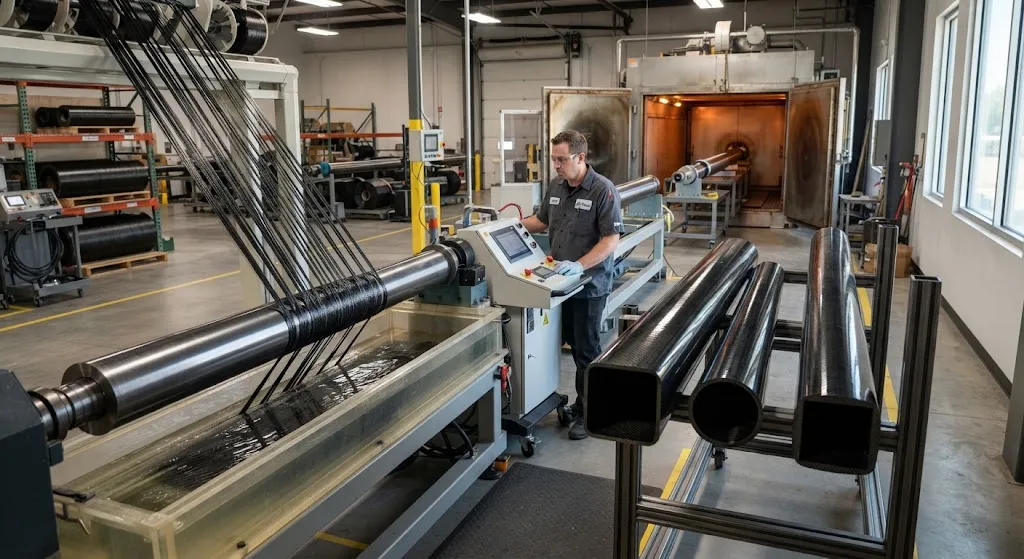
The filament winding process is continuous and highly automated. A machine feeds fiber tows from creels through a resin bath, then wraps the wetted fiber around a rotating mandrel at a controlled angle. The wound structure is cured in an oven, and the mandrel is extracted to leave a hollow tube. The four steps are:
- Resin impregnation: dry fiber tows pass through an epoxy bath where a metering system controls resin content, typically 25-40% by weight.
- Winding: the carriage moves along the mandrel at a programmed speed, laying fiber at angles from near-hoop (85-89 degrees) to near-axial (5-15 degrees).
- Curing: the wound mandrel is oven-cured at 120-180 degrees Celsius for two to six hours, depending on resin chemistry.
- Mandrel removal and finishing: the tube is extracted, ends are trimmed, and the outer surface is machined or ground to final tolerance.
Because the fiber is placed under tension and follows a continuous helical path, filament wound tubes have fewer fiber discontinuities than rolled or braided constructions, which translates into higher strength and better fatigue life.
Winding Angles and What They Do
The winding angle is the single most important specification for a filament wound epoxy tube because it controls the balance between hoop and axial strength. The table below shows how angle choice maps to mechanical behavior.
| Winding Angle | Hoop Strength | Axial Strength | Typical Use |
|---|---|---|---|
| 85-89 degrees (hoop) | Maximum | Minimal | Pressure vessel liners, ring reinforcement |
| 45-60 degrees (helical) | High | Moderate | Drive shafts, torque tubes, general-purpose pipe |
| 5-20 degrees (low-angle) | Moderate | High | Axial struts, load-bearing columns, structural tubes |
Most structural tubes use a combination of layers — for example, a low-angle layer for axial stiffness and a hoop layer for burst resistance — rather than a single angle. This hybrid layup is why filament wound epoxy tubes can be tuned to a specific load case in a way that pultruded profiles cannot: pultrusion produces a fixed unidirectional architecture, while winding can vary angle by layer along the same tube.
Filament Wound Epoxy Tubes vs. Pultruded Tubes
Buyers often compare filament wound and pultruded tubes because both are continuous-fiber products available in similar diameters. The practical differences are substantial.
| Property | Filament Wound | Pultruded |
|---|---|---|
| Fibre architecture | Helical, angle controllable by layer | Unidirectional, fixed by die |
| Hoop strength | High, adjustable | Low |
| Axial strength | Good, angle-dependent | Excellent |
| Pressure capability | Excellent | Limited |
| Surface finish | Good; machined on request | Smooth as-pulled |
| Cost per metre | Higher | Lower |
| Tooling / minimum order | Mandrel per size; flexible runs | Die per profile; long runs preferred |
Choose pultrusion when the load is primarily axial and the cross-section is constant — structural struts, rollers, drone arms. Choose filament wound epoxy tubes when the part sees hoop loading, internal pressure, torsion, or a combination of loads — drive shafts, pressure tubes, robotics and hydraulic applications.
Applications of Filament Wound Epoxy Tubes
Filament wound epoxy tubes serve industries where strength-to-weight ratio and fatigue resistance justify a higher material cost than metal. Common applications include:
- Drive shafts and torque tubes in automotive, marine and industrial machinery, where torsion is the dominant load.
- Pressure tubes and pipe for hydraulic systems, pneumatic cylinders and oilfield equipment.
- Robotics arms and telescoping booms, where light weight reduces actuator load and increases reach.
- Aerospace struts and landing gear components, where fatigue life and weight are critical.
- Sporting goods and leisure equipment such as fishing rod blanks, bicycle frames and kayak paddle shafts.
- Electrical insulation components, where non-conductive epoxy combined with glass or hybrid fiber provides structural isolation.
In each case the winding schedule is designed around the specific load case, which is why a filament wound tube supplier needs the application details — not just an outer diameter and length — to quote the right product.
Specifying Filament Wound Epoxy Tubes
A complete specification for a filament wound epoxy tube covers six parameters: outer and inner diameter or wall thickness, length, fiber type and grade, resin system, winding angle schedule, and surface treatment. For carbon fiber, common grades are T300 and T700 with tensile moduli of 230 and 230-245 GPa respectively; for glass, E-glass and S-glass are standard, with S-glass offering roughly 20% higher strength at higher cost. Epoxy systems are chosen for service temperature, chemical resistance and cure cycle, with standard formulations rated from -50 to +150 degrees Celsius and specialty systems beyond.
Tolerances also need definition: filament wound tubes typically hold outer diameter within ±0.1 to ±0.3 mm as-wound, and after grinding or machining, within ±0.05 to ±0.1 mm. Wall thickness consistency is usually ±0.1 to ±0.2 mm. Buyers should specify which surfaces matter — a machined end, a ground outer diameter, or an as-wound finish — because each carries a different cost.
Cost Factors and What to Expect
The cost of a filament wound epoxy tube is driven by fiber type, wall thickness, winding complexity and finish. Carbon fiber tubes typically cost several times more than equivalent glass fiber tubes on a per-metre basis. Winding angle complexity adds little material cost but affects machine time, and any post-cure machining adds a step that typically increases unit price by 10-30%. For buyers comparing filament wound epoxy tubes usa suppliers against offshore options, count the same factors as any composite purchase: freight, duty, communication and rework risk, alongside the quoted unit price. Minimum orders are usually modest because mandrels are per-size tooling, and short prototype runs are common in the industry.
Frequently Asked Questions
How strong are filament wound epoxy tubes compared with metal tubes?
A carbon fiber filament wound tube offers tensile strength of roughly 1,500-2,500 MPa in the fiber direction while weighing about 60% less than aluminium and 75% less than steel of equal dimensions. Hoop strength depends on the winding angle: near-hoop layers deliver the highest burst resistance, which is why pressure applications specify steep angles. For torsion-limited drive shafts, a 45-60 degree helical layup typically outperforms steel on strength-to-weight by a wide margin.
Can filament wound epoxy tubes be made to custom sizes?
Yes. Filament winding uses a mandrel per diameter, so custom outer diameters and wall thicknesses are standard practice rather than an exception. Tooling lead time for a new mandrel is typically three to six weeks, and because the winding angle and layer sequence are programmed per order, the mechanical properties can be tuned to your load case. This flexibility is one of the main reasons buyers choose filament wound tubes over pultruded profiles for custom work.
What is the temperature rating of epoxy filament wound tubes?
Standard epoxy systems are rated for continuous service from about -50 to +150 degrees Celsius, with short-term excursions to 180 degrees. High-temperature epoxy formulations extend service to 200 degrees or more, and cyanate ester or BMI resin systems push the envelope further for aerospace use. If your application exceeds these ranges, specify the service temperature to the supplier so the resin system and cure cycle can be selected accordingly.
Conclusion
Filament wound epoxy tubes combine high hoop strength, light weight and fatigue resistance in a way that metal and pultruded alternatives cannot match for torsion, pressure and combined-load applications. Specify the winding angle schedule around your load case, confirm fiber grade and resin system for the service environment, and agree on tolerances and finish before quoting. The right supplier will tune the layup to your application rather than selling a catalogue item.
YongXian manufactures filament wound carbon fiber tubes with custom mandrels, material certificates and export documentation. View our carbon fiber tube range or request a quote with your diameter, length and load case.
Related Articles
- Filament Wound FRP Pipe: Complete Guide
- Pultruded Carbon Fibre Rods: Cross-Sectional Properties and Standard Sizes
- Carbon Fiber Tube Fittings and Connectors: Joining Solutions for Structural Assemblies
- Carbon Fiber Plate Insert: Threaded Insert Design for Composite Structures
- Filament Wound Epoxy Tubing: Selection Guide for Industrial and Aerospace Applications
- Filament Wound Epoxy Tubes Advantages: Over Metal and Pultruded Alternatives