
How are carbon fiber parts made? Understanding the answer is the fastest way to evaluate a supplier's price, lead time and quality claims. The short answer: carbon fibre is first manufactured from a polymer precursor, then formed into a shape with resin, then cured under heat and pressure. The long
Introduction
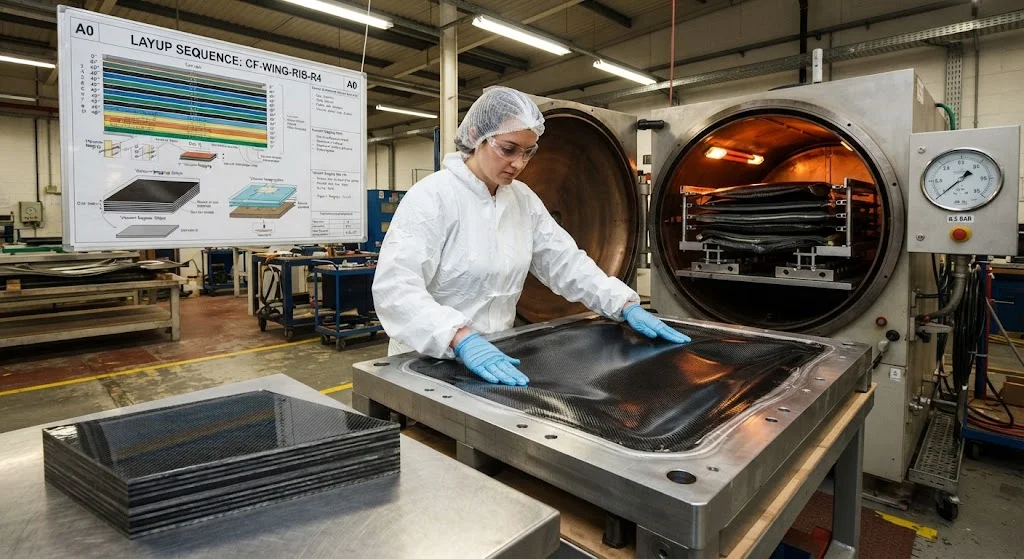
How are carbon fiber parts made? Understanding the answer is the fastest way to evaluate a supplier's price, lead time and quality claims. The short answer: carbon fibre is first manufactured from a polymer precursor, then formed into a shape with resin, then cured under heat and pressure. The long answer involves a chain of specialised processes — precursor conversion, weaving or layup, resin infusion, moulding and curing — and each link determines whether the finished part is a structural component rated for flight loads or a cosmetic cover that carries almost nothing.
This guide explains how carbon fiber parts are made step by step, compares the dominant manufacturing processes with realistic cost and volume data, and details the quality controls that matter when buying from carbon fiber parts manufacturers.
Step 1: From Precursor to Carbon Fibre
Every carbon fiber part begins with the fibre itself, and more than 90% of the world's carbon fibre is made from polyacrylonitrile (PAN). The PAN precursor is stretched into filaments, then stabilised in air at 200-300°C, carbonised in an inert atmosphere at 1,000-1,500°C, and optionally graphitised above 2,000°C for high-modulus grades. The result is a fibre that is 90-99% carbon, with tensile strength up to 4,900 MPa (T700 class) and a modulus of 230 GPa. High-modulus M-series fibres trade some strength for stiffness up to 440 GPa. The fibre is sold as tow — bundles of 1,000 to 50,000 filaments — which is the raw material for everything that follows.
| Grade | Process Step | Tensile Strength | Modulus | Typical Use |
|---|---|---|---|---|
| Standard (T300) | Carbonised | 3,530 MPa | 230 GPa | General parts, sporting goods |
| Intermediate (T700) | Carbonised | 4,900 MPa | 230 GPa | Aerospace, automotive structural parts |
| High strength (T800) | Carbonised, refined | 5,880 MPa | 294 GPa | Pressure vessels, high-load parts |
| High modulus (M40J) | Graphitised | 4,400 MPa | 377 GPa | Space structures, stiff shafts |
The fibre grade sets the ceiling for the part's mechanical properties; the manufacturing process decides how much of that potential survives into the finished component.
Step 2: From Fibre to Preform
Before moulding, the fibre must be arranged into a shape that suits the chosen process. There are three common routes. The first is weaving: carbon tow is woven into 2D fabric (plain, twill or satin weaves) which drapes over moulds easily and is the default for hand layup and prepreg work. The second is unidirectional (UD) alignment: fibres are laid parallel in a sheet, giving maximum strength in one direction and used in engineered layups. The third is braiding or 3D weaving, which places fibres in multiple directions — including through the thickness — for parts that face impact or multi-axial loads. The preform stage is also where reinforcement material can be combined with resin to make prepreg: fabric or UD sheets pre-impregnated with partially cured epoxy, stored cold and ready for layup.
How Carbon Fiber Parts Are Moulded and Cured
Moulding and curing are where how carbon fiber parts are made diverges into distinct processes, each with its own cost, cycle time and property profile. The four dominant routes are:
- Prepreg autoclave: prepreg layers are laid into a mould, vacuum-bagged and cured in an autoclave at 120-180°C under 5-7 bar pressure. Highest quality and fibre volume fraction (60-70%), slowest and most expensive — the standard for aerospace and motorsport.
- Resin transfer moulding (RTM): dry preforms are loaded into a closed mould and resin is injected under pressure. Cycle times of 30-90 minutes with good quality, making it the workhorse for medium-volume automotive and industrial parts.
- Compression moulding: chopped fibre moulding compound is pressed in heated dies at 3-10 minute cycles. Lowest cost for high volumes, but shorter fibres limit strength; used for interior panels and semi-structural parts.
- Vacuum infusion: dry fabric is laid up and resin is drawn through by vacuum. Low tooling cost suits large parts and prototype runs, with fibre volume fractions of 50-60%.
The table below summarises the trade-offs:
| Process | Cycle Time | Fibre Volume | Tooling Cost | Part Cost | Best For |
|---|---|---|---|---|---|
| Autoclave prepreg | 3-8 hours | 60-70% | High | Highest | Aerospace, structural |
| RTM | 30-90 min | 55-65% | Medium | Medium | Medium-volume structural |
| Compression | 3-10 min | 30-50% | Medium | Low | High-volume, non-structural |
| Vacuum infusion | 2-6 hours | 50-60% | Low | Low-medium | Large parts, prototyping |
Autoclave processing produces the strongest parts because pressure consolidates the laminate and suppresses voids; RTM and infusion are competitive where cycle time and tooling cost matter more than maximum performance.
How Carbon Fiber Parts Are Finished and Inspected
After curing, a carbon fiber part goes through trimming, drilling and surface finishing, then through inspection. Trimming removes flash and net-shapes the part with CNC or water-jet cutting. Surface preparation ranges from simple de-moulding for matte finishes to gel-coat or clear-coat application for cosmetic parts. Inspection is where structural quality is proven: ultrasonic testing finds delaminations and voids, coordinate measuring machines verify geometry against the CAD model, and witness panels from the same cure batch are tested for mechanical properties. For aerospace and automotive safety parts, this documentation is mandatory — a part without test data is a part without a pedigree.
Designing for the Process
The choice of manufacturing process is usually settled during design, not after. Part geometry decides first: deep, undercut or heavily curved shapes favour RTM and compression moulding because the mould closes over the part, while large flat panels with simple curves suit vacuum infusion and autoclave bagging. Production volume decides second: prototype and low-volume runs use infusion or wet layup because the tooling is cheap and fast to make, while volumes above a few thousand parts favour RTM or compression moulding where the higher tooling cost is amortised across many parts. Wall thickness is a third constraint — autoclave prepreg laminates are typically 1-10 mm thick, while compression-moulded parts are limited to around 3 mm because the chopped fibres cannot fill thicker sections evenly. Designers who align geometry, volume and thickness with the process avoid the most common failure in carbon fiber part programmes: choosing a process for cost and discovering too late that it cannot produce the required geometry or thickness.
Quality Controls That Matter
When comparing carbon fiber parts manufacturers, four controls separate a reliable supplier from a risk:
- Material traceability: fibre and resin batch certificates link every part to its raw materials.
- Process records: documented cure cycles, pressures and layup sequences make quality repeatable.
- Inspection data: ultrasonic, geometric and mechanical test reports verify the part actually meets its ratings.
- Environmental controls: prepreg handling and layup must be humidity- and temperature-controlled, because moisture degrades the resin system.
A supplier that provides all four on request is treating the part as an engineered product; one that cannot is selling a moulding, not a component. Whether you search for carbon fiber parts manufacturers near you or source from the United States, the same documentation standard applies.
Frequently Asked Questions
What is the cheapest way to make carbon fiber parts?
For high volumes, compression moulding with chopped fibre compound is the cheapest route — cycles of 3-10 minutes and low material cost — but the short fibres limit strength, so it suits non-structural parts like interior panels. For low volumes, vacuum infusion has the lowest tooling cost. RTM is the best balance for medium volumes of structural parts. Autoclave prepreg is always the most expensive; it is chosen for performance, not price.
Why are carbon fiber parts so expensive to make?
The cost stack has four layers: carbon fibre itself costs $20-200 per kilogram depending on grade, tooling for moulding runs from thousands to hundreds of thousands of dollars, processing consumes energy and skilled labour, and inspection adds overhead. Aerospace-grade parts are expensive because autoclave cycles take hours, tooling is certified, and every part carries test documentation. Prices fall as volume rises — which is why automotive programmes drive process development towards RTM and compression moulding.
Is a handmade carbon fiber part as strong as an autoclave part?
No. Hand layup with wet resin typically achieves 30-50% fibre volume fraction and relies on the laminator's skill for consistency, while autoclave processing reaches 60-70% fibre volume with low void content under controlled pressure. The same fibre in an autoclave part can be 30-50% stronger and far more consistent. Handmade parts are fine for cosmetic or lightly loaded applications, but structural parts should be autoclave, RTM or infusion-moulded with documented process control.
Conclusion
How carbon fiber parts are made determines what they are worth: the fibre grade sets the strength ceiling, the preform route shapes the fibre architecture, and the moulding process decides how much of that strength survives into the finished part. Autoclave prepreg delivers the highest performance at the highest cost, RTM balances quality and volume, and compression moulding wins on price for non-structural parts. Whatever process you choose, demand material traceability, process records and inspection data — they are the difference between buying an engineered component and buying a moulding.
YongXian manufactures carbon fiber parts with prepreg, RTM and vacuum infusion processes, with full material traceability and inspection documentation on every batch. View our carbon fiber product range or contact our engineering team to discuss your part design and process selection.
Related Articles
- Filament Wound Tube: Complete Guide
- Filament Wound FRP Pipe: Complete Guide
- Filament Wound Epoxy Tubes: Complete Guide
- Pultruded Carbon Fibre Rods: Cross-Sectional Properties and Standard Sizes
- Carbon Fiber Tube Fittings and Connectors: Joining Solutions for Structural Assemblies
- Carbon Fiber Plate Insert: Threaded Insert Design for Composite Structures
Interested in Our Products?
Contact our team for competitive pricing and technical specifications.
Get a QuoteRelated Products

Carbon Fiber Plate — 3K Twill T700 3.0mm
Medium-thickness 3.0mm carbon fiber plate offering significantly higher load capacity while maintaining attractive 3K twill finish. Suitable for structural brackets, reinforcement plates, and load-bearing panels.

Carbon Fiber Plate — 3K Twill T700 1.5mm
Thin 1.5mm carbon fiber plate with 3K twill weave surface. Lightweight and stiff, commonly used for covers, panels, drone bodies, and applications requiring a premium aesthetic appearance.
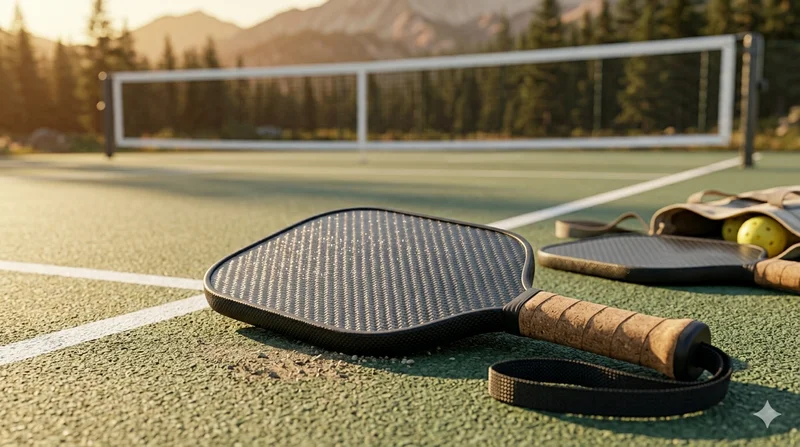
Carbon Fiber Pickleball Paddle
High-performance pickleball paddle with Toray T700 carbon fiber face and polypropylene honeycomb core. Delivers excellent power-to-weight ratio, spin generation, and vibration dampening for competitive play.

Square Carbon Fiber Tube — 3K Twill T700
Square cross-section carbon fiber tube manufactured with 3K twill weave for torsional strength. Preferred for structural frames, trusses, and support columns where rectangular geometry offers design flexibility.

Carbon Fiber Trekking Pole
Lightweight carbon fiber trekking pole manufactured from high-grade carbon fiber tube. Weighs only 160g per pole while providing superior shock absorption and durability for hiking, trail running, and backpacking.