
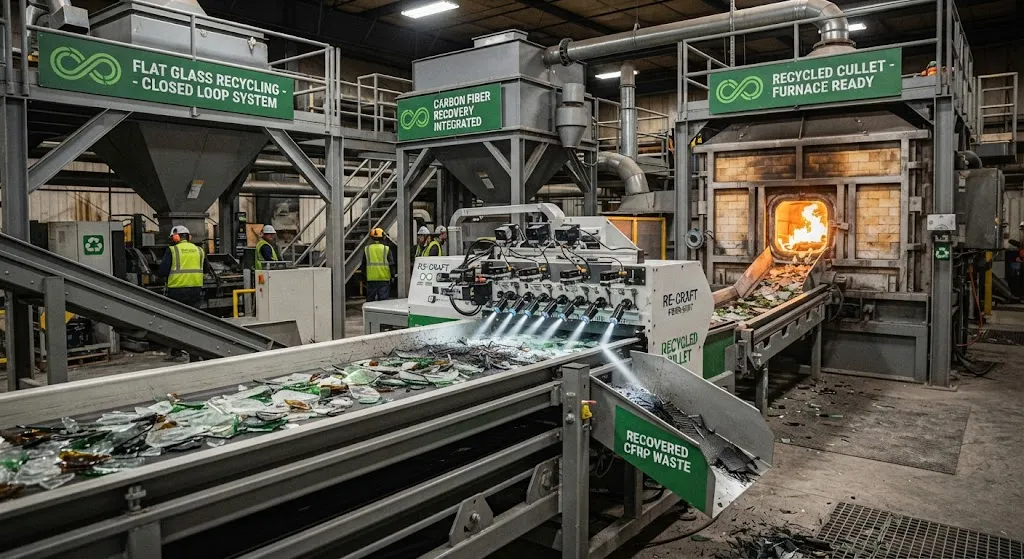
The flat glass industry is developing closed-loop recycling systems that incorporate carbon fiber composite materials into cullet processing. This article examines the integration of CFRP materials in glass recycling loops and furnace operations.
Introduction
The flat glass industry — producing architectural, automotive, and display glass — generates significant waste through manufacturing offcuts, end-of-life products, and process rejects. Traditionally, this cullet (broken glass) is recycled back into glass melting furnaces, reducing raw material requirements and energy consumption. The integration of carbon fiber composite materials into glass recycling loops represents an emerging opportunity to address CFRP waste while supporting glass industry sustainability goals.
Carbon fiber reinforced polymer (CFRP) materials enter the glass recycling stream through several pathways: composite tooling and fixtures used in glass manufacturing, CFRP structural elements in glass processing equipment, and end-of-life composite materials from the construction and automotive sectors that contain glass components.
Integration Pathways
CFRP materials can be integrated into glass recycling through several approaches:
Composite-to-cullet processing: CFRP materials are processed into small particles that can be incorporated into glass cullet streams. The carbon fiber content is either burned off during glass melting (at temperatures above 1,500°C) or separated before melting through density-based sorting.
Carbon source utilization: The carbon content in CFRP can serve as a reducing agent in glass melting furnaces, partially replacing fossil fuel inputs. The controlled introduction of carbon from CFRP materials can improve furnace chemistry and reduce emissions.
Energy recovery: CFRP materials have significant calorific value due to their resin content. When properly processed, CFRP waste can supplement furnace energy requirements, reducing natural gas consumption.
Process Considerations
Integrating CFRP into glass recycling requires addressing several process challenges:
Contamination control: Carbon fiber particles must be carefully sized and controlled to prevent quality issues in the recycled glass. Excessive carbon content can cause discoloration, inclusions, or structural defects in glass products.
Furnace chemistry: The introduction of CFRP materials affects furnace chemistry, including redox conditions, bubble formation, and refractory wear. Process parameters must be optimized to maintain glass quality while utilizing CFRP inputs.
Sorting technology: Advanced sorting systems — optical, density-based, and electromagnetic — are needed to separate CFRP materials from other recyclables and control the composition of the cullet feed.
Environmental Benefits
Integrating CFRP into glass recycling offers several environmental benefits:
Waste diversion: Diverting CFRP waste from landfill or incineration to glass recycling reduces waste disposal volumes and environmental impact.
Raw material substitution: Using CFRP as a carbon source or energy supplement reduces the consumption of primary raw materials and fossil fuels in glass production.
Circular economy: Closed-loop recycling of CFRP through glass manufacturing supports circular economy objectives by maintaining material value in the production cycle.
Conclusion
The integration of carbon fiber composite materials into glass recycling loops represents a novel approach to managing CFRP waste while supporting glass industry sustainability. As sorting technologies improve and process understanding develops, CFRP-to-glass recycling could become a significant pathway for managing end-of-life composite materials.
Part of topic
Related Articles
- Recycled Carbon Fiber Market Forecast 2030: Technology Maturity and Commercialization Path
- South Korea Carbon Fiber Market 2026: Hydrogen Economy and Shipbuilding Innovation
- Wind Turbine Blade Leading Edge Protection 2026: Polyurethane, Tape, and Metallic Shield Solutions
- China Carbon Fiber Overcapacity 2026: Price War Impact and Industry Consolidation
- India Carbon Fiber Market 2026: Wind Energy, Aerospace, and Defense Expansion
- PAN Precursor Market 2026: Acrylonitrile Supply and Carbon Fiber Cost Structure
Interested in Our Products?
Contact our team for competitive pricing and technical specifications.
Get a QuoteRelated Products
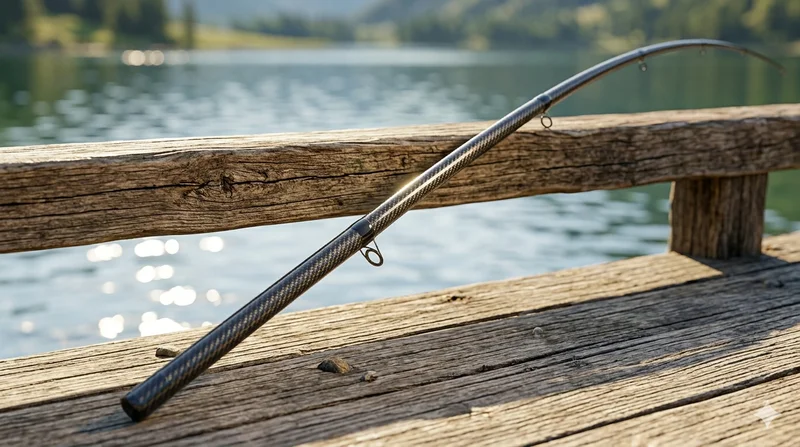
Carbon Fiber Fishing Rod Blank
High-quality carbon fiber fishing rod blank manufactured from multiple grades of Toray carbon fiber cloth. Available in a wide range of lengths, powers, and actions for freshwater and saltwater applications. Suitable for OEM rod building.
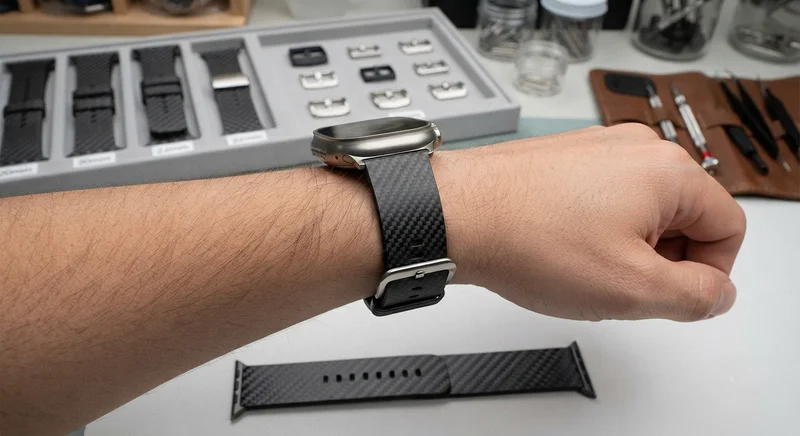
Carbon Fiber Watch Strap — 20mm/22mm Quick-Release
Premium carbon fiber watch strap with quick-release spring bars. Woven from T700 3K twill prepreg with a flexible resin system that conforms to the wrist. Available in 20mm and 22mm lug widths, compatible with Apple Watch, Samsung Galaxy Watch, Garmin, and traditional mechanical watches. Features a stainless steel buckle and carbon fiber keepers. The natural weave pattern makes each strap unique.

Carbon Fiber Plate — 3K Twill T700 1.5mm
Thin 1.5mm carbon fiber plate with 3K twill weave surface. Lightweight and stiff, commonly used for covers, panels, drone bodies, and applications requiring a premium aesthetic appearance.

Carbon Fiber Plate — 3K Twill T700 3.0mm
Medium-thickness 3.0mm carbon fiber plate offering significantly higher load capacity while maintaining attractive 3K twill finish. Suitable for structural brackets, reinforcement plates, and load-bearing panels.

Square Carbon Fiber Tube — 3K Twill T700
Square cross-section carbon fiber tube manufactured with 3K twill weave for torsional strength. Preferred for structural frames, trusses, and support columns where rectangular geometry offers design flexibility.