
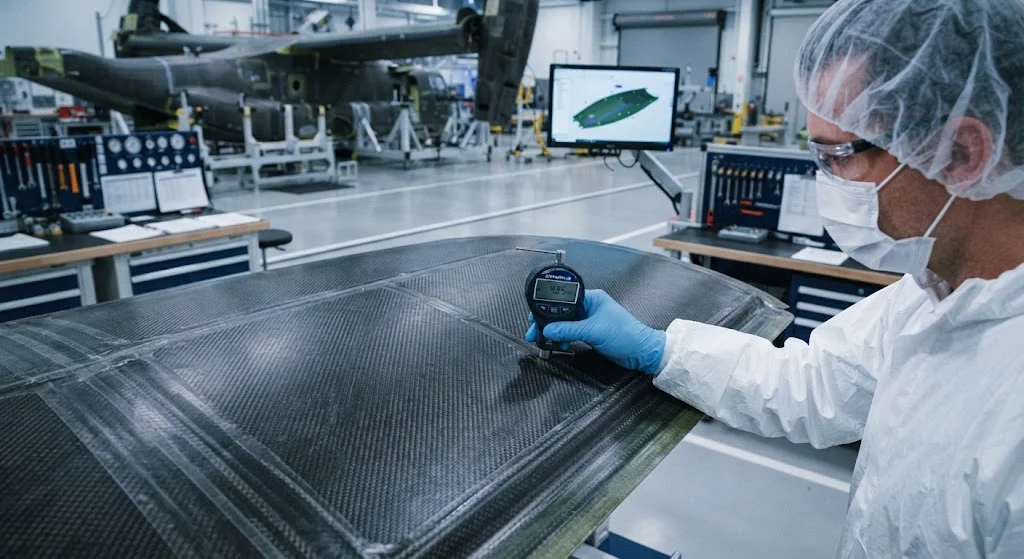
The selection of Toray's T1100/3960 prepreg system for the U.S. Army's Future Long-Range Assault Aircraft (FLRAA) program represents a significant endorsement of high-performance carbon fiber composites in next-generation military rotorcraft. The V-280 Valor tiltrotor, developed by Bell
Introduction
The selection of Toray's T1100/3960 prepreg system for the U.S. Army's Future Long-Range Assault Aircraft (FLRAA) program represents a significant endorsement of high-performance carbon fiber composites in next-generation military rotorcraft. The V-280 Valor tiltrotor, developed by Bell, requires an airframe that balances extreme structural performance with the weight constraints essential for vertical lift aircraft. The T1100/3960 material system — featuring intermediate-modulus carbon fiber with a toughened epoxy matrix — offers the combination of damage tolerance, fatigue resistance, and specific strength that military rotorcraft demand.
This article analyzes the technical properties that drove the T1100/3960 selection, reviews the qualification testing program, and examines the broader implications for aerospace-grade carbon fiber suppliers seeking to serve defense procurement programs.
Material Properties Driving Selection
The T1100/3960 prepreg system combines Toray's T1100S intermediate-modulus carbon fiber with the 3960 toughened epoxy matrix. This pairing delivers properties optimized for primary airframe structures:
| Property | T1100/3960 | T800/3900 (Previous Gen) | T700/2510 (Standard) |
|---|---|---|---|
| Tensile strength (0°) | 3,020 MPa | 2,900 MPa | 2,550 MPa |
| Tensile modulus (0°) | 162 GPa | 154 GPa | 135 GPa |
| Compression strength (0°) | 1,580 MPa | 1,500 MPa | 1,200 MPa |
| CAI strength (6.7 J/mm) | 275 MPa | 260 MPa | 195 MPa |
| Glass transition temperature | 185°C | 180°C | 155°C |
| Open hole tension (OHT) strength | 415 MPa | 390 MPa | 320 MPa |
| Open hole compression (OHC) strength | 265 MPa | 250 MPa | 210 MPa |
| Interlaminar fracture toughness, Mode I (J/m²) | 2,200 | 1,900 | 1,400 |
| Fatigue life at 60% UTS (cycles to failure) | 500,000+ | 400,000 | 250,000 |
The critical advantages for FLRAA are the combination of high specific strength (35% improvement over T700 at similar weight), exceptional damage tolerance as evidenced by the 275 MPa CAI value, and the elevated glass transition temperature that supports high-speed flight thermal environments. The 3960 matrix specifically delivers improved toughening through controlled rubber particle distribution, providing impact resistance without sacrificing hot/wet performance.
Qualification Testing Program
Qualification of the T1100/3960 system for FLRAA follows the rigorous MIL-HDBK-17 (CMH-17) framework adapted for tiltrotor-specific loading conditions:
- Building block approach: Testing progresses from coupon-level properties through element tests to sub-component and full-scale structural demonstration. FLRAA qualification includes approximately 45,000 coupon specimens across multiple environmental conditions.
- Environmental exposure: Hot/wet conditioning at 71°C/85% RH for 2,000 hours, with testing at both conditioned and ambient states. The tiltrotor mission profile includes desert operations requiring extreme temperature cycling.
- Damage tolerance assessment: Barely visible impact damage (BVID) testing at design limit load, with residual strength verification after impact events representing operational hazards. The 275 MPa CAI property of T1100/3960 provides margin over the minimum 240 MPa threshold.
- Fatigue and durability: Spectrum loading tests representing 40-year service life with 30,000 flight hours, including tiltrotor-specific rotor hub load spectra and transition flight load cases.
- Bolted joint characterization: Extensive testing of fastener types, edge distances, and joint configurations under combined tension, shear, and bearing loads relevant to airframe assembly.
FLRAA-Specific Design Considerations
The V-280 Valor tiltrotor imposes unique structural requirements that favor the T1100/3960 material system:
- Conversion loads: The tiltrotor mechanism generates complex combined loads during conversion between helicopter and airplane modes. The balanced fiber architecture of T1100/3960 laminates provides consistent performance across multiple load directions.
- Rotor hub region: High cyclic loads at the rotor hub attachment require exceptional fatigue resistance. The 500,000+ cycle fatigue life of T1100/3960 at 60% UTS provides the durability margin needed for this critical zone.
- Survivability requirements: Military rotorcraft must maintain structural integrity after ballistic impact events. The toughened 3960 matrix and high fiber strength of T1100 provide controlled damage progression and residual strength that meet MIL-STD ballistic resistance criteria.
- Weight optimization: Tiltrotor aircraft have stringent weight budgets due to the dual-mode flight requirements. The 15-20% weight saving of T1100/3960 composites over aluminum alloys directly translates to increased range, payload, or fuel capacity.
Supply Chain Implications
The FLRAA T1100/3960 selection has broader implications for the aerospace carbon fiber supply chain:
- Production scaling: FLRAA production rates of 50-75 aircraft per year at peak will require 200-300 tons of prepreg annually, representing a significant commitment to T1100 fiber production capacity.
- Qualification barriers: The multi-year qualification process creates high barriers to alternative material substitution, locking in T1100/3960 for the FLRAA production run through at least the 2040s.
- Technology transfer: Military qualification data and manufacturing experience with T1100/3960 may influence commercial aerospace material selection, particularly for helicopter and business jet primary structures.
- Pricing dynamics: Defense procurement volumes provide stable demand that supports T1100 production investment but may create allocation constraints for commercial customers during peak defense production periods.
Frequently Asked Questions
Why was T1100/3960 selected over newer intermediate-modulus fibers like T1110 or T1200?
The FLRAA qualification timeline and risk management favored T1100/3960 because it leverages mature T1100 fiber production with extensive qualification data from commercial aerospace programs (Boeing 787, Airbus A350). While T1110 and T1200 offer incremental improvements in specific modulus and strength, they lack the production volume and qualification history needed for a defense program with aggressive delivery schedules. The 3960 matrix system also has the most extensive environmental conditioning database for military applications, reducing qualification testing scope and schedule risk.
How does the T1100/3960 qualification impact availability for commercial aerospace customers?
Toray's T1100 production capacity is being expanded to accommodate both FLRAA defense volumes and growing commercial aerospace demand. The fiber is produced at multiple facilities, and defense allocation is managed through dedicated capacity reservations. Commercial customers may experience lead time extensions during peak FLRAA production phases but will not face supply elimination. The military qualification investment also strengthens the commercial business case by validating production processes and quality systems at scale.
What specific certifications must a carbon fiber supplier achieve to serve FLRAA-class defense programs?
Suppliers must maintain AS9100 quality management certification, NADCAP special process accreditation (for surface treatment and processing), ITAR registration for defense-related materials, and facility security clearances where required. Materials must be traceable to certified fiber production lots with full property documentation per CMH-17 requirements. Environmental and occupational health certifications (ISO 14001, ISO 45001) are increasingly expected by defense prime contractors as part of sustainable sourcing requirements.
Conclusion
The selection of T1100/3960 prepreg for the FLRAA V-280 Valor airframe validates the material system's position as the current benchmark for military rotorcraft primary structures. The combination of 3,020 MPa tensile strength, 275 MPa CAI damage tolerance, 185°C glass transition temperature, and 500,000+ cycle fatigue life provides the comprehensive performance envelope that tiltrotor aircraft demand. For carbon fiber suppliers and material engineers, FLRAA represents both a significant market opportunity and a reference program that will influence material selection for military and commercial aerospace applications through the 2040s.
For engineers evaluating prepreg systems for demanding aerospace applications, understanding the T1100/3960 property envelope and qualification approach provides valuable benchmarking data. Explore our carbon fiber prepreg and intermediate-modulus fiber product range, or contact our engineering team to discuss material specifications for your aerospace program.
Part of topic
Related Articles
- Carbon Fiber Mooring for Floating Offshore Wind: Fatigue and Corrosion in Deep Water
- Carbon Fiber Bicycle Frame Optimization: Layup Design and Manufacturing for Competitive Racing
- Carbon Fiber CFRP Retrofit for Infrastructure: Bridge and Building Seismic Strengthening
- Carbon Fiber Medical Imaging Equipment: Lightweight Gantry and Couch Structures for MRI/CT
- Carbon Fiber EV Battery Enclosures: Crash Safety and Electromagnetic Shielding Design
- Carbon Fiber Structures for Low-Altitude Economy: UAV Airframes and eVTOL Components