
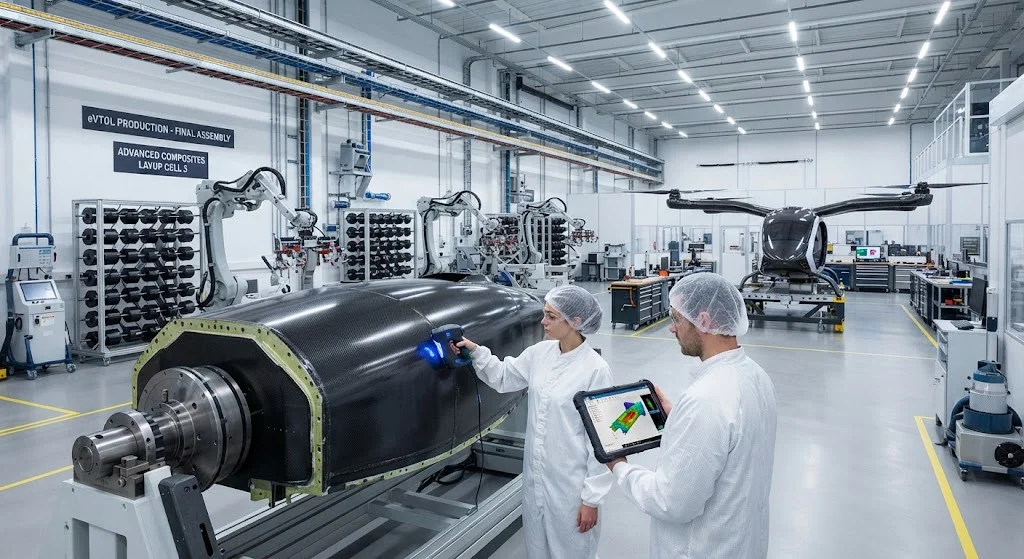
Every eVTOL program in development leans heavily on carbon fiber. Airframes, rotors, drive structures, and battery enclosures are designed around aerospace-grade composites because the entire vehicle concept depends on weight. Yet casting composite-intensive aircraft is not the hard par
Introduction
Every eVTOL program in development leans heavily on carbon fiber. Airframes, rotors, drive structures, and battery enclosures are designed around aerospace-grade composites because the entire vehicle concept depends on weight. Yet casting composite-intensive aircraft is not the hard part — producing them at fleet scale is. As of late 2026, no eVTOL manufacturer has demonstrated serial production beyond a handful of aircraft, while several programs still promise output measured in hundreds of units per year. This article looks at the production ramp risk from the material supplier's perspective: how much composite demand these programs project, how credible the timelines are, and what buyers can do while the supply chain is still uncommitted.
The central tension is a classic chicken-and-egg problem. Suppliers of aerospace-grade carbon fiber and prepreg will expand capacity only against firm, committed volume, but eVTOL manufacturers historically signed letters of intent and option agreements, not binding purchase commitments. Until the demand signal becomes contractual, the material supply chain will stay sized for development programs rather than series production — and the ramp, when it finally comes, will hit a qualification bottleneck that takes years to clear.
How Much Composite a Fleet Really Consumes
Before evaluating timelines, it is useful to size the demand. A typical four- to five-passenger eVTOL carries roughly 350-600 kilograms of advanced composite structure, including fuselage skins, wing and rotor support beams, landing gear arms, and battery enclosures. At a carbon fiber content of roughly 150-250 kilograms per airframe, a manufacturer producing 500 aircraft per year consumes about 75-125 tonnes of fiber annually. Against the global advanced composites market this is small — total carbon fiber demand is estimated above 130,000 tonnes per year. The constraint is therefore not global volume but the availability of certified aerospace-grade material from a handful of qualified suppliers.
Aerospace-grade carbon fiber — high-strength and intermediate-modulus grades sold as qualified prepreg — is a niche inside that market. Most global tonnage goes to industrial, sports, and low-cost energy applications. The eVTOL industry must compete for the same qualified aerospace supply that commercial aircraft, defense programs, and the space sector already consume. When a ramp is accelerated, this qualified pool, not the global fiber market, is what tightens first.
Announced Timelines Versus Demonstrated Output
The credibility problem is easier to see with a direct comparison of program announcements and the production evidence available by late 2026:
| Program | Certification Path | Announced Build Rate | Composite Structure Share | Demonstrated Ramp Status |
|---|---|---|---|---|
| Joby Aviation S4 | FAA type certification | ~500 aircraft per year at Marina plant | ~70% of structural weight | Low-rate pre-production, no serial output |
| Archer Midnight | FAA type certification | ~650 aircraft per year at Covington plant | High, all-composite airframe | Pilot line, no serial output |
| EHang EH216-S | CAAC type certificate (2023) | Production in China, multi-batch | Composite airframe and rotor arms | Certified but delivery volume modest |
| Beta Technologies Alia-250 | FAA certification in progress | Not formally announced | All-composite airframe | Development fleet only |
| Vertical Aerospace VX4 | UK CAA path, restructured | Paused after 2024 restructuring | High, composite wing and fuselage | Returned to development |
| Lilium Jet | EASA path, halted | Production abandoned | Composite structure | Insolvency 2024, ramp never reached |
The pattern is consistent: every row shows a wide gap between the announced rate and demonstrated output. The most advanced programs have built a few dozen pre-production aircraft at most, while their plant designs assume hundreds per year. Scaling a composite airframe line from a pilot flow to five hundred units a year is not a linear expansion — it requires new tooling across dozens of part families, automated layup cells, and a cured-part inspection pipeline that few suppliers have ever operated.
Material Qualification: The Hidden Bottleneck
Even if the airframe builders scale their assembly lines, the material side cannot follow instantly. Aerospace qualification of a new carbon fiber grade, a new prepreg system, or a new resin formulation takes 12-24 months of testing against material specifications, including batch release data that must cover dozens of production lots. Changes to fiber areal weight, tow count, or resin mixing ratio reopen the qualification window. For a new process — such as automated fiber placement of complex eVTOL geometry or out-of-autoclave cure of thick mast structures — each program must generate design allowables, environmental data, and defect tolerance evidence before the FAA or EASA will accept the data for certification.
Much of the certified capacity in the aerospace supply chain is already allocated. Established customers place multi-year requirements with Toray, Hexcel, Syensqo, and other qualified producers, and eVTOL entrants must either secure allocation from those same producers or qualify new sources — which takes years, not quarters. This is why material supply chain readiness, and not just airframe assembly, decides whether a ramp timeline is credible.
The Demand Signal: Commercial Versus Defense Procurement
The structural difference between eVTOL and defense procurement comes down to how the demand signal is transmitted. Defense buyers issue multi-year firm orders with guaranteed volume, requiring suppliers to hold production slots and often mandating domestic or friendly-nation sourcing under supply security rules. Contractual certainty is the precondition for industrial investment, and the supplier base responds by building capacity in advance.
Commercial eVTOL demand, by contrast, is largely expressed through letters of intent, option agreements, and early-deposit reservation schemes — none of which gives a material supplier the revenue visibility to fund a new prepreg line or a second production facility. Without committed offtake, the rational supplier behavior is to wait. The result is a lag: when series production finally does begin, qualified material availability will trail demand by the length of the qualification cycle, plus the construction lead time of any new capacity.
How Buyers Can De-Risk the Ramp
Procurement teams and program leaders can act on this risk today, even while certification timelines are still moving:
- Convert intent to commitment: Replace letters of intent with binding multi-year offtake agreements that give suppliers an investable volume signal.
- Qualify second sources early: Run qualification of an alternative fiber or prepreg in parallel with the primary source, so a single supplier problem cannot stall the entire ramp.
- Use parametric material requirements: Order prepreg and fiber against program milestones rather than calendar dates, so material arrives as the build rate actually develops.
- Build inventory buffers at critical items: Carry stock of long-lead, qualified materials such as intermediate-modulus prepreg and structural film adhesives.
- Pace tooling investment to demonstrated output: Stage factory automation against proven production data instead of the end-state annual rate.
Frequently Asked Questions
Why is eVTOL carbon fiber demand a problem if total global capacity is large?
Because raw tonnage is the wrong metric. eVTOL airframes require aerospace-grade, qualified material — high-strength and intermediate-modulus carbon fiber supplied as certified prepreg with full pedigree data. That grade is a niche of total carbon fiber production, and its available capacity is already heavily allocated to commercial aircraft, defense, and space programs. An eVTOL ramp consumes only tens of thousands of kilograms a year at first, but it competes for the same small qualified pool, and the pool cannot expand faster than the 12-24 month qualification cycle allows.
What happens if a manufacturer hits its production target before material qualification catches up?
Airframe assembly can run ahead only up to the limit of qualified material inventory, then stalls. Programs typically respond by slowing their build rate, substituting a qualified alternative material at short notice, or flying with lower material pedigree — none of which is acceptable on a certification-critical schedule. In practice the ramp absorbs the delay on the ground: aircraft are built, parked, and re-inspected while qualification catches up, and the announced annual rate slips to the next year. The financial impact lands on program cash flow and on delivery commitments made to launch customers.
How is eVTOL material procurement different from buying composites for a defense program?
Defense procurement rests on firm, multi-year orders with guaranteed volume and supply security requirements, so suppliers can invest in capacity against a contractual base. eVTOL programs have historically relied on letters of intent, options, and deposit schemes, which give suppliers no investable revenue signal. The practical difference is timing: a defense customer can demand and receive reserved manufacturing slots years ahead, while an eVTOL customer is one of several uncommitted buyers waiting in the same queue. Buyers who convert their intent into binding offtake move themselves to the front of that queue.
Conclusion
The eVTOL industry's composite ambition is real, but its production ramp risk is concentrated in exactly the place most announcements do not discuss: the qualified material supply chain. Aerospace-grade carbon fiber capacity is already committed, qualification takes years, and the demand signal reaching suppliers is still too weak to justify industrial investment. Programs that convert intent into contractual volume, qualify second sources, and pace tooling against demonstrated output will clear the bottleneck; those that rely on announced timelines alone will inherit the lag.
For engineers and buyers sourcing materials for eVTOL and other advanced air mobility programs, explore our carbon fiber products for aerospace-grade prepreg and tow options, or contact our engineering team to discuss qualified material sourcing and supply planning for your ramp program.
Part of topic
Related Articles
- Recycled Carbon Fiber Market Forecast 2030: Technology Maturity and Commercialization Path
- South Korea Carbon Fiber Market 2026: Hydrogen Economy and Shipbuilding Innovation
- Wind Turbine Blade Leading Edge Protection 2026: Polyurethane, Tape, and Metallic Shield Solutions
- China Carbon Fiber Overcapacity 2026: Price War Impact and Industry Consolidation
- India Carbon Fiber Market 2026: Wind Energy, Aerospace, and Defense Expansion
- PAN Precursor Market 2026: Acrylonitrile Supply and Carbon Fiber Cost Structure
Interested in Custom Carbon Fiber Products?
Contact our team for competitive pricing and technical specifications.
Get a QuoteRelated Products
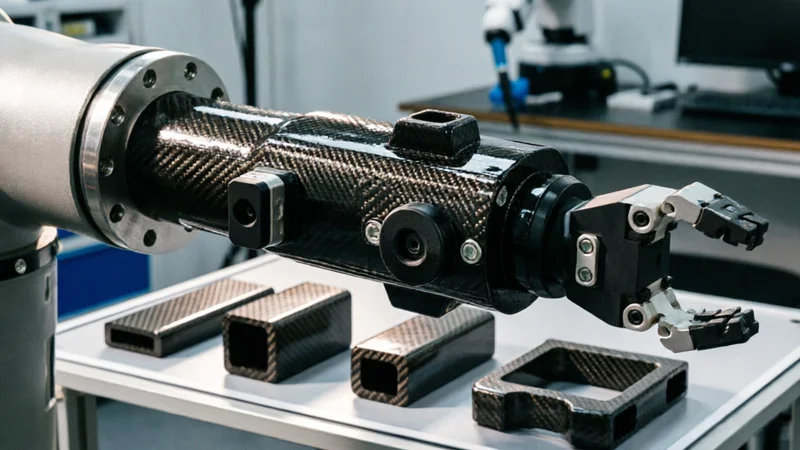
Carbon Fiber Robot End Effector Link — Custom Shape & Sensor Integration
Custom-shaped carbon fiber end effector links for robotic arms. Designed for automation integrators and research labs requiring lightweight, rigid connections between the robot wrist and gripper/tool. Can incorporate sensor mounting bosses, cable routing channels, and quick-change interfaces.

Custom Carbon Fiber Musical Instrument Parts
Carbon fiber components for musical instrument manufacturing offering superior dimensional stability, low weight, and consistent acoustic properties. We produce carbon fiber bows, guitar necks, violin chin rests, drum shells, and wind instrument bodies. Carbon fiber instruments are immune to humidity changes and temperature fluctuations that affect wooden instruments.
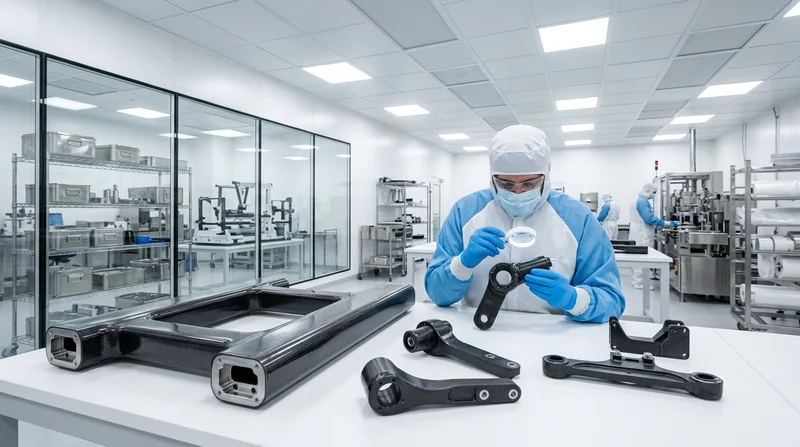
Custom Carbon Fiber Medical Device Components
Medical-grade carbon fiber components manufactured for imaging equipment, surgical instruments, and patient support systems. Carbon fiber's radiolucency (X-ray transparency) and high strength-to-weight ratio make it ideal for CT scanner beds, wheelchair frames, surgical robot arms, and MRI-compatible accessories. Biocompatible resin systems available.
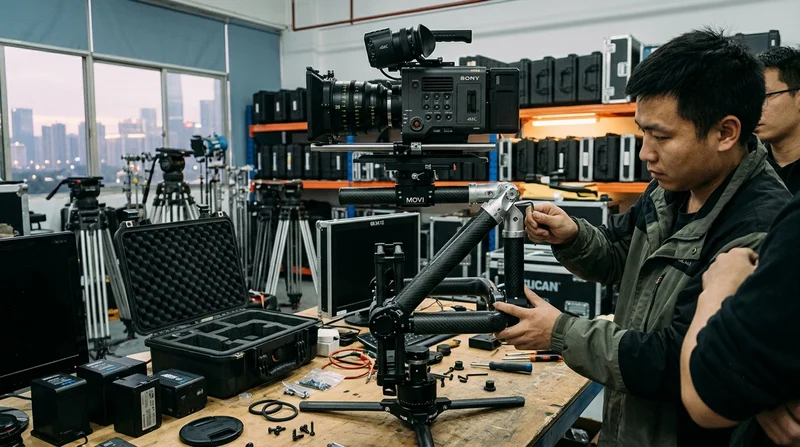
Custom Carbon Fiber Gimbal & Camera Mount
Lightweight carbon fiber gimbal arms and camera mounting components for aerial photography, film production, and broadcast applications. Our precision CNC machining ensures tight tolerances for vibration-sensitive equipment. Available in custom shapes to fit specific gimbal systems.
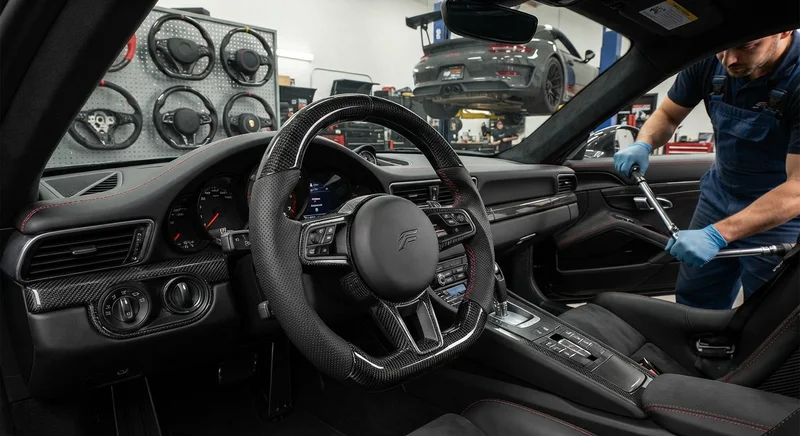
Carbon Fiber Steering Wheel — Custom Leather-Wrapped with CF Inlay
Custom carbon fiber steering wheel with genuine leather wrapping and carbon fiber inlay sections. Molded from T700 3K prepreg for maximum rigidity with a 30% weight reduction over OEM wheels. Available in D-shape (flat bottom) and round profiles. Direct bolt-on fitment for popular sports car and performance vehicle models. Custom stitching color and leather grade available.