
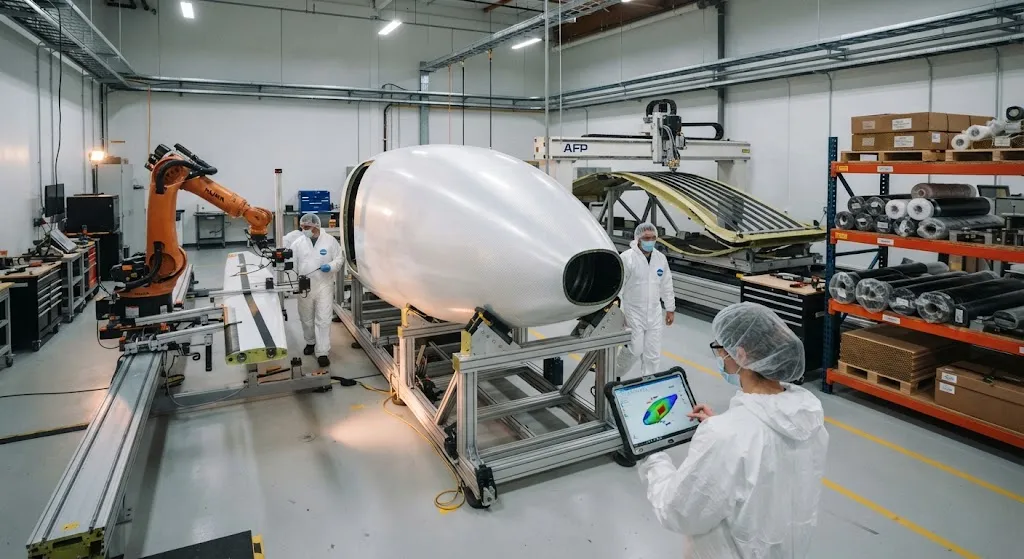
Electric vertical takeoff and landing (eVTOL) aircraft are the most composite-intensive aviation category ever designed. Where conventional airliners use carbon fiber for roughly 50 percent of primary structure by weight, eVTOL airframes routinely exceed 80 percent, because the aircraft
Introduction
Electric vertical takeoff and landing (eVTOL) aircraft are the most composite-intensive aviation category ever designed. Where conventional airliners use carbon fiber for roughly 50 percent of primary structure by weight, eVTOL airframes routinely exceed 80 percent, because the aircraft is fundamentally a battery carrying structure and every kilogram saved extends range. The design logic is clear: composites give the stiffness-to-weight ratio, fatigue resistance, and parts integration that hover-capable electric aircraft require.
Yet the industry's defining challenge is no longer materials — it is proving that a composite airframe can be certified by aviation authorities and manufactured at automotive-like volumes. This article examines the certification paths available to eVTOL developers, the material and process decisions that shape the airframe, and the manufacturing readiness gaps that determine whether a program reaches series production on schedule.
The Certification Landscape for eVTOL Airframes
Certification is the single greatest filter in the eVTOL supply chain, and it shapes every material and process decision downstream. Three pathways dominate. In the United States, the Federal Aviation Administration (FAA) certifies eVTOL aircraft under Title 14 CFR Part 23 (normal category airplanes) with rotorcraft-like special conditions, or under Part 21.17(b) for special class aircraft, which applies a tailored set of requirements. In parallel, the FAA has evolved its approach toward consensus standards — ASTM F3230 and F3231 — to streamline certification of powered-lift aircraft.
In Europe, EASA introduced Special Condition VTOL (SC-VTOL) in 2019, the first dedicated regulatory framework for eVTOL, and it has since driven the standards toward a ruleset aligned with existing rotorcraft and airplane requirements. The table below summarizes the main paths and their features:
| Pathway | Authority | Basis | Key Implication for Airframe |
|---|---|---|---|
| Part 23 with special conditions | FAA | Normal category airplane rules plus rotorcraft conditions | Conventional composite certification experience applies |
| Part 21.17(b) special class | FAA | Tailored requirements for novel aircraft | Flexible but slower, case-by-case negotiation |
| Consensus standards (F3230/F3231) | FAA (powered-lift) | ASTM-based performance and safety standards | Faster certification, requires standards to keep pace |
| SC-VTOL | EASA | Dedicated eVTOL special condition | Early clarity, influenced global design assumptions |
For composite airframes specifically, certification demands full traceability of the material allowables, repeatable process control at every production site, and a defined inspection program for voids, delamination, and impact damage. Authorities require the builder to prove not that the material is strong, but that it is strong consistently — which is where manufacturing readiness becomes a certification issue, not merely a cost issue.
Materials and Structures: Why Carbon Fiber Saturates the Airframe
The typical eVTOL airframe is a carbon fiber sandwich construction: carbon fiber reinforced polymer (CFRP) skins over aluminum or aramid honeycomb, with carbon fiber monocoque fuselage sections, wing and rotor support structures, and crash structures. The choice of fiber and resin follows the same logic as any aerospace program, with two twists specific to eVTOL.
The first twist is the balance between weight and cost. eVTOL developers target manufacturing costs an order of magnitude below conventional aircraft, so standard and intermediate modulus fibers dominate, with high modulus fibers reserved for rotor shafts and highly loaded beams where stiffness drives design. The second twist is the crash and battery interface: airframes must protect a large battery pack in a crash, which drives energy-absorbing subfloor structures and crushable composite elements, and the structure must survive the thermal and load environment of repeated rapid charging cycles without hidden damage.
Manufacturing Readiness: The Gap Between Prototype and Series
Building five certification prototypes demonstrates a design; building hundreds of aircraft per year demonstrates a manufacturing system. The industry's production ambition — tens to hundreds of aircraft annually per program in early years, with eventual targets in the thousands — forces a step change in how composite parts are made. Hand layup and vacuum bagging, the workhorses of prototype and low-rate production, cannot support the required output or the consistency that certification surveillance demands.
Manufacturing readiness therefore hinges on four capabilities:
- Automated fiber placement and automated tape laying: Robotics apply prepreg for skins, spars, and fatigue-critical components, removing human variability from layer orientation and gap control.
- Out-of-autoclave and rapid-cure prepregs: Lower energy and faster cycles than autoclave curing, enabling press or oven curing that scales with volume.
- Quality assurance digitization: Automated ultrasonic inspection, automated dimensional metrology, and digital records that link each part to its raw material batch and process parameters.
- Supply chain industrialization: High-rate fabric, tow, and honeycomb supply agreements, and suppliers with audited process control at scale.
For a raw materials supplier, this readiness gap translates into a practical requirement: eVTOL programs procure against aerospace-grade material specifications but with automotive-scale delivery schedules, and they qualify suppliers not only on material properties but on demonstrated statistical process control and batch-to-batch consistency. The practical consequence is that material supply for eVTOL is a development partnership rather than a catalog transaction: suppliers join test article production, allowables generation, and manufacturing scale-up years before the first serial aircraft is built.
How Suppliers Qualify into the eVTOL Supply Chain
Qualification is the commercial gate for carbon fiber suppliers. The typical path starts with a material qualification program against a documented specification, followed by batch acceptance testing of each delivered lot, and ongoing surveillance by the airframer and, ultimately, by the regulator through the design approvals. For new entrants, the practical entry point is often prototype and development support: supplying material for test articles, generating the property data that feeds design allowables, and building the traceability systems the certification basis requires.
Developers also evaluate suppliers on responsiveness, because eVTOL design cycles are short and material requirements shift quickly. A supplier holding stocks of qualified prepreg, with documented test data and short lead times, reduces program risk more than a nominally cheaper but slower alternative. This is why material sourcing decisions in eVTOL are strategic partnerships rather than spot purchases.
Frequently Asked Questions
Why do eVTOL airframes use so much carbon fiber compared with conventional aircraft?
Because weight is the dominant design driver. An eVTOL must lift a heavy battery pack, hover efficiently, and cover useful range, so every kilogram of structure saved directly increases payload or range. Carbon fiber composites offer the highest stiffness-to-weight and strength-to-weight ratios available, and they allow parts integration — a full fuselage section can be molded as one piece, eliminating thousands of fasteners compared with a riveted aluminum airframe. Most eVTOL airframes are therefore over 80 percent composite by structural weight.
What certification rules apply to eVTOL composite airframes?
In the US, the FAA certifies eVTOL aircraft under Part 23 with special conditions, under Part 21.17(b) as special class aircraft, or against the ASTM F3230/F3231 consensus standards for powered-lift aircraft. In Europe, EASA applies its Special Condition VTOL (SC-VTOL). All paths require the composite airframe to meet equivalent safety requirements: proven material allowables, process control, and inspection programs for voids, delamination, and impact damage.
What manufacturing processes are considered ready for series eVTOL production?
Automated fiber placement and automated tape laying for skins and spars, combined with out-of-autoclave or rapid-cure prepregs cured in ovens or presses, are the processes considered ready for scaled production. They are paired with automated NDI, digital quality records, and parts designed for assembly rather than manual fit. Hand layup remains acceptable for prototypes and low-rate parts but is not viable at the hundreds-per-year volumes the industry targets.
Conclusion
eVTOL airframe composites are technically mature — the material systems are proven, the certification frameworks exist, and the manufacturing methods to scale are available. What separates programs today is execution quality: disciplined certification management, manufacturing systems that demonstrate consistency at volume, and a supply chain of qualified material partners with process control to match. For carbon fiber suppliers and composite processors, the opportunity is real, but the bar is exacting: aerospace-grade material discipline at automotive-scale cost and delivery expectations.
YongXian supplies carbon fiber fabrics, unidirectional tapes, and prepreg systems qualified for aerospace and advanced mobility programs. Explore our carbon fiber product range or contact our engineering team to discuss material specifications and qualification support for your eVTOL airframe program.
Related Articles
- Recycled Carbon Fiber Market Forecast 2030: Technology Maturity and Commercialization Path
- South Korea Carbon Fiber Market 2026: Hydrogen Economy and Shipbuilding Innovation
- Wind Turbine Blade Leading Edge Protection 2026: Polyurethane, Tape, and Metallic Shield Solutions
- China Carbon Fiber Overcapacity 2026: Price War Impact and Industry Consolidation
- India Carbon Fiber Market 2026: Wind Energy, Aerospace, and Defense Expansion
- PAN Precursor Market 2026: Acrylonitrile Supply and Carbon Fiber Cost Structure
Interested in Our Products?
Contact our team for competitive pricing and technical specifications.
Get a QuoteRelated Products

Carbon Fiber Fishing Rod Blank
High-quality carbon fiber fishing rod blank manufactured from multiple grades of Toray carbon fiber cloth. Available in a wide range of lengths, powers, and actions for freshwater and saltwater applications. Suitable for OEM rod building.

Carbon Fiber Plate — 3K Twill T700 1.5mm
Thin 1.5mm carbon fiber plate with 3K twill weave surface. Lightweight and stiff, commonly used for covers, panels, drone bodies, and applications requiring a premium aesthetic appearance.

Square Carbon Fiber Tube — 3K Twill T700
Square cross-section carbon fiber tube manufactured with 3K twill weave for torsional strength. Preferred for structural frames, trusses, and support columns where rectangular geometry offers design flexibility.
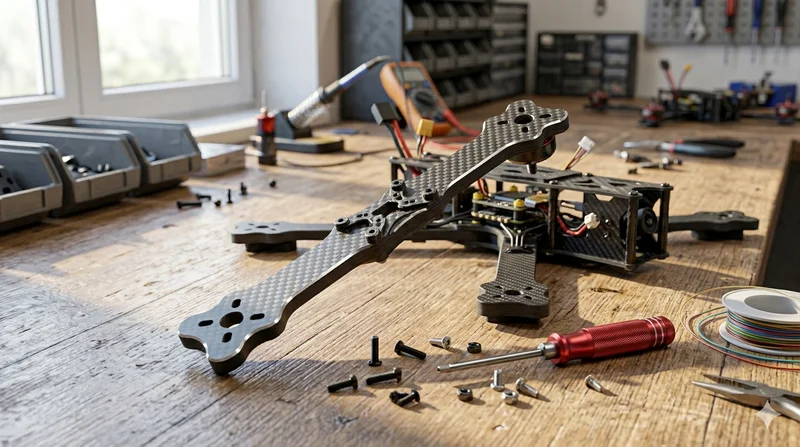
Carbon Fiber Drone Arm
Precision-molded carbon fiber drone arm combining unidirectional fiber for stiffness and woven layers for torsional strength. Designed for FPV, photography, and industrial drone platforms. Each arm is CNC-machined to exact specifications.
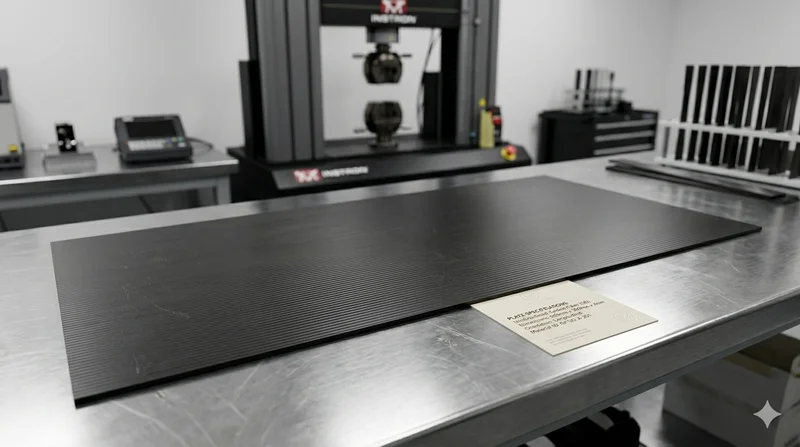
Carbon Fiber Plate — UD Unidirectional T700
Unidirectional carbon fiber plate with all fibers oriented in a single direction for maximum strength along the fiber axis. Essential for structural reinforcements, splints, and applications where load direction is predictable.